Showing posts with label mordheim. Show all posts

Friday, March 11, 2016

Comes Chaos

OKAY. I spent a bit of time at lunch today getting a little stinky-drinky and writing more bad JuJu about Paraguayan ignorance (and drawing parallels with certain presidential campaigns in the home country)...but I'm almost 100% certain that no one wants to read more of that kind of nonsense.

So let's talk about B/X-related nonsense. And, no, not superheroes.

Waaaaaay back in January, I mentioned I was going to get in on this whole B/X Campaign Challenge thing, set up by Mr. James V. West. I also said I figured I could knock-out a 64 page supplement in about 64 days, giving myself (approximately) till the end of March to get it done. Seeing as how it's been seven days since the last time I worked on the thing (just checked...March 4th) people may be wondering how is the project progressing?

Pretty good. I'm at 53 pages (formatted)...a bit more than 36,000 words without counting headers and page numbers. Since I'm aiming for about 58-60 (to make room for illustrations, a cover leaf, and table of contents), I'm pretty close to completion.

It's always that last bit that's the bitch, ain't it?

Actually, that's NOT why I've stalled. For a "campaign book," I started to find there was surprisingly little campaign to the thing...mainly a collection of rules and notes about how to inject a little crazy into one's standard B/X game. I started to think maybe I needed a bit more setting, a bit less system. And then, of course, I got distracted with other brainstorms...

But I'm digressing. As I wrote back on the 22nd (when I was first considering the challenge), the idea I had was an incredibly derivative one, and it still is....specifically, I am adapting the old Warhammer Realm of Chaos books (Slaves to Darkness and The Lost and the Damned) to the B/X game system, an idea that I once thought was pretty ridiculous. Also, not a terribly original idea, considering folks like Steven A. Cook have already done similar work (his Hordes of Chaos is a nice little "monster manual" designed for use with Labyrinth Lord).

But whatever...it's only a 64 page book. It's specifically designed for use with B/X (which everyone loves and now has access to, thanks to the release of the PDFs). It files all the serial numbers off anything that might be considered IP by other game companies. And it's written for a B/X system...for a game of exploration and treasure hunting...not a war-game.

And it does have a setting...one that could easily be expanded with additional books, if I was so inclined.

Slaves to Darkness.
So good, I own two copies.
The fact of the matter is Slaves to Darkness and The Lost and the Damned are damn masterworks. They have terrible, disgusting, magnificent, tragic themes. They are well-designed (for their time and their purpose) and are filled with beautiful, terrible, horrible, awesome artwork. They are classics that most buffs of dark fantasy (and dark fantasy games) should have on their shelves. I own physical copies of both, having paid an exorbitant price for one after many years of searching.

They are also fairly unplayable as they are. While the fluff from the books have penetrated the Warhammer universe for nearly three decades (Slaves was written in 1988 and last time I checked a 40K Chaos Codex they were STILL recycling quotes from its most excellent pages), the Warhammer game long ago dropped the systems found within their pages, keeping only the themes. Mordheim's chaos war band was a pretty poor substitute for a champion-led retinue of miscreants and mutants.

SO, because I love these books...their themes (which simply emphasize the dark spaces in the human heart to terrible extremes) and their mutants and their monsters and their madness...because I do love them, I've adapted them to a system that I love (B/X) so that they can see play at the table. They deserve to see play at the table.

And I find the setting I've designed (that I'm thinking I might want to detail in greater depth) so intriguing that I'd really like to run a campaign set in it, despite having voiced (only a few months ago) a longing to try a Holmes-style campaign. B/X...sucking me back in! Seducing me to the darkest of dark sides!

Anyhoo, it's almost done and my intention is to do my own artwork for it (not sure how that's going to go...) and sell it for a pittance in electronic form. That's my intention; we'll see what happens. But regardless, I've got to finish the writing first.

Hopefully by the end of the month.
; )

Sunday, June 22, 2014

Mordheim: City of the Damned

I've had an idea for a blog post that's been rolling around in my head for the last few hours, but after watching tonight's Portugal v. USA game, I'm really not up for it. It's funny...if your team ties the score in the last 30 seconds, you end up feeling elated that you didn't lose, but if the other team equalizes, you feel devastated that you didn't win.

Ah, well...so it means that Game 3 (versus Germany) matters. Make 'em work for it. Personally, I'd like to dream that this is our "payback year;" after all, Brazil won the World Cup on U.S. soil in 1994 (back when I didn't know there was such a thing as a "world cup").

[ugh...just thinking about that last goal really, really irritates me. Five minutes of stoppage time? And the guy scores at 4:36? Just...aaaaaRRGHH!]

Um, so ANYway...one thing I keep coming across in this blog is the fact that I write less than I actually mean to write. Which has (believe or not) been an issue even since the early days (pre-children) when I was writing scores of posts every month. I think of things to post, fail to post them, and then reference the very things I failed to post, thinking that everyone knows what the hell I'm talking about. Call it a pitfall of the diarrhetic mind.

Case in point: I've written extensively about the Mordheim game before, right? No...wrong. Not here, anyway. I did write a review of the (now out-of-print) GW skirmish game on Board Game Geek back in June of 2006 (about three years before the advent of this blog). Because, I'm feeling a little lethargic (i.e. lazy) at the moment, and because I want to get up earlier tomorrow, I'm going to copy and paste the thing here...my thoughts on it remain largely the same, strange enough. It also helps set up the aforementioned, soon-to-be-baked (I hope) topic on which I've been meditating.

*ahem* Here it is:

MORDHEIM: CITY OF THE DAMNED


Sorry...no longer available for sale.
Real Fantasy Wargaming

Dave Arneson and Gary Gygax (creators of the Dungeons & Dragons game) came from a wargaming background. Their creation of the RPG was an attempt to recreate stories like The Lord of the Rings into a workable game (killing monsters gets you treasure, getting treasure gives you (experience) points, gaining points rewards you with more effectiveness, allowing you to kill bigger monsters, etc). Very simplistic and very open in scope.

Mordheim takes these concepts to the next level of game play. First off, it is focused setting-wise. All the action takes place in the ruined city of Mordheim, a surface level dungeon filled with both treasure (precious “wyrdstone”) and opponents (mutated denizens and competing treasure hunters). You play a “warband:” a group of like-minded fellows looking for brawls and booty. These are represented both abstractly (on a roster that keeps track of each band members abilities) and with customizable miniatures that represent your warband on the game board.

The “board” is a number of small 3-D structures representing ruined buildings that can be configured in whatever fashion the players choose…it changes with every game, giving you a constantly evolving game board. You can also create your own models for use in the game to update your play area.

Gameplay is streamlined and tactical. Players alternate turns during each battle and actions are resolved by rolling dice. Careful positioning, movement, and use of special abilities/equipment (different types of warband have different gear and bennies) is more important than random chance. Cautious use of terrain, cover, and ranged weapons can be effective, but fortune often favors the bold, and hand-to-hand combat is resolved both quickly and decisively.

Once a battle is concluded, players check to see what treasure their warband found, and update their warband roster with new abilities gained from the experience of the battle. They can also buy new and additional equipment or hire new members for their warband.

The game is quick enough that you can play 2 to 3 battles in an evening.

A Word About Miniatures

A lot of wargaming hobbies require the purchase of scores of miniatures to field a decent playable army, often at exorbitant (imported) prices. Mordheim can be played with pretty much any fantasy miniatures of the 20mm range and as each type of warband has a maximum number of pieces allowed (usually 12-15) your cost is very small, especially if you only play with one favorite warband. I decided I wanted to kit out a dwarven warband (modeled after the dwarves of The Hobbit) and simply bought a box of dwarf footmen from the Warhammer Fantasy Battle line…no blister packs, no ordering, and highly customizable. You can spend your extra money on the beer and pretzels you’ll be consuming on game night.

The original game (no longer sold) came with pieces for two warbands; one human, one skaven (rat humanoids). Sadly, the boxed set is no longer printed as the quality and number of minis alone was worth the price of the game.

Is It Fun?

Absolutely. There’s no angsty role-playing involved in this game. Just simply laying the smack-down on your opponent. Gains you what treasure should: the money to purchase better arms and armor. Becoming a veteran of many battles makes your warband member a hardened killing machine.

The game is easily played as a one-off single session, no attachments battle. Different missions provide different goals/scenarios for victory, and a changing variety of opponents and terrain means the re-play factor of the game is high.

Using the campaign rules lends continuity to the game and gives a player a sense of accomplishment outside of simply “Did I win or lose the battle?” Sure you may have lost one night, but your warband gained something from the experience (money, training), and the next game night it will be your turn for revenge.

There are even supplemental scenarios for multiple warbands and semi-cooperative play (there’s one in which part of the mission involves slaying a dragon).

Comparison With Other Games

Many have compared it to Necromunda (another game by the same company) and have complained that it is not as detailed, that it doesn’t allow “cover fire” for example. However, this game is set in an earlier renaissance period, and the weapons and tactics for using a bow and black powder musket are not the same as those by, say, the U.S. military in CQC or house-to-house battle.

The movement and combat is similar in many ways to other Games Workshop miniatures games (like Warhammer 40K), but each member of the warband is an individual, unencumbered by squad cohesion rules…basically allowed to roam throughout the battlefield on their own recognizance. Again the game emphasizes, tactics; playing a couple times with the same warband will give you an idea on when to huddle for protection, when to take cover, and when to charge. Also members of a warband are much more customizable ability-wise and equipment-wise than your average wargame platoon.

The learning curve on Mordheim is pretty slight for folks with previous Games Workshop wargame experience. For those that haven’t played GW games (or that only know Blood Bowl), the curve is moderate. You can learn the rules in an evening, but it takes a lot of time to master.

Should I Get This Game?

If you’ve read this far, I’d strongly suggest getting this game. If you like the fighting/challenge aspect of certain fantasy role-playing games without the “role-playing,” then this game is for you. If you like the gritty, dark ages setting of the Warhammer universe you’ll probably like this game. If anything about “fantasy skirmish action” rings your bell, you should get this game.

If you really enjoy painting and customizing individual miniatures (individual stars or heroes) to the point where you give certain pieces names, or personalities, or “talk” to them…in other words, if you are a freak like me, then this is definitely the game for you. Your minis in this game are not faceless, nameless troops…heck, they’re not even the linemen (and “lineorks”) of Blood Bowl. A warband has personality…much like a pirate crew. They can be themed creations, or simple reflections of their owner (you). However, you won’t need to purchase 50+ miniatures to get a “themed” army like some games.

Softcover; killer interior art.
Oh, and yes the game is out of print now, but it is available for free as a download (see the link below). You can’t beat that price for this type of entertainment. Download a copy, kit-bash some structures from cardboard and whatnot, and break out those old Ral Partha miniatures!

[***EDIT: as of 2014, Games Workshop's "Specialist Games" site is dead; however, you can still find PDFs of the Mordheim rulebook with a quick internet search. Note that not all of these are the original, official rules released with the game***]

Limited Setting (last note)

Of course, the one disadvantage of a focused game like Mordheim is the limited setting…it all takes place in one ruined city. However there is another excellent setting available for download on the internet: Lustria: Cities of Gold. Lustria (in the Warhammer universe) is the name of the South/Central American continent. Like pre-Hispanic America, it is filled with rain forests, ancient pyramids, and deadly creatures. Unlike the real world, the main inhabitants are savage lizard folk living in the jungle. If you want to explore the new world and bring back gold in a fantasy setting, check out the Lustria sites. And please-oh-please post some pictures of any step-pyramid set pieces you design!


[***EDIT: Lustria: Cities of Gold can also be found rather easily...there's even a quick link in yesterday's post***]
A Model Wargame

Recently I've had the chance to encounter Chirine's Workbench, a blog by a war gamer and modeling aficionado who happens to have discovered Empire of the Petal Throne and Professor Barker a couple-three decades ago, and has been gaming in Tekumel ever since. Chirine describes himself as a modeler first and foremost, and was first tasked with painting and creating miniatures for the Prof's EPT games "back in the day" before becoming enamored with the world setting; now he continues to play (and model) using the richly detailed setting along with a home-brew rule set that combines EPT with pieces of OD&D and Chainmail.

Watching videos of his recent mini-skirmish campaign (posted to YouTube here), a couple thoughts strike me, besides the obvious comparisons to Mordheim and its (online, unofficial) expansion, Lustria: Cities of Gold.

A) With regard to D&D (and all its variations, everything from EPT to my own Five Ancient Kingdoms), we just don't give enough consideration to the game's wargaming roots. So many things about the game...what might be called, I suppose, "D&Disms" are based in and on the needs and wants of the wargaming subculture. 3rd editions five foot squares are a poor substitution for the games originals inches and scales (from a war gamer's standpoint) yet is an attempt to make sense of the need for ranges and scales anyway. Personally, I have never worried all that much about whether or not a person was shooting their short bow at long range or short range...or the radius of light sources...or even (usually) the f'ing diameter of a fireball spell! Instead, I'm just "roll to hit with your bow" (assuming the character's not engaged in melee) or "you see the monsters" or "you're going to launch that thing underground into a tiny chamber? What exactly are you hoping to occur?"

[alternatively, I'll just say, "ok" and roll saving throws for the bad guys]

The micromanaging of ammo and light and rations and encumbrance and ranges, etc. is just so low down on my priority list, it just often slips through the cracks of my games (I'm writing this as a DM or "referee"). It's just not IMPORTANT...and yet we still pay dutiful attention to it when noting movement rates and tracking how many arrows are left in the quiver. This attention to detail during the game (to be clear, shopping for high, soft boots or short, hard boots during character creation can give you a distinct image of the PC you are playing), slows the pacing of the game...and when you are trying to keep a group of players engaged and enthralled in your imaginary world, it's important not to disrupt that pacing.

Having said that, I have played and enjoyed war-games in the past and my personal preference is to have those games move along at a good pace, too. An over-abundance of "realism" can make a long, slow game even longer and slower...which I detest (yes, I realize that this stance is anathema to many die-hard war-game fanatics). I don't know...maybe I just have a problem with opponents taking a shit-long time to maneuver and measuring every measly half and quarter inch when my assumptions of battle are that they tend to be kind of fast-paced and (at times) sloppy.

I will say this: Chirine's skirmish/battle was a lot quicker paced than some war-games I've seen, and faster than many (recent) edition D&D games, despite maneuvering several teams of miniatures for each player, and using two different playing surfaces.

B) Models are cool.

That's something I keep forgetting or letting slip from my mind, and not in the way I do with "D&D's wargaming roots" (the latter is something I always know "intellectually" but simply fail to process or consider or give weight to). I remember models from when I was a kid...and here I'm talking painted miniatures that represent characters/monsters...models that were owned by older players I knew but with whom I never gamed. They did not have the fantastic, realistic paint jobs you see in those Golden Demon award winners or anything, but they were still so cool...they inspired me, made me want to play a game that used them. I can see the same glow in my son's eyes when we see miniatures in a game shop...he wants to have them and hold them and play games with them. I saw it with the teenagers that I introduced to Warhammer back in the day, too.

I don't know what it is about gaming minis...they're not dolls (or "action figures") that have posable limbs for play. But their sheer static nature makes one want to fill the void...the lack of movement...with story and imagination. "This is my adventurer X; here's what he's going to do." Anyone ever see that old Henry Thomas movie, Cloak & Dagger? It's about a kid that talks to his imaginary friend, personified in an RPG miniature (from a secret agent game) that he carries around with him.

I love miniatures, love to paint them, sometimes even love to modify 'em. Here's the thing though: few of us (outside the truly dedicated) have the time and money to really go whole hog with the miniature thing. Certainly, I could never afford them as a kid...I shoplifted one once (as a pre-teen), but didn't have any paints or tools or knowledge and so did nothing with it. We never used minis in our games as kids anyway...using those stand-up cardboard cut-outs and "area maps" in Marvel Superheroes was a novelty for us (and one that we eventually dispensed with).

As an adult, I found myself (for a time) with an excess of both money and time, and became a collector and painter of minis. Since then, the money has receded somewhat (kids, dogs, mortgages, debts) and the time has dwindled to almost nothing (kids). I still have plenty of unpainted (or half-finished) minis, just no time to paint. As for modeling...wood-working and sculpting set-pieces...well, I'm fairly hopeless with anything requiring much "hands-on" creativity. Comes from being 1) a perfectionist (stopping before I start) and 2) never wanting to 'get messy.' Just beginning to paint minis in the first place (circa 1997) represented a bit of a breakthrough for me.

[and, yes, improvement does come with practice]

Killed some PCs with a very similar model.
However, using "found objects" for models (as Chirine does at times) or re-purposing other things for minis/models (like rubber frogs, plastic animals/monsters, those giant packs of generic zombies, etc.) IS something I can do...and something I experimented with good results, back when I was still running a B/X game down at the Baranof. It was a lot of fun to use minis in a game...but it sure was a pain in the ass hauling all the props and whatnot to the venue (something that really hit home when I was transporting my gear to last summer's Dragonflight convention). If you have the stereotypical basement or garage or unfinished concrete bunker in which to play with your buddies, that's certainly ideal...though I'd imagine enticing new players down to your "lair" might be tough (ugh!).

ANYway...those were my main thoughts when watching Chirine's videos. It's after 3am here, so I better hit the hay.

[oh, yeah...go USA!]

Thursday, November 18, 2010

Campaign Ideas

Tuesdays and Wednesdays have turned into some of my loooongest “work days” for a variety of reasons…mainly that there are other commitments that I have AFTER work that keeps me busy all the way up till bedtime.

I say this simply to preface the following: I’m a bit un-prepared for tonight.

Tonight my Baranof group will be meeting for the first time since completing White Plume Mountain, and I know folks are going to be looking forward to starting SOMEthing. The idea is a decent campaign (or rather, “creating characters with the possibility of some long term serial play”). But I’ve got no idea what kind of campaign I want to run.

Fortunately, there was an “all staff” meeting for two hours at the office to discuss “combating stress” in the workplace. Since I’m a pretty stress-free guy, I was able to do a little notebook brainstorming for some possible campaign options. The only reason I’m posting ‘em now is to give my players (probably reading the blog) something to think about before we meet this evening.

None of this is set in stone. These are not listed in any particular order of preference.


Option #1: After the Goblin Wars. Already discussed in recent posts.


Option #2: Adventuring in the world of Krull. See the much earlier posts.


Option #3: Mythic Norse adventures. Harkening back to VERY early posts inspired by Elizabeth Boyer and Viking lore. Classes available to PCs include:

Fighter, Magic-User, Thief – as per B/X
Dwarves – as per B/X but able to craft magic items as a magic-user
Fighting Wizards – as per B/X elf class, withOUT the infravision/languages
No Clerics or Halflings
Skalds – as per the B/X Companion “Bard” optional class

Special Rules
“Binding Wounds:” characters can bandage themselves, healing D6 hit points, once per day. This can only be used immediately following a fight during a restful period of at least one turn.
“Broken blades:” non-magic weapons break on a roll of a “1.” Better carry a back-up axe!
“No plate mail:” sorry.
"Human or Elf:" aka "Scipling or Alfar;" they're the same thing.


Option #4: Bronze Age Heroes. Again, going back to my earlier musings on the “Bronze Age” nature of the D&D universe (monsters of ancient Greek and Roman myth, etc.). Characters will be the equivalent of a small party of Roman Legionnaire adventurers, exploring the ancient kingdoms of North Africa…desert, jungle, mountains, and pyramids. Classes available to PC include:

Cleric, Fighter, Magic-User, Thief – as per B/X
Dwarf – “throwback man” (Neanderthal-like, no weapon restrictions, but no infravision…a member of a northern culture enslaved by these mythic Romans and adopted into the army).
Halfling – “miniature savage” (like a mythic pygmy or Pictish warrior; same story as the “neanderthal” but class is EXACTLY the same as Halfling).

Special Rules
“Roman deities:” clerics worship the ancient Roman pantheon (pre-Christ) and may need to make occasional sacrifice. Mithras is a good sponsor for the excursion.
“Lorica Segmentata:” there IS plate mail. However, the slave classes (“Dwarf” and “Halfling”) are not allowed to wear it; only human fighters and clerics.
“Far from Rome:” most plunder found will be sent back to the Empire (via ox cart or whatnot) rather than hauled around; XP is gained for all treasure found, despite these donations of tribute.


Option #5: Warhammer Europe. As per WHFRP using the B/X rules. Chaos is encroaching from the north. The orks take the place of the Huns. Much of the continent has been developed by kingdoms that war with each other. Skaven lurk in the sewers. The usual…plus black powder weapons. Classes available to PCs include:

All standard B/X classes. Might modify them somewhat using my random B/X class mods.

Special Rules
“15TH Century Technology:” All gunpowder rules apply.
“Mordheim as a Mega-Dungeon:” You better believe it.
“WHFRP Critical Hits?:” Might be added to my own Random Death table.


Option #6: Run something other than B/X.

Here are some other games I’d be interested in running that I think would work with this particular group. In no particular order:

- Trail of Cthulhu: GUMSHOE is sooo much cooler than Chaosium for this kind of thing

- Boot Hill: because Boot Hill is the BEST; might also be interested in running my steampunk version, Clockwork (still un-published…could sure use some play-testing!

- Hollow Earth Expedition: I might need to modify the system A LOT, or at least boost starting characters somewhat, but hunting dinosaur with an elephant gun in the lost ruins of Atlantis is just so damn awesome…ugh, chalk up another much needed B/X adaptation to the growing list!

- Pendragon: A Chaosium game where I don’t mind the system (for whatever reason). I only own the 3rd edition, but I’d love to play this game with a group of 6-8 and see how their different characters develop over time.

The following games I would be interested in running “someday” in the far, faaaar future…though my players MIGHT be able to talk me into it now:

- Some Supers game (Superworld, Heroes Unlimited, TSR’s Marvel, or Godlike/Wild Talents). MAYBE…but only just maybe (I don’t feel like making a comic book campaign world that has any semblance of “sense” right now).

- Some Rifts-based game (specific interests: Mexico, Atlantis, Russia, or Wormwood…MAYBE, maybe Pac NW or Canada; everything else, setting-wise tends to be a lot of dog-shit). I would be more likely to adapt a Rifts setting (if the players were interested) to a B/X-based campaign. Yeah, it’s not as hard as it sounds (Palladium already heavily rips off Gygax and Arneson). Of course, anything I did in THAT arena would go un-posted on the blog…can’t have Siembieda suing me,right?

- Star Wars/Space Opera: Still working on my own game (that’s what I’ve been doing with my free time this week!) and it’s not ready to play. But I MIGHT be tempted to playtest it. MAYBE.

All right…that should give everyone plenty to think about. We’ll see what they want to get up to tonight (see y’all at 8pm!).

; )

Sunday, September 12, 2010

B1 Aftermath: The De-Brief


Despite killing off my brother's two characters in three weeks, and wiping out almost his entire cast, he was still willing to go back down into the dungeon and immediately rolled up a new character. However, we ended play for the evening, and I was willing to hold him off on going back to Castle Q. I wanted to move onto a new adventure, having sprung most of the "surprises" from B1 (I forgot, the final battle included a couple mummies as well...taken care of quickly by the party).

In de-briefing (i.e. on the way back from the bar), AB had no unkind words for the hand he'd been dealt. Talking to him again tonight, he still didn't. "It didn't stop me from playing the next day, did it? We're still playing again on Thursday, ja?" But this has often been my experience when DMing games...characters die but the players want to come back for more. Really. Even my poor wife, the FIRST time she played (not the Keep on the Borderlands adventure I described awhile back...a BECMI adventure in Threshold from either Mentzer Basic or Expert, played a few years back)...she rolled up three characters and had each of them killed in fairly quick succession, but kept wanting to play. Her main reason for not wanting to play RPGs has to do with her "becoming to attached to the characters."

Now contrast this with our experiments with Mordheim...possibly my favorite game ever published by Games Workshop. We played one match, and I destroyed her...and she never wanted to play again. For whatever reason there is a difference between playing someone one-on-one and acting as an "impartial referee." Even though I'm not gloating or yelling "In your face!" at my wife over a wargaming table...it's hard to watch one person's dice rolls remove individual playing pieces from a game board. A DM though...he (or she) is simply interpreting dice rolls and describing "what happens." The DM's not really trying to kill you off, is he?


Anyway, while I've had people crumple up character sheets at the table (which always annoys me...what if the character gets brought back to life with a spell?), I can't recall anyone who let the death of their character ruin the play of the game. Which is why it has always been weird to me that so many game groups make such an effort to keep player characters alive, fudging dice rolls and whatnot.

Not that I don't understand it...even my Old School buddy Kris has said, "Dying is no fun." BUT the Doctor also notes that "Dying is part of the game." You take character death off the table and the challenges...and the triumphs!...mean a lot less to the players.

Well, anyway, back to the debriefing of Thursday's game: though AB had no issue regarding his character's death, that's NOT to say he didn't have some complaints about the game...specifically, he felt there wasn't ENOUGH back-story.

The whole confrontation with Z and R had given him a momentary epiphany regarding the nature of Dungeons & Dragons in general. "What the hell ARE we doing here?" he asked. "Basically, we're not doing anything more than knocking over these guys' house!" Home invasion. Burglars. Nothing lofty or "heroic" regarding their actions at all.

Faced with the realization didn't make him want to quit the game, nor did it detract from the fun...after all, all his characters to date have been Neutral in alignment. He just hadn't really thought of the whole r'aison d'etre for being there in the first place. Yes, the adventurers were a group of members with varied skills seeking treasure, willing to risk their lives in dangerous situations...and looting some higher level adventurers' stronghold was a certainly part of their M.O.

However, it left him curiously un-satisfied at the end.

My brother wanted there to be more reason for his mission. More "backstory" is the term he used. "I got more backstory from the random rolls for how the characters knew each other! What we needed was more of THAT." He actually suggested I create random tables/charts for why they were in the dungeon in the first place.

Huh?

We were playing an adventure module...a modified one, but still a module. It presents a scenario...a reason for being there. A background is presented, and your characters are supposed to be motivated to be there. Treasure. Danger. The whole nine yards, ya' know?

It didn't seem enough to him.

On pondering, I guess it wouldn't have been enough for me either.

I'm going to consider the question more for our upcoming Thursday night game and think about what (if anything) I can do about it. Right now, I can only look at it in terms of myself and my feelings.

It's the same old chestnut, chewed over at the Forge multiple times, relating to the ability of story magically emerging in-play. For some people...maybe those over the age of 13 (15 or so for males) there's an interest in their RPG being about something. An idea that more is at stake here than simple house-breaking and tomb-robbing. And there's this great hope that when we are done with a play session, we can "look back on what we've wrought" and see some sort of existing coherent narrative tapestry...a "story" that has been created by the events of the game play.

It's tough to do this with RPGs not expressly built to facilitate this agenda...like Dungeons & Dragons. And yet, I'm not really ready to junk D&D in favor of an indie-fantasy RPG that addresses story directly...I prefer the abstract systems of B/X D&D as written for a fast-paced, exciting game that provides all the means one needs to create a fantasy world.

Maybe a random motivation or "kicker" chart IS needed. Certainly both the Hats and the Relationship tables have been highly successful so far.

Thursday, July 2, 2009

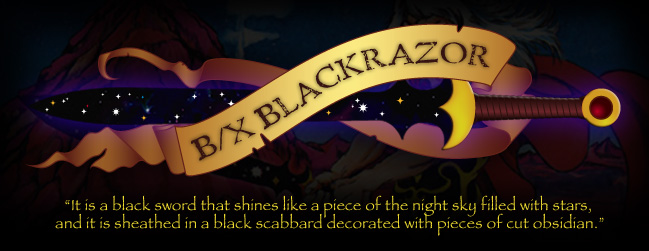
Thrall of Blackrazor

Ha! I've never played the D&D Miniatures game (nor even the old New Chainmail)...but if I did I would make sure my warband contained this guy.

'Course, I might need to greenstuff the miniature to give hime a new hairstyle...and a new Blackrazor. What's up with Jimmy Neutron wielding Grazz't's sword?

Yeah, Thrall of Blackrazor...it's just such a cool name I'd be tempted to buy the piece simply for posterity. But it would probable be better to do my own conversion of an Alejandro-type piece (I found an illustration of the fighter the other day...once I figure out how to hook my scanner to my Mac, I'll upload the picture...).

I never did use miniatures in D&D games...that was one "option" I never put into practice. I always preferred the abstract "battlefield of the imagination." Even with 3rd edition it was a challenge to convert my game play to the tactical map...but I was a lot better than the "old school" players I tried with whom I tried 3E gaming...they were fairly awful with 5' steps and attacks of opportunity and such, and I was constantly getting the better of them through sheer maneuver. This is probably due to my years of WH40K, Blood Bowl, and Mordheim game play (started long after I stopped playing RPGs regularly).

Hmm...I wonder if I could convert Blackrazor's Thrall to a Mordheim sell-sword. Sounds like my upcoming 4-day weekend (sorry, jokers!) will have a project or two for me to pursue.