Showing posts with label attributes. Show all posts

Tuesday, December 17, 2024

*sigh* Cavaliers

This post is going to address several "bad ideas" found in the UA;  I mean, might as well get them all out of the way at once, right?

Weapon specialization is a VERY bad idea...it falls under the category of "how much have you been drinking, Gary?" Len Lakofka first introduced the idea of an archery specialist (character class) along with a lot of really crunch missile fire rules in Dragon #45; it's not terrible (we had an archer PC back in the campaign of my youth), but most of the crunch only serves to slow down the game (worrying about whether actions occur at the beginning, middle, or end of a segment? Come on, dude...we don't need to micromanage more than we already do). And it introduced the idea of "point blank range" (*sigh*), to Gygax and got him thinking about OTHER possible types of specialists. Hence, weapon specialization.

One can see the appeal in an existing (long run) campaign: high level fighters are watching all the other character classes get fancy spells and abilities for achieving those 'teen' levels and, yet, they're doing the same-old-same-old since they picked up that frost brand sword back at 6th level; 'where's the love?' they cry. Unfortunately, implementing weapon specialization wrecks the combat economy from the very beginning. A normal party generally has a potential damage output of 4.5 damage per PC (roughly) with the high strength fighter types making up for low damage wizard types. But this goes off the rails with weapon specialization and (especially) double specialization (both available at 1st level). A fighter with an 18+ STR (up to 18/50...achievable for most fighter types) and double specialization in longsword strikes with a +4 to hit and +6 to damage, as well as getting two attacks every other round...a potential average damage output of 21 points in round one (25 against a large sized creature). Average hit points for an ogre are 19...for a bugbear 15. First level fighters should not be able to chop down gnolls and hobgoblins with impunity, and if the DM ups the challenge of monsters thrown at 1st level groups, the other party members (who have the same combat abilities as ever) are far more likely to suffer. Plus PBR rules means that same fighter, even without double specialization had a potential average damage output 34 damage per round, due to double damage and adding STR bonuses (all part of the PBR rules) for shots fired within 30'. Back when we used the UA rules in my youth, we saw a LOT of bow specialists. 

Bad Len. Bad, bad, bad. 

Next terrible idea to discuss is the Method V version of generating ability scores. Ostensibly restricted for human characters, this method of ability generation all but assures you of achieving the scores you need to take whatever particular class you desire to play. Having also used this a bit when the UA first came out, I can tell you the PCs end up having a LOT of high scores, not just in the ones they need...far more so than any of the other methods found in the DMG. Rolling 9, 8, 7, 6, and 5 dice (and taking the best three) for the five most important abilities of a particular class are going to give you much better scores than the DMG's Method I which has you roll 4d6 across the board...and who cares if MV makes you roll 3d6 for one (ONE!) ability score when that ability is, more often-than-not, Comeliness?

Method V appears to have originated in Dragon #63 with the introduction of the barbarian class. Originally, the barbarian had NO minimum ability qualifiers (probably a good thing, considering it's supposed to replace normal man types like the nomad, caveman, tribesman, etc. in the MM), but instead determined its abilities through a new method: 9d6 for STR, 8d6 for CON, 7d6 for DEX, 3d6 for INT and CHA, and 4d4 for WIS. The sea change here, however, is the choosing of the class before rolling the dice (i.e. before seeing if the player has achieved the dice rolls needing to qualify for the class). Gygax discusses this decision in Dragon #67:
A few wondered why a decision to be a barbarian character had to be made prior to rolling dice for attribute scores. The answer is simple: The game is based on role-playing principles, and it is easier to do so with a course determined in the first place. Method I of Generation of Ability Scores encourages the player to choose a character profession from a predisposition rather than dice determined statistics. It is but a step removed from there to deciding on play as a barbarian subclass fighter and rolling dice accordingly. Frank Mentzer suggests that the 4d6 system could be employed with minimum score requirements of 16 strength and constitution, 15 dexterity, and a maximum wisdom of 15. That will work, but it seems to beg the question. Playing as a barbarian is a determined choice, not as one of several possibilities -- or a mere afterthought. This is a part of the whole concept...

...In all truth, the sub-class is not too powerful. It is, in fact, under-powered unless some very good rolls are gained in the areas of strength, dexterity, and constitution. To have real prospects for long-range play, the character must have 18, 16, and 17 respectively. That, Gentle Readers, is why they are given 9d6, 7d7, and 8d6 for those categories. A low-level barbarian has a better than average chance of survival without such high rolls, but at higher level, he or she is not going to do well unless strength, dexterity, and constitution combine to give high hit points, low armor class, and superior punishment potential.
Indeed. So the lesson, Gary, is "don't play a barbarian if you can't roll the high stats," NOT 'give the players the ability to play whatever they want.' Sorry. After 40+ years of game play (more than Gygax had at the time he was writing), I've seen what coddling does to one's game. That ain't the way to go.

So, now we turn our attention to the cavalier...a class that may have had an interesting kernel of an idea, but then worked hard to make it work with these other concepts (like weapon specialization) to its overall detriment.

I mean, that's sugar-coating things. The class is a travesty.

Here's what you get with the cavalier in its FINAL presentation (i.e. as it appears in the UA):
  • It is not a subclass of fighter, but its own class...and it puts the paladin subclass beneath its banner (more on this later).
  • STR, DEX, CON of 15+, INT and WIS of 10+ to enter; however, Method V in the UA makes these quite easy requirements (with 8d6, 7d6, and 9d6 dice rolls).
  • Open to humans, high elves, gray elves, dark elves, and half-elves with NO LEVEL LIMITS. That's right...you don't like being limited to 6th or 8th level fighter? Be a cavalier (who still fights and saves as a fighter), and achieve whatever level you like.
  • Hit points start at 1d10+3 at 1st level with D10s up through 10th (note: fighters only go through 9th) with +3 hit points thereafter (same as a fighter).
  • Progressive "to hit bonuses" in lance plus two other weapons of choice (one a sword, the other a horseman weapon like a flail or military pick). This bonus starts at +1 and increases by +1 every six levels with no end. This bonus can be used defensively as part of a parry (and can also "parry" with a shield at the same time). Cavaliers may make multiple attacks as a fighter 5 levels higher than their actual level with these weapons of choice. High elves would be advised to select longsword.
  • A bunch of horse/riding related skills that no one cares about in a dungeon.
  • Each of STR, DEX, and CON are assigned a % number (similar to exceptional strength) and every level the cavalier rolls 2d10 and adds the number to the current percentage; when the number exceeds 00, they move up to the next number, eventually topping out at 18/00 in all three abilities (the percentage doesn't mean anything for DEX and CON, but an 18 is still an 18). How this interacts with the CON reduction from a raise dead/resurrection spell isn't stated, nor if these numbers can exceed racial maximums.
  • Immunity to fear, +2 bonus to save versus illusions, a bunch of 90% chances to resist mind-effecting magic, etc.
  • Ability to continue functioning at negative hit points (though cannot continue to fight).
All pretty swell, right? Like a fighter except more powerful (and potentially a LOT more powerful). You'd probably be thinking, man, that cavalier cat must need a ton of experience points to level up (as the barbarian does). HA! That's the kicker, son...the cavalier needs LESS x.p. to level up than the 'lowly' fighter...at least into the teens:

9th level --    fighter: 250,001       cavalier: 220,001
10th level --  fighter: 500,001       cavalier: 300,001
11th level --  fighter: 750,001       cavalier: 600,001
12th level --  fighter: 1,000,001    cavalier: 900,001
13th level --  fighter: 1,250,001    cavalier: 1,200,001
14th level --  fighter: 1,500,001    cavalier: 1,500,001

So, sure...after reaching 14th level, the cavalier will need more x.p. per level than the fighter to level up (an extra 50K per). But his 300K per level is still a damn sight faster than the ranger (325K), paladin (350K), or barbarian (500K). And to out-pace the fighter? With all those additional benefits? I mean, just what the hell was Gygax thinking? 
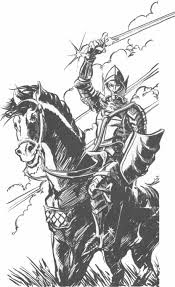
Elf? Probably.
This cavalier class makes the fighter all but meaningless in an AD&D campaign. It wrenches humans from their proper place at the center of the universe and allows elves to be ascendant (what is the incentive to play a human cavalier over a high elf?). Of course, it also radically changes the paladin class (now open to half-elves) giving the pally ALL the abilities of the cavalier PLUS all the abilities of the paladin (listed in the PHB), plus the ability to raise the character's CHA every level in the exact same manner as their STR, DEX, and CON.

This is not a complaint about "power creep;" this is simply stabbing the character economy in the heart with a red-hot (lance) point.

SO, NO. There will be no cavalier in my games, sir...not in the way they are detailed in the UA. Neither will there be any weapon specialization or "point blank range" for missile fire. Nor, will I be using Method V for the generation of ability scores (I remember axing that waaay back in high school...and having fierce arguments with my brother over the subject). No sir!  Method I will (continue to) do us just fine.

However, I might very well include the barbarian class...I'll just remove all minimum ability requirements for entry. You want to be a sickly member of your tribe/village, that's okay by me.
; )


Thursday, May 20, 2021

Wow. I FINALLY Get It!

Sorry. This has nothing to do with whimsy, "gods in D&D," or Dragonlance in any way, shape or form. But I just had an amazing...nay, mind blowing epiphany that I wanted to share. 

For those readers who don't follow Grognardia, James has been writing about D&D ability scores lately. Musing about them really. Anyway, todays post was about the weirdness of the OD&D trade-off for prime requisites, a subject I thought I'd long since answered to my own satisfaction based on the instructions given in the Moldvay Basic book. In brief, my conclusion was: ability score adjustments are a means of offsetting low dice rolls in order to play a better version of the character class you've chosen for your PC.

But was it always meant to be that way?

Moldvay's mechanic is a streamlined version of OD&D's system, and in this context (helping out a low roll in one's prime area of expertise) it makes sense. However, Talysman from The Nine & Thirty Kingdoms had an incredibly astute observation. He wrote:
I think Gygax and/or Arneson had two conflicting ideas here: 

(1) Although each class has a prime ability, other abilities should improve performance in a class (smart and strong fighters should advance a little faster than those who are just strong.) This explains the different point ratios and why M-Us can't use Strength to improve earned experience. 
(2) An actual point swap, to reduce the risk of bad rolls. 

The problem is, they should have gone with #1 without #2, or #2 without #1. Trying to hang on to both leads to confusing language about lowering other ability scores, but only "for purposes of earned experience". Are we lowering the scores, or not?
To which I have the answer: they're not.

Gygax has penned a magnificent mechanic in OD&D that has been completely lost in his inability to express it coherently. Here is what he wrote:
Prior to the character selection by players it is necessary for the referee to roll three six-sided dice in order to rate each of the various abilities, and thus aid them in selecting a role. Categories of ability are; Strength, Intelligence, Wisdom, Constitution, Dexterity, and Charisma. Each player notes his appropriate scores...

The first three categories are the prime requisites for each of the three classes...

Strength is the prime requisite for fighters. Clerics can use strength on a 3 for 1 basis in their prime requisite area (wisdom), for purposes of gaining experience only. Strength will also aid in opening traps and so in.

Intelligence is the prime requisite for magical types. Both fighters and Clerics can use it in their prime requisite areas (strength and wisdom respectively) on a 2 for 1 basis. Intelligence will also affect referees' decision as to whether or not certain actions would be taken, and it allows additional languages to be spoken.

Wisdom is the prime requisite for Clerics. It may be used on a 3 for 1 basis by fighters, and on a 2 for 1 basis by Magic-Users, in their respective prime requisite areas. Wisdom rating will act much as does that for intelligence.

[insert table that shows adjustment to earned experience based on prime requisite]

Note: Average scores are 9-12. Units so indicated above may be used to increase prime requisite total insofar as this does not bring that category below average, i.e. below a score of 9.
The problem here, with my previous interpretation, is that I was using my knowledge of Moldvay (the B/X system I learned the game from) to infer the way the mechanic works in OD&D. In B/X a character's ability scores are exchanged...i.e. spent...in order to increase its prime requisite. That's not what Gygax writes. His term is USE.
A cleric may use strength on a 3 for 1 basis...
Both fighters and clerics can use [intelligence]...
[Wisdom] may be used on a 3 for 1 basis by fighters...
Units so indicated may be used to increase...
"Use" does not mean "spent" or "exchanged."

What does that mean? It means that if I have a fighter with a 15 strength and a 13 intelligence, then my prime requisite is treated as 17 for purposes of gaining experience only. I can USE my intelligence on a 2 for 1 basis in my prime requisite area (strength), insofar as this does not bring the category below average, i.e. below a score of 9

In other words, I can only USE those points that exceed 9 when calculating my prime requisite, and only on a 2 for 1 basis (if we're talking about a fighter and her intelligence).

Why? Because a strong fighter that is SMART will advance just a bit faster than a fighter that is only strong.

This is the reason for the different rates of "use." Strength cannot be "used" by a magic-user (no exchange given) but by a cleric. Intelligence (smarts) are useful for both clerics and magic-users. Wisdom  is more useful to magic-users than the (bold, courageous, incautious) fighter.

And, yes, this STILL makes sense when you add in the thief class from Greyhawk (Supplement I): the prime requisite of a thief is dexterity. "They may use 2 points of intelligence and 1 point of wisdom to increase their raw dexterity score so long as they do not thereby bring the intelligence and wisdom scores below average." Smarts and caution/insight aid the thief in advancement, not strength. Makes perfect sense.

This is not an expenditure of points to improve an ability score. In answer to Talysman's query: NO, we are NOT "lowering" anything. We are USING points in excess of an average score in CERTAIN abilities (depending on class) to adjust a character's CALCULATED prime requisite to model the advantage of PCs that excel in multiple abilities deemed important for their profession.

Gygax just had a hard time saying that. And later he axed the mechanic from the game and simply said: roll 4D6, put them in order and if you have a 16+ in your prime requisite we'll give you a 10% bonus. Period, end of story.

Very simple. Fine for a game. Less of a model of "reality."

Man, I like OD&D more and more.

***EDIT TO ADD: And as Fr. Dave points out, the side benefit of this is that racial level limits can be increased (using these rules) withOUT the need for an 18 ability score. Your elf or dwarf fighter can make up for a lesser strength score with smarts or wisdom, de-emphasizing the imperative of high (rolled) scores.***

Monday, May 10, 2021

Fluency

First: a quick reality check. Before I start diving into discussions of language (and language design), please understand that your humble author has no academic background in linguistics or communication, nor historical anthropology applying to the subject, nor even any background in teaching or education. I write for (i.e. "design") games. The games I design for (tabletop RPGs) seek to emulate specific particulars of my choosing, and they try to do so with an eye towards playability, balancing "fun" and "practicality," and my tastes for these two elements may well run counter to other folks' tastes. 

In the case of language fluency, what I want to emulate is based largely on a combination of "adventure fiction" and personal experiences, not necessarily in that order.

Your humble author is pretty much crap at learning foreign languages. Here's the brief history: took French class in the 8th grade and got straight A's. Took three years of Japanese in high school and got a B'ish average, yet retain ALMOST NOTHING despite actually traveling/living in Japan for three weeks or so (I did manage to acquire a girlfriend who later came to the U.S. and had an interest in marriage, but she was fluent in English). Took a year of French at University where I bottomed out in my third trimester (I believe the mark I received was a "D+") due to me skipping a LOT of class to be with my romantic interest of the time (another train wreck story). Took some night classes in Spanish at the local community college, years later, in order to get enough grounding in the language to fake holding a conversation with my Mexican in-laws (this AFTER a couple years of marriage and certain spousal threats relating to my inability to communicate with the family). And that's about it, education-wise...unless you count a couple-four CDs used to "try" learning foreign languages: Russian (that was for a different girl), German (for travel), Czech (for travel), and Italian (?? I think...for fun? Maybe, but we did travel there as well eventually. Regardless, I speak NO Italian).

These days, I'm fairly fluent in Spanish, but that's after 20+ years of marriage to a woman from Mexico (we've been together since '98), annual or twice annual trips to Mexico (where all the friends/relatives reside), three years or so living in Paraguay, several excursions to various Spanish-speaking countries (Panama, Guatamala, Argentina, Uruguay, Chile, and Spain). I knew NO Spanish before I met the wife, other than what was on the menu at a Tex-Mex joint...at least, nothing but bad words (picked up working in restaurant kitchens). 

"Fairly fluent" means the following: I can hold a conversation with someone in Spanish, though generally not a profound or deep one. I can follow (comprehend) a conversation between native Spanish speakers, so long as they are not A) speaking too fast, B) using a lot of "slang" or specific terminology, C) talking about anything particularly complex. I can communicate with native Spanish speakers enough that they understand (more-or-less) what I am trying to communicate to them (the reverse does NOT always hold true). I can teach simple concepts in Spanish (on par with what you'd teach a small child up to the age of 5 or so); we raised our kids to speak Spanish as their first language, and could only do this by only speaking Spanish in the home. 

Oh...and I can generally follow movies in Spanish, even without subtitles (though it's easier with...yes, even with subtitles in Spanish).

My reading comprehension is actually better than my listening/speaking ability because reading is a slower process, allowing me time to distinguish recognizable root words, make sense of syntax and context, and because writing is (generally) more formal in composition than the way people talk. Also: no accents in writing. I can distinguish (some) cultural accents these days, and some accents are so thick they don't even sound like Spanish at times. This was an issue for us when we liven in Paraguay...even my wife only understood two-thirds of what people were saying the first year we were there. 

My wife, unlike me, is amazing at learning languages (except French. Terrible, terrible French). She is fully fluent in English (with an extensive vocabulary) and "fairly fluent" in Italian. She can get by in Portuguese, and picked up Czech pretty quickly (though I doubt she remembers any now). She left the German stuff to me (when we were in Germany) but I doubt she'd have much issue with it, seeing as how closely related it is to English. But then, her work and education are in the field of communications (and she LOVES to travel).

In Dungeons & Dragons, knowledge of a language is a binary switch: your character either knows how to speak "troll" (or whatever) or she doesn't; degree of fluency doesn't enter into the equation. In D&D, the number of languages you speak is the resource that is counted, and it is tied directly to a character's intelligence attribute: the higher your character's INT, the larger the quantity of languages known and understood.

Which doesn't jibe with my experience. Your O-So-Humble Scribe (me) is a pretty smart guy...on a day of extreme modesty, I'd probably rate myself a 15 on the ol' INT scale. But despite years of effort (especially the last ten or so) my ability to speak ANY language other than Inglais has met with a LOT of frustration...you can be smart all day, and it just ain't easy (at least, nor for me). On the other hand plenty of folks (especially those raised outside the USA) speak multiple languages just as a matter of course. Native Paraguayans, from the most educated professor to the lowliest laborer, speak two languages fluently: Spanish and Guaranii. And those with ANY degree of education (i.e. anyone with some family money) speaks unaccented, fluent English (care of The American School) and probably some Portuguese as well (due to the country's history and cultural exchange with Brazil). "Intelligence" is not the issue; so far as I can determine, the main drives of "fluency" (i.e. the ability to communicate in a language) come down to use, opportunity, and access. Roughly in that order.

These days, I only rarely use my Spanish language, except for the habitual phrases and sentences I use (yelling at my children, buying chicharon at the Mexican grocery store), and as a result I'm quite "rusty." My kids are worse: since the pandemic, they've cut the Spanish class from our school (one of the reasons we were sending them there) and sometimes they forget even phrases like "merry Christmas"...at least, until their mother takes them aside and lectures/communicates with them for a couple hours in Espanol. Usually that's enough to knock the rust off. For me, my Spanish improves remarkably after a week in a country where I'm surrounded by the language, my fluency "amping up" to two or three times its normal level...but never more than what I've had the opportunity to learn.

Should an elf or wizard be able to hold a jovial conversation with a couple orcs when they spend most of their free time "in town?" Should the gnome illusionist using a change self spell be able to pass as a native speaking kobold? Personally, I don't think so...unless the character is some serious student of the language/culture. And yet, in Seattle I know many folks of non-American birth, switch seamlessly between their native tongue (still spoken in the home) and the English language that is all around them. Though many (including my wife) will at times complain of a loss of fluency in their original language due to living and working on foreign soil.

[actually, when we first returned from living in Paraguay, I would accidentally slip into Spanish quite often the first few months we were back. I don't do that anymore]

SO...how to model this in game terms? Well, what's the (game) objective here...besides making a more nuanced game world for the players to live in? For me, I want to give the PCs some options that will aid them in their navigating the challenges...specifically hostile NPCs...through the time honored means of negotiation and deception (or both).  And because this is a game, the system needs some abstraction. Here's how it works:

For any language, there are four degrees of fluency:
  • Non-fluent (0 points): the character cannot communicate in the language. Oh, a person might be taught a word or two ("Breeyark," "yes/no," "please"), but the character will not understand what the language speaker is saying; communication is only one way, or very rudimentary and bolstered by gesture (point at food, point at mouth, etc.).
  • Moderately fluent (1 point): character is "fairly" fluent...about the same as what I describe for my ability to speak Spanish (see above). Complex ideas cannot be conveyed, but basic conversations - both ways - are possible. Topics of conversation will be limited to the character's general interests, perhaps chitchat (food, treasure, directions, danger, etc.) not profound philosophies, deep matters of the heart, or intricacies of political situations.
  • Fully fluent (2 points): character can communicate as well as befits a person of his or her station (type and level of education, intelligence, profession, etc.). The character cannot pass as a native speaker, and will exhibit a marked accent; subtleties of conversation (including humor and condescension/disdain) may be missed, but the character should "get it" most of the time. Character will have insights into the culture, but may still be thrown for a loop by rare words, new slang, or unique concepts.
  • Native speaker (3 points): character speaks as well as someone born to the culture; the only limitations being the character's particular class/stature/station in life (this can be eyeballed based on a character's class, level, and CHA score). Appearance will be the only mark of a character's "foreignness," and perhaps not even that if the culture is sufficiently diverse enough to include members of the character's species. Character will be familiar with customs, clothing, food, etc. of the culture and will understand idioms, expressions, and subtleties as much as INT/WIS allows.
Characters start the game with 4 points worth of languages so long as their INT is at least six, otherwise they have only 3 points worth of languages. Elves and dwarves receive one bonus point (total of 5) so long as their INT is at least six. This number is modified by the character's Intelligence score as noted in the PHB for "number of additional languages spoken." For example, a halfling with a 13 intelligence would have 7 points to spend; a dwarf with an 18 intelligence would have 12 points; an elf with a 4 intelligence would only have three points, the same as a human of 4 intelligence.

Some languages (in my game world) share the same root "language family" such that a native or fully fluent speaker counts as moderately fluent without the need to expend additional points. These include:
  • Dwarf to Gnome (and the reverse)
  • Goblin to Kobold (and the reverse)
There may be others. "Bugbear" is not a goblin in my world. Hobgoblins are a larger form of goblin, but otherwise the same species (see dialect, below).

Creatures/characters of the same species share the same language but may have different "dialects." Native speakers may communicate as fully fluent when communicating with a speaker of a different dialect. Some examples from my world include:
  • Humans (those West of the Cascades versus those to the East)
  • Elves (wood elves versus high elves, etc.)
  • Giants (hill, frost, stone, fire, etc.)
[Drow, if such exist (I haven't yet decided) are far enough removed culturally to be considered a different language family, rather than a different dialect. The same would probably apply to svirfneblin, derro, and duergar]

Mechanic-wise, characters should receive a bonus to reaction checks of +1 if fully fluent and +2 if a native speaker. Characters who are non-fluent should receive a -2 penalty when attempting to communicate (moderately fluent character receive neither bonus, nor penalty). These are in addition to the normal adjustments for CHA and circumstance (a group of adventurers with blades drawn are going to be seen as a threat regardless of their communication skills!).

Can fluency be lost? Yes, of course. So long as a character has the chance to use their conversation (either talking to NPCs, practicing with fellow party members, or residing in a "base town" where the language is spoken), fluency may be maintained at the purchased level. It takes 2d6 months for fluency to diminish (call it seven months) from non-use; fluency will never diminish more than one step, and never below moderately fluent. Former fluency level can be regained after immersing themselves in the language for 1d3 weeks.

[folks who want even more nuance can add a somewhat fluent category under moderately fluent; this degree of fluency is never purchased but may be fallen to from non-use. It carries a -1 reaction penalty]

Now, I'd bet there are some folks out there, reading this and saying "Eh? Who cares? Why add this needless complexity to the D&D game?" And, of course, you don't have to. You don't have to use weapon proficiencies either (B/X doesn't). Heck, if you really wanted to simplify the game you could remove all coinages besides gold pieces, lots of "simpler" fantasy board games get by with nothing else (games like Dungeon!, Dark Tower, Talisman...).

For me, some amount of complexity (no more than I can handle) makes for a richer, deeper gaming experience. For other folks it just adds to an already dizzying array of overwhelming rules. To each their own. But I think this is kind of neat, and I plan to put it into play pretty much immediately.

Next post, I'll talk about literacy.
; )

Monday, June 24, 2019

Oh My.


I suppose I should know better than to post rants penned in the wee hours of the morning following copious consumption of red wine, but sometimes the urge to hit that little orange "publish" button is so darn hard to ignore. Ah, well.

However, I do know better than to expect any sort of agreement from such a contradictory stance...I mean, it's pretty silly in the light of day to pretend that the game hasn't been doing its damnedest to define the six ability scores as something other than class-assigned mechanics ever since the first set of rule books was published. In fact, it's as ridiculous for me to state otherwise as is the publishers' various attempts to do so.

So why bother doing so? Why get mad about something that already has buy-in from so many D&D players of all stripes and generations? Just because I want to poke the bear? Generate a bunch of comments on my blog.

No, no. It was just the wine, really...loosening my already lax self-restraint. I've been having these particular thoughts lately, see? About the ascendance of importance of ability scores. And it's really started to bug me...like some hard-to-reach itch or a nagging irritation or kink in the neck that you just can't quite work out. Because it IS silly...the mechanical importance that has been attached, over time, to certain descriptive qualities that offered minor adjustments to specific individual game systems. What was once a bit of generosity has instead become all-encompassing definitions of one's fictional persona, leading to all sorts of unwelcome practices: perception rolls, social rolls, etc.

Once upon a time someone asked: "Why must my character be as stupid as me when HE has an intelligence of 18? Why must I, the shy and not-so-smooth gamer geek have to 'role-play' some interaction with an NPC, when my character has this humongous charisma stat? It's not like Bob doesn't get to "bend bars" with his 18/00 strength score...and Bob can't even do a chin-up in real life!"

AND WHAT COULD HAVE BEEN SAID (by the DM) IS:

"The characters are our avatars in the imaginary world. Ability scores provide numbers that describe certain measurable aspects that of the character that directly impact specific systems. Strength measures ability in melee combat and certain physical feats. Intelligence measures mental capacity for working magic and learning languages. Charisma measures the character's ability to make a first impression and engender loyalty in followers. Wisdom measures insight into the "clerical mysteries" and innate resistance to magical attacks. But that's ALL the numbers represent...they are a measure of certain measurable aspects. But just because you have the intelligence to master magic doesn't make you 'smart;' it means you've got a good handle on a particular career path when choosing your character's class."

That's what could have been said. It wasn't. Instead attempts have been made to fit agility, speed, reflexes, hand-eye coordination, depth perception, balance, etc. all under the single heading of "dexterity." Instead pages and pages of internet ink and silly arguments have been made trying to clearly delineate the distinctions between "intelligence" and "wisdom."

And designers from various (MOST) editions of D&D have attempted to use the ability scores as the basis for some type of skill system. And I hate skill systems...especially ones that try to use a universal mechanic to model all skills when clearly nothing could be LESS universal than "skills."

Is carpentry a skill? Is medicine a skill? I have little training in either of these, but I can learn to make a passable birdhouse or picnic table far easier than I could perform surgery. And not because it's easier to saw wood than cut flesh with a knife! But I made a working catapult when I was an eight-year old Cub Scout; I made a (poorly) working crossbow when I was but a year or two older...not that I could, for the life of me, remember now HOW exactly I did these things.

Once upon a time I was a single guy who would get dates with girls. Was this a skill? Maybe...it was a matter of learning particular social cues and finding the courage to talk to women (and the brains to listen to their own subjects of interest and not bore them overly with my own). I'd say it took me a long time to "learn" it...it wasn't until I was 19 or 20 that I really got the knack for it after perhaps a decade of trying. And even afterward it was always a difficult task...always hard to control yourself when you're with a person who's making your emotional self fire off in all sorts of unpredictable ways.

Skill systems also fail to take into account atrophy. I was once a pretty good (stage) actor...though I always had difficulty with the memorization of lines. But it's been a quarter century since the last time I was on stage; I sincerely doubt I could turn in the same kind of performance I could at my "peak," when I was reeling off reams of blank verse and captivating audiences. And it's not because my body has degenerated (the way my knees have...I definitely couldn't fence the way I did when I was in my twenties!)...I just haven't practiced my craft in decades and I've allowed my skills to lapse. This happens...I got pretty expert at laying paving stones a couple summers back when I spent eight weeks doing nothing but landscaping my back yard. Today, I can barely remember the first thing about it.

Still, I'm digressing. Here's the deal: I don't disagree that a strong character shouldn't get some (slight) bonus to a task of physical labor for which she is untrained...nor that a weak character should suffer some penalty to the same. But for the game I play (and, sure, I understand not everyone plays as I do), I feel that a character's class IS the bulk of the character's training...that's where the emphasis should be and ability scores a minor consideration as far as representing a character's "skill."

Apologies for the inflammatory scribbles.

For the Love of God...

...please, PLEASE stop using "ability checks."

Ability checks are nothing but sheer f'ing laziness, whether we're talking "roll under" or "roll versus target with ability bonuses." Just stop it. StoooooOOOOP IT, please!

Stop mistaking characters for something other than the player who's playing the character. Just stop. Stop now. If I am playing a character with a high Intelligence score that doesn't make him a frigging genius...and if he has a low Intelligence score it doesn't make him an imbecile. Nor does a specific Charisma or Wisdom score represent aspects of my personality (i.e. the player's personality) that I am obligated to play. It doesn't! It is unfortunate that the name carries connotations that expand the mechanic beyond the scope of what it's intended for but...well let's just talk sense for a moment.

Let's start with "Intelligence." Forget the name for the moment. Just forget it. Call it something else...anything! Call it "Wizard's Prime Requisite" (which it is...originally anyway). Call it "ability X" for all I care. Just divorce the mechanic from the connotation that comes with naming it "intelligence." Let's just call it "X" for now...or, better yet, call it "INT."

INT is a random attribute that determines how skilled a magic-user character is at learning his or her craft. That was the thing's original definition. Later, this wasn't simply designated mechanically with the acquisition of experience points (bonuses and penalties to XP) , but also included how well the magic-user learned spells (chances to learn, minimum/maximum numbers per level). Parenthetically it also provided a number of extra languages the character might know, presumably because it represented some sort of scholarly pursuits, even if the character was not trained specifically in the skills of a magic-user.

That's it. It doesn't mean a character is more perceptive: lots of well-read or knowledgable individuals are hopelessly obtuse about all sorts of things. A high intelligence doesn't equate with the ability to solve riddles or craft wooden furniture. Having an INT of 18 doesn't make someone "MacGuyver." It doesn't even mean the character is a particularly good student...except insofar as we're talking about being a student of magic. But you can be a stupid, stupid person and still great at your job. Happens all the time. D&D is not about "renaissance men (and women)" skilled in a variety of tasks and careers.

Wisdom isn't a stat that measures how "wise" or "intuitive" or "insightful" is your character. It's a measure of your character's ability to advance as a cleric. Again, forget the the word "wisdom;" it's a short-hand term, and a confusing one. Just call it WIS. Later editions provided that it made clerics even better (by giving them additional spells). For the non-clerics it acted as an adjustment to saving throws versus magic (though why exactly was never really made clear...certainly this was a late development in a game that mechanically went nearly unchanged between the mid-70's and 1999). You can be an extremely devoted zealot, well-versed in the tenets of your religion...or a doubter and closet agnostic who nevertheless has a firm grip on the ways of "universal (divine) law." Despite the name given to the ability, an 18 WIS doesn't make you wise; there's nothing "wise" about being an adventurer. There's nothing "wise" about joining a band of cutthroats and delving into ancient mines and tombs full of horrible ways to die. It is a MECHANIC with an unfortunate name, nothing more.

Charisma? It's not a measure of your personality. It's a measure of your abstract "it" factor, how much people naturally trust you and your immediate likability. It gives a bonus or penalty to reaction, something only checked in an initial encounter...your ability to make a first impression, probably based as much on your carriage, manner of speech, and straightness of teeth as much as anything else. Why do some people attract sycophants and fantastical followers while others have a tougher time making friends? Why do some people get elected president despite being eminently unqualified for the position? Why are some people blessed with popularity even when their words and actions are sheer nonsense? Eventually, all but the unfortunate few will see through the facade to a person's true worth based on his or her actual actions...and the length of time that takes to become disillusioned can be slowed or speeded depending on the depth to which that initial first impression got made. But it happens eventually...and probably sooner if the person shows herself to be a monster right from the get-go.

The same holds true of all the ability scores. Strength is a measure of fighting ability, not athletic ability. Originally, dexterity measure only marksmanship; later it was used to measure thieving ability (both as a thief's prime requisite and in bonuses/penalties to thief skills). Constitution adjusts a character's ability to withstand damage, not her ability to resist disease or hold her breath or sustain a sprint over distance.

I'm sorry, but I'm irritated. Hell, I'm angry. I'm mad at 5th edition and 4th edition and 3rd edition and 2nd edition (with its non-weapon proficiencies) and BECMI's "General Skills" (from the Gazetteers and, later, the Rules Cyclopedia). Hell, I'm mad at Tom Moldvay's admonition on page B60 of the B/X (Basic) Rules that:

"The DM may want to base a character's chance of doing something on his or her ability scores...to perform a difficult task (such as climbing up a rope or thinking of a forgotten clue), the player should roll the ability score or less on 1d20."

Bullshit. Bullshit, bullshit, bullshit!

Characters are trained in the skills of their class. They're not "renaissance men (and women)." They are not taking night courses at community college. They're not hitting the gym or practicing aerial aerobics. They're not shelling out money at the hot yoga studio to increase their flexibility and focus. They're not researching the internet for the best diets to and exercises to maintain health and fitness, nor to see how to build a rowboat from scratch or live off the land or fletch their own arrows. WE can do that...even in the days before the internet we had libraries and city colleges and trade schools and a military industrial complex capable of churning out trained soldiers from hopelessly soft civilians in a matter of months based on carefully crafted science of physical and mental conditioning. But that's us...21st century people.

Stop using ability scores to define the character holistically. It's a terrible simplification. Gygax would have done well to have NEVER suggested the inclusion of "secondary skills" in AD&D, but even he provided a near-20% chance of a character having NO SKILL OF MEASURABLE WORTH. A fighter is trained to kill people, not forge and repair armor, not execute standing broad jumps or pole vault or climb like a spider. Thieves are trained to steal (in various ways); they are not tumblers and acrobats, no matter what their DEX score is. Acrobats are trained to do these kinds of things, and I encourage anyone to add such a class to their game if they find those skills desirable (I even wrote up an "acrobat" for The Complete B/X Adventurer). But don't look at a 16 dexterity as an 80% chance to perform such feats. Knowing one set of skills doesn't translate to another set (see professional soccer players versus professional baseball players versus professional ballet dancers).

Stop with the ability checks. Your wizard's 18 intelligence means she's an impressively knowledgable wizard for her level of experience. It doesn't make her an impressively intelligent person. It doesn't make her better at finding secret doors or sussing out ambush's or identifying things she's had no experience with. Your cleric's 18 wisdom makes her an impressively accomplished cleric for her level of experience...it doesn't mean she's wise. She's only as wise as YOU, the player, make her. If you decide to open the chest without searching for traps or decide it's a good idea to make a deal with a greater demon, there's ZERO RESPONSIBILITY on the DM to have you reconsider these un-wise actions. The stat is called "wisdom" but that's just a word; stop thinking of it as more than a term.

I'm sorry. I'm sorry to irritate people. I'm sorry to once again yell about things that are indelibly ingrained into some (most) D&D players' psyches, wasting everyone's blessed time, especially my own. But I was once again reading some blog on which someone was (once again) complaining about some aspect of 5E ability checks they didn't like...as if some checks were "good" and others were bad...and just, no. No. Stop the madness. There are no "good" ability checks. There are no good "skill systems" for D&D. Your character class tells you what you can do. Your ability scores might adjust some aspects of effectiveness. But YOU, player: YOU are the one responsible for working with what you've got. I don't care what your character's Intelligence or Charisma is. Your Strength and Dexterity scores mean jack-all to me outside the adjustments the game rules explicitly provide. If you can't figure stuff out, tough shit.

You need a boat? Buy one or pay someone to build it for you. You're not boatbuilder. This isn't MacGuyver; it's D&D. Boatbuilder isn't an available character class.

Stop with the ability checks already.
[vented at 2am]

Tuesday, May 3, 2016

A Different Type of "Skill Check"

I'm sure I've posted the following excerpt in the past, but I can't be bothered to find it at the moment, so here it is again:

"SAVING VS. ABILITIES (OPTIONAL): The DM may want to base a character's chance of doing something on his or her ability ratings (Strength, etc.). The player must roll the ability rating or less on a d20. The DM may give a bonus or penalty to the roll, depending on the difficulty of the action (-4 for a simple task, +4 for a difficult one, etc.). It is suggested that a roll of 1 always succeed and a roll of 20 always fail."

- From the 1981 D&D Expert Set, page X51

A simple enough rule, and one that I've used on many occasions running B/X; it is the basis for the BECMI skills first presented in the various Mystara "gazetteers" and later in the Rules Cyclopedia.

[these, by the way, worked pretty much the same as the AD&D "non-weapon proficiencies" (first presented in Oriental Adventures, a book mainly written by the same guy: Zeb Cook), and exactly the same as Cook's 2nd Edition AD&D non-weapon proficiencies...all of which I hate, by the way]

I never much cared for the BECMI skills (even when I liked BECMI), and these days I'm not even a fan of the "roll under ability" rule. Simple as it is, when I look back on the way I've used it in the past, I find myself shuddering a bit.

Why? Because I used it as a catchall guideline rule for determining whether or not a PC could execute a particular plan or out-of-the-box action effectively, rather than presuming character competence. It's an antithetical approach to my current philosophy of D&D play.

But aside from any "philosophical" issues, as a form of micro-managing character action it leads to a higher rate of character incompetence, which is less fun for everyone involved. Consider one of the classic challenges of AD&D: the suspended disks acting as a "trail" over boiling mud from White Plume Mountain. A standard method of getting across the cavern (for those who aren't able to fly) is to make a series of jumps from disk-to-disk, using a "roll-under-ability" for success. Certainly, that's what I've always done in the past.

[don't laugh]

Here's the problem: with a check of this type, a series of task rolls reduces one's chance of success exponentially. Consider the guy with a DEX of 16...an 80% chance to make the jump to a disk is pretty good, right? Sure...but having to make all nine jumps (there are nine disks in the cavern) means that the cumulative chance of success is only 13%. It's a bit better if (like me) your DM allowed a "reroll" attempt on a miss (a second DEX check to see if the PC can "catch herself") but even then it's no better than a 4-in-6 chance of overall success...and less if the guy has to roll to make it from the last disk to the opposite ledge (a 10th jump). And THAT for a PC with DEX 16...what about the shlub who only has DEX 10?

"Aiieeee! It burns! It burns!"
[by the way, even 3E's alternate skill system runs into this issue in their version of WPM, requiring a jump skill check of 14 for every single disk. Fine and dandy for 7th level PCs who've maxed out their jump and have an 18 DEX (the average L7 thief in 3E)...but what about the guys who didn't put points into jump? Multiply their success chance against itself ten times to see what they're REAL chance of navigating the challenge is!]

Of course, there's more to complain about than just this. Binary (yes/no, success/fail) systems lack any kind of grey-area gradient. There's no room for partial success (nor partial failure), which can curb the irritation at "whiffing completely" while still preserving the old school integrity of character's NOT always failing up just because they're (story) "protagonists."

Thus enter Steve C's rather brilliant idea of repurposing the standard B/X reaction table to account for more than simply whether or not a wandering subterranean denizen wants to take your head as a trophy for its mate. Steve's idea was to use the table to expedite all manner of random issues that might come up in game, rather than spend time searching for obscure systems or hemming-&-hawing over how to rule certain situations...things that other DM's might determine with a simple coin flip (the ultimate binary test) could instead have a non-binary gradient to it.

For folks unfamiliar with the reaction table, it's a 2D6 roll which can be modified by a CHA adjustment (max of +/- two, and usually no more than one point) or circumstance (again, usually by no more than a point or two). The table results break down like this:

2 or less: Immediate attack
3 to 5: Hostile reaction
6 to 8: Uncertain, confusion (roll again)
9 to 11: No attack, leaves or considers offer
12: Enthusiastic friendship

[I realize that this table originally appeared in Might & Magic (OD&D), but Steve's use of an ability score adjustment is what leads me to presume he's taking it from B/X, seeing as how neither OD&D nor Holmes offered specific ability-based (CHA) adjustment to reaction checks...and Moldvay did]

Steve runs with this, giving a simple five-result table ranging from "catastrophically bad" to "extremely good" as a way of judging all those little things that crop up in a game. I say, hell, let's take it a step further and use it to resolve all those "ability saves" in a non-binary fashion!

Take the White Plume Mountain example. Rather than force players to make a series of jumping rolls, why not have them make a single roll (modified by DEX) to see how well they navigate the challenge?

2D6 (modified by DEX initiative adjustment):
2 or less: mistimes jump, plummets into mud (take damage from fall and boiling mud, as usual)
3 to 5: nearly slips but manages to grasp edge of disk though being completely dowsed by muddy geyser (take damage and al further checks to navigate disks are made at -2 penalty).
6 to 8: holds up on disk just in time as a geyser blows (take moderate damage; roll again to continue with cumulative +1 bonus)
9 to 11: made it across! only light damage taken from geyser splatters
12 or more: what a show! made it across without being splashed (and damaged) by boiling mud.

Nice, huh? So much simpler and quicker to resolve than a series of tests, and with an easy range of possible outcomes. Using the reaction table as a base, many "ability challenges" can be resolved in this way, with tastier results than binary systems, and little-to-no need for any kit-bashed skills system.

Some folks may object to such a simplified system of task resolution, saying it doesn't take into account character experience...shouldn't a 6th level character (for example) be better at such a task than a 3rd level character? To those folks I say: HUH? What in a character's class training has taught her how to navigate some mad wizard's bizarre challenge? Why would "experience" count for any such thing?

This isn't a "skill" in which a character trains (like fighting and thieving and spell-casting)...nor is it something that falls into a character's presumed sphere of competence (like knowing how to build a fire or how to tie a good knot or how to mend her basic equipment). We're talking about strange situations, outside the ordinary things encountered...things where the "save versus ability" roll has (in the past) been the main explicit option. Even if a character HAS done the "jumping disk" thing in a past adventure, chances are she hasn't been prepping every weekend since, like some fitness nut training for the American Ninja Warrior competition.

No...success or failure at these kinds of challenges need a system that shows the virtual crapshoot of attempting it (i.e. via random roll), possibly modified by native talent, possibly modified by other DM-arbitrated adjustments (as with reaction rolls). And in such cases, I think it's fair to have a range of possible consequences, only the worst of which is "abject failure."

This is something I'll be throwing into my future games...assuming I ever get back to the gaming table. Thanks for this, Steve!
: )

Monday, August 24, 2015

Dissing Dexterity

AKA The Usual Futility

This is not the post I was originally planning to write. What I had planned to write, what I was working on formulating (somewhat) in my head last night, was a post about the ability score called Strength (STR) that we all so love and over-rate, and some ways in which it might actually be used to garner more love, even from the softer (magicky) section of adventurers. But while formulating, this little problem child kept sneaking into the forefront of my brain and annoying the heck out of me.  So let's deal with that little bastard first: Dexterity (DEX).

First a little history (just roll with me, folks...the 'why' of it will be explained in due time).

DEX first appears in Men & Magic (volume 1 of OD&D) with the following description:
Dexterity applies to both manual speed and conjuration. It will indicate the character's missile ability and speed with actions such as firing first, getting off a spell, etc.
That's all it says. It's sole mechanical effect is to give a +1 bonus to firing missile if the score is 13+ and a -1 penalty if the score is less than 9. The Greyhawk supplement expands this, stating it is also "affects the ability of character to act/react" and allows fighters of high (15+) DEX to "use their unusual manual dexterity to attempt to dodge or party opponents' attacks," reducing opponents' attack roll by 1 for every point of DEX above 14.

[this translates to the standard AC bonuses...not penalties...found in the 1E PHB]

Greyhawk also made DEX the prime requisite of the thief class, first introduced in the same volume.

Holmes Basic states simply that DEX "applies to speed and accuracy" and while it retains the ability as a prime requisite of the thief class (now, apparently, standard), it ignores the defensive bonus while keeping the missile fire bonus of the original book (Holmes does offer an alternate "parry rule" that is available to all classes and not dependent on DEX). Holmes takes the ability's description of speed as a mandate and uses DEX as the sole determinant of ordering actions in combat...a mechanic never repeated in later editions.

Gygax further expands the ability in AD&D, writing that:
Dexterity encompasses a number of physical attributes including hand-eye coordination, agility, reflexes, precision, balance, and speed of movement.
Which is a very broad definition indeed, if one is used to the idea of dexterity being synonymous with  manual dexterity, the most usual "real world" use of the term. Regarding mechanics, DEX provides the Greyhawk fighter bonuses, though now for all characters, along with a similar bonus against certain types of saving throws that can be "dodged;" there are also equivalent penalties for low DEX scores. The bonus/penalties to missile fire have also been expanded to a range on 1-3 and apply equally to surprise situations (as a number of awarded segments of action).

Moldvay Basic (B/X) has a smaller range of bonuses/penalties, though they apply over a broader spectrum of DEX (anything outside the 9-12 norm). Combat rounds in B/X are not the segmented affair of AD&D and so the reaction adjustment doesn't apply, but Moldvay offers the option of allowing DEX to adjust individual initiative, if the DM is using the more complicated "pair combat" (the real precursor of individual combat order as found in 3rd edition+). Moldvay's definition states:
"Dexterity" is a measure of speed and agility. A character with a high Dexterity score is "good with his hands" and has a good sense of balance.
Note the "good with his hands" phrase would seem to refer to manual dexterity...this might not be what the original author intended (we'll come back to this).

I don't have copies of BECMI/RC or the 2nd edition PHB at hand, but my remembrance is that their definitions and adjustments are unchanged from B/X and 1E (respectively). If I'm mistaken, I apologize.

Likewise, I don't have a 3rd edition book available here in Paraguay, but the on-line SRD for D20 defines DEX as follows:
Dexterity measures hand-eye coordination, agility, reflexes, and balance.
It's adjustments apply to armor class, ranged attacks, reflex saving throws, and DEX related skill rolls...these latter being skills that pertain to agility, balance, or manual dexterity,

Jesus Lord, how this shit morphs over three to four decades.

Manual dexterity, the real world term generally used when one hears the word "dexterity" outside of a gaming context, refers to a person's ability with their hands, specifically how skillful (deft) they are with their hands. In the "old days" a person with good manual dexterity might be skilled at a (hand) craft...like carving or sewing. These days, we'd probably use it when discussing someone's ability to mash the controller of a console game. If you look up the term "dexterity" in wikipedia, it redirects you to the entry for fine motor skill...hand-eye coordination, in other words. This is the common definition of the term.

However, there is a broader use of the term "dexterity" which applies to mental adroitness...the skillful and clever handling of any complex situation can be done with dexterity, even if its not done with one's hands. The word comes from the latin word dexteritas meaning aptness or readiness.

But we'll come back to definitions in a moment...let's focus on what the damn stat does, and maybe then we'll be able to reconcile it with the meaning (if necessary). 'Cause, at the moment, the thing is a bit of a mess. To be clear, there are three main mechanical effects that have been used over the years with regard to this thing called "DEX:"

- a measure of proficiency with ranged or "missile" attacks
- a measure of combat reaction/speed
- a measure of defensive bonus in combat

The way these mechanics are handled from edition to edition varies, but that's pretty much the list. Let's blow 'em up one at a time.

Missile combat: using a ranged weapon, whether you're talking rifles or archery or knife-throwing, is only minimally a matter of "hand-eye coordination." The more important factors are proper technique, a good eye/depth perception, and (and longer ranger) and understanding of physics and environmental factors. Perhaps hand-eye coordination (which is a part of "fine motor skills" and thus manual dexterity) might be more pertinent to short-range, non-assisted shots (i.e. thrown weapons as opposed to shooting with a bow or crossbow)...this can be observed by a "coordinated person" having  a better basketball shot, for example. But, at least with regard to knife-throwing (I have no experience with spear/javelin throwing), such coordination is of minimal use...proper technique is required to throw a weapon with the accuracy needed to achieve an effective "hit" (i.e. one capable of inflicting damage). This is best modeled (in D&D) by class and level. Perhaps more coordination will help one to learn faster (like a prime requisite adding an XP bonus), but since D&D handles advancement in broader strokes (at least, with respect to combat), it would seem little worth to draft such mechanics.

Combat reaction: in (American) football, they have a couple sayings regarding speed. "You can't coach speed" is one; "speed kills" is another. But unless you're doing an Old West style showdown (or attempting to pull the trigger of your automatic firearm faster than the other guy), straight-line speed is not a huge factor in combat. Hell, sometimes making a brash attack is a good way to get suckered into the other guy's attack. Timing and distance is important, knowing when to be aggressive and when not to, and (for purposes of accuracy and effectiveness) keeping a cool head, are the most important factors in determining who's going to damage (or kill) the other person first. Training and experience (again, best modeled by class and level), followed by a good combination of level-headedness and controlled aggression are the most important parts reacting quickly and effectively in combat...as opposed to panicking, stumbling, and fumbling into a massacre or route. In the "primitive" non-modern combat found in D&D, physical speed and dexterity should have no part.

Defensive bonus: much as we might romanticize the swashbuckling swordsman in cinema, dodging and weaving isn't really a big part of hand-to-hand combat with weapons. Timing, distance, and technique...all of which come, again, from training and experience...are the things that will keep you from harm's way. And in cramped quarters (like, say, fighting a squad of goblins with fellow party members in a subterranean chamber) the idea agilely dodging is laughable; you're more likely to "dodge" into the attack of a different foe (or one  of your buddies!). Discipline, armor, good use of cover, and shields are all things that will serve to protect you from harm. A certain amount of manual dexterity could, I suppose, help you in batting aside ("parrying") a spear with your hand axe...but for me, this is best modeled with training and experience: class and level dependent hit points. Whittled away hit points can model the fatigue that comes with parrying blow after blow, not to mention the bruise caused by catching the haft of an axe with your shoulder (instead of the sharpened business end).

Agility, by the way, isn't generally necessary in hand-to-hand combat. Most fighting techniques focus on bringing the pain, in the most expedient manner possible, closing distance as soon as a good opening is found. Moving quickly with precision (i.e. accuracy) is a matter of practice, practice, practice, in order to move smoothly. That was the mantra of my old fencing master, anyway: slow is smooth, smooth is fast. And we'd practice handwork for 20 minutes trying to be slow, precise, and smooth, all in aid of training the fast (smooth and precise) hand.

[and that, of course, was sport fencing. In real combat, you're not worried about "precision;" you're worried about killing without getting killed. Practice and experience become so much more valuable, then, to act with minimal thought]

Going through these, it makes me wonder why one would even need such an ability score, even in the earliest edition. What makes it so necessary to add an additional descriptive measuring a character's dexterity, when it had so little effect on the mechanics of the game (compared to the prime requisites and the very important mechanics of CON and CHA). It feels like the designer(s) were harkening back to school days, and the drafting of teams for the playground activities. I'm sure most of us have had the childhood experience of encountering kids who excelled in hitting and throwing the ball, kids who could naturally (as a gift of good genetics) run faster and farther than others, even from an early age without training. If we were lucky, we might have been these kids...but there's always someone faster, who can throw/hit farther, jump higher, swim better, etc. As children learning our place in the world, we often find ourselves measuring ourselves against our peers, asking ourselves "where do I rank?"

Years of training...not DEX.
Even though DEX need not serve any great mechanical purpose in terms of the adult fantasy adventurers we portray in the game, it feels based on a measure of which character would be better at softball. Or, to put in less snarky fashion, which characters are more athletic than others. Even though the importance of general athleticism was pretty small in medieval life (and D&D is usually gauged as pseudo-medieval). And even giving it importance, it means little when it comes to adult, trained adventurers...who's to say the wizard hasn't become proficient at a thousand yoga postures as part of his mystic training, or engaged in some sort of acrobatic bootcamp similar to Jedi Luke on planet Dagobah? Sure, the fighter knows how to ride and joust in full armor, but he's got a lot more important things to learn than how to touch his toes or throw a tight spiral.

My default presumption is that D&D adventurers are hardy individuals that can ride, climb, swim, and hike for miles over rough terrain. Athletics and hand-eye coordination (except as it pertains to an individual's training and class abilities) is of little use to me. If it was especially important to be (for example) a strong swimmer or agile climber, the easiest thing would be to have a feat or talent called "naturally athletic" that would provide a small bonus over other (non-talented) characters. But otherwise, I have a hard time justifying the inclusion of the ability score, based on its physical description alone...too little mechanics to justify it.

Now, as a prime requisite for a thief character, and using the broader definition of "dexterity," I can see it as potentially useful. But that's for another post.

Friday, April 17, 2015

The Big Six

As I look towards writing a "new" Fantasy Heartbreaker (or, more accurately, converting a conversion of a conversion), I find myself looking back at D&D editions over the years to see how ability scores were handled. Of course, I always start with OD&D (the Little Brown Books) because, well, that's where it all originates, yeah?

So in looking at the Big Six ability scores I notice something that I have (of course) noted in the past: namely that the Great Three Prime Requisites have absolutely zero effect on characters other than "rate of advancement" (i.e. XP gain). Which, just for the record, is no MINOR mechanical effect, BUT is really small potatoes compared to the mechanical effects of later editions and the incredible importance and weight these attributes carry. Things like attack and damage bonuses, number of spells known, and potential power limits of spell-casters.

I hate all that.

I especially hate the whole Strength bonus thang, not the least-wise because it got me into stupid trouble in the past. Nope, I hate it because The Game is soooo combat-oriented that it is just a matter of time before one's character gets embroiled in a melee and the importance of being able to hit and inflict damage gains life-and-death importance and thus becomes a paramount mechanical adjustment for ALL characters. When really, the only thing I want to use to model attacking ability is: A) character's training (class), and B) experience (level).

[there's also the issue of the resentment I've seen at the table due to the random strength roll. The fighter with the 13-15 STR, for instance, who looks at the cleric with the 16 STR and sees that healer is a better melee fighter for three levels of play, despite the focus of their careers. In reality, there have been plenty of small statured warriors who were better at inflicting damage with a single blow than incompetent, larger individuals. Ask any U.S. marine about that sometime!]

SO...since I wasn't planning on using Prime Requisites in the FHB, I thought I might simply DROP the whole stat from the character sheet. Just ix-nay the issue all together in a Gordion Knot kind of way. If there's no mechanical bonus to be derived from the attribute, why bother rolling the 3D6? Issue resolved.

Likewise, I figured I could do the same, axe-wise, with Intelligence and Wisdom. After all, I've decided to take a hint from folks like Alexis (and 3rd Edition Pendragon) and just realize that the whole "challenge" of not being able to speak another sentient's language isn't all that fun. Or rather, it detracts from an aspect of what IS fun: namely, being able to negotiate and bargain with potential allies and adversaries encountered. If a creature is sentient, it's going to speak the language of the region, not some weird "other tongue." Besides, do creatures with a split-tongue and a mouthful of fangs or tentacles really have the ability to form words like a "foreign human" would? It's all just fantasy, yo...let 'em talk "real people speak." Give 'em an accent, if it suits you.

So...axe, axe. The Lesser Three attributes were a different story. Dexterity, Constitution, and Charisma have ALWAYS carried in-game mechanical bonuses: Dex adjusted missile attack rolls, Con adjusted rolled HPs (and "surviving adversity"), and Cha adjusted maximum number of hirelings and said hirelings loyalty base. Since I was trying to move away from ability scores adjusting combat rolls, I was pretty certain I wanted to cut Dexterity from the game.

IN ADDITION, I had to consider the "new" ability scores I'd dreamed up back in my last go around with this project: Agility (which had replaced DEX), Learning (which had replaced INT), Spirit (which is really its own thing), and Wit (which had...more or less...replaced WIS). Of these, I really only considered Spirit a "must have"...it really represents something new that I want. And Agility and Learning were tied to classes (and class abilities) that I've kind of decided to do away with. Oh...and I find myself hating Dex/Agility bonuses to Armor Class (whatever you call it in your game) these days. Just armor, folks. Just armor. Axe.

SO, I found that I only really had three ability scores I wanted to use in the new FHB:

Charisma
Constitution
Spirit

But was I getting too far away from the roots of this fantasy adventure game?

The designer in me would say that such is an irrelevant question. BUT...even if I don't like the mechanical benefits derived from most of these ability scores, as simple NUMBERS, they still provide a ready, short-hand description of one's character. Something that could quickly identify (as in "create an identity") the words on the paper into an image in a player's mind. And those three by themselves, really aren't enough.

Then I came across GusL's abstract encumbrance mechanic based on Strength that I mentioned in my earlier post, and I realized that maybe there was a way to make a descriptive number of the stat useful without being mechanically overwhelming (i.e. by not being of benefit in combat, but of retaining a mechanical advantage for exploration, as described in the follow-up post). Strength added back. It also turns out that Wit, then, still proves useful for abstract accounting of items brought along (previously, I had thought I'd need to go back to old school, granular, encumbrance and resource accumulation to model the treasure acquisition that would be the focus of the new FHB iteration). All of a sudden, I was back up to five ability scores...and if I was going to get all "traditional" like that, why not just find a sixth to complete the batch.

GusL's "skill tree" system (my term not his)...which I have yet to blog about...convinced me to add back Learning, and develop my own similar system (it's not a super-original take...see both 1st edition Empire of the Petal Throne and World of Warcraft, but in a simplified way it adds a nice little variety). I haven't yet talked about "classes" (that's another post), but the return to "roguish" roots has meant that the heroic "everyone-gets-magic" idea has been dropped by the wayside. Acquired skills ("dabbling") puts a little bit of this back, and having a LRN stat models the characters who benefited from early education (its availability and/or their level of focus) over those who did not. Which I like.

OKAY: we've got Strength (for representing that strong back). We've got Learning (instead of "Intelligence"). We've got Wit (instead of "Wisdom"). We've got Spirit (my own, personal deal...but one that I really like). And we've got Constitution and Charisma, largely unchanged...

Wait a sec...Constitution? No, no...we can fold its traits (and mechanical bonus of +1 HP per level) into Strength. Back down to five.

So...still looking for that sixth trait apparently. And there's ol' Dexterity staring me in the face. I don't want Agility because (again) the game has moved away from the heroic swashbuckling I once envisioned (and the help of uber-AC bonuses I was...previously...going to provide).

[sorry Boris Vallejo hero-types...y'all need real armor in this version]

What the hell exactly was "dexterity" back in the days before it became the second most preferred combat stat (after strength)? Well, Gygax's description in Men & Magic states simply:
Dexterity applies to both manual speed and conjuration. It will indicate the character's missile ability and speed with actions such as firing first, getting off a spell, etc.
No chainmail bikins. DEX is speed only.
This is all very nice, but with the exception of missile fire (+1 to attack rolls for DEX >13, -1 for DEX <9) absolutely none of this is mechanically modeled within the OD&D books. Chainmail (the default combat system for OD&D) has no such "speed" rules in it; first attack in combat goes to the dude with the longer weapon or that is behind cover (like a castle wall), or else (if neither of those apply) then whoever attacked first (i.e. whose turn was it that decided to move into melee). It isn't till Holmes Basic, that DEX really starts to see the mechanical benefit as applied to "speed of action." In addition to the aforementioned missile fire adjustment (which remains the same in Holmes), melee combat is determined in order of descending DEX.

This inclusion of "melee speed" as part of dexterity's purview is a Holmesian addition, and not a terrible one. What I think is especially interesting is the part in Holmes where
if dexterities are within 1 or 2 points of each other a 6-sided die is rolled for each opponent and the higher score gains initiative - first blow.
Which is actually different from what is portrayed in Holmse's combat example (where Mogo the Mighty with DEX 9 simply strikes after the giant spider with DEX 10). I like the idea that two folks, close in natural "speed" ability have a more-or-less chance of getting their "go" before the other. Of course, I also like Arrowflight's spot rule that in cases of ties (with regard to speed) the guy with the lighter armor gets first go (wow...an Arrowflight reference. That might be a first for this blog!). Yeah, probably some combination of all these is what I'm going for...

Aaand...I suppose that means dexterity is back in the game.

So there you have it...I went from "my own" five, up to six (with Charisma), down to three, back up six, almost all of which are the same as the original "Big Six" of D&D:

Strength
Learning (in place of Intelligence)
Wit (in place of Wisdom)
Dexterity
Charisma
Spirit

I'm not sure they'll appear in exactly that order (alphabetical makes a lot more sense, don't you think?) but that's where I am at the moment. Cue snickers and usual jibes about "reinventing wheels."

Just wait till I get to my post on the classes that are going to make an appearance.


Thursday, September 11, 2014

Fighting Women

[in which JB starts down the road to crucifixion]

Forget Robert E. Howard's Conan character for a moment. Or Karl Wagner's Kane character. Protagonists that are uber-strong, super-cunning, catlike in their speed, steely-thewed, and charismatic "leaders of men." In other words, forget the characters that (if modeled in D&D) would not only have a high level and (perhaps) multiple classes, but exceptionally high ability scores across the board. Forget that.We used to see the occasional character like that back when we used the ability score tables from the 1E Unearthed Arcana (Type VI method of generating abilities? I think that's what it was called), but since then I've seen very few uber-statted character's rolled up at my B/X sessions. Maybe one (named Farnsworth). And he ended up down four levels to a vampire and fleeing for his life, so I'd hardly compare the dude to "Conan."

Heroes in fiction are known for being exceptional...usually in one or two ways...but for me, the best heroes aren't exceptional in every regard. They have some normalcy that we can relate to (if not outright weakness). Superheroes are fun and all, but if they are infallible godlings most of the time...well, they can get boring.

In the new FHB ("fantasy heartbreaker") I'm writing, I have players (mostly) roll 2D6+6 for their ability scores  (this is something I've started to incorporate in all my "B/X based" designs lately. Um...a total of three, at the moment). This gives a range of 8 to 18 for player character ability scores with an average rating of 13. Since the normal human range of ability is still 3 to 18 (average 10-11) this makes the heroic player characters a "cut above" the average slappy.

Mechanical bonuses for ability scores start at 13. Exceptional range of abilities is 15 to 18. Since a player would need to roll a 9 or better on 2D6 to hit 15 (a 28% chance), most PCs on average will have one or two "exceptional" attributes...like the fictional heroes I prefer.

Please note: there is no mechanical disadvantage for a low ability score. The game doesn't even have a "roll under ability" mechanic, so there's really no penalty for having a low score. You just don't receive any bonus.

Now, I did said "mostly." As I wrote in yesterday's post the exception to this is female characters (not players) who roll 2D6+3 for their strength (STR) score. This is done with the purpose of reducing the average strength of a female character (from 13 to 10) and capping a female character's maximum strength at 15. Now there is some recompense for this...female heroes have learned to compensate for their lesser muscle mass in other ways, and receive 3 bonus points to distribute among their ability scores (which is pretty good since each point increase above 12 is it's own "breakpoint").

Why would I do this? And no, I don't just mean, "why would I open myself to criticism" (I can be something of a masochist at times). Instead, I mean:

"Why bother to write sex-specific game mechanics in a day and age when we are striving for inclusivity and working hard not to be part of the problem by carrying forward old fashioned stereotypes into fantasy tropes...especially given a fantasy setting with magic and dragons, etc.?"

[notice, I said "sex-specific," not "gender-specific." Spent half a day yesterday researching transgender lingo to make sure I've got my brain on straight when it comes to sensitivity. "Sex" is considered distinct from "gender" because the former is a product of biology and the latter is a mental-societal construct and, thus, open for interpretation: see Uruguay for the logical reinterpretation of this census datapoint. Regarding my game mechanic: it doesn't matter what gender the player or the character consider himself/herself to be, the mechanic is tied to the biological status of the character's sex: male or female]

*ahem* Where was I? Oh, yeah...why would I do this? Well, two reasons: one good and one bad.

The Bad: I hate Wizards of the Coast. Well, "hate" is probably too strong a word, but they have been rubbing me the wrong way for years now. And their abstract ability scores that (in 3rd-4th edition) went "to infinity an beyond" with no real rhyme or reason or justification just bugs the hell out of me. What does it mean that a 16th level elf girl fighter has a strength of 22 (for example) and a burly half-orc dude has a strength of 17? Not a blessed thing. It's just abstract numbers giving you a mechanical bonus that makes ability scores O So Important for killing folks and collecting those XPs.

[yes, I realize ability scores are capped in the new 5E rules]

So given a choice between being like WotC and "doing something different," I usually opt for the latter (usually...I'm totally stealing the advantage/disadvantage mechanic for Cry Dark Future). I want ability scores to represent something...and if a character can have a strength of 20-30, just what does that represent? By my game's definition of the Strength ability score, that would be "one big honking brick shithouse of a person." Which leads me to my better reason...

The Good (or, at least, "Justifiable in My Mind"): I'm trying to model something specific. 

No, no, not that "women are the weaker sex." Even if that is a biological reality (across most of the animal species on planet Earth), we're still talking about a fantasy game. There's no reason to say that women (or for that matter, men) of a certain subset can't grow to a size and muscle mass of equal proportion to any NFL linebacker. Call them the "titan" sub race of humanity. I can even picture them: they are all (male and female) around 7' tall with big hair (80's style), anime-fantasy garb, and sporting two-handed great swords in back sheaths that "normal" humans couldn't even lift. They only live in the southeastern part of the continent, but some have emigrated to other portions of the game world where they mix and mingle freely with other humans. People with strength over 15 are presumed to have at least some "titan blood" in their ancestry.

See how easy that is? Easy-shmeezy.

What I'm trying to model is what I see in fantasy fiction: the heroic female adventurer. They're there, though sometimes it can be hard to find them. Teres in Wagner's Bloodstone. Jirel of Joiry. Howard's Dark Agnes de Chastillon and Red Sonya of Rogatino (and their directly inspired Red Sonja...she really deserves her own post) as well as his character Valeria from Red Nails. Eowyn. Lythande and (many) other characters by MZB. Aspirin's character Tananda (from the Myth series). Kildee Wu (from Steve Perry's otherwise fairly bland Black Steel novel; I haven't read the other Matador books, but they appear to feature female assassins as protagonists). "Harry" from Robin Kinley's The Blue Sword (and Aerin Dragon-Killer from the prequel-sequel). And, sure, Brienne of Tarth.

Ride, Harry, Ride!
These are all "warrior women" of some form or another. There are other female sorcerers and thieves and minor "adventurer" characters scattered through fantasy literature (Cythera from David Chandler's Ancient Blades trilogy comes to mind as a good one), but right now I'm just talking about good fighters in fantasy fiction...fighters that happen to be female.

Some are exceptionally clever, some are fairly ignorant and uneducated. Some are charming seductresses, some are awkward with potential partners. Some are lesbians, though not the majority. Some use magic or sport "psychic powers." All are deadly combatants in hand-to-hand.

None of them are iron-thewed, 'roided-out monsters.

But then, my new fantasy heartbreaker doesn't require a character to have a high strength to be deadly in combat. "Fighting skill" (that is, one's capability in mortal combat) is a product of the character's experience...i.e. the character's level. And remember, a character that gets a better "roll over" result on his or her attack is going to score more damage. Strength does not add to one's attack roll (though a character with "exceptional" (15+) agility does receive a +1 bonus); instead, it simply increases the maximum damage the weapon can do. You still need to hit...and hit well...to do that damage.

My purpose here is to model the types of female adventurers one finds in fantasy fiction. Outside of video games and the superhero genre, I don't generally see super strong or brawny heroines. Instead, I see highly capable women who use their other attributes...brains, fighting spirit, whatever...to make up for any "deficiencies" their lack of muscle might cost them. And that's what I want to represent. Not all male adventurers are "brawny" types either (see Elric, for example)...but then, that's why all players have the option to swap an ability score to better fit their character concept, right?

But perhaps, perhaps, perhaps I am being insensitive here or marginalizing female players by having sex-specific creation mechanics. Because even though a male or female player can choose to play a character of either sex, real live people reading the game book are going to say, "O look...girls are so weak!" and we will have all sorts of mayhem ensue because of it.

If that's the case, um...sorry? Should I put in some sort of disclaimer in the book? Or essay? Or apology? Because I really, really don't want to change the mechanic. I have another B/X game (a more pulpy action game) that doesn't even have a "strength" score because, you know, who cares how much Indiana Jones can bench press? Fitness and physical prowess are better ability scores for that type of genre...and in such a game, biological sex really doesn't matter.

Okay...gotta' go. Please comment as I'd like to hear folks thoughts. Thanks!