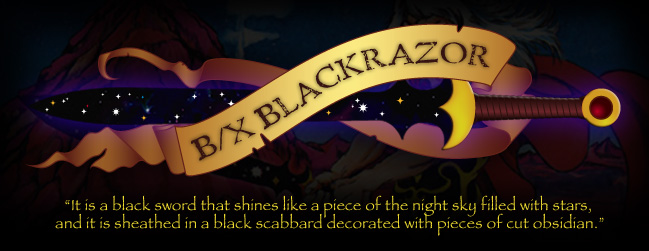
Showing posts with label supplement. Show all posts

Friday, July 23, 2021

Into The Borderlands

Digging through old podcasts, blog posts, and reviews is (for me) a bit like prospecting for precious metals: most of what I find is frustrating (either empty or excruciating tantalization), but on some rare occasions I strike a vein of especially pure gold.

As I type, I'm looking at two products, recently purchased. Both came from "prospecting;" both deal with similar themes, both were "recommended," both were of interest to me. Only one, however, is true gold. The products are Mike's World: The Forsaken Wilderness Beyond and Renegade Crowns: Adventures Among the Border Princes.

I'll spare my readers the suspense: Renegade Crowns is the golden goose.

Mike's World is a cool product/project...an expansion and development of the Borderlands' wilderness from B2: The Keep on the Borderlands. You can read good (positive) reviews of it here and here. It does have some interesting ideas in it, but even so I find it...um...boring? Yeah, kind of boring. 

And the scale is far too small. The area that its 14 maps cover amount to about 100 square miles (11.35 by 8.85). A single adult, male grizzly needs a home range of 200 to 500 square miles...and this thing is stuffed full of dragons and monsters and humanoid tribes and whatnot? And you can walk from the Keep to the farthest reach of the wilderness in half a day? No, sorry...doesn't compute for me.

[just as a comparison of scale, the distance from Richland, WA to Kennewick, WA is 11.2 miles by means of the Riverfront Trail, a distance which can be easily hiked in three and a half hours. Imagine that trail supporting a tribes of kobolds, troglodytes, gnomes, half a dozen displacer beasts, a pair of land-bound green dragons, and a couple storm giants with their score of pet giant crabs. Even in a world where weirdness can be explained as "magic," things still need to eat]

But Mike's World is cheap and its readily available. Renegade Crowns is not. Written for 2nd Edition Warhammer Fantasy in 2006, it's been out-of-print for a while, and print copies on-line are selling for more than $150+ (I saw one copy priced at $405). I was fortunate enough to stumble across a shrinkwrapped copy in my local game shop for $70 last week...the day after hearing about the thing on an old Wandering DMs video. I had them hold it behind the counter for me a couple days before pulling the trigger, and I've spent the last week reading it. It doesn't disappoint.

[Renegade Crowns IS available in PDF form from DriveThru for $15, but I prefer hard copy for reading and reference. The thing also has tiny, eye-straining type, which I can't imagine is especially easy on the oculars when backlit. Maybe I'm wrong]

Now: a few words about Warhammer, before I begin my gushing.

Very Nice
I've owned Warhammer Fantasy Roleplay since it was still published by Games Workshop. I have never "upgraded" to the later editions (Hogshead was originally the same anyway). I find it an enjoyable, entertaining, and inspiring read...I've run a scenario or two (I own the first three tomes of The Enemy Within), but I've never really cared to do a full-blown WFRP campaign. Its combo of grim darkness and humor isn't really the style of game I run (which, surprise-surprise, is more "heroic" and "all-too-serious"). I favor bold adventuring with the possibility of gold and glory, not grim skulking and squalor-survival. 

Also, while I really like many of the system mechanics one finds in WFRP (different schools of magic! critical hit tables! a neat skill system!) the systems in D&D just work better for me. Or for my style of play. Or for the style in which I run my games. Something...I don't know. 

[yes, I've seen Chris Hogan's Small But Vicious Dog. I love it; it's wonderful. But I want PCs to have more potential in my games than what they have in SBVD. D&D is already plenty deadly...let them have the possibility of rising above their God-given station in life!]

The main thing, though, that prevents me from running WFRP is its setting. The Old World...decidedly pseudo-European modeled over maps of Middle Earth...is too densely populated for my campaigns. It's Europe of the Hundred Years' War (plus orcs and chaos mutants) whereas I prefer a wilderness that is far more wilderness. Where PCs are worried about encountering bullywugs and lizard men at river crossings, not money-grubbing ferrymen and toll bridges. I don't want a 15th century version of Tolkien.

Of course, that's a fairly superficial view of the Warhammer's setting (in my defense, having a bunch of adventures and scenarios set in the heart of the Empire doesn't help). If you dig beyond Bretonnia and Kislev and the Reik you'll find it does have its wilderness full of adventure and monsters. Enter the Border Princes.

From WFRP (p. 271):
Unlike the Empire, Bretonnia, or even the Wasteland, the area known as the Border Princes does not form a nation or state, but is rather a loose confederacy of various petty Princedoms. Most Old Worlders think of and refer to the Border Princes in much the same way as they would the Badlands - an amorphous and largely lawless area, cut off from civilization by the Black-Vaults-Apuccini mountain chain. The fight that certain eastern Princes are waging against the Goblin hordes who pour across the Blood River and out from Mad Dog Pass goes virtually unnoticed. 
The Border Princes region covers roughly 750 miles by 300 miles (at its widest point). That's damn near twice as big as my campaign map (a slightly enlarged Washington State)...in other words, nearly an ideal setting size for a campaign. Full of petty kingdoms, small settlements, ancient ruins, and hostile monsters it is an area ripe for adventure. The various "princes" are generally adventurers and bandit chiefs...outlaws, exiles, and opportunists...and their reigns are (usually) short-lived. PCs will find ample opportunity to carve out their own niche realms in such a place...provided they can survive the monsters, politics, and strife. It is the Borderlands...a real "Borderlands" of a kind that might easily find B2's Keep. 

Renegade Crowns is a true tool kit for creating a setting. It offers no maps, no NPCs, no monster lairs. Instead, it offers you a step-by-step process for generating all of these things, including population centers, relationships, and histories. It is extremely well-done and (perhaps because it was written for 2nd edition WFRP) treats its subject rather seriously with a minimal amount of snark. Despite being written for Warhammer, it is easily adaptable to D&D because most of it is "system agnostic." It is just about perfect for creating a Borderlands wilderness from scratch and it can help fill in the blank details of an existing wilderness map as well.

The book can be divided into two sections. The first part is the six-step system for creating your particular section of the region. Using random tables (coupled with common sense) you generate the landscape/geography, the various ruins, the princes of that particular region, the princes relationships with each other, the settlements in the area (including their resources), and the monsters/threats that exist. With nice details and ideas, its elegant system of tables fits into 64 pages(!) followed by a detailed example of generating such a region from the ground up using its system.

While some may scoff at the idea of a randomly generated campaign setting, I find the system as laid out to be eminently sensible. The systematic approach helps organize your world building, and nothing prevents you from stepping in and superseding the roll of the dice with your own ideas...to the contrary, the instructions tell you to do just that. But the book provides you with a systemic approach and appropriate steps with plenty of good ideas. It's the most refreshing resource I've ever seen in this regard.

The second section of the book deals with actually running a campaign in the Border Princes territory, paying specific example to ways and means by which PCs may become princes themselves and what particular problems (internal and external) they'll face if and when running their own principality. This part does not possess various random tables but, rather, scenario ideas, along with the steps and events that have to occur for one to seize (and retain) power. 

Again, it is refreshing stuff: here is a version of the famous D&D "end game" scenario that has players being awarded a barony upon reaching 9th level with some off-the-cuff text about "clearing a wilderness hex." Just what type of wilderness do you intend to "clear?" A swamp? A barren desert? The good land for settlement is almost certainly claimed already...if not by some warlord, then by a semi-organized group of individuals uninterested in being "ruled." Are you going to "clear" them off the land, too? Not exactly an inviting kingdom you're setting up for potential settlers that way!

Raids (from neighbors and monsters), diplomacy, open warfare, and resource development is all discussed in the book, as well as an easy system mechanic for generating "trouble" via adventures. It's provides a simple foundation to build upon (for folks who'd like a bit more complexity), but it's definitely more advanced play than what one usually finds in a fantasy RPG supplement. Extremely thought-provoking, if not outright useful, I'd call it.

The sample Border Princes region given in the book covers an area 132 miles by 100 miles...about the same amount of area as the region the PCs in my campaign are currently exploring (from Banks Lake, i.e. Xak Tsaroth, in the northeast down to Yakima in the southwest). Working with the "real world" as I am, I already have a map sketching out much of the geography (as well as the major settlements)...but that doesn't mean Renegade Crowns is useless to me. Quite the opposite: I can use it to generate areas of control and rulers of these various "city-states" (Wenatchee, Ellensburg, Moses Lake), their relationships to each other, and the available resources and features that make them places of interest to adventurers. My world has an "empire," too (the Red Empire, about 80-100 miles east of the PCs' current location) and the wild west of this region east of the Cascades certainly counts as "Borderlands" in my world. Knowing where the mutant hordes winter and what ancient ruins exist for delving (as well as some of the local "fantasy" history) is incredibly useful stuff. Renegade Crowns makes a nice little content/idea generator in this regard.

Anyway...in case anyone was wondering the reason for my lack of blogging this week, I've been rather engrossed with my new toy. Cheers, folks!
; )

Monday, April 27, 2020

Supplemental Material

Started work on a new OD&D supplement this morning (my personal "Book IV"), mainly because I wanted to capture the new illusionist material. My intention, once completed, is to have a working "campaign Bible" to supplement (ah! That's the word!) my edited version of OD&D. At this point, it is perhaps putting the cart before the horse, considering I haven't yet set down one word of Book II.

[there are a couple reasons for this "hole" in The Work. First off, I haven't really needed the book yet: I own two copies of Book II anyway, and many creatures in my adventures to date have been hand-designed or else adapted from other sources. But mainly, I'm really considering an entire overhaul of Book II's structure, organization, and contents...and I'm still considering the exact paradigm I want to use. Is this supposed to be a book for me? Or a book for anyone? Or a book for players and DMs who want to use my campaign setting? Or what? I *do* eventually want some "bestiary" type book, but I'm not yet sure exactly what it will contain...perhaps every entry will have an "ecology" section while the tables have the necessary short-hand combat info for inclusion in adventure write-ups]

[oh, yeah...I also want to completely overhaul or do away with the treasure tables as designed. I do make use of them - somewhat - for identifying how much treasure a monster tends to have in its lair, but then I tailor each encounter's hoard individually to suit my needs. And while I have been using the included magic items as "templates" and inspiration, I am striving to make each one unique and special, and none of them are being generated via random roll. Figuring out how to rewrite THAT section is a bit of a bear, and I might not even do so, instead simply throwing some hasty notes into an appendix of Book III]

Why throw a PC class like the Illusionist into a supplement? Because I'm not yet ready for the class to be "open" to players (some things shall be "revealed" in time). For a similar reason, gnomes (as I conceive them) will not be added into Book I but, rather, left for the "supplement;" they are my own strange species (call them "svirfneblin lite"). Besides, I can't be adding a race with an illusionist option before I've introduced the illusionist, can I?

The new supplement should also include the Thief class, once I've overhauled the damn thing. Despite his Gord the Rogue writings, I'm starting to get the impression that Gygax disliked the thief concept, and I'm starting to feel the same. However, I continue to feel a lot of love for the assassin as a concept, and a thief baseline is thus a necessary evil. Starting player characters at 3rd level mercifully solves the issue of new assassins having no thief skills, and the idea currently bumping about my noggin is that of assassins as a sort of "prestige class;" that is, there aren't any 1st or 2nd level assassins (at least, not as player characters). Non-human thieves are NOT going to be the "go to" class (caused, I'm sure, by the unrestricted leveling); instead, any such character is going to be some sort of outcast from their society, probably restricted from training or progression in ANY other class.

[might make an exception for half-elves with a wisdom under 13; i.e. half-elves who are unable to progress as clerics. To me, half-elves are the true "jack-of-all-trades" character]

Of course, that would do away with my favorite multi-class combo: the gnome illusionist/assassin. But since gnomes, illusionists, and assassins are all going to be part of the supplemental material, maybe they'll get some sort of exception, too. Or maybe not...phantasmal killer is fine and dandy for any illusionist styling herself an "assassin."

[as is using a phantasmal image to conceal a booby trap, pit, or hidden assailant]

Bards will probably be a similar story (i.e. unavailable except as a single, restricted class). But then why would anyone choose to be a thief if you could get all the abilities - albeit at reduced level - plus magical abilities, bardic charming, an increased (d6) hit dice?

Why indeed.

I am, of course, looking at bards as originally presented by Doug Schwegman in The Strategic Review (volume 2, issue 1). This particular bard had none of the multi-classing madness (even though it would have functioned better and more sensibly in OD&D...). Schwegman's bard is also available to elves, dwarves, and hobbits, unlike the version Gygax gives us in the PHB. While half-elves are not mentioned, I would guess that this is a case of the class being submitted to TSR before the publication of Greyhawk (or before it was read by Schwegman), just as happened with Aronson's illusionist class (requiring his later update in The Dragon #1). Schwegman's class is a bit over-powered...attacks and saves as a cleric, magic-user spells up to 7th level (hmmm...guess he did read Greyhawk), bardic charm and legend lore, double languages, chain armor, and d6 hit dice, plus unrestricted weapon use. Sheesh.

[can you imagine a teleporting bard with the ability to cast delayed blast fireball?]

I see why A) Gygax threw the class into an appendix as an optional class, and B) attempted an update to make the thing playable within the spirit of the original, while preserving some semblance of "balance" (OR, alternatively, making the class as hard to play as possible in order to dissuade its use). I haven't yet got around to my (planned) post on the AD&D bard, but...well, now I've got this OD&D trainwreck to deal with.

[one might ask why bother? Multiple reasons, not the least of which my soft spot for the class after spending the majority of my AD&D career playing bards. Recently, I've been reading the old MZB Lythande stories...part of my research on Thieves World, one of the major inspirations for my campaign setting...and I am considering how such a character might best be modeled in the game. "Bard" would be a fair choice...]

As for other stuff that will be in the Supplement: info on the campaign world, including its geography, cosmology, history, etc. The various deities, the PC races (how and why they interact with each other), major political entities, etc. Probably The Haggard Goat (the tavern/inn that is the PCs' base of operations) and its proprietor, Meredith. Assuming she survives the players' antics.

Yes, there will be rangers as a playable class...but again, they have not yet been introduced to the campaign (they are outside the city my players are currently exploring). Half-orcs...no. This isn't Tolkien. And even in Tolkien, "half-orcs" appear (to my reading) to have been very much a product of magical cross-breeding (a la Saruman), NOT the biological offspring of two distinct species. My orcs are not the "fecund race" of 1st edition. I'm not yet quite sure WHAT they are (my players haven't encountered any); once I figure that out, I'll consider blogging about it. Maybe.

[probably some sort of magically created slave race, engineered in the misty past by decadent, sorcerous elves. Would explain why elves speak their language, as well as the animosity between the two species. In fact, done. That's the short answer to the "orc question"]

Monks? Ummmmmm...haven't decided. Need to run some mock combats between monks of various levels with a variety of opponent types. That's a loooong way off, at this point. Assassins first.

Druids? Yeah, maybe, probably. This isn't really a foresty setting (as currently conceived). Mostly sand and scrub and swamp and sea...the four S's of environments (also snow and subterranean...six S's, I guess). My original intention was to include them as a character class (the "neutral cleric" option), but I kind of like the neutral clerics I've already added to the game. Nothing in OD&D prevents a player from playing a "neutral" cleric; they're simply limited to 6th level of experience (i.e. no 5th level spells). This has allowed me to add multiple "minor (i.e. neutral) deities" to my world along with perfectly competent clerics that have no ability to raise dead, commune, or create food (they still have the potential to turn any of the undead types). Adding the druid diminishes the impact and utility of such characters...why go to a lesser cleric when one can find a druid? Mainly, however, it's more of a setting/environment thing. I'm not sure yet how many bears and beasts are going to be in the setting. Still developing.

Anyway. Huh. I sat down to blog about elves this morning and I got completely distracted with my own thoughts and ideas. And I didn't even talk much about the campaign, just thoughts on what's going into the supplemental material. *sigh*

Apologies folks. More later.


Friday, May 22, 2015

KLOANE WAR KNIGHTS - Intro

KLOANE WAR KNIGHTS

Created for and compatible with Dave Bezio’s X-Plorers™ under the X-Plorers Trademark License.

INTRODUCTION

Welcome to KLOANE WAR KNIGHTS, a game supplement for use with Dave Bezio’s X-PLORERS™ role-playing game. This supplement is not a “stand alone” game product; you will need a copy of the X-Plorers RPG to play in the setting presented here. You should be able to acquire a copy from your local game shop; you can also purchase it on-line from Brave Halfling Publishing and its distributors.

Like the basic setting found in X-Plorers, Kloane War Knights is designed to help players experience games of interplanetary adventure. Unlike the basic setting of Mr. Bezio’s book, Kloane War Knights (hereafter abbreviated KWN) takes place far away, in a galaxy very different from our own real world solar system. It is heavily influenced by literature of the space opera genre, especially those that feature swashbuckling action, interplanetary conflict, and psychic heroes, like the Lensmen books of E.E. “Doc” Smith. In addition, the author grew up watching the films of George Lucas, and the visual impressions left by them have undoubtedly colored the “look” of space opera in his mind’s eye. The author gratefully acknowledges a debt to both these sources, in addition to the many other authors and filmmakers of the space opera genre, all of which have provided some measure of influence and entertainment over the years.

Experienced gamers may wonder why bother with yet another hyper-warping, space opera RPG when so many other games have been created for the setting over the years. The answer lies in the simple elegance of the X-Plorers game, a system easy enough to pick up and play quickly with very little effort or learning curve, providing the necessary mechanics to facilitate play without “bogging down” in hundreds of pages of rules minutia. Character generation is fast and requires little forethought compared to other “rules light” systems, yet remains open enough to add extra “color” should a player desire. The author’s objective is to maximize actual play with minimal effort; Kloane War Knights simply develops and expands Mr. Bezio’s basic system with a few additional rules based around a fantasy space opera setting in a fictional galaxy filled with weird aliens, dark empires, and strange psychic powers.

Hopefully you’ll enjoy playing as much as the author (me) enjoyed writing it.

KLOANE WAR KNIGHTS: THE SETTING

Another time and another galaxy, a long way from here…

The GALACTIC REPUBLIC has stood for untold millennia, indisputable evidence of the ability of sentient species to coexist despite being spawned from more than a million divergent evolutionary tracks on nearly as many worlds.

That they have managed to do so in relative peace and harmony is an even greater accomplishment and a testament to the STAR KNIGHTS, galactic peacekeepers acting to protect the peoples of the galaxy while upholding order and justice. The Star Knights have served the Republic for more than a thousand generations, and though few in number they are well known throughout the galaxy for their loyalty and dedication. Their psychic training in the use of the STAR FORCE gives them access to powers beyond the ken of ordinary beings.

Now, a new enemy has appeared on the horizon. The KLOANE EMPIRE, a star-faring race from another galaxy, has invaded Republic space bent on conquest. Technologically advanced and utterly ruthless, the Kloane army is vast...far greater in number than the standing forces available to the Galactic Republic. With huge space dreadnoughts and legions of armor-clad troops, the imperials wage war across the galaxy.

And yet the Republic armies are bolstered by the might of the Star Knights, a power against which few foes can dare to stand. To counter the heroic Knights, the Kloanes have made dark alliance with the SHADOW LORDS: corrupt psychics, adept at using the Star Force for selfish and evil ends. The Shadow Lords have long been the bane of the Star Knights; many were once Star Knights themselves, but abandoned the calling in their lust for power. Though fewer in number than the Star Knights, the true danger these sorcerers present is their seductive lure of corruption, hoping to draw more Knights to their banner.  

This is the galactic struggle in which you will heroically take part!

USING THIS BOOK

This supplement provides an alternative setting for the X-Plorers role-playing game, namely the Kloane War conflict in a fictional galaxy “far, far away.” Many of the rules in this book differ from those in the original X-Plorers rulebook; in general, this is done in order to better integrate the original rules with the unique setting presented in KWN. You are free to disregard these changes and use the original rules, but doing so may change game play in a way different from that intended by the author.

Regardless of rule changes, you will still need a copy of Dave Bezio’s X-Plorers to use KWN…in many sections the rules have NOT changed, and this book will not include information that can be found in the original game. Whenever possible, the author will try to keep to the same Chapter organization as found in X-Plorers.

One of the main changes in KWN is with regard to psychic abilities and how they function. If playing KWN, all information in Chapter Y of Mr. Bezio’s book should be completely disregarded; it is fully replaced by the rules presented here. All characters in KWN are presumed to be heroic Star Knights and will thus have some measure of psychic training; however, this will be detailed in Chapter 1: Character Creation.

As with X-Plorers, KWN uses both the D20 and the D6. It also uses the D8 and (sometimes) the D4; however, for the latter you can simply roll an eight-sided die and divide the result by two (round up) to achieve a number from one to four.


[to be continued]


[Kloane War Knights is copyright 2013 by Jonathan Becker and Running Beagle Games. The X-Plorers rpg is copyright 2009, Dave Bezio & Grey Area Games. The X-Plorers trademark is used under the X-Plorers Trademark License]


Tuesday, May 19, 2015

B/X Cosmonaut

Finally feeling almost normal again after accidentally (and stupidly) poisoning myself with an overdose of mineral iron yesterday. This is what happens when a person who doesn't normally eat more than his usual, regular allowance spends the day eating dried apricots and almonds by the handful and then mistakenly takes one of his wife's prenatal multivitamins: stomach cramps, the shakes, and loss of circulation/feeling in Ye Old Extremities. It doesn't help that my liver is already in fairly rough shape.

Ugh...that kept me from posting more (or doing much of anything) last night. But I'm better today, and I wanted to post about ANOTHER sci-fi game based on an old D&D chassis: Michael Gibbons's B/X Cosmonaut.

Weird enough for ya'?
Gibbons is an artist (you can check out his weird and wooly web-comic, Cosmic Tales, here) who also writes the blog Metal Earth. B/X Cosmonaut is a free, illustrated, 6-page PDF that introduces a character and campaign concept for use in the B/X game. No, it's not a complete game...it's a game kernel, and one that holds a lot of potential for a full-on campaign (either long-term or short-run). The idea of the Xlathar and their hive ships (quite possibly populated by all sorts of genetic monstrosities and artificial perils...i.e. "monsters" and "traps") provides a very workable way of doing "D&D in space." It just needs to be fleshed out a bit more.

The super-soldier "cosmonaut" idea isn't a bad one at all...I'd just like to see some ways to distinguish the characters other than equipment selection (which would appear to be the only method of differentiation). A selection of specializations or some type of talent/trait/feat development over time (like every couple levels) would go a long way towards adding variety to a party of cosmonauts.

Though I suppose a cosmonaut that crashes down on some sort of "primitive world of magic" could partner up with normal elves and clerics and whatnot. Such a game might be reminiscent of SnarfQuest.

Anyway, it's short and worth checking out. It's a nice, original piece of work with pretty drawings and the kind of thing that spurs the imagination. Well, my imagination anyway.
: )

Oh, yeah...the link for the download (on the blog) is here; the actual MediaFire file is here.

Monday, October 20, 2014

Revisiting Variable Weapon Damage

Let's see...where was I? Oh, yeah...basic weapons.

[I suppose I should extend a congrats to the St. Louis Skaven this week...those tricksy, tricksy rats. Congrats. I was smart enough to only have a couple Fullers on hand this weekend so as not to get too tossed. Ugh...]

Taking a look at the Moldvay list, I find that I want to talk about variable weapon damage. Back in 2009, while working on my B/X Companion, I thought it would be a great idea to vary weapon damage by character class instead of by weapon (an option I included in the book), in order to allow PCs of any flavor to use whatever gear best suited their personal taste. Over 18 months later, after many actual games of awesome B/X play I came to the conclusion that I really preferred straight, Rules As Written, D6 damage for ALL weapons (with minor bonuses for two-handed weapons). I wrote why here, and have been using some variation of "standard D6 damage" ever since.

However, with some evolving ideas I have regarding the nature of hit points, I'm starting to reconsider my stance. Yes, it's easy (for me) to roll D6s when it comes to damage...but then, I've been working on getting rid of damage rolls, anyway. With that in mind, does a six point range of damage make sense?

So we come to that wonderful unit of measure, the hit die, and what it represents. Simply put it is a measure of attacking power, equal to one human scale soldier.

The ashcan that started it all.
There are no "hit dice" in Chainmail; at least, the explicit term is not used. The number of dice rolled for attack (and the target number needed to "kill") depends on what type of troop attacking and the type of troop being attacked. Hit dice, as explained in the second book of OD&D (Monsters & Magic) is described in terms of the default combat system (Chainmail, remember?) so that an ogre (with 4+1 HD) would roll 4 times, attacking the same as 4 men, and requiring the equivalent of 4 wounds (four successful attack rolls) to kill. The +1 gives the ogre a +1 on one of these attack rolls and +1 to the number of "hits" (i.e. HPs) possessed.

Again, these attack dice are not as straightforward as they might appear, as they depend on the type of troop being attacked to figure their relative value. Chainmail is explicit that an ogre fights as "heavy foot." With 4 HD, these attack dice look like the following against various defenders:

vs. Light Foot: roll 4d6, any 5+ kills.
vs. Heavy Foot: roll 4d6, any 6 kills.
vs. Armored Foot; Light Horse: roll 2d6, any 6 kills.
vs. Medium/Heavy Horse: roll d6, any 6 kills.

[remember, the ogre receives a +1 bonus on one die roll, so (for example) really only needs to roll a 5+ against a medium or heavy horseman]

Using OD&D's alternative combat system (the D20 system in place with every edition since, and which is the base for D20 in general), hit dice transforms to a probability of inflicting damage within one round of combat, and a measure of vitality (HPs) for a creature, each HD being equivalent to a single fighting man...the latter being made clear with the advent of Supplement I (Greyhawk) when both fighters and monsters were awarded D8 hit points per HD (and non-martial adventurers/humans being awarded fewer).

Here in Greyhawk we see the first "variable damage by weapon" chart, which is generally adapted in Moldvay. The only differences found (at least where the weapons on the two lists match) are the pole arm whose D8 damage in OD&D increases to D10 damage in B/X (matching the missing "halberd" damage type), and the spear which, in OD&D, has 3 different damage ranges depending on how it is used. Both sword and battle axe are given D8 damage...though note that a battle axe does not carry the "two-handed only" restriction found in B/X.

Just for review, here's how the variable damage types break down (in B/X, which contains a better "dungeoneering weapon list"):

D4 damage: torch, dagger, sling stone ("rock"), club ("stick")
D6 damage: arrow/quarrel, hand axe, mace/hammer, spear, "short sword"
D8 damage: battle axe, "normal sword"
D10 damage: pole arm, two-handed sword

The more I stare at this list, the more sense it starts to make for me...but only with a changing idea of what hit points are.

See, before I was looking at the D6 damage thing in light of the idea that all normal humans have D4 hit points...a range of 1 to 4. But this isn't entirely accurate. A human being in B/X (or OD&D + supplements) has a HP range of 1 to 8 (with a single hit die); however, most humans encountered aren't "worthies" sporting more than four. Allow me to break it down (a little different from my D6 post):

  • 1 hit point: an individual on death's door. Any damage will slay this person. True invalids, babies, people without the will or strength to stand on their own. Such individuals may take no action in combat, save to crawl around on the floor.
  • 2 hit points: small children or the elderly. People with diminished capacity, suffering from severe illness, or wounds. Such an individual might survive a weapon wound...if they're very lucky. Such individuals suffer a -2 penalty to attack rolls in combat.
  • 3 hit points: a "deficient" person...someone who's out of shape, lacks energy/vitality or a "will to live," but who is otherwise capable of normal (if weak) human action.
  • 4 hit points: a normal person in full health.
  • 5 hit points: a normal person in full health but one who is exceedingly healthy/strong in body OR incredibly strong-willed and spirited (able to fight through pain/illness, etc.).
  • 6 hit points: a normal person in full health who is both exceedingly strong in body AND in willpower/spirit.

To this range of 1 through 6 use the following adjustment:

  • If a character has had formal fight training (professional soldiers, noblemen, etc.) add +2 hit points.

This gives us the full range of 1 to 8.

This is what I'm currently using, by the way, to calculate HPs for creatures of all shapes and sizes (and by reverse applying these principles, for finding out what kind of monster is encountered based on the average number of HPs per HD the thing has). A normal "orc soldier" would have 6 hit points, for example...an exceptionally strong or cunning one would have 7, while a leader type with both size and an iron will would have the full 8 hit points. A soldier "past his prime" (perhaps retired based on injury in battle) would still have 5 hit points (3 HP category + 2) while even an elderly chap (if he can carry a sword) would still have 4 hit points.

12 to 14 HPs
This is per hit die, you understand. The aged gnoll warrior would have 8 HPs (2 HD at four each) compared to average adult warrior, who'd have 12 (6 per die). If they were hardened veterans, they'd have 14 apiece, while elite types (the chief's bodyguards and such) would have 16. A gnoll child would be pretty tough (4 hit points), but would not fight as well as a human warrior (-2 penalty to attack rolls, reducing Base Attack Bonus to +0).

OKAY...having given you an overview of this "HD reinterpretation," let's look at the weapons and their damage maximums.

First, change the term "short sword" for one-handed sword, and "normal sword" for longsword. Then consider the following:

  1. Remember that damage range is based on "roll over" attack number and so die type (in this case) equals "maximum rollover" (i.e. maximum damage).
  2. Battle-axes and longswords (both with a maximum length of c. 4') can be used one or two-handed.
  3. When used two-handed (and only when used two-handed) these weapons bump their maximum damage from 6 to 8.
  4. True "two-handed" weapons (zwiehanders and pole arms) have additional penalties when used within the close confines of a dungeon environment (even in a wide chamber, you're often dealing with a low ceiling, precluding the full range of motion...poleaxes and two-handed swords inflict their greatest damage when being swung downwards on an opponent). Personally, I would probably model this with a -2 penalty to both attack and maximum damage...but in an open space/chamber, these weapons could prove devastating).

Here we see the damage range of all weapons is enough to slay an adult human at least 50% of the time with anything bigger than a dagger, stick, or rock (these "lesser" weapons can still inflict death on a healthy adult person with a perfect strike of "4 over"). A perfect blow with a one-handed weapon will slay even a trained warrior ("6 over") and a perfect strike from a two-handed weapon will slay even an elite fighting man ("8 over").

The "Big Boys" (two-handed swords and pole arms) have the potential to deliver significant "over-damage," but rather than giving them a ten point damage range, this might be better modeled by having them decrease the effectiveness of armor by 2 (a +2 bonus to attack individuals wearing armor) and leaving their maximum damage at 8. Remember, wearing armor not only makes it more difficult for your opponent to inflict damage but reduces your opponent's ability to inflict significant damage (because the "roll over" target is higher). A +2 bonus to attack armor reduces armor's effectiveness, and increases the chance of doing good (i.e. "killing") damage.

Okay, that's about it for this series...though there might be a slight addendum tomorrow.

Thursday, October 16, 2014

No Such Thing As "Normal" (Part 1)

Much as I'd like to get sidetracked by a couple different subjects (specifically, "Changing Gamer Culture" and "Wandering Monsters"), I'm going to get back to my series on basic (D&D) weapons because...well, because I said I was going to, darn it! Jeez. One thing at a time, JB!

Now I wrote before that, up through Holmes Basic (i.e. prior to 1st edition AD&D) the weapons available to a D&D player character were the exact ones found in the Man-to-Man combat section of Chainmail. That wasn't entirely accurate, however, as Supplement I (Greyhawk) added a couple additions to the "standard starting thirteen," specifically the military pick and dwarves hammer which, considering my thoughts on hammers, makes perfect sense. The military pick and war hammer are pretty much the same weapon and as I describe them, fall into the same basic section as the mace. Gygax echoes this sentiment by keeping the same 12 step order (as from Chainmail) and lumping both these weapons in the same slot as the Mace (before Sword, after Hand Axe); he likewise gives them the same damage range.

I had not bothered to review Greyhawk prior to my first couple posts in this series, and so I was happily surprised to find Gygax had considered some of the same things I had and was not quite the blithering idiot he's been made out to be be. Here we find some ideas about what "space required" (from the PHB) actually means: for a flail, halberd, or two-handed sword the weapon require "not less  than 6' of space on each side of the wielder" to use the weapon effectively (meaning such a weapon cannot be effectively used in a 10' wide corridor). Morning stars (the one-handed flail) require 5' on either side and battle axes require 4'. And check this kicker...pole arms and pikes?
"These weapons are not usable in dungeons as a general rule due to length."
Ha! Makes you wonder why gnolls (who are "subterranean 85% of the time," per the Monster Manual) have 35% of their soldiers carrying pole arms.

[okay, maybe Gary was a little idiotic at times]

ANYway...

The Moldvay version of Basic cleans up the weapons list, reducing it to "dungeon-worthy" gear and re-organizing it not by length (as such doesn't matter to the basic rules) but by weapon type. Specifically by five weapon types: axes, bows, daggers, swords, and "other." The bows section (which I realize I haven't to this point discussed in the series) is cut down to the short, long, and cross- varieties, leaving out the heavy crossbow and composite bow found in earlier editions. Axes and daggers remain the same weapons found earlier (though with the addition of the "silver dagger," its first mention in any version of D&D). "Other" lumps in the mace, hammer, pole arm, and spear, as well as two new weapons: the club and the sling. The cleric never had it so good.

[actually, the sling was introduced with the 1E PHB. However, I'd contend that part of Moldvay's objective here was to provide a number of options for all class types...hence the silver dagger (for magic-users with too much gold in the bank) and a plethora of blunt (cleric) options]

Flails and morning stars were dropped from the list; likewise halberds and pikes (unless they were subsumed into "pole arms" and "spears"). It's in the sword category however that we find what may be my one (main) gripe about the Moldvay's list:

Short Sword
Sword (normal)
Two-Handed Sword

"This is a really big sword."
The two-handed sword, what the Germans call a zweihander (hey, zwei is German for "two!"), has been around since Chainmail and has been a mainstay of D&D editions until 3rd edition when it was replaced by something called a "greatsword" which, as far as I can tell is a term first used by Michael Moorcock in his Elric books (at least the term "greatsword" is found as in the Stormbringer RPG as early as the 1st edition, 1981), though it is the literal translation of claymore, the two-handed weapon of Scottish highland fame. For swords, two-handers are heavy (5-7 pounds), long (5'-6'+), and carried like a pole arm...over the shoulder and without scabbard. Aside from various movies featuring guys in kilts, Verhoeven's 1985 film Flesh and Blood has an excellent depiction of a typical zwiehander in the hands of a Landsknecht merc (played by a young Rutget Hauer, ladies!).

I've got no problem with the two-hander as an adventurer's weapon...so long as one accounts for the pole arm-like space requirements needed to wield the thing. It's the other entries on Moldvay's sword list that I dislike.

But this post is getting pretty long, so I'm going to have to break it up into two parts...sorry, folks.

[to be continued]

Monday, March 18, 2013

Tarnhelm's Terrible Tome


Just finished reading Tarnhelm's Terrible Tome, a book I'd consider to be the latest entry into the phenomenon I call D&D Mine.

Nice work.

You can download Tarnhelm's Terrible Tome for free from Retro's blog here. Randall Stukey (the author) has presented a nice little 40 page book with his personal house rules for 0E. Similar to Planet of Eris, you'll still need a copy of the LBBs to play D&D using TTT...and would, in fact, appear to need some extra books, too (like the supplements detailing higher level spells and later classes and subclasses). But regardless of whether or not you have access to those things, there's plenty to peruse and (possibly) purloin for your own games...even B/X and LL.

Stukey's approach to D&D is much more fantastic then my own, what some might call "high fantasy"...though I use that term with some hesitancy as (for me) it has derogatory connotations and Stukey's handling is much more classy. Some of the ideas in his book that I'd call highlights include the following:

- the craft (and use) of magic implements. Whereas I have kicked "magic wands" to the curb in my book, Stukey revels in them. Of course, they have to be hand-crafted by the mage (if you want one), but you don't have to wait till 9th level to do so and afterwards you gain bonuses to your spell-casting when using such implements.

- minor magic that's always on contributes to the "high fantasy;" magicians ability to do minor conjurings (or throw "magic darts" which here doesn't feel nearly as crappy as, say, 4th edition) makes the character class a joy to play from level one, while still providing room for "power ramp-up."

- Stukey's handling of clerics...again, he went a different route from myself where, instead of making them more different from magicians, he made them more similar, right down to carrying "prayer books" with their magical spells (clerics use their holy symbols the same way magicians use their wands). It's tidy...we're simply looking at two different schools of magic...or two philosophies...that still operate under the same principle. That's all to the good if you want a more magical campaign setting.

- I see he went the same direction as myself with regard to armor (in the sense of light, heavy, etc...this is a separate blog post that I'm planning for the immediate future). The class bonus to AC is nice, as are the spell-casting penalties...magicians lose their highest castable spell level with light armor, highest two with medium armor, etc. This means that a 1st level mage has too much to deal with (mentally) to wear ANY type of armor and still cast spells, while a high-level sorcerer can wear plate and mail and still toss off fireballs without batting an eye. That's pretty hip (though now that I reread it, I see this is an "optional" rule...isn't everything in this book kind of optional?)

- I like the combat maneuvers based off critical hits and misses. Simple and effective.

- I liked the divine intervention rules (though again, this is only an "optional" rule): not only does it make the game more "magical" in feeling (the gods are among us!) it provides a decent mechanic for getting players out of trouble, while forcing them to sacrifice goods for the privilege. No more must the DM send thieves to steal that +5 sword...just put the PCs in a death trap and make them break it themselves! Ha! No, in all seriousness...sacrifice to the gods is a GOOD thing to have in a fantasy game (it's very much a part of our own ancient and mythological past)...and adding mechanics to encourage its use is the best way to make it a part of your game. I also like that lesser gods and demigods are MORE likely to intervene (their attention is less divided) than greater powers.

- I think I like his character "background" rules as written better than the DMG secondary skills...or even his own "skill system."

Anyhoo, Tarnhelm's is not a book I'd choose to adopt wholesale for myself (a lot of the bits are just too fiddly for my taste...why not simply substitute CON for "body points," for example?). But it has good ideas and it's a nice example of what people should be doing: making their own "Gaming Bibles" for use at the table. This one's nice, clear and concise...and illustrated to boot. Not a bad free offering to the discussion.

Now, if you'll excuse me, I'll be getting back to writing my own version of D&D Mine.
: )