Showing posts with label vampire. Show all posts

Friday, October 22, 2021

Clallam

A little Friday action that I wasn't expecting to do. What do ya' know: I got a good night's sleep for a change (about eight hours) rather than waking up between 2am and 4am as has been happening the last week or two.

[stress affects everyone different]

Have spent most of my "free" hours the last couple days researching Clallam county, Washington...specifically the geography and history around Port Angeles, which I intend as the site of my "new Ravenloft." Lot of good stuff there, though I will probably end up filing the serial numbers off (or, at least, slightly modifying) many of the proper names. I don't generally bother doing this in my actual "home campaign" but when publishing for others, I don't want to run the risk of offending (for example) the indigenous people of the region who will be taking the place of Ravenloft's menacing gypsies.

Just picture a castle
overlooking the sea...
The more I dig into it, the more I am really enjoying the creation process. My father was born and raised in Port Angeles, his siblings and most of my relatives on that side of the family still live thereabouts. We used to visit the Peninsula once or twice a year when I was a kid, and there's something about the region that still calls to me...the grey, wet, windswept coast, the high bluffs, the dense forests looming over the highways. 

I don't get the opportunity to get out there as much these days (doesn't help the relatives are all estranged, each for a different reason), though we did get out there a couple times over the summer. West of Sequim, it really doesn't appear that much has changed the last 40 years...which is yet another reason the area is GREAT to replace "Barovia." Probably The Wreck Tavern (once owned and operated by my grandfather) is still out there...though I wonder if my uncle is still running it.

Of course, it's not lost on me that Forks, Washington is in county Clallam...I have a second (third?) cousin that lived in Forks and what I heard about the town wasn't...mmm..."complimentary." But that was back in the 20th century (maybe the tourist trade drummed up by the Twilight trade has spruced it up?). Regardless, my population totals and distribution are based on the 1880s and Forks was just a dairy farm in the middle of the woods back then...that's not going to be the site of a castle and town. No vampires out that way in MY world. Werewolves, maybe. Lots of werewolves.

Working on the "math" of the Ravenloft encounters, I become more and more convinced (if I wasn't already) that this was originally designed as a LOW LEVEL adventure...probably for characters levels 3rd to 5th. Run in the B/X system, nearly every encounter circles around 4 hit dice. The "iron golems" in area K78? I'm just substituting Moldvay's Living Statues, Iron (page B37) for the pair. They are *ahem* also four HD creatures. 

The real stinker of an encounter are the four small red dragons, who should absolutely destroy ANY party because of their breath weapons (18 hit points each x four = 36-72 automatic damage, depending on saves). It should probably be viewed more as yet another railroad plot-block (like the mist that auto-kills PCs leaving the town) since they only attack parties trying to leave the castle (*sigh*). Interesting that dividing those little dragons' 18 hit points by 4.5 would give you 4 hit dice. Hmmm...

Even the new "Strahd zombies:" four hit dice. For me, there's no reason to do this: the "severed body part" thing is cool, but it's just color, and one can simply double the number of zombies encountered. What's the problem with normal zombies? Is it just the need to have them "turn as mummies" (in order to FORCE PCs to fight them and thus experience the cool color of severed zombie parts attacking?)? Um...no, that's not necessary. Even the auto-destroy of a 5th level cleric (assuming I'm reworking this for levels 3-5) only affects 2d6 hit dice of zombies.  Make sure there's enough left over (on average) that a few will need to be dispatched in the usual (sword-swinging) fashion. No nerf, everyone wins.

Converting the giant spiders to B/X is a little tricky because (surprise!) the monster is more specific in Moldvay than the abstract version found in the MM. Fortunately, black widow spiders are native to Washington State, so putting giant ones (3 HD, but deadly poison) in Clallam county makes perfect sense.

SO...things are coming together. I *do* want to add a flesh golem to the monster list (because for the horror trifecta there's that need to reference Frankenstein) but the monster as written for AD&D is a little too tough for that 3rd-5th level range in B/X. Dropping it's damage to 2d6 per punch makes it better (though the special defenses are rough) and I'll probably go with that. But then, should I be adding a mummy? A creature from the Black Lagoon? Where does the madness end? 

[probably with the coven of witches in the upper tower]

Nah...it's all fun stuff. My vampire is a countess, not a count. The werewolf in the dungeon is a 5 HD pack leader, desperate to get back to his people. The flesh golem is kind of a Ser Robert Strong bodyguard type, though I haven't decided if he is a former husband, lover, or son (or sons) of the countess. The zombies make for cheap servants and soldiers that don't ask questions about the castle's goings ons. And the people of the town, far from being terrorized by their ruler (and needing to be saved) are in on the secret, feeding outsiders to their monstrous liege lord in exchange for being left in relative peace. 

It's fun. I like it. And (for whatever reason) it feels very Port Angeles to me.

[a quote from my father: when asked why Port Angeles has the...um..."issues" that it does, he responded "Well, what I've observed from most small towns I've visited (in the USA), people are pretty big into their religion. But folks out in Port Angeles, well, they never really took to religion." Personally, I always suspected it might have a little something to do with being a town full of sailors, but whatever. For my purposes, it's vampire country]

All right, that's it. Hope everyone has a great weekend.

Monday, June 7, 2021

Ravenloft Numbers

Man, this D&D subject...always something to write about, huh?

I've been continuing my examination of the I6: Ravenloft module the last few days, even checking out a little bit of its sequel I10 (which is a terrible hash of an adventure...oh my goodness!). Talk about "going back to the well," Ravenloft must have sold an awful lot of copies (and/or received a ton of fan mail) to necessitate that particular publication. I shan't be discussing it any time soon, but I think it's interesting to note that it includes pregenerated player characters for use in both modules (including one whose secondary weapon is a normal longsword), and that some...mmm..."liberties" have been taken with the AD&D rules when it comes to their construction. 

One of the reasons I continue to poke at this thing, is that I'd LIKE to have a fun "vampire adventure" to throw at my players, and Ravenloft is more than halfway there. A while back (like years back...around the time I finished my first book) I had this idea to write a vampire adventure module of my own, somewhat modeled after Palace of the Vampire Queen, but I never got around to it...and the thought of re-purposing Ravenloft honestly never entered my mind. Now, though...well, there's grist here to work with. 

So...let's talk some numbers with regard to tackling Ravenloft as a monster hunt.

I'll admit that when I read through the adventure before, I glossed over a lot of the "getting there" part of the module, instead focusing on the dungeon (castle) proper. It's mostly box text anyway, and I don't really "do" box text these days...I don't even read it when looking at an adventure even (since I'm not planning on reading it when running), unless it's necessary to explain just what the heck an encounter area IS (there's a lot of this issue in the Dragonlance modules). It's...straightforward enough, if full of typos and inconsistencies. We are told the mayor has been dead ten days, then (in the same paragraph) we're told he's been dead "nearly a week." Sometimes the gypsies are listed with 4 hit dice, sometimes 5, sometimes 6 with no explanation. Ability scores are dropped altogether from NPCs. Just some glaring errors...not sure who "Curtis Smith" is, but he wasn't much of an editor.

But I'm getting side tracked again (per usual). As an adventure hook, it's not a terrible lure of the "false pretense variety." Promises of obscene wealth is actually better than usual (certainly better than the "we have nothing to offer you please help us out of the goodness of your hearts" story found in adventures like N2: The Forest Oracle). 'Oh, look, we can do a good deed AND get paid.' Simultaneously play to the party's compassion (or desire for fantasy heroism) and greed. Problem is, once they find out about the false pretenses, it becomes apparent why the magical poison mist is needed to keep the party in place (because otherwise, they'd just blow off the joint). And while that might work to incentivize a vengeful group of players into launching a raid on Strahd's castle, the adventure is designed to be a spooky/scary mood piece with creepy narration and jack-in-the-box scares. What we want (well, what I would want) is an adventure that draws players to it like moths to a flame...and then creeps them out along the way. Thus heightening the player tension, despite their incentive to press on. Also, it'd be nice to make them sweat a bit.

All that means juggling the risk-reward factor of the thing. Now for D&D players of all stripes, vampires should strike some fear into their hearts. In going over this module, I constantly struggle with NOT trying to tinker with the vampire monster as written in the MM...the urge to "improve" the thing (making it more sensible or more in-line with a particular movie version of Dracula) is immense. And it's totally unnecessary: the D&D vampire is its "own thing" and works just fine as written for putting the fear of the God into players (with good reason! They're vicious!). At the same time, they have some solid weaknesses that a prepared party can exploit...which can make the risk seem low enough to attempt bearding such a beast, given a reward that is high enough.

Does a hundred and fifty thousand gold pieces worth of treasure PLUS ownership of a dilapidated castle sound like a decent enough reward? For a party of 3rd to 5th level characters? Especially if it was known that the current owner was a powerful sorcerer with a decent-sized spell book (AD&D magic-users are always looking to add to their spell lists, right?)...yeah, it sounds pretty hefty. It's not really (for reasons related to castle ownership), but it's still a tasty hook for players to bite on. So what's the risk?

Sunrise in Transylvania on October 31st (a good enough place/date as any) is at 7:21am. Sunset the same day (and same location) is 6:15pm. That gives players a nearly eleven hour window of time in which to hunt up Strahd's coffin and kill him in the traditional fashion (stake through the heart, etc., etc.). All well and good...except  that PCs aren't going to be camped outside the gates, ready to break in at first light of dawn. I mean, they could be...if they don't mind being food for the immortals.

The village of Barovia is about one-third of a mile from Castle Ravenloft...if, like Strahd, you can fly. Otherwise, the road is from the village to the castle gates is 2.7 miles long. A horse with a rider can trot/canter about 8 miles in an hour, which puts Strahd's stronghold about 20 minutes away by horse. Assuming a party is really on the ball, they can probably be up, saddled and ready to go within 10-15 minutes of sunrise (since it only takes Strahd six minutes to fly home from the village...three when mounted on his nightmare...smart adventurers won't want to poke their heads out till first light of day). That means the earliest PCs can expect to get to the mountain stronghold is 7:50am, with 8am being more likely...if they are as expedient as possible, working like a well-oiled machine.

Let's assume they are pretty good and are thus able to arrive by 8 (there are always delays). The party will (hopefully) want to give themselves some time to get back to the safety of the village, just in case they aren't able to locate the vampire lord's coffin. 5:50pm would be a good mark to exit the castle, giving the adventurers a full 25 minutes to get back to Barovia, get the horses unsaddled, and get under cover (i.e. into a house that the vampires can't enter). Such speed will only be possible, of course, if the party brings along one or two henchfolk to hold/guard the horses (while they explore the castle interior), and make them ready for departure (upon their swift exit).

8am to 5:50pm is nine hours and fifty minutes...the equivalent of 59 turns for exploration. Ten torches worth of time (or two and a half flasks of lantern oil). That is all the time the party has to locate Strahd's tomb and end him. 

Every thirty minutes they are inside the castle, they have a 2 in 6 chance of facing a wandering monster. On average, they can expect to face 20 encounters. Each encounter will cost them one turn of exploration time. With only 39 turns to work with, a conservative group of adventurers will leave themselves at least half the allotted time to return to the front door (20 turns). 19 turns of movement to penetrate into the heart of Strahd's lair, where the monster lies sleeping.

As one might expect, Strahd's coffin is [SPOILER!] located in the castle's crypt. There are only two entrances into the crypt area, unless characters have the ability to assume gaseous form (like Strahd) or have thought to bring pickaxes for tunneling through a masonry wall and thirty feet of rubble. Assuming such isn't the case, the shortest distance to travel is 770' from the front door of the castle. It involves avoiding two traps (neither of which is deadly, but both of which will derail the party's exploration), a secret door, an encounter with a crazy (human) servant, a fight with a shadow demon that automatically attacks, and a puzzle involving two iron golems which might also result in combat. If the party wears no armor heavier than chain (9" movement) the distance could be covered in nine turns...plus three turns of searching (assuming success) for secret doors and traps, and another three turns to deal with other encounters. Finding the entrance to Strahd's specific tomb is no easy feat (there are 40 possible crypts to open), but the party will have 40 extra minutes to search.

The second method of entering Strahd's tomb is 980' from the front door, and includes a 390' drop down a smooth stone shaft. So long as the party brought 60 pounds of good rope, this might be the "easiest," most viable and most obvious means of entry. At only 11 turns, it leaves them a bit over an hour to locate the correct tomb in the crypt (assuming the same movement rate as above), but returning the way they came (a nearly 400' rope ascent?!) may take longer than the initial entry time, depending on the generosity of the DM. Doubling the time to descend (43 minutes) would make it a nine turn climb.

None of which is accounting for mandatory rest breaks; parties "should be required to rest one turn in six" (per the DMG; bottom of p.38). Unlike B/X, AD&D does not provide specific penalties for fatigue...but then it doesn't say DMs must give PCs an option regarding rest. Knock one turn off the trap/secret way in, or two turns off the rope climb method. That would STILL leave enough time for a well-organized, well-prepared party to make a deep foray into Castle Ravenloft and stake Strahd while he sleeps. A party with any way to spy out his location and map a route ahead of time (via a crystal ball, scroll with wizard eye, etc.) would be able to execute a true surgical strike with minimal losses, even at low level...depending on how well they deal with the wandering monster encounters.

Of course, Strahd isn't the only vampire on the premises. There are both two "brides" (one located in the crypts, one acting as...a maid?!) and the possibility of encountering 1d4 on the wandering monster tables ("hapless past victims" of Strahd). All of these should be half-strength vampires (per the DMG, page 119), but presumably the death of the Count would launch them into a feeding frenzy, as they drained the other living inhabitants of the castle (gypsies, witches and such) bringing them up to full hit dice. The possibility of the dungeon suddenly containing half a dozen, free-willed vampires, plus their newly created "half-vamp" minions, should be a daunting situation for ANY party of adventurers, regardless of level. Under Strahd's yoke, they did little more than bemoan their fate (and scrub his floors). But now...hoo-boy! What's been unleashed!

That's the ugly truth of Ravenloft. Strahd might be an evil undead creature (or "Creature" as they call him in I10), but at least he maintains control over the situation; he IS still 'lord of the manor,' after all. His continued existence allows him and Barovia to live in a state of perpetual detente...taking him out is, in many ways, a "nuclear option." Perhaps, to some degree, the villagers even realize this; perhaps they don't want the party to exterminate "the Devil Strahd," understanding that the county would face a worse fate should their liege and tormentor meet the final death...being overrun by a horde of undead monsters!

Welcome to vampire country.

[assuming there are "only" six half-strength vampires in Ravenloft...the two ladies and up to four encountered wanderers...a total of 24 hit dice would have to be drained to get all six up to full-strength. 7 witches would provide 21 hit dice and three 0-level humans would provide 1 each. Wandering (6HD) gypsies can also be encountered in the castle...up to eight at a time...but these others are all known and sedentary and would thus probably be targeted first. That makes a total of sixteen vampires (six master, ten thrall) for Barovia...and possibly the PCs...to deal with]

Um, yeah. Real ugly.

All right, that's enough number crunching. Lots to do this week (last full week of school for the kids). Hope everyone has a good one!
: )

Thursday, June 3, 2021

I6: Ravenloft

A few days ago, Sir Rob asked me if I'd review I6: Ravenloft, not to critique it so much as to analyze whether or not I thought it truly was the Hickmans who started the "Adventure Path" trend (with I6 and/or Dragonlance), and ALSO how I might go about making the game more "player-centric" while still maintaining its "gothic vibe." In other words, how would I un-couple the thing from its railroad aspects while not killing the mood. Being the gracious (and egomaniacal) type of guy I am, I said 'sure, why not?'

THIS. IS. RAVENLOFT!

But first, allow me to say this: when they look back at their lives, I'm going to guess that the Hickmans (Tracy and Laura) are going to say that the greatest thing they ever did for their careers, was to take a job offer at TSR and move from Utah to Wisconsin. Had they not done that...had they instead taken other gigs locally, gotten help from their parents, continued to raise their kids in the same town they'd grown up...I just can't see them going on to having the success they managed to achieve. Without the backing of TSR (and the built-in fan base)...would they have ever been much more than independent publishers of the occasional D&D module? Would they have even continued to do that?

The fact is, Hickman wasn't a great writer...and I say that as someone who has read the first six Dragonlance novels (multiple times!) and enjoyed the hell out of them. Maybe I'm wrong but I don't think Hickman becomes a famous, bestselling novelist without TSR. Steinbeck he was not.

[sorry, I've had Steinbeck on the brain a lot recently, considering the parallels between The Grapes of Wrath and our current pandemic-enhanced homeless crisis. But I digress]

What he was...what both the Hickmans were...were rather good adventure designers. I have no experience with Rahasia (one of two modules that got the Hickmans hired by TSR), but I've run I3: Pharaoh two or three times, I4: Oasis of the White Palm at least three times, and I5: Lost Tomb of Martek once or twice...both as "one-offs" and as part of on-going campaigns. While I have a notable soft-spot for anything Arabian Nights related, the adventures were quite interesting, filled with ingenious dungeon design, evocative situations, and (yes) whimsy (the floating tomb of Martek was written/published a year before the rather paltry knock-of appears in DL4: Dragons of Desolation). I especially like the combination of ancient Egyptian mythos with Golden Age Islam fairy tale stuff (this is best seen in I4: Oasis of the White Palm)...but skating over a sea of glass with light-powered sky-ships, avoiding sunspots and purple worms...I mean, come on, that shit is cool!

But it's been twenty years since I've read those modules and it's certainly possible I'd see them today in a less favorable light. The clever intertwining of adventure sites (with actual treasure!) is a bit of a "railroad" but the idea of needing to "solve an adventure to escape" (as in I5) has been around long since before the Hickmans came on board at TSR: Moldvay did this with X2: Castle Amber in 1981, and there's a bit of that in 1980's Q1: Queen of the Demonweb Pits as well. Likewise, there are other examples prior to the Hickmans' career of both "backstory" and forced compliance with the adventure (a common gripe with the I3-I5 series): you see the former in modules like N1: Against the Cult of the Reptile God and B3: Palace of the Silver Princess, and the latter in the introduction to the G-series...all adventures that (generally) receive high praise and/or are considered "classics."


So, now...Ravenloft. For me, I think Ravenloft is best understood (and judged) by looking at what the adventure was and why it was designed. Published by TSR in 1983, the Hickman's wrote the adventure circa 1977 (long before they joined the company) as an adventure to be played on Halloween. It is thus best viewed as a one-off theme-style adventure, NOT something to be viewed as part of an existing or on-going campaign. It is NOT a regular, ordinary adventure.

Viewed in this light, many of the design choices not only make sense, they are...quite frankly...brilliant. The well-themed card mechanic that randomly determines locations of important artifacts, the adventure's antagonist, and the overall motivation of said-antagonist? THAT is an elegant method of ensuring the annual "spooky adventure" is different from year-to-year. Yes, we already know that the living tower is going to attack us with halberds if we aren't careful, but Strahd (or some needed McGuffin) might be up there this year! 

It's almost like a tournament challenge: will we get Strahd this Halloween, or will he get us? Who knows?!

Many of the adventure's problems, I think, can all be laid at the feet of publishing the thing as an ordinary "I-type" adventure, and the changes made thereof. People attending an annual themed get-together are already going to be on-board with the spirit of the adventure...there's no need to add all the heavy-handed stuff that forces a party to act in a particular way (2 hit die villagers, 5 and 6 hit die gypsies, impassable mists, etc.). In a "true" adventure module, there's no need to randomly pull cards to determine locations of important items and adversaries...they should simply be placed in the most suitable, appropriate locations. You can still "read the tarot cards" (or whatever) but with all the "signs" fixed, i.e. set in place. Even though Ravenloft was never run at tournament, it would have fit well with the C series (there's a lot of 1980's C1: Hidden Shrine of Tamoachan in this adventure in Ravenloft), and probably would have benefitted well from a set of pre-generated characters, rather than mandating one PC "must be a fighter with a longsword" or other stipulations.

So then, what if you WANT to make Ravenloft an "actual adventure" for insertion into your campaign?

Well, the module has another rather large issue (besides being purposed for something other than it is) and that is a matter of scale: Ravenloft really wants to be a low-level adventure rather than a mid-level one. I think there are three main reasons it is written for levels 5-7, and they lead to a host of cascading problems:
  1. Being placed in the "I" (intermediate) series suggests mid-range (though suggested levels fluctuate wildly across I modules).
  2. Having a big, bad Vampire suggests a higher level of character (because vampires are one of the most powerful forms of undead...THE most powerful undead in OD&D and Basic play).
  3. General survivability: more levels mean more hit points, which means a longer game experience (especially appropriate in a one-off, theme-night adventure).
The adventure would have been served better by writing it for levels 2-4. This mitigates a lot of issues: the treasure is more appropriate for this level of party (it's pretty slim for any adventure this size, but downright criminal for a 1E adventuring party of levels 5-7...again, remember this was not designed for an on-going campaign!!!). Villagers can be level 0 in stead of 2 hit dice (otherwise, we're going to cast charm person on that 9th level fighter with the intelligence of 3 and retain him FOREVER). The "evil gypsies" can be re-scaled as ordinary bandits rather than wandering minotaurs. Madame Eva doesn't need to be a 10th level cleric (I mean "she never gives aid and never needs any" so why does she need to have spells like raise dead or cure serious wounds available to her? Just make her high enough level to curse insolent players!). Get rid of the wandering specters, banshees, and ghosts (all too powerful as is), maybe substituting a wraith or two, knock the Strahd Zombies down to 2HD (and have them turned as zombies not mummies), and re-do trap damage where appropriate.

[actually the traps are all pretty good, even for low-level parties. The sleep trap at #38 doesn't need to carry a -4 penalty...low level characters fail saves just fine...and the crushing trap at #31 should probably just be an auto-kill anyway (how are they going to pull a party member out that survives the damage?!). Most of the killer traps (thousand foot falls and whatnot) simply need to be telegraphed better to give players a choice of risk/reward]

But what about All The Vampires, JB?! First off, vampires DO have vulnerabilities. Garlic, mirrors, and holy symbols will hold a vampire at bay, and don't require a cleric "turning" roll (would a 7th level cleric really have much chance anyway?). The module gives specific ways that Strahd will attack the party and stipulates he will only attack three times (once each of three methods)...and only ONE attack will be direct combat. 

[of course, the module appears to assume that the adventure will be completed in a single 24 hour time period. Remember! The thing was designed to be played one night (Halloween) per year!]

Whatever happened to half-strength undead? Why are all these "brides of Strahd" full hit dice vampires? Is that not a thing in AD&D? Oh, wait...it is (page 119 of the DMG). As I wrote when first exploring the Dragonlance stuff, the Hickmans come off as DMs used to only using OD&D + Greyhawk, and here's another example. Half-strength (4 hit die) vampires are fine opponents for low-level characters, assuming they don't attack in packs (they don't in Ravenloft)...I might even rule they only suck one level on a hit, rather than two, which puts them on the same footing as an encounter with a single wight, right? Except that they have all the extra (vampiric) vulnerabilities, too. Give them a lesser charming ability (no save penalty) if you like.

As for Strahd ("The First Vampyr"), parties have multiple resources for aiding in their fight, including the Icon of Raveloft and the Sunsword (just allow the entire sword to be found, instead of only the hilt) while using normal preventative measures (listed above) for holding him off till they can find the artifacts. OR they could just use that time-honored method of hunting vampires: wait till daytime and hunt for his coffin, stake in hand. Even low-leveled parties can handle that, and properly hit diced monsters can serve as great guardians. 

Strahd himself isn't all that great shakes as an antagonist. He's not the earliest "classed" vampire to appear in a TSR module (Drelzna the fighter vamp in Lost Caverns of Tsojcanth might be the first) nor even the first magic-user vampire (see Vlad Tolenkov in Q1 or Sakatha in I2). He's not the first antagonist to have a "motivation" that involves more than killing every murder-hobo that enters his lair. He's a Dracula knock-off (much as Vlad was) and there's nothing wrong with that...for an annual Halloween adventure. But there was nothing particularly original or outstanding about Strahd, even in 1983. Regrets over a dead sibling? Unrequited NPC romance plots? See X2 and B3 respectively.

All four of Strahd's possible goals are pretty lame, actually. If he wanted to switch identities, why do so now? What's so special about the PCs? Would a genius level intelligence really make the mistake about the black opal spell component (never mind the fact that a 10th level magic-user is incapable of manufacturing magical items!)? The missing sunsword is pretty dumb, unless you set this up in an earlier adventure with the thought of later running Ravenloft...and the "reincarnated love" living in the local village...I mean, this thing worked for Bram Stoker's Dracula when she was living in faraway London, but do you really need the machinations for the local damsel? And would such an adolescent ploy ever work better than simply offering her a castle and immortality? And didn't we say this guy has genius intelligence?

[just by the way, can I just say I HATE the whole polymorphing undead thing? A walking corpse...or incorporeal spirit...is NOT an animal to be polymorphed, so should fall under the purview of polymorph any object, if such transformation is possible at all. The idea of Strahd polymorphing a PC into a vampire is just...so...arrghh! That is NOT how one makes vampires!And even if it was, why not do that with one of your willing gypsy henchmen?!]

In the final analysis, I think the best way to uncouple Ravenloft from its story is to treat it as a straightforward monster hunt. IGNORE Strahd's "motivations." Who cares what turns his crank...what is it that motivates the PCs? The Hickmans' original impetus for writing Ravenloft came from playing in a dungeon that had some random vampire sitting in a room next to the oozes and goblins for no good reason. Yeah, that's dumb: but that's not what you have here. This vampire has a reason for being in this room: it's his castle! He's been the lord of the realm for a couple hundred years! The villagers are his prey! Etc. Etc.

[I actually really like the idea of Strahd being a greedy bastard. If you draw the card that says Strahd is in his treasury, you find him gleefully "counting his ill-gotten gains." That's motivation right there! The guy is milking the surrounding territory...and any would be passers-through (like the PCs)...to add to his ever-growing treasure hoard. He's the undead equivalent of a miserly dragon! Love it...probably killed his brother over some piece of treasure. Oh My Precious!]

To run Ravenloft for a NORMAL campaign adventure (as opposed to a one-off) I'd do the following:
  • First, decide on a motivation for the party to confront Strahd. Maybe they are looking for an artifact that he's rumored to have in his hoard. Maybe they're looking for a friend, relative, or colleague ('what's up Jonathan Harker?') that's being held in the castle. Maybe they've been sent to collect outstanding back taxes due to a greater lord. Maybe their deity visited them in a dream and told them they had a sacred duty to stamp out the undead fiend (or face excommunication). Whatever. If nothing else, appeal to their greed (that guy's been sitting on a load of loot for generations, people!)...it IS AD&D, after all.
  • Next, figure out why the villagers remain in this cursed locale. Look, Dracula had his peasants, too, and they weren't sticking around because of some magic, poisonous fog. There are many reasons why a community might decide that sticking it out is better than the alternative: persecution in other lands, friends and relatives, food supply, the devil you know versus the unknown. Vampires only attack at night, right? So as long as you're indoors after dark (and have your garlic/cross nailed over the door) you're safe to go about your daily farming business during the daylight hours and only need worry about the occasional gypsy abduction. Treat Strahd like any other nobleman/lord and his "gypsy servants" as his equivalent of patrols and men-at-arms (which they basically are anyway).  Decide who might be helpful/sympathetic to the PCs, and who is firmly in the pocket of Strahd (for example, the town mayor or anyone else who benefits from Strahd's magnificence...i.e. not being eaten...in exchange for cooperation and spying). Remember that Strahd has some human servants, who may actually be "hostages" of village families. Other village families might have made "deals" with Strahd (given over daughters to be his "brides" in exchange for concessions). We are talking a campaign game, not a Sunday night movie!
  • Re-write the thing for a low-level party. I'd say 3rd or 4th would be best (because one vampire hit to a 2nd level character is going to end her adventuring career), but definitely nothing 5th or higher (no need to be flinging fireballs and lightning bolts around your gothic castle mood piece). Gypsies as bandits, villagers as villagers, village idiots as strong villagers (not 9th level fighters...dude should have his own castle!). Shadows and wraiths in place of banshees and ghosts and specters. Half-strength vampire wives instead of full strength ones (treat as wights in all regards). Strahd zombies exactly as written except they only have 2 hit dice and turn as ghasts (inside the castle...outside, they should turn as normal zombies). Probably get rid of the 12 HD trapper (make that the lair of the wandering rust monsters, if you like...clever PCs will find a way to use those on the iron golems). Much as I like the jack-in-the-box of three hell hounds in a crypt, they'll probably destroy most low level parties...knock 'em down to two at 4 HD, if you want to keep Strahd's "hunting dogs" (who wouldn't?). And I kind of love the nightmare (Strahd's "steed") and like the idea of him riding through the streets, bellowing challenges and calls for vengeance the night after the party's first foray into his home.
  • Figure out where you want to put the Holy Symbol of Ravenkind, the Tome of Strahd, and the Sunsword; I would not stash any in his crypt, but you could still draw cards to figure out where they are, if you don't have a preference (I would not use the bonuses/penalties associated with card suit). Since Strahd (presumably) moves around a lot during the night, I'd just roll a D6 whenever the party enters one of his possible encounter areas, perhaps with a cumulative chance of finding him (1 in 6, 2 in 6, etc.). I would NOT have Strahd in his crypt except during daylight hours (when he'll always be present).
  • Treasure: the total value of monetary treasure in Ravenloft is a bit more than 120,000 g.p. -- close to double what eight 4th level characters need to level. However, in an adventure with this much expected energy drain, I don't mind the extra experience points. Magic items range from good (helpful scrolls and potions) to weird (three maces +3 in the treasury?) to wow (a deck of many things!). Probably needs some modification with regard to the blander magic weapons. 
  • Stocking: however, the distribution of treasure needs work. In a dungeon this size, I'd expect to find some type of treasure in around 30 encounter areas, not 10. Monsters should be in one-third of the areas, not one-fourth. Around 56% of the castle is EMPTY...just box text description...and while there's fairly good interactivity (especially for DMs that don't mind doing some improvisation when they see "carriage room," for example) I'd want to spread things around a bit more, and probably add a couple more encounters (gypsy henchmen and the like...especially during the daytime). The crypt area especially is a little bland...I can see PCs simply knocking down tombs, one after another, which is more-or-less the same as the (often lambasted) Kick-In-The-Door style of dungeon. Rather than an empty tomb with a bag of coins, I'd prefer to furnish the castle a bit more with golden candelabrum (never lit) and decorative china- and silverware (never used)...maybe a well-stocked wine cellar full of expensive vintages. Maybe figure out where the vampire wives go during the nighttime hours and what the witches are doing when they're not brewing in Ye Old Cauldron. Maybe give the witches a few potions, and give their 42,750 g.p. spellbook to Strahd (they only peruse it when they need to memorize a spell). Hell, put it in his study...simple enough.
With regard to RUNNING the adventure, I'd want to make sure I was keeping excellent track of time, because sundown and sunset becomes VERY important when you're hunting vampires. Party encumbrance and movement rates are going to be essential for tracking time, and every ten minute turn spent searching for secret doors is going to bring the party closer to the witching hour. Probably need to prep some sort of graph beforehand, just to make it all go smoothly. The adventure lists "types of attacks" for Strahd, but they're kind of nonsensical for a character with genius intelligence and centuries of experience. A situational list of actual tactics (based on party location, party defenses, level of vampiric ire, etc.) probably needs to be mapped out and available to the DM so that your players aren't asking 'hmmm...where did these 15 Strahd zombies suddenly appear from when we locked ourselves in this tower room?'  Anyway...

It is doable. That is, it's an adventure one could run FAIRLY EASILY with MINIMAL MODIFICATION. Nothing nearly as extensive as what I'm doing with the Dragonlance modules, because Ravenloft IS a fairly straightforward adventure. It was not the advent of (or precursor to) the Adventure Path or "story driven" adventure design, with its railroads and plot-protected NPCs. Heck, you can't even blame box text on the Hickmans, as that was certainly showing up as early as 1980 (see C1: The Hidden Shrine of Tamoachan as Exhibit A). Ravenloft is not some sort of linear rail path requiring specific action from the PCs (besides destroying Strahd, of course). Nothing compels the PCs to deal with (lovely NPC) Ireena Kolyana in any particular fashion...or even keep her alive! The fact that she only has six hit points (as a 4th level fighter?) and no CON score (um...) means she's probably not long for the world anyway.

There is no way in hell I would ever rank Ravenloft "the second greatest adventure module of all time." I wouldn't even call it the second greatest adventure module written by the Hickmans!  But it's not terrible...it's pretty great as a light-hearted one-off played for a spooky theme night. And considering it was written by the Hickmans in their early 20s (they weren't even 25! Just kids!), it is a remarkable testament to their abilities as game designers that they were able to craft something that touched so many people and launched an entire game line and setting.

Then again, it may be that people just love vampires. 
; )

Friday, March 29, 2019

Re-Working The Black Eagle (P.2)

Before I continue, allow me to take a moment to address the question "Why bother?" Am I simply writing to denigrate these products of 20-30 years ago? To show how I could have "done it better?" No, not really. I actually believe you can still get use out of these products...they provide a ready-made campaign setting to start with (as my friends and I used the Greyhawk maps in the past: we kept the geography and city names and made up all the rest). But more than that, there WAS a lot of thought, effort, and creativity that was poured into these books (the Gazeteers especially), and while I might not have the same taste for the material that I once had (if I ever did), I can at least APPRECIATE the work that was done even as I mine what material I can from the writings. At least these booklets are spurring my imagination; they're making me think.

[and some people, upon reading these ideas, might actually WANT the Disney-ish cartoon villains for their own campaign...perhaps they, like me, have small children they want to introduce to D&D. If any of this encourages people to go back and acquire these old books, maybe even run an older edition of D&D...well, so much the better. And if they still want to adapt the material to their own 5E or Pathfinder campaign? Well, at least I'm encouraging folks to read and think and explore and experiment and we definitely need more of that in our world, IMO]

So picking up where I left off: here are a few ideas I've had for re-skinning the "Black Eagle" to make the character more interesting to me. I write these down to record my ideas (so I don't forget) and to offer possibilities for others. They may be just as trite and tropey as what TSR did back in the day, but at least they're different...and I like these ones better.

Baron Black Eagle as Vlad the Impaler: Karameikos has a certain "Hollywood Transylvania" vibe going on with its nosferatu lords, misty forests, and forbidding mountains. Why not go whole hog and model Ludwig after the voivode of Wallachia himself, Vlad Tepes? I've read more than a couple books on Vlad over the years (fiction and non-), but I find his most colorful portrayal in the film Bram Stoker's Dracula. The man was indeed cruel and bloodthirsty, with a penchant for torture and brutality; Ludwig's "depredations" positively pale in comparison.

Blood drinking? Sure.
Vlad ruled Wallachia during the 15th century, a border territory of the Holy Roman Empire that changed hands with the Ottoman Turks multiple times. He spent most of his adult life in battle, mostly on the side of Christendom (as a youth, he had been a political hostage of the Turks, from which he learned their language fluently and achieved his first reign in Wallachia at the head of a Turkish fighting force). There are many posited reasons for his terror tactics, but from his own words a good portion of this was to inspire fear in a tremendous enemy against whose might he stood little chance (also fear in his own people, who might well have preferred religious conversion to destruction and bloodshed). He was killed in battle with the Ottomans, who hacked his body into small pieces.

It would be very easy to reskin the "Black Eagle" as the "Young Dragon," using the monstrous humanoids of western Karameikos as a stand-in for the Ottoman Empire.  A strong warlord would be considered a necessary evil by Archduke Stefan, and model why Ludwig is allowed to operate in the fashion he does. Keep in mind the reason (in B/X) that a fighter is granted the title of "baron;" the character must be of sufficient level (9th) and be able to keep a territory controlled and cleared of monsters. As the Halag was awarded to Ludwig/Vlad as a fiefdom, he must have demonstrated sufficient ability to the duke.

Baron Black Eagle as Aethelwulf: now that it's available for streaming (and my wife's gotten into the show), I've finally been able to get back to watching the television series Vikings. Despite some historical inaccuracies (mostly the specific timeline of events; for example, Ragnar's first attack of Paris in 845 was basically a "walk-in touchdown" while the famous siege when Count Odo successfully repelled the Norsemen was 40 years later against the historic Rollo) I find the show both fascinating and interesting, especially the way it dramatizes the events of the 9th century in light of the politics and (especially) religion/faith of the time.

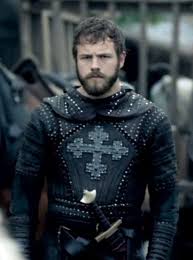
Banner still has
a black eagle.
Aethelwulf, son of the scheming King Egbert, is another excellent inspiration for a Black Eagle reskin. In this case we have another brutal warlord, faced with repelling invasions of humanoids (this time a stand in for the Norsemen), but here we have a motivation based as much on piety and faith as on the need to stem the invasion. Only humans can become clerics in B/X...this is a little explored concept in most campaigns. While Ludwig/Vlad is a sadistic tyrant fighting for his life, Ludwig/Aethelwulf sees himself as a holy crusader, battling the enemies of the Lord. Note that he is no "paladin" (such do not exist in B/X anyway), but a devout soldier tasked with a bloody mission. While Vlad would be a tool of the archduke, Aethelwulf is a tool of both his sovereign and his church...and which side will win out in the end (if either)? Note also that demihuman characters (dwarves, elves, halflings) would fall into the "nonhuman" hatred of such an individual...the refugees found in Luln would be demihumans driven from the Barony and their human friends ("sympathizers"). The Black Eagle would see himself as a "good" person, doing God's will, and even if he had the ambitions of Egbert, he'd more likely be going about them in the usual fashion (i.e. making political alliances through marriage to the Archduke's daughter, rather than open warfare).

Baron Black Eagle as King Haggard: as I've written before, I love Peter S. Beagle's novel The Last Unicorn, and for whatever reason I am particularly fond of the animated version of King Haggard (voiced by Christopher Lee). I wouldn't mind adopting the character wholesale to replace Baron Ludwig, age and all. Halag would become Hagsgate; "Fort Doom" could keep its name (a fitting euphemism for Haggard's dire keep), though it would retain the witch's curse from the novel. Heck, I'd probably add the Red Bull and adopted son Lir to the mix. I like a little fantasy whimsy (as I've written before), and King Haggard is plenty callous and dangerous without making him all mustache-twirly. He should be more of a "force of nature" in the campaign than an outright antagonist.

Described as "seventy
years old, or eighty,
or more."
I'd probably put him back about 10-15 years before the events detailed in the novel. Lir would be around, but only a small child; Haggard and his retainers would still be old, if maybe not quite so ancient. Hagsgate would look more like Nulb than a post-apocalyptic, almost-ghost town. And, of course, Haggard would still possess his "magician's magician" Mabruk, replacing Bargle in the campaign. Perhaps Mabruk would still possess the power to delight the grim lord with his magic. In such a scenario as this, the dynamics between the barony and the capital would probably need to change: I see Haggard as having come to the region many years before Archduke Stefan (though probably still from Thyatis)...an appointed governor/sentinel/warlord who chose to live far outside the bounds of the more populated Specularum due to his particular misanthropy.

Will not be driven away
by halflings. He eats halflings.
Baron Black Eagle as Gregor Clegane: this one is pretty easy, though the stat line will need to change a bit (I'm fine modeling "The Mountain" as a 12th level fighter, but Strength 18 is definitely required...possibly more). Once again we go back to the "brutal but necessary" warlord protecting the Grand Duchy's border, but here's a villain that everyone can really hate, as he's so hateful. In this incarnation, Duke Stefan plays the role of King Robert "Look the other way" Baratheon (or Tywin Lannister if you want your Archduke to be a scheming manipulator). Clegane is the worst kind of robber knight; he is a man without code or honor, with no sense of duty, paying only lip service to liege and faith as it allows him to do that which he wishes to do. He has no loyalty, not even to his own family or retainers (he murdered his own father to assume his title; he killed his own man for snoring too loudly). Clegane lives only to fulfill his basest passions and momentary whims. He slays his warhorse, a very expensive piece of horseflesh, in a flash of anger at losing a joust.

And yet, Ludwig/Clegane has the title and power and fighting prowess that allows a man of such horrible character to not only survive but thrive in a savage, brutal world. Other lords and would-be kings WANT him on their side, because of the terror he instills in their enemies, because of the threat he poses, should they decide to let him off the leash. Like star athletes that have committed despicable acts off the field, people still want The Mountain on their team; definitely better to have him on your side than fighting against you! However, he has no designs on the throne...I prefer this option for the Black Eagle if there are other vying factions in Karameikos (allowing Ludwig/Clegane to act as wild card). He's a man of "simple pleasures," after all.

Beloved by all...except
the French.
Baron Black Eagle as Black Prince Edward: finally, we have the idea of the Black Eagle as an actual, honest-to-goodness hero (or whatever passes for one in a pseudo-medieval period)...a warlord trying to be chivalrous even as tries to be a strong leader for his people. All those rumors about the Black Eagle? Slander. "Fort Doom?" Called that because every prior-appointed baron met their deaths fighting humanoids. Reputation for cruelty? He is hated and feared by his enemies because he is O So Good at what he does. The "black eagle" is simply his banner...or perhaps the baron is a black (i.e. dark skinned) man who happens to use an eagle in his heraldry. Ludwig the "black" Eagle...get it?

In this scenario, Baron Ludwig gets his bad press from his rivals at court (i.e. other barons, nobles of Karameikos) who are vying for the attention/largesse of the Archduke. Alternatively, the rumors could be spread by Duke Stefan himself, keeping in mind that he's ruling a conquered people who have no great love for him (oh, wait...I haven't gotten to that post yet). Maybe the Black Eagle is descended from Traladar nobility or perhaps he is "half-blooded." Maybe he has married into a once-noble Traladaran house, despite his Thyatian roots, "going native" and earning the epithet "black eagle" (like "black sheep") based on the Imperial crest of Thyatis. Such an individual might be loved (or better respected anyway) by the indigenous people of the region, and a focal point for rebellion and the eventual overthrow of Duke Stefan. Being from Luln, the player characters might have more reason to discern truth from the scandal (Lulnish refugees either being from other areas of Thyatian control or victims of humanoid raids and looking to the Black Eagle for protection). That would make for a more interesting campaign then simply overthrowing "Bargle's boss."

But then, I find ALL these alternatives "more interesting" (which is why I bothered to write them down). Derivative? Sure...but fun in a way that "Bwahaha! I'll throw you in my dungeon and feed you to Bargle!" just isn't. Not for me, anyway.

[hmm...I don't think any of these guys are the type to even use dungeons. Torture, sure, but generally "to the death" and in spectacular, public fashion. Only Ludwig/Haggard is likely to drop a character in an oubliette...and then just to forget about him]
Monday, August 14, 2017

RPGaDAY 2017 #14

From the #RPGaDAY2017 challenge (info here):

[as I'm starting this thing a little late, I shall be doubling up on my daily posts until I catch up. Early posts will be post-dated to the date they were originally supposed to appear]

Which RPG do you prefer for open-ended campaign play?

Tempting as it is to do yet another Vampire post, despite its scope (start your game in ancient Babylon! Stop off at the middle ages, run a few sessions through various eras and decades of the 20th century!), the game tends to collapse under its own weight. Not to mention, if you continue the immortal being timeline you can't help but end up with Vam-Pires In Spaaaaaaaace! Which is a simply awful idea. Listen, people, THIS is what a space vampire should look like:

Nightmares for years...thanks, Thundarr.

NOT this:

Come on, Wilma...Nosferatu has nothing on Buck!

So, no...Vampire always needs an end...generally once every player character has met a much-deserved, fiery death, or has become stuck in a thousand year torpor.

Other games suggest themselves for long-term, "open-ended" campaign play, but which is best? Somewhat surprisingly, I find myself considering AD&D as the best of the bunch. Even better than B/X, if we are going to limit ourselves to using the Rules As Written...and I think that's only fair with regard to this question. Otherwise, you could modify most games for long-term play.

But AD&D (first edition) provides a lot of structure for long-term play, including options for high level play and exploration...monsters and magic that can still appeal to jaded player characters even after years of play (presuming you don't dole out too much, too fast), while providing so many optional options ('porting in Boot Hill and/or Gamma World) that there's little chance of getting bored with the game. Mainly, though, I like that AD&D has built-in decrepitude...rules for aging that will (eventually) force most characters to retire and "pass on the torch" to trusted henchmen and/or progeny.  And unlike Vampire and other "generational" games (Pendragon, Ars Magica, Chivalry & Sorcery), being set in a mythic/fantasy realm, there's little chance that your campaign will last into some age of anachronism, even through successive generations of adventurers. Generally, most AD&D settings take place in a magical realm that never develops past a pseudo-16th century tech level.

So, yeah...AD&D. Even though I've been more a proponent of B/X and its simple elegance, taken RAW the AD&D game provides more tools for long-term play than the un-modified B/X game.

Just thinking about the possibilities almost makes me want to play the old thing. Almost.
: )

[folks interested in my "Day 5" post for the #RPGaDAY, can check out this link]