[quick note: I've decide to try moderating comments for the time being as I've been getting an excessive amount of spam lately, and it's become a real irritation]
This isn't really what I planned on writing about, but after reading Father Dave's recent post, I figured it was time to finally throw down my two cents on alignment, my (current) thoughts on the concept, and how it will apply in my game setting.
Over the years, I've gone back and forth on the subject many, many times. My current stance (which I've had for less than six months) is to use alignment in my game. Multiple reasons go into this decision that I [still] don't want to enumerate [yet]. However, I will assure the reader that NONE of those reasons stem from a personal desire to simplify the game ("Rules As Written!") nor make my DMing life easier. Finding a way to use alignment in a meaningful and effective way is actually more difficult and not a headache to be readily embraced; it certainly isn't a headache I've found terribly enjoyable.
Still, I think alignment is important to my game world, as the cosmology of the setting is at least as important as the physical geography to its overall design.
SO...having said that (and having spent the last few days going though the OD&D monsters and figuring out the IFs and HOWs needed to slot them into my setting), please indulge me a moment to talk about my personal viewpoints on evil and how it works in a game context.
Father Dave's post discusses the importance of evil as a concept for an RPG; how reducing the game setting to one of moral relativism (if I may be allowed to paraphrase) makes the struggle between selfish individuals (and the stories told of those struggles) both boring and pointless. I assume some folks would take umbrage with this statement, as "boring" can be recognized as a matter of taste (television shows that I find tedious are undoubtably stimulating to others) and "pointless" ...well, what can be more pointed than watching humans (and/or tieflings, etc.) struggle in the face of adversity? That IS the point of The Game, after all.
But I understand the good padre is writing from his stance as a Christian theologian and I respect his perspective.
[ooo...I can see the potential for this discussion to get nasty. Lots of people get LOTS of things out of D&D besides any potential "meaning" or morality lesson, people who hold the game on an equally high (or higher) pedestal. I really, really don't want to have that debate here. Please don't go down that particular road in the comments; yes, I understand D&D holds a lot of juice for a lot of people of all stripes and persuasions...]
For ME, it is important that my campaign setting is sensible; if the setting doesn't make sense to me, I will (eventually) become tired of and frustrated with the nonsensical elements until I chuck the whole thing...something that has happened many, many times to me in the past. I'd rather have a game setting that will last, oh say, a hundred years or so (enough time that it should outlive me) and my best strategy for doing so is picking an epoch in our real world past that is so far removed from today that who knows WHAT might have happened "way back then" (knowledge does tend to get lost after a few thousand years...). However, making use of our Real World means using a real world cosmology or, at least, a close approximation given the circumstances of the setting and the rules of the game; that, to me, is sensible.
So then what is "evil" as I believe it? Father Dave defines evil as the absence of God. "Goodness" is the same as God...God is the source of all goodness. The more you remove good/God from the equation the higher the degree of evil; the padre compares evil to cold, and God/goodness to warmth. Cold increases the more you remove yourself from the source of heat; add heat and cold is diminished. Easy-peasy...that's a fairly typical Christian perspective on the way the cosmos functions.
My own take is a little more New Age-y (I'm not the world's greatest Christian by any stretch): God is All; All is One. "Evil" comes from denying this fact...by separating ourselves (through thought and/or action) from the truth (or Truth) that All is One. Forgetting our place and our purpose as "higher beings," parts of God's whole, destined and designed to do God's will because we are one with God. Forgetting our higher purpose...or ignoring it, or working against it...results in the only "sin" that matters: selfishly separating ourselves from God. This causes suffering in the whole (for All is One)...it is a sin against God, against ourselves, and against our fellows for we are all part of a single whole.
But why does such sin (or the possibility of it) exist? Here, I'll take a page from Tolkien and draw the analogy that Eternity is like a grand symphony, composed of many notes, chords, rhythms, and movements. Only with an omniscient understanding can its whole be observed at once; only with the perspective of God can it be seen how one part leads to the next, how each portion is necessary to the whole. The struggles and challenges of those humans residing on our planet may seem terrible and terrifying...or petty and sordid...when viewed with only a limited ability to perceive. But that limitation, too, is part of the overall scheme and design of the composition.
Putting that into D&D language: I am using the three-point alignment system of Law, Neutrality, and Chaos in my setting. A Lawful person is one who actively does God's will (purposefully, though regardless of whether or not there exists understanding). "Persons" mean creatures with a level of intelligence rising to the level of sentience; "God's will" generally means living in harmony (with others and with nature), and generally promoting the same. There are very few species in my game that are (culturally) of the Lawful disposition; most are angelic beings.
By my definitions, anyone NOT actively doing God's will would be in the "evil" category (to greater or lesser degree), but the difference between Neutrality and Chaotic is a preferred distinction for my setting. While there are certainly selfish people out there who are more interested in their personal desires than following the Law of One, not all are so wicked as to actively be working AGAINST the cosmic design (i.e. trying to create MORE separation from God). This, then, is the distinction: a Neutral person is not working to create a closer bond with God, nor are they working to undermine oneness (and, generally due to ignorance and disinterest, these may perform deeds at various times that move the needle one way or the other: helping an individual in need one day, while cheating someone else another). These maintain the "status quo" of life on Earth, perpetuating its cycles, and maintaining the possibility to join one side or the other. In contrast, the Chaotic person, by thought and deed, continuously pushes to destroy One-ness through selfish aggrandizement, exploitation of others, and general awfulness.
Regarding non-sentient beings: most are of the Neutral alignment (all "natural" creatures, for example) unless their very nature is an offense to the natural order: undead creatures, for example, or certain magical abominations created by stray and terrible magics (like trolls). "Demons" are not "fallen angels" in the Milton sense, but there are certain ethereal beings whose interaction with humans usually take a malignant turn (for the humans), much the same way that interacting with other "forces" (fire, gravity, etc.) have the potential to cause harm to the unwary; such forces are labeled as "Chaotic" due to the danger their interference poses to humans attempting to follow God's will. Such creatures (and those who harness them as tools in their quest for personal power) provide a steady source of conflict in the setting.
Hope that all makes sense.
This, by the way, has brought up other headaches...er, "interesting challenges"...with regard to the design of the campaign's mega-dungeon. Licancabur is a natural formation, one that in recent centuries has been sacred and holy to the people of the region, much as such sites (Olympus, Rainier, Danali) have been sacred to other peoples throughout history. Moreover, nature may be aloof and uncaring to the wants and needs of human beings, but that doesn't make it evil...merely dangerous. So what "lawful" reason could there be for adventurers to delve its ancient depths, explore its hollowed out volcanic tubes, slay its denizens, and pillage its treasures? If Licancabur is not some sort of gateway to hell, what gives them the right to ravish it, sword in hand?
Corruption. Perversion. The temple has become a den of inequity. The hallowed halls are defiled with mutants and monsters of the vilest sort. Something must be done to return the place to a state of grace, though it may take years, and the blood of many would-be heroes, to do so.
And, for now, that's enough to kick-off a campaign. Because my setting takes place some 9000 years before the time of Christ, there are no Judeo-Christian-Islamic religions in the game, but there are religious orders and clerics. The line between magic-users and clerics is very thin, in my setting, the difference being mainly one of perspective and mission. Only followers of the Law of One have access to the full range of healing powers; worshippers of false gods and natural powers are little more than hedge wizards, and idolatrous demon-worshippers have no access to healing magic at all, being only capable of harnessing the powers of malice and harm for their personal "benefit."
Magic-users as a class hold themselves aloof from matters of the spirit and worship, but they are aware of the way the cosmos works, and ignore it at their own peril. Many wizards, lacking wisdom or lost in their pursuit of knowledge and power, will tread the path of chaos. Bad things undoubtably await them (in this life or in the next), but such a road will not curtail their progression.
My use of alignment in D&D isn't meant to dictate behavior, neither with regard to players, nor their characters. With regard to player characters, alignment is a stamp and statement of where their souls lie in terms of the cosmic struggle. There is no requirement to "act one's alignment:" presumably, a character's actions will stem from a [Lawful/Neutral/Chaotic] motivation, and even if not, so what? Individuals slip up, make mistakes, and act against type. Lancelot sleeps with the wife of his friend and liege. Hercules gets drunk and kills his family. Darth Vader decides he'd rather go out a hero than watch his son be murdered. Do such deeds make up for a lifetime of goodness/badness? Maybe, maybe not...the player is free to discuss a possible alignment change with the DM (me) if she wants to entertain that possibility.
Regardless, I'll assume that the character is doing plenty of acts "off-screen" that readily bolster and justify the alignment chosen.
Actions have consequences...all sorts of consequences. Kill all the lizard men in the local swamp and you have no lizard men. In some ways, this is a good thing: fewer dangers in the swamp (if the lizard men were apt to ambush unwary travelers), perhaps more game to be found by the locals (since the lizard men aren't hunting it). Perhaps, though, the lizard men acted as a natural "buffer zone" between the local village and a different threat of some sort, a more dangerous tribe of creatures that will now take their place. Perhaps the lizard folk worshipped a black dragon and their occasional "sacrifices" kept the thing from looking for prey elsewhere. Perhaps they hunted a particular type of animal that is difficult for a non-scaly hunter to eradicate, and now the unchecked pest threatens to overrun the swamp...maybe some sort of giant spider whose venom was ineffective against the lizard people (but is fatal to humans).
The point is: the genocide of the lizard people isn't necessarily evil...it may have been an expedient solution to a very real problem. But actions have consequences, and there may have been more than one solution to "the lizard man question." Finding a harmonious approach is, generally, the Lawful way, as I'm defining the term...but sometimes, stamping out a Chaotic threat IS the "Lawful" method needed.
But that isn't to say my world is one of moral relativism; I personally don't believe in moral relativism, and since my setting is my own, personal creation, I get to determine the truth of the matter. So there are absolutes of good and evil, right and wrong, broadly defined as moving in alignment with God or against God. And unfortunately, for most humans trapped in a fallible bodies of limited perception, having actual knowledge of what is God's will is pretty much impossible to fathom. Which is why we rely on the wisdom of priests and the teachings of religions for guidance. It's only too bad that the priesthood and writers of religious tracts are (mostly) composed of fallible humans of limited perception.
*ahem* Anyway, having a system of alignment allows me to shape the scope of my setting in (morally) absolute terms: these creatures are an abomination, these magic items are designed for the use of Law, these spells can only be used in the service of Chaos, etc. Alignment allows me to steer the tone of the game and provides a convenient shorthand for defining the nature of the cosmic struggle in my own morally absolute terms. It provides another layer to the physics of the game world, an extra dimension of challenge to be navigated, an additional meaning to the experience of play.
Again: its purpose is not an edict of player (or character) behavior.
That being said, it would probably be strange to have both Lawful and Chaotic characters in the same adventuring party.
Showing posts with label laws. Show all posts
Showing posts with label laws. Show all posts
Saturday, August 1, 2020


Friday, March 7, 2014
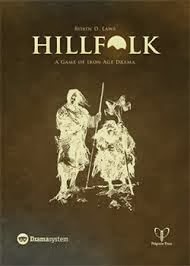
Hillfolk (Robin D. Laws)
With the second season of Vikings starting, my mind turns to axe-wielding maniacs in longships pillaging the English coastline. Briefly, I considered the idea of creating a B/X setting based in large part on the show (adding fantasy elements, of course), but however interesting exploration/exploitation is, that's not really the focus of the show. Rather, what's important is the relationship between the characters and how those relationships intersect (and often conflict) with the characters' desires and ambitions. B/X is not a great vehicle for that type of role-playing.
But Hillfolk by Robin D. Laws is perfect.
I picked up Hillfolk in January (I think)...shortly before things started getting really hectic around the home front. I own several games written (or co-written) by Laws, including Over The Edge, Pantheon, Feng Shui, Hero Wars, Ashen Stars, Mutant City Blues, and the Dying Earth RPG. Most fall into the category of "games-owned-but-never-played;" the only ones I have played are Over The Edge and Pantheon, and only OTE more than once...mainly because no one I know is interested in them. Sure, I may not do a great job selling 'em to people...but whatever. Point is, I like Laws's games, I have a lot of respect for his work and his designs, and I have put more money into his pockets than I have with any other designer, save Gygax, Siembieda, and Mark Rein-Hagen.
[ooo...that's kind o sad when you think about it!]
Hillfolk uses a new system (the DramaSystem) to cut right to the chase of where long-term RPGs eventually end up: a soap opera of clashing personalities. That may sound less-than-complimentary, but I don't know a more succinct (and yet positive) way to describe it. The point of the system is to play the emotional exchanges that occur between people in tightly-knit (clan) relationships. The default setting is a small group of Iron Age villagers (hunter-warrior types) just on the borders of the "civilized" clashing empires. Consider perhaps a pre-Conan look at Cimmerian life, and how the people of the village get along in the face of internal politics, familial ties, and external threats.
Like Fiasco, PCs are created together and are defined (in part) by their relationships with each other: specifically what they want emotionally (and what they're unlikely to get) from each other. Unlike Fiasco, the characters also have some practical stats (for doing things like fighting and whatnot) and inner drives that color the ways they go about seeking their emotional "payoffs;" also, Hillfolk uses a GM, unlike Fiasco...though with a little thought, I don't think it would have been too tough to push it into the realm of collaborative role-playing.
Also, like Fiasco, the default setting is only a jumping off point...the game mechanics easily translate into other close-knit, tribal (or tribe-like) structures. Only one-third of Hillfolk's 230 pages is devoted to the system and its basic, Iron Age setting. The rest of the book is additional settings in which to use the DramaSystem, including a rural moonshining family, the Aztec empire during the coming of the Spanish, a support group for recovering "mad scientists," Spanish patriots fighting the Franco's fascists, a colony of humans on Mars, and the henchmen of a low-powered super villain. In all, there are thirty additional settings with players taking the form of everything from robots to pirates to irks to faeries at war with Victorian England. It's easy enough to come up with new settings: the key ingredients are simply small group facing external odds/adversity, while dealing with the normal group dynamic of clan. Hillfolk does the kind of thing OrkWorld wanted to do, but doesn't pussyfoot around with it, cutting right to the heart of the matter with its system.
I assume, anyway...I haven't actually played Hillfolk.
Back when I was a kid/pre-teen, I played in a looooong-running AD&D campaign, one that lasted several years. It eventually got to the point that "actual adventures" weren't as interesting to our high level characters as our own agendas, schemings, intrigues, and romances; if we killed some trolls in a session, it was usually a very minor part of whatever else was going on (internally) with our "characters." I've written before that I've never managed to reproduce this kind of D&D experience (a very fun one), because such an experience only developed organically after years of play, bushing the boundaries of the system, exploring the end game of high level play, and developing trust and intimacy within our gaming group. Hillfolk produces this kind of play without the need to sit around the gaming table for years. If this is the kind of gaming experience you long for, you might want to check it out.
One more interesting thing about Hillfolk: back before I started experiencing the burnout that led me to look at GM-less RPGs, I was working on an even simpler fantasy adventure game, that more emulated a literary/folktale type genre over the D&D mold of "treasure-seeking delvers" and one of the things I was looking at was mechanics regarding character motivation/desire, internal obstacles to that desire, and player created statements of who the PC is...like a ritualized, "this is the story of (blank) who seeks to do X, Y, and Z." Hillfolk does all this, mimicking in many ways the very structures I was implementing. The difference is Laws does this to get to the emotional exchange between players in a system devoted to emotional exchange...while I was still trying to figure out how to mechanically impact an "adventure game." The end result: his works and mine was struggling mightily (to the point where I mostly ignored the systems in actual play-testing, instead simply allowing such signs to stand as guidelines for "how to play your character;" lame!). Seeing the system in print (and the way it works) really took the wind out of my sails!
Anyhoo, Hillfolk...like most of Laws's games...is quite innovative and interesting, and may be the best offering I've yet seen from Pelgrane Press (I like GUMSHOE and Dying Earth, but they are still a little too clunky for my taste...damn skill systems!). It's not something I'd want to play all the time, but it's certainly something I'd like to play.
Probably with a Vikings setting, though.
; )
But Hillfolk by Robin D. Laws is perfect.
I picked up Hillfolk in January (I think)...shortly before things started getting really hectic around the home front. I own several games written (or co-written) by Laws, including Over The Edge, Pantheon, Feng Shui, Hero Wars, Ashen Stars, Mutant City Blues, and the Dying Earth RPG. Most fall into the category of "games-owned-but-never-played;" the only ones I have played are Over The Edge and Pantheon, and only OTE more than once...mainly because no one I know is interested in them. Sure, I may not do a great job selling 'em to people...but whatever. Point is, I like Laws's games, I have a lot of respect for his work and his designs, and I have put more money into his pockets than I have with any other designer, save Gygax, Siembieda, and Mark Rein-Hagen.
[ooo...that's kind o sad when you think about it!]
 |
| Spear-chucking with purpose! |
Like Fiasco, PCs are created together and are defined (in part) by their relationships with each other: specifically what they want emotionally (and what they're unlikely to get) from each other. Unlike Fiasco, the characters also have some practical stats (for doing things like fighting and whatnot) and inner drives that color the ways they go about seeking their emotional "payoffs;" also, Hillfolk uses a GM, unlike Fiasco...though with a little thought, I don't think it would have been too tough to push it into the realm of collaborative role-playing.
Also, like Fiasco, the default setting is only a jumping off point...the game mechanics easily translate into other close-knit, tribal (or tribe-like) structures. Only one-third of Hillfolk's 230 pages is devoted to the system and its basic, Iron Age setting. The rest of the book is additional settings in which to use the DramaSystem, including a rural moonshining family, the Aztec empire during the coming of the Spanish, a support group for recovering "mad scientists," Spanish patriots fighting the Franco's fascists, a colony of humans on Mars, and the henchmen of a low-powered super villain. In all, there are thirty additional settings with players taking the form of everything from robots to pirates to irks to faeries at war with Victorian England. It's easy enough to come up with new settings: the key ingredients are simply small group facing external odds/adversity, while dealing with the normal group dynamic of clan. Hillfolk does the kind of thing OrkWorld wanted to do, but doesn't pussyfoot around with it, cutting right to the heart of the matter with its system.
I assume, anyway...I haven't actually played Hillfolk.
Back when I was a kid/pre-teen, I played in a looooong-running AD&D campaign, one that lasted several years. It eventually got to the point that "actual adventures" weren't as interesting to our high level characters as our own agendas, schemings, intrigues, and romances; if we killed some trolls in a session, it was usually a very minor part of whatever else was going on (internally) with our "characters." I've written before that I've never managed to reproduce this kind of D&D experience (a very fun one), because such an experience only developed organically after years of play, bushing the boundaries of the system, exploring the end game of high level play, and developing trust and intimacy within our gaming group. Hillfolk produces this kind of play without the need to sit around the gaming table for years. If this is the kind of gaming experience you long for, you might want to check it out.
One more interesting thing about Hillfolk: back before I started experiencing the burnout that led me to look at GM-less RPGs, I was working on an even simpler fantasy adventure game, that more emulated a literary/folktale type genre over the D&D mold of "treasure-seeking delvers" and one of the things I was looking at was mechanics regarding character motivation/desire, internal obstacles to that desire, and player created statements of who the PC is...like a ritualized, "this is the story of (blank) who seeks to do X, Y, and Z." Hillfolk does all this, mimicking in many ways the very structures I was implementing. The difference is Laws does this to get to the emotional exchange between players in a system devoted to emotional exchange...while I was still trying to figure out how to mechanically impact an "adventure game." The end result: his works and mine was struggling mightily (to the point where I mostly ignored the systems in actual play-testing, instead simply allowing such signs to stand as guidelines for "how to play your character;" lame!). Seeing the system in print (and the way it works) really took the wind out of my sails!
Anyhoo, Hillfolk...like most of Laws's games...is quite innovative and interesting, and may be the best offering I've yet seen from Pelgrane Press (I like GUMSHOE and Dying Earth, but they are still a little too clunky for my taste...damn skill systems!). It's not something I'd want to play all the time, but it's certainly something I'd like to play.
Probably with a Vikings setting, though.
; )
Thursday, January 24, 2013
Ashen Stars – Indie Space Opera
[this post was written up back in..what…early November?
Maybe late October. Though it may not be entirely timely, I know SOME folks are
tired of reading superhero discussions…I thereby offer this up as “new content”
for the blog]
You know why people are crying out for space opera RPGs?
Because in the imaginary fantasy world of space opera, all your child care
needs are as simple as handing off your child to your portable android while
you and the wife are busy flying the rocket ship or fighting the forces of the
villainous emperor or making sure the color of your capes match that of your
ever-charged ray guns.
(*sigh*)
At least I live in a day and age where my ability to eat
is not based on my personal ability to cultivate crops or hunt the local
wildlife.
Ah, well…so in looking over my recent posts, I see I
STILL haven’t finished my “Benjamins” series, nor even yet posted my “offensive
post” (exactly 1500 words in length and only about half finished…ugh!). And yet
here I am with an urge to discuss my latest RPG acquisition and the points of
interest are directly related to these (un-posted) topics. What O What is one
to do in this kind of situation.
Press on, I guess.
 Ashen Stars is yet another GUMSHOE system RPG, this one
written by Robin D. Laws and featuring a space opera setting that is about as
space opera as space opera gets…in the old school, serial series sense of the
phrase. I know I’ve talked GUMSHOE before (Mutant City Blues, Trail of Cthulhu,
etc.), largely heaping it with praise and when I first saw Pelgrane’s space
opera offering a few months back I immediately wanted it…until I remembered
that I’ve yet to play a single one of these excellent, excellent games.
Ashen Stars is yet another GUMSHOE system RPG, this one
written by Robin D. Laws and featuring a space opera setting that is about as
space opera as space opera gets…in the old school, serial series sense of the
phrase. I know I’ve talked GUMSHOE before (Mutant City Blues, Trail of Cthulhu,
etc.), largely heaping it with praise and when I first saw Pelgrane’s space
opera offering a few months back I immediately wanted it…until I remembered
that I’ve yet to play a single one of these excellent, excellent games.
Here’s the problem: I’m the only person I know that
actually owns these games. Which means that if I want to play one, I’ll
probably be the one introducing it and running it for folks. And in addition to
the normal headache of trying to interest non-interested parties in learning a
new RPG system (let alone getting them fired up and enthusiastic)
investigation-type role-playing really isn’t my thing. I like fantasy
adventure, not mystery solving. I suppose I’d be much more comfortable PLAYING
such a game (as a player myself) as opposed to running it…but there again I
have the issue of being the only person I know who even owns these books.
In other words, the usual issue.
Whatever…this isn’t just a woe-is-me post (really!); I’m
simply explaining my reservations at buying yet another GUMSHOE game. But Laws
and Kenneth Hite (the other main GUMSHOE designer) are excellent at what they
do and usually good for both insight and inspiration (not to mention good
reads) AND space opera has been my flavor-of-the-month for awhile now and I’m
trying to get my hands on as many different games of the genre as I can find.
So when Diego and I were in the game shop a couple days ago with a little extra
money, we picked up a copy (D really liked the pictures). My first impression?
Wow.
Laws doesn’t disappoint. Well, actually, he does disappoint (we’ll get to that in a moment) but his entry into the space opera
genre of RPG is one of the best I’ve seen. I mean it’s really got some good
stuff going on, and I’m not just talking about the artwork and layout and
writing (though those bits are pretty good, too).
[just by the way, did WotC ever carry an original SciFi
setting for D20? I know they did Star Wars, and I seem to recall a D20 Future
game, but was there ever anything more “space opera” specific? Just
wondering…having had my fill of D20 I sincerely doubt I’d ever buy such a
thing; it’s a question of curiosity]
Laws, like Bezio, takes a lot of the same design tactics
I was using myself when attempting to design a space opera RPG…in fact, if you
were to remove the unique settings and splice Ashen Stars together with
X-Plorers, you’d have a (very) rough approximation of the direction I was
going, pre-DMI. My problem, though, was in my attempts to “pull it all
together,” and the way both Mr. Bezio and Mr. Laws manages to do so is by
adding specific space opera settings to their games, something I was extremely
loathe to do (I was shooting for a more “generic” space game with an “add
setting to taste” sensibility…in the end it hamstrung my efforts).
This is actually something that would make sense more (to
my readers) if I’d bothered to do the original posts on Action/Reaction and
Benjamins/Motivation. I know, I know…cryptic references to un-published blog
posts really don’t really help explain anything, but without going into to
great of detail:
- Player behavior can be self-motivated or GM motivated
- Self-motivation is better but requires tricky game design
- A strong theme can keep players on the same page
- Most games take this shit for granted
But MEANWHILE let’s just grapple with Ashen Stars; here’s
the basic premise:
- The setting is a multi-(alien)-culture galactic quadrant that is a few years removed from an interstellar war (THIS, by the way is new…I usually classify space opera in three ages: Golden Age, Age of Corruption, and Age of Strife (war). What Laws does is find a fourth stage to the cyclical space opera paradigm following Strife but precursor-ing the new Golden Age…call it an Age of Reconstruction).
- Characters are all members of the LASER profession: highly competent individuals acting in a capacity of mercenary troubleshooters/detectives/peacekeepers in the absence of strong government/law enforcement due to the aforementioned war.
- The PCs are all members of the same ship crew. PCs pick their ship and customize it, then have to upkeep it by accepting and fulfilling contracts (“missions”). Most normal GUMSHOE procedures regarding investigation and task resolution applies.
- Characters main driving motivation is one of Reputation: being successful LASERS and handling things in an altruistic or heroic fashion increase their Rep while being scumbuckets (acting in selfish or homicidal fashion) will lower Rep. Having a low rep means time between lucrative contracts is increased, meaning characters can run low on money and fail in the upkeep of their ship and equipment leading to a reduction in their personal (and ship) capabilities.
And if they stopped right there that would be a good
enough AND cool enough game. However, in emulation of the genre (especially such
serial shipboard trouble-shooting TV shows as Star Trek or Firefly), Mr. Laws
oversteps in his design process, with (to my mind) nonsensical results.
[by the way, there’s a lot of other neat stuff I’m
leaving out: like the various races/species, the classifications of lifeforms,
the various cyber-enhancements, etc. all of which are cool and well-thought out
and neater-than-your-average-inside-the-box-RPG. But those things aren’t
pertinent to this discussion. However, I’d strongly recommend purchasing or thumbing
through a copy if you’re into “cooler-than-usual” space opera weirdness. Lots
of stuff worth stealing for your own game even if you don’t want to play in the
world of Ashen Stars]
The over-stepping is with regard to Drives and “arcs”
(both story and personal) which are “personality mechanics” even less useful
than “alignment” in a standard D&D game. And I’m talking about usefulness
with regard to mechanics and effective game design.
The funny part is I went through the exact same thought
process with my last couple games, especially with my space opera game. Hell, I
even called these character motivations “drives” in my game, too…and while mine
were based on Jungian (astrological) archetypes, I still ended up with a lot of
the same ones (duh…there’s a reason they’re archetypes). However, while mine
have mechanical effect (and fail to work in practice), Laws’s Drives have
almost ZERO mechanical effect…and appear to fail in practice.
[I say “appear to fail” because I haven’t played the
game, but the principles seem to be in place for a failure…or at least for an
extraneous system that adds little to the game]
[hmm…I’m not a very nice critic, just reading back over
what I wrote. I’m not even in a bad mood or anything!]
By not providing game mechanics (i.e. a system) that
describes how the mechanics impact the game you end up with little more than
useless “color.” Oh sure, the author describes how the GM should take these
drives and arcs into account when shaping a story, and how players should pay
attention to them when determining behavior…but nothing in the rules COMPELS
participants to pay any attention to such things, and nothing INCENTIVIZES
participants either.
And if there’s nothing compulsory and no incentive then,
um, why do I care?
Now I don’t think Laws includes this information just to
“pad” the word count or something, nor simply as a writing exercise/practice.
My guess is that his idea was (by including drives as a part of the chargen
process) to try to draw players’ minds deeper into the role-playing “immersion
experience;” something that is either unnecessary (because your players are
already on-board with developing characters) or a waste of time (because
players are NOT on-board and the whole idea is unenforceable within the rules).
I mean, alignment in D&D has some consequences of
behavioral compulsion…specific alignments are required for some classes and the
use of some magic items, and some characters run the risk of loss of class
effectiveness for failure to follow their alignment (not to mention XP loss
suggestions given in the DMG for alignment violations). Even though it matters
little whether or not a fighter is Lawful or Chaotic (with the possible
exception of picking up an intelligent sword), it still has SOME enforceable
game effects.
“Okay, okay, JB,” I already hear some of you yelling. “We
get it! You don’t like it! So what? If it has no mechanical effect on the game,
just ignore it and play the game without it. The rest of the rules work, right?”
Well, sure, I guess they do. But here’s the thing:
I don’t get it. I don’t understand it. Laws’s motivations
for including it at all is a mystery to me…and I’m afraid I’m missing something here.
I own several of these GUMSHOE products, and I don’t
recall seeing something like this in any of the previous books. They’re not
necessary…the setting provides all the motivation you need! In Trail of Cthulhu
the PCs are investigating weird Cthulhu happenings, and work as a team to do
so. In Mutant City Blues the PCs are members of a (super-powered) police force
trying to solve cases and keep the streets clean (and work together to do so).
In Ashen Stars, characters are all members of the same
LASER crew, on the same ship, taking contracts and making money. They already
have incentive to work together (completing missions) and doing things in a
particular (heroic) fashion: the Reputation mechanic, which affects the monies
received which affects the team’s ability to perform maintenance and upkeep
which affects the crew’s effectiveness (if you can’t keep up your ship,
rules-wise it starts to deteriorate) which affects the ease with which you
complete missions. What did Laws find (in play-testing or the design process)
that made him think it was necessary to include this aspect of the game? Is it
a gross over-sight? Laws seems too good a designer for that to be the case. Did
he find players would lack the proper motivation without drives? Was there
something particular that “bugged” without a named character “arc” for each PC?
It confuses me and muddles things (for me) putting a
damper on an otherwise excellent game.
[I do also have some gripes with the STARSHIP COMBAT
mechanics…which I have described in an earlier post…but those gripes aren’t
with principle design tact taken so much as the EXECUTION of that tact; but
like I said I already wrote about that]
All right, that’s enough of that…since picking up Ashen
Stars (and writing the bulk of this document), I’ve since nearly completed my
own space opera supplement for Bezio’s X-Plorers AND drafted the basic core of
a DMI Supers game AND moved onto other things, none of which are GUMSHOE
related. I really don’t want to beat up on the book; I just think it might be a
little misguided in including “too much” (something I’ve been guilty of on
occasion myself).
You know, one of these days someone will come out with
and RPG that deals solely with the interaction of different personalities in a
cloistered environment…like a spaceship or a submarine. It IS one of the more
interesting aspects/dynamics you find…in film and fiction anyway…and a lot of
RPGs simply take it for granted that such “interesting group dynamics” will
spontaneously develop. And they do…but without some direction, some “help,”
from the game mechanics/design it’s going to be kind of happenstance how it
happens. And maybe THAT’s what Laws was aiming to do, but I think the execution
of it was less-than-adequate (to be charitable).
Incidentally, Kayce (who will be joining the play-test
tonight) has been running Bulldogs! recently, a FATE-based space opera RPG
which I do not own. For her, the most interesting part of the game has been the
interaction between the various PC crewmembers and their drunken oaf of a
captain. But I’m not so sure that interaction was intended to be the EMPHASIS
of the game (hard to say without reading the rules)…it’s just developed that
way due to the disparate personalities of the players. But that’s the thing…you
can’t count on your players always stepping up to that particular plate (and
sometimes, you might not want them to!)!
: )
Subscribe to:
Comments (Atom)