Showing posts with label demon. Show all posts

Sunday, October 18, 2026

Cauldron Day 3: Battle Fatigue

Serious gaming can take a toll on you, depending on how intense it is. Running the same scenario more than once, or a single long scenario (say six hours instead of three) isn’t the same as running multiple scenarios in which you, as the DM, have to reset, reorient, and refocus to a new premise, a new situation, and new player characters. Doing it over and over again, over multiple days, can be grueling. Usually, at the end of a three-day Cauldron, I’m checking into a hotel and sleeping for 20 hours before boarding a plane back to Seattle. The jet lag, the short turnaround, and the copious amounts of alcohol probably don’t help much.

This year, though, Day 3 wasn’t bringing breakfast, a last session, and a welcome respite. No. I had a whole ‘nother 24 hours of gaming. Got up, showered, dressed, and off to breakfast before my first morning session. Stretching exercises and deep breathing was having less impact and a diminishing rate of return.


Saturday Block I: Horn of the Eye

When I was a kid…and I mean, waaaay back, before I played AD&D proper…I wrote an adventure I called “Labyrinth of the Beholder.” It was a typical, kid-type adventure: a big mess of a maze, with plenty of funhouse monsters sitting in rooms ready to get killed and looted. At the center of the adventure, waiting like Theseus’s minotaur, was a beholder…taken from my first Monster Manual, despite the fact that we were still playing B/X and had yet to realize AD&D was a different thing (we thought “Expert D&D” and “Advanced D&D” were the same, you see?). It was one of the highlight adventures of my early DMing career, meaning it gave both me and my players some memorable stories. As a teenager, I’d tried to recreate it like a 'real AD&D adventure module,' but while I drew the map (I still have the map, actually), my endurance with writing modules was pretty thin in those days. I found a page (along with the map) that had three encounter write-ups (by hand, in pencil)…all pretty terrible. That’s as far as I got.

This year, I decided I’d recreate the thing…as a location in my campaign world. Kind of a Lost Caverns of Tsojcanth if Iggwilv was still kicking around the Prime Plane…and if she were a beholder, getting regular tribute from the locals. Set in the Seven Devils mountain range of (western) Idaho, I wrote it up and playtested the thing back in April with my kids right before Spencer left for his chef job in Japan. It was a great success and, while it ended in a TPK, it actually felt a little soft to me…a full party of eight players, avoiding bone-head mistakes (like purposefully antagonizing a pyrohydra) would probably succeed where my own group had failed miserably.

Or so I thought.

This one’s your typical, “iconic” (sterotyped) subterranean cavern complex, with lava lakes and fungi forests (is there a bottomless pit? I might have left that trope out, but it would definitely fit). Flinds (from the Fiend Folio) are the main minion of the beholder (who has a name, but I’m not going to look it up right now since I’m not wearing my reading glasses as I type this anyway)..he also has a fire giant lieutenant, there are a couple trap rooms, various other minions of a lawful evil bent. There’s a grell in one part which I found to be fairly useless in play-testing…I left it in anyway because, you know, grell.

The party was well-organized and advanced cautiously after descending a couple hundred feet in a lift of brass and iron. Past the stone causeway (wide enough to drive a wagon) over a lake of magma. Surprised the first guard post, murdered the hell out of everybody, then sent the thief ahead into (what turned out to be) the den of a pyrohydra. Uh-oh.

Full retreat not fast enough, party dropped a portcullis on the thing and then butchered it, but the thief player needed a new character (duh). More caution, then started wandering the wing populated by the flind minions. Three more fights and a lot of dead flinds later, they picked up a nice treasure chest and a couple magic items including a ring of fire resistance…handy in a land of lava pools. Good play from the party included ample and strategic use of a scarab on enraging enemies.

Good mapping (yes, Charlotte, the mapping was good) allowed the players to find their way back to the hydra den where they stashed the chest before proceeding back into uncharted territory. Avoided the wing with the fire giant, fortuitously skirted another flind guard post (thus avoiding an alarm) before finding themselves at yet another cavern filled with lava, this one with tall stones of basalt allowing for crossing…in single-file only. Sent the new thief (I think) forward only to have his way barred by four salamanders rising from the lava…no attacks, just questioning, but he didn’t speak salamander and he decided to back off, unmolested. Fighter/magic-user put on the ring of fire resistance and used comprehend languages to converse and understand their speech (even though he couldn’t speak it). Figured out they were asking what tribute the party was bringing to their lord and master and that they’d better have something good or they wouldn’t be allowed to continue.

Magic-user, meanwhile, was turning invisible in order to scout ahead. F/MU came back, gave the MU his ring who then dashed across the columns, unbeknownst to the salamanders (I should note…and I explained this to the players…that hanging out on the path where the temperature of the lava is around 1200 degrees centigrade causes the equivalent of a heat metal spell if you dilly-dally more than one round inside the cavern). Magic-user found a trap down a side passage beyond the cavern…a deadfall that crushed the hell out of him…but he managed to stagger back to his companions for some much needed healing

A bunch of confusion at this point, with a lot of players voting to do different things. The halfling decided to use his oil of etherealness for more hardcore scouting. Fighter/magic-user wanted to fly to the other side of the cavern (over the salamanders heads), while half the party was considering making a sprint to the other side and/or fighting the creatures. The invisible magic-user took the scarab of enraging enemies that they had used to wipe out the larger flind mobs and moved out into the middle of the path, figuring he would use cone of cold (while still invisible) if the scarab didn’t do its job. He had to go to the middle of the path because of the range of the magic item (4")...about halfway out.

[the use of the scarab was not an attack that would end invisibility]

The scarab only worked on one salamander who was promptly dispatched by its comrades. Declaring actions, the cleric decided it was now time to make a mad dash to the other side, while the magic-user declared he was casting cone of cold. The cleric ran into the invisible magic-user (overbearing attacks) and knocked the wizard into the lava while knocking himself down; he was then grabbed by a salamander tail and constricted. The fighter and ranger next raced out to help (in single file), only to be subsequently grabbed as well. Having no resistance to heat, after two rounds of constriction the heated metal of their helmets caused both warriors to succumb to unconsciousness, while the cleric simply died.

The F/MU next cast charm monster on the lead salamander, which was then attacked by its comrades while the dwarf, having already imbibed a potion of speed, shuttled unconscious companions back to the safety of the cavern entrance. The lead salamander slew a companion before being slain himself, and the party was able to polish off the last one with (I believe) the dwarf...the latter having removed his helmet. Unfortunately, he still sustained severe, disabling burns to his body for the rounds of melee he spent in combat with the thing.

In the meantime, the halfling finally went ethereal (the oil not taking effect till three rounds after application), and decided to scout ahead while the party waited for their companions to recover from their heat-induced comas. I tracked the duration of the potion and he spent so long wandering the caverns on the other side that his etherealness eventually wore off…just as he managed to stumble his way into the beholder’s presence. Somehow, with a quick wit and a “00” reaction roll, the halfling was able to convince the beholder that he was an envoy of the dragon queen sent to broker an alliance based on tribute, slaves, and monument erected to the beholder’s greatness. This was deemed sufficient by the Eye Tyrant and the character was allowed to leave, taking the beholder's message of acceptance back to Tiamat. “Don’t get eaten by the [black] pudding on your way out!” it called after him.

He found his way back, explained what happened to the party, and they all decided to get the hell out of Dodge, retrieving their small chest of treasure on the way. A very nice run, in my opinion.

[EDIT: Lutz, aka Der Oger, was my nod for Most Valuable Player]


Saturday Block II: Jewel of Demogorgon

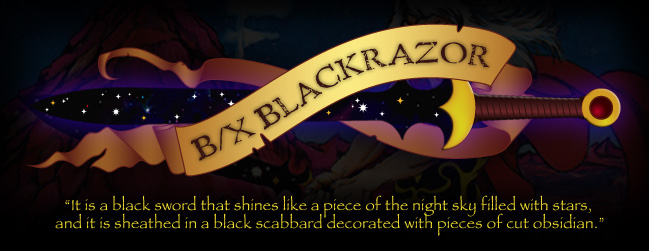
Time for a little more "personal history:" as a child, before I’d ever held or seen a D&D book of any kind, we used to “play D&D” at recess, pretending to be “fighters,” “assassins,” and “magic-users”, arguing over who got to wield “Blackrazor,” and fighting “Demogorgon.” Once I discovered that this D&D game was an honest-to-goodness, real thing...and after I had my own copy of Basic D&D and the Monster Manual and knew what an adventure module was (thanks B2!), I asked my friends (the ones who had first hipped me to this D&D concept) if they knew of any adventure that contained the Prince of Demons. They said, yeah, there was one called something like “Revenge of Demogorgon.” I spent many years looking for this module before deciding it probably didn’t really exist.

For Cauldron, I wanted to run a high-level adventure, and decided that I would craft my own version of this fable…something I probably should have done years before. However, for the life of me I couldn’t come up with any legitimate reason why Demogorgon would want “revenge” on a group of snot-nosed adventurers so, instead, I penned what amounts to a high level "heist" scenario.

As with Sky Fortress, this adventure was only finished in the last few days before I left for Cauldron; it was never play-tested. When I first decided to do it, I had expected it to be the capstone piece for my seven-adventure mini-campaign. I’d also planned on running it in the Saturday Night block where there is no four-hour time limit. Now, however, I had it slated for the afternoon session with the idea that, if it proved to be too long, I could continue to run it after dinner in the Night block…a two-parter, in other words.

First thing’s first: as I sat down at my table after lunch, I was surprised by a player (Theo) passing through asking if I was going to join their game since no one had signed up for my session. What?! This was exceptionally odd, as (to this point) all my tables had been full. What the heck had happened?

I went down to check the sign-up sheet and it was nowhere to be found. Thought that was pretty odd…until a helpful person informed me that session sheets with no takers were simply removed out of the assumption the DM would withdraw their offering.

[later, I had at least one or two people tell me they would have LIKED to play in my game but they felt it was “too high level” and they did not have enough experience playing to feel comfortable. 12th is too high? Sheesh!]

In the end I did have a few players…five or six…who took pity on my empty table and allowed me to run Jewel. I thought the adventure played pretty well, but it was very difficult for the number of players we had…the Abyss is no joke, even for characters in the 12th-14th level range. That being said, it WAS quite long, especially as the premise was tricky to explain, and we had to do some re-calculations of armor class and whatnot due to magic items being less functional on the outer planes. Still: we made it roughly halfway through the adventure, even with a pair of novice players in the group, and when I offered to run it after dinner, they all agreed to come back (except for Ghoul, who was running his own adventure in the Saturday Night block). 

So…I guess not everyone was tired of dying in my games?

Puts hair on your chest.
Final feast/dinner and the annual auction followed, and this was a great time, as always, with much generosity of spirit (and currency) all around. Bidding was fierce, as was the drinking, and my favorite local spirit (a bottle of Rainier Mountain Fresh Gin) was popular enough that I only consumed a third of it myself, the rest being passed around in exchange for palinka, hazelnut liqueur, wine…you know, the usual. I didn’t get any of Estelle’s chartreuse unfortunately (especially disappointing as she ended up at my gaming table afterwards!) but perhaps next year. On to the Night Block!


Saturday Block III: Jewel of Demogorgon (cont.)

I actually ended up with six players at the table after I’d had five (-ish?) at the previous session…just not as many DMs were running games that night (only seven in fact, although one was Bruno’s 23-player OD&D extravaganza) and players were looking for empty seats. I did my big table last year, but I find it tough to run AD&D with the same amount of proficiency and attention I like when there are more than eight participants. Hell, seven is about the perfect amount, but eight gives you extra bodies to slay…you lose one or two PCs from a 6-7 party and the game can quickly go all “death spiral” on you. In my experience.

But, hey, I’m being coy, and I know it. I don’t really want to say anything about my Demogorgon adventure because I actually REALLY like it…and the thing needs some fine-tuning. Despite the map fitting on a single page (unlike most of my dungeons this year), it’s pretty beefy, pretty elaborate. No, the Prince of Demons does not actually make an appearance (unless the players do something very, very wrong) but I really like how I decided to handle the Abyss, and this particular layer. Also, the scenario itself...breaking into a Demon Prince’s stronghold while he’s away, hoping to loot his “Hoard of Spite” without getting caught...is a good one. Spoiler Alert: the players did not find the Hoard (although they got all the way to Demo's audience chamber: a heroic feat in and of itself) but, even if they had, I don’t know if the juice would have been worth the squeeze. As I said, the adventure needs fine-tuning. It was a really ambitious design and I needed more time with it than what I actually took.

Saturday night, I called the game at what I thought was a pretty decent stopping point, but there hadn’t been enough treasure (by my standards) up till that point (I’ll work on it). Plus, let’s be honest: I was pretty hammered by the time we were finishing up, and it had to be after 3am (or 4). I packed my bags, found Prince and Soren embroiled in their usual, last night political discussion, and got into it with them, continuing well into the wee hours of the morning in our usual, jovial fashion. 

And I mean…wow. For once I saw the backside of Prince staggering away (he’s usually the last man standing at these events). But then I looked at my watch and saw the local time was 5:40am, I realized I might have made a BAD mistake. I headed off to bed, in as straight a line as I could walk. 

Not very straight.

[Jewel of Demogorgon may well may make another appearance at a future Cauldron; if it does, it will be in an updated and upgraded format]

[oh, and one last MVP nod...Walid, sometimes called "the Cruel," was my nomination for this round, with his good use of a robe of scintillating colors helping the party immensely]

Thursday, October 23, 2025

Let Slip The Dogs Of War (Part II)

In which I continue to describe the games I ran at Cauldron 2025, spoiling secrets and providing insights into the mind of a geezer DM...


SATURDAY NIGHT BLOCK: Ship Of Fate

The rousing success of Caul’s Dark Citadel…as well as the final three runnings of the tourney module in Saturday Block II...led to dinner being a boisterous affair, especially at my table. Everyone at Cauldron was in a fine mood and, plied with copious amount of alcohol, a lot of money ended up being shucked out at the auction, with much backslapping, congratulating, and toasting of each other.

A lot of palinka. A lot of whisky.

Thus the set-up for the so-called “night block:” a 9pm to WHENEVER affair (no time limit). At Cauldron 2023 I had skipped this (to my later chagrin), instead unwinding and bantering a bit before calling it an early night. THIS year, I had originally left the slot open hoping to get into one of Prince’s epic night-festivals…and then he decided not to run a game in the block! “Sorry, man, there are games I want to play in,” is he wrote to me last month.

SO determined not to miss out, I decided I would be the one to fire up a big-ass, high level adventure into the wee hours. Enter Ship of Fate, a high level extravaganza I wrote for Prince’s NAP II contest (get it HERE if you like).

Ship of Fate is quite obviously inspired by (and heavily based on) Michael Moorcock’s Elric story Sailor on the Sea of Fate. If you haven’t read it…um, why not? Elric stories are pretty much required reading for high level AD&D play, especially Elric of Melnibone, Sailor, and Stormbringer. But, yeah, I know some people think D&D is supposed to top out around 7th level. *sigh*

Good read.
I digress…Ship of Fate is an adventure designed to be played by from four to 16 players, four of whom take the part of high-level lady and gents (the “Heroes”) and 12 of whom are mid (7th – 10th) level “Companions.” The idea being that each Hero has three Companions. The kicker is that all 16 of these characters were once actual player characters, played either by myself of by my friends…however, I’ll note that – with regard to the high-level guys – they’ve been considerably “toned down” from their original stature and abilities. *AHEM*

I have only had the chance to run Ship of Fate one time…for my home group…and we did not finish more than five or six encounters due to an abbreviated session. Alas, we never returned to it because, being a one-off with pre-gens, it held a lot less “spice” for us than using our regular, organically grown PCs; such is life in a living campaign. Because of this, I wasn’t exactly sure how the adventure would play out. Certainly it was much too big for a standard 4-hour time slot. But we were in NIGHT BLOCK, baby! There aren’t any rules! Go all night like when we were 14 and high on caffeinated drinks!

[it’s possible I was a little drunky when I decided to register this game, pre-Cauldron] 

So, unsure of how I was even going to seat 16 people around the table I’d been assigned, I found myself somewhat relieved when “only” nine people showed up to the game. And then while handing around the pre-gens I immediately lost one of the four “Heroes” (the 12th level fighter)…noooo!

[I might have been a little drunky…again]

Fortunately, Tom still had his 14th level fighter pre-gen from Settembrini’s earlier high-level game. I knocked two levels off, reduced the hit points to a reasonable amount (they were set something like 2 points below max), and axed a magic item or two, but most of the character was allowed to stay.

And we were off!  Just organizing such a group was a bit of an ordeal, but it wasn’t too long before they got it together and decided to send the thief into the first cavern and…

Oh, wait…what’s the point of the adventure?

So, in Ship of Fate the heroes are sailed across the Dunkle Zee…a kind of phantom ocean that connects the various planes of the multiverse…to an island nexus where two sibling wizards (brother and sister) are using a rift in the space-time fabric to drain power from all the planes in existence, gradually snuffing them out. Players are supposed to find the building at the center of the island, kill the wizards, and then fire the building using special magic firebrands designed for the purpose. The ship has a cargo hold full of gold for the players after success in their quest and the wizards themselves are likely to have treasure, too. However, they also have many minions and protectors.

SO…big ass building (like the length of three football fields). Players did spend a flare trying to burn the place down with the wizards in it, but the structure…a monstrous, twisted behemoth that looked something like an amalgamation of alien machine and melted giant humanoids…simply extinguished the flame itself. Which the players had been told it would do which is why they needed kill the wizards FIRST. Amateurs.

A couple entrances suggested themselves to the PCs…a large cave, overhung by vines OR a large stairway leading up. They sent the thief down into the cave where he was soon filled by needles from the needleman forest inhabiting the cavern. Retreating, the party had the wizard nuke the plants with a fireball before proceeding. Into the troglodyte caves.

Those proved nightmarish to try to map, let alone explore in a coherent fashion [it’s possible the players were a little drunky] and the group eventually decided to give it up and go up the grand staircase to the “main gate” (as they called it). At this point, James (the guy playing the 12th level cleric) gets a brilliant idea: “Why don’t I use a find the path spell to locate the wizards?” Can’t…the spell can’t target living beings.

“What about the nexus rift? We know it’s there…and the wizards are likely to be with it!” That seemed reasonable and the spell immediately starts pulling the cleric (who leads the party) the way of the shortest route to the object desired.

Which worked pretty well for a while, as it ignored or helped bypass several encounters, while revealing secret doors and hidden passages. Great stuff; great use of available resources! Plus, it lasted a good long time (12 turns!) meaning they were covering a LOT of ground. No sweat, guys, we got this!

Then it led them through the cavern of the shadow demons.

Mean.
Now, I'd guess there are a lot of us for whom the phrase "shadow demon" conjures to mind the little toadie/spy who follows Venger around the D&D cartoon like a whipped dog. Yeah, no. Shadow demons are highly intelligent, vicious 7+ hit die creatures that are 90% undetectable and can leap and claw and tear at opponents while also having the abilities to dowse lights (darkness 15' radius), cast fear, and magic jar opponents. In this particular instance (not a mandatory encounter, by the way...just the shortest path to the wizards!), it turned into a nightmare scenario for the PCs. Their lights were dowsed, and then the attacks from the shadow demons ended up preventing casters from turning on the lights: every time they lost initiative...or won by too low an initiative amount....they'd get attacked and have their spells interrupted. Fighters were swinging away in darkness and hitting their companions. Two characters blew their saves against fear attacks and fled into the darkness, never to be seen again (one of those blundered into a room full of spectres and was sucked dry in the darkness; I think the other just went to bed). 

They eventually managed to overcome the demons, but it was a brutal toll: only three PCs (all Heroes) had survived. Sonka (now playing Tom's fighter, as he decided to go to bed), Ollie (as Lucky the 12th level magic-user), and James continued on, the find the path spell still functioning. They made it to the nexus chamber, but no wizard was present (50% chance, and missed the roll). However, some minor exploring found her in her workroom, toiling away at constructing flesh golems, with three completed. No surprise, everyone attacked!

Again...pretty brutal encounter. The cleric was felled by a fistful of magic missiles, the wizard badly damaged while the fighter tried to fight his way through flesh golems and mirror images. Tired of having his spells interrupted, the wizard backed off to use his scroll on monster summoning VI, conjuring a pair of weretigers...who did not appear for a couple rounds. Meanwhile, the fighter was stunned with a power word and the flesh golems proceeded to curb stomp him in a fashion unseen in Germany for four score years.

[too soon?]

However, Ollie/Lucky managed to hold on and the were-tigers finally showed up. Something happened to neutralize Giz-Kala (though that part is hazy...perhaps yet another hold person spell?) and the golems bereft of an order-giver allowed the much reduced party to escape, the fighter left with three hit points to his name. 

Deciding "stealth" was now the order of the day, the two utilized a potion of polymorph and a polymorph self spell to change into rodents, with which they finished their exploration of the main chamber, were-tigers in tow. They found the other wizard, laying in a comatose torpor of slumber, and slit his throat. "Now how the hell do we get out of here?!" Neither had been mapping.

It was decided to risk teleporting to the exterior, despite having only observed the island terrain once. Fortunately, Lucky was high enough level to take the beefy fighter with him. The die roll was successful and they fired the dungeon from outside, the flames quickly consuming the structure, and declaring victory, agreeing to split the gold between them. The time was after 2:30am, the players still standing thanked me, and headed off to bed, as I cleaned the table and turned off the lights of the floor (we were the last group still going).

I did not bother to reveal how much treasure they'd left behind.

*****

SUNDAY BLOCK I: Ybarra Florin

Our final session of Cauldron, the "brunch block" took place only after breakfast and the award ceremony had been completed. Some of us (*ahem*) had continued to drink into the wee hours of the morning, by which I mean 5:50am. Given one hour sleep to work with I was...not in great shape.

Thus it was a good thing I chosen an easy adventure to run! The original idea had been to run my I3: Pharaoh re-work, Desert of Kartha, but it's not anywhere close to being finished, let alone prepped and cut to fit a four hour time block (I would have been running the thing with a few sketchy notes). So, realizing my ass would be dragging at the end of a long three days, I decided to go with something I've run several times before: Ybarra Florin.

Again, this NOT really a "Becker original." Kenneth St. Andre penned a short adventure called Tower of Yrkath Florn for the first edition of his Stormbringer RPG. It's a nice little introductory scenario, one I've run two or three times over the decades I've owned the game. About three years ago, I converted it to AD&D; but it's mostly unchanged in terms of layout and premise. Mostly.

A wealthy patron hires the party to go check out the ruins of a dead Melnibonean sorcerer, and bring back any relics you find. Of course, "Melnibonean" in my campaign world means "high elf," all of whom seem to have a Spanish bent to them (hence, the name change. Don't ask me why...).

[I'm not even the first one to do "Spanish elves;" see Aaron Allston's Principalities of Glantri]

The ruined tower is two levels of a once three-story structure that's been wrecked by an earthquake...in my world it's on the Olympic Peninsula, right off Dabob Bay near Quilcene. The St. Andre version of the adventure has a family of clackars...winged gorilla creatures...lairing in the lower portion of the dungeon. But, of course, AD&D doesn't have this monster...

[other than in the 1980 DDG with the Melnibonean Mythos, page 88: they have HD 8, 2x 1d12 damage claws (+rending), immunity to fear and surprise, etc., etc.]

...so I didn't something else for my conversion. Now, when I say "fur, feces, and feathers," does anything D&Dish spring to mind immediately? Of course it does.

I ran this adventure when we were introducing Maceo's younger brother, Winston, to the AD&D game. Of course, he was ripped to shreds. Later, their family took them to see the new Dungeons & Dragons movie and Winnie told his mom, "That's the thing that killed me! An owl bear! See I told you they were scary!"

ANYway, they're scary for adults players, too. Our group (another eight stalwart souls) brought not one but TWO paladins to the adventure. The first paladin was killed by the pair of juveniles in the first room of the main hall. As the rest of the party maneuvered to lure the creatures out into a killing area, the Papa Bear came out of a different door to investigate the sounds of battle (and smell of blood) that had disturbed its slumber. Things got very dicey for the group very fast, despite having a ranger who kept negating the "completely surprised" rolls of the party (without the ranger, it could've got real ugly...)

However, give bulk of the credit to Ludwig the magic-user for saving the party's bacon. Ludwig's pre-gen had a wand of wonder and he wasn't afraid to use it, luckily getting decent results throughout the session! A stinking cloud and failed saves from the 'bears allowed the party to move outside the tear gas and missile the critters to death before they had a chance to clear their nasal passages...a pretty fortunate outcome, all things considered.  After slaying the mother 'bear (combining a slow spell from the wand along with an insect swarm from Paul the druid), the party claim to the family's nest of eggs and young, all worth a pretty penny on the open (elven) market.

Then it was up to the second level and Old Ybarra's workroom, hidden behind a magical door. The door is unlocked but electrically jolts individuals crossing its threshold for some pretty gnarly damage; fortunately, it was Michal the (last) paladin who took the blast, thereby rendering the thing inert. Inside lurks a demon...the same creature that killed Ybarra two centuries before when an earthquake cracked the pentagram that contained it. For AD&D purposes, I used a Type II demon, which is about the right power level, despite being vulnerable to normal (iron) weapons, thanks to an excellent armor class and magic resistance. Using it was nice (it's been a while since I've dropped any demons in an adventure) and I should probably use them more often. In the end, it was defeated without inflicting a single casualty (although it did force both the paladin and druid to flee the tower in terror with its cause fear ability)...and while in retrospect it probably should have caused more casualties through the liberal use of teleport and gate, I will not blame my lack of tactical badassery on "going soft." The fact of the matter is: I forgot about these abilities.

One hour of sleep, remember?

SO...an easy adventure to run and only a light challenge (in my opinion) for the players, thanks to a little good fortune and a heavily hung over DM. And that's okay...the con had been a looong three days (not counting the 5,000 miles of air travel), and I was happy with how the session wrapped up. I even took the time to calc out the experience and treasure take for all surviving party members...per their request. It wasn't a bad haul for the ADDKON characters.

[to be continued...]
Also mean...


Monday, June 14, 2021

Killing Gods, Part 4

All right…that’s a long enough break since my last post on “killing gods.” More than enough. 

As a precursor, I need a moment to talk about the relationship between clerics and deities; I realize this will seem yet another digression, but it’s pertinent to the conversation. You see, this whole subject came up because I was unsatisfied with the way I feel (many) adventure designs of recent years have been unreasonable with their treatment of gods…but it’s quite possible that this trend (and my preferences) come in part from learning different styles of play. 

I will elaborate.

I’ve written before about the shift in perspective of What Exactly A Cleric Is that came about in 1983 with the publication of the Mentzer version of Basic. As I’ve recounted (often enough) this was NOT the brand of D&D by which I learned the game. The clerics in my first campaign (which I ran up till circa 1988) didn’t receive their spells from “the strength of their beliefs.” No. Un-uh. Spells come from the gods they worship…they are divine favors, pure and simple, miracles granted by higher powers. 

This is, of course, EXPLICIT in the text. The 1981 Moldvay Basic set described it thusly:
Since clerical spalls are divinely given, they do not have to be studied; the cleric need only rest and pray for them.
"Divinely given" is the key phrase here. I can understand if there is some confusion caused by the actual description of the cleric class in Moldvay; its text ("...they are trained in fighting and casting spells. As a cleric advances in level, he or she is granted the use of more and more spells...") could be interpreted as meaning that their magic is separate from their deity, that magical training is something only those who are initiated into the cult's higher secrets are taught. But unless Moldvay is speaking metaphorically (I don't think he is), the phrase divinely given in the Spell section makes clear just who is "granting" access to clerical magic...not higher level priests and patriarchs, but the god or goddess whom the cleric serves.

And Gygax is even more clear in the AD&D Dungeon Masters Guide:
It is well known to all experienced players that clerics, unlike magic-users, have their spells bestowed upon them by their respective deities.
The DMG text (page 38) goes on for more than half a page detailing exactly how clerics receive their magic directly from their gods, either by being divinely empowered (1st and 2nd level spells), bestowed upon them through intermediaries (saints, angels, demigods, etc. for 3rd through 5th level spells), or granted by direct communication with the deity itself (6th and 7th level spells). It is not a cleric's "inner strength," "strong beliefs," or "mystical training" that allows the character to create miracles...it is the god itself. A cleric with no god receives no magic. Period.

As said, Mentzer changes this in his 1983 Basic rulebook...a book I never owned until the 2000s, and certainly not the book I learned to play with. But a subtle shift in thinking is evident in TSR's publications as early as 1982. I refer here to two classic modules published that year: N1: Against the Cult of the Reptile God and B4: The Lost City. I imagine both modules might be held up as inspirations for the works of recent designers I cited earlier, examples of "sword & sorcery" style adventures featuring "godlike beings" who are nothing more than actual (non-divine) monsters needing to be killed...respectively a spirit naga named Explictica Defilus and the tentacled monstrosity known as Zargon. These false gods, whether through longevity and fear or powerful mind control, have created cults of worship around themselves, followers who hold them in awe and carry out their "divine will, much as one might expect of followers duped by a charlatan.

And yet both modules include actual cleric followers of these monsters...clerics with the ability to access clerical magic. N1 has multiple clerics of Explictica using spells of up to 4th level (7th level clerics). B4 features Darius, a 6th cleric (also with access to spells up to 4th level) of the "cult of Zargon" as one of the Big Bads of the adventure. None of these characters make sense under the rules of the game; none of these characters should have ANY spells whatsoever.

Contrast this with the backstory found in the 1980 module C1: The Hidden Shrine of Tamoachan:
Eventually a new Archon mounted the throne in Pontylver, one who claimed [lawful neutral] Alia as her patron. The Temple of the Correct and Unalterable Way grew in followers and prestige, and as time passed, Myrrha noticed that her peers and superiors were becoming increasingly arrogant and arbitrary....Myrrha saw they were falling into the heresy of believing that law is concentrated in the individual and not the community. Investigating, she discovered a well-kept secret: many members of the ecclesiarchy were no longer able to cast high-level spells, thus proving their estrangement from their deity!
If N1 was properly designed (that is, written to follow the instructions laid out in the rule books), neither Abramo nor Misha would have access to clerical spells above 2nd level (and maybe not even those) and Gareth Primo would have no magic at all because a spirit naga is not a god and, thus, not capable of granting spells.

That is the game, folks, and I honestly don't think it's "open to interpretation." But...perhaps because of "satanic panic" pressure over the pretending to worship strange gods (see the 1982 Mazes and Monsters where Tom Hanks plays a batshit-crazy cleric)...TSR started to move away from its own rules. Started to say, hey, being a cleric isn't really about worshipping a god, it's about your character's training and "strong beliefs" manifesting powers...you're just a magic-user in priest's clothing and it doesn't matter whether you're worshipping the One True God or some tentacled space slug that crashed on the planet a thousand years ago. We aren't teaching children about the worship of strange pagan gods...heavens, no! There is no god except God, these are just strangely deluded fantasy priests. Pay no attention!

And you see that carried all the way down to today's designers. From Jason Sholtis's magnificent Operation Unfathomable:
...clerics operate under the delusion that their deities actually exist (they do not!). In truth, clerics are merely a distinct variety of magic-user, devoted to one or more of the ten thousand Gods of Order. Clerics manipulate chaos to achieve their results through the mental constructs of their religious practices, rather than rote memorization of arcane mummery.
From 2017's Lamentations of the Flame Princess (James Raggi):
Cleric magic is divinely inspired, and is granted to Clerics through prayer. Whether these powers are granted to Clerics by higher powers, if these higher powers are what the Cleric believes them to be, or if all Cleric spells are merely ritualized forms of sympathetic magic, are all subjects frequently debated...
I would include the 2018 adventure The Red Prophet Rises in this mix of confusion, in which a heretical priest (Khazra), mistakenly worshipping an ancient vampiric entity, still (inexplicably) retains access to the spells of a 6th level cleric of "the Bull God." Why? Is the Obelisk that Thirsts a divine entity? No. Does it serve the Bull God? No. One would think spells would be withheld from the priest, if only to inform him of his delusional apostasy.  Guy uses a sword in combat anyway.

These authors (and others) seem to have been influenced somewhat by these later (post-1982) influences when it comes to explaining the relationship between clerics and their gods. Which is to say, there is little relationship, if any. Any failure of clerical magic can simply be attributed to the cleric losing faith in herself: it is not the deity that withholds magic, but the cleric's own psychological barriers to accessing a purely internal mechanism. 

I'm not a big fan of that interpretation. It doesn't jibe with the D&D I learned to play. It is not the AD&D of Gygax; it runs counter to the DMG and the information found in Deities & Demigods. And while I'll be the first to admit to being a stodgy, groggy, grumpy old man when it comes to my D&D, I'd even say that it's not very "Sword & Sorcery," either...despite what (many of) these authors hope to emulate.

Because as discussed in my first post on the subject, much of D&D is inspired by fantasy fiction of the pulp variety...and in pulp fantasy you see PLENTY of deluded cultists following charlatans and false gods, but they aren't getting any magical powers by doing so. False priests don't get spells: they use tricks and psychoactive powders or rule through fear and tradition and superstition. Real magic linked to worship is generally called sorcery and rightly so, as it is linked to the favors granted by demonic entities...but such infernal divinities are still "divine," supernatural and extra-dimensional. Only divinities grant divine powers: when Jagreen Lern or Elric conjure in the names of their chaos gods, THEN magical stuff happens. 

But maybe I need to rein in a bit and bring this all back around to the subject at hand ("killing gods"). There is, I think, a certain prevalence or attitude or orientation in the Old School Role-playing circles that has wandered far afield from the game as it was originally envisioned. Maybe. Maybe I'm wrong. But here's how I see it:
  • As Mike Mornard writes, the original designers "made up some shit they thought would be fun." It involved exploring strange environs, finding treasure, building worlds. It was inspired and influenced by adventure fiction, much of it "fantasy" in nature.
  • As a game, D&D has a system; it has rules. It models something (a fantasy world of adventure) and the rules are applied to the thing it models (the fantasy world of adventure) up to and including things like "how/why a cleric gets spells" and "how many hit points a god like Zeus might have."
  • That divine architect that Elric is always searching for? The supreme being that orders the lives of even the gods of his world? D&D has that, too: it's called the Dungeon Master. And just like Elric's "supreme being" (who would be Michael Moorcock...duh), the DM is not a creature to be encountered by the protagonists (in D&D's case, the player characters). The DM creates the world but is not OF the world. What will be encountered are game constructs, up to and including the gods that inhabit the game world.
  • As a constructed fantasy world D&D has a cosmology. As a game that models a fantasy world, that cosmology can be exactly and minutely defined...right down to just how much damage Thor can do with a hammer blow, or how many greater devils inhabit the 3rd layer of the Nine Hells...should such info ever become necessary for play.
  • The game (D&D) has parameters (structure) of play. It has assumptions and expectations of how play resolves.  These expectations of play resolution are determined by 1) the rules, 2) the way the rules model the world, and 3) the fiction that inspires the game...in that order. Don't (for example) tell me "well, Gandalf used a sword!" The inspiring fiction (#3) comes behind the rules (#1) and the modeled fantasy world (#2).
As originally conceived, Dungeons & Dragons was never about "telling stories." It was about playing a game of exploration and survival (adventure!) in a fantasy game world. However, some folks were quite unimaginative with how they worked within those parameters, creating murder-hobo funhouses of the poorest variety and this caused pushback in the form of front-loaded drama. We shall not wait for a story to emerge from our adventures! We shall make sure there is MEANING to these characters' (fake) lives!

Combine the success of that front-loaded drama (through company supported publications like Ravenloft and Dragonlance) with an imperative to cut anything perceived as controversial (i.e. impacting the bottom line) from a game now being marketed to children (this being the shift that began circa 1982), and one can readily see the consequences: we don't kill gods. We kill demons. We kill immortal liches. We kill creatures masquerading as gods. We kill surrogates in order to have our high stakes, high drama, emotionally invested play.

Because, originally, emotional investment in a character was mainly found in long-running (i.e high level) characters. And high level characters, by necessity, required greater challenges to stay engaged...tackling gods (modeled as part of the cosmology) and godlike beings (that giant ape from WG6) are a natural evolution of challenge for characters of the highest echelon, because lesser challenges don't cut it anymore. If you want to run a high level campaign, you're going to want to study up your copy of Sailor on the Seas of Fate because that's about "par" when it comes to suitable challenges. Good old Demogorgon has been a part of the D&D tapestry since 1976...and for good reason. 

[hell, I used to fight Demogorgon...on the playground...waaaay back before I ever laid eyes on ANY D&D book. Before I even opened my first box of the Dungeon! board game, even]

Not low level characters (I'm guessing).

Outside of WotC's latest-greatest editions, D&D designers have (mostly) moved away from front-loaded drama and railroad story arcs, but they've still passed some sort of threshold from which they can't seem to return. They want high stakes, high challenge, high weirdness in their adventure...but they don't want high level player characters. They want their players to continue playing "small ball" forever after, retiring (I suppose) should they ever, somehow, reach 8th or 10th level of play. "Too superheroic," is the refrain I hear. "The game is no fun after around 5th (or 6th or 7th) level."

Bull. Crap. But that discussion is for another post.

Throwing high level challenges (like godlings) into low level adventures is an attempt by designers to have their cake and eat it, too. It's an attempt to inject Elric-levels of amazeballs fantasy into the lives of grubby, Warhammer Fantasy-level adventurers in order to draw out low-level play while still keeping long-since-jaded players engaged with the game in front of them. Is that as bad as playing pre-generated snowflakes traveling the Dragonlance railroad? Absolutely not. But it's got to be grating after a while. It would certainly bug the shit out of me.

All right, that's it. I lied about this being the concluding post...just had too much more to say. The NEXT post will definitely be the conclusion to this series. 

Tuesday, June 1, 2021

Killing Gods, Part 3

All right, let's get this finished up...I've got other things to blog about: secret D&D languages, the uses of audible glammer, maybe even a run at "reviewing" Ravenloft (that was a pseudo-request). Buckle up, folks...this entry might be a looong one.
; )

When it comes to the Advanced Dungeons & Dragons game, there are two inspiring sages that act as my guiding lights, two pole stars by which I steer my ship. They are Alexis Smolensk and Anthony Huso. There are other blogs that I read (and podcasters I listen to), but in the main, these two are the only external forces shaping my outlook on the game. If I had to name one more, Gary Gygax would, I suppose come in a distant third place. 

[does it seem strange to folks that Gygax isn't the brightest star in my AD&D firmament, despite being responsible for the game's existence? There is some precedent. I have it from strong authorities that Jesus is only the third-most important figure in shaping the Roman Catholic Church; the main individuals responsible for our religion (and, thus, all other Christian denominations descended from the western Church) are St. Paul (not even one of the Twelve!) and Thomas Aquinas]

Anyway, don't shake your head at me, Dear Reader; I have my reasons.

Longtime readers of my blog are surely well-acquainted with Alexis, I've mentioned the guy often enough. Huso, on the other hand, has a small enough presence on the internet (his web site has only been around since 2018) that while I'm certain I've mentioned him, he may have well fallen through the cracks of people's perceptions. He is an AD&D aficionado of the deepest stripe, and his blog deals at great length and fair eloquence with that specific rule set, the edition of D&D he's been running for his table since 2014 when he chucked his Pathfinder game for good. It is excellent reading.

However, that's not the reason I mention the man. In my last post on the subject of killing gods, I cited several published adventures of recent years that involved physical confrontations with gods, godlike beings, and pseudo-godlings, all of which were aimed at the low level adventuring party. I explained that I don't find these particularly reasonable, given the parameters of the D&D game as designed. My feeling is that D&D provides at least some guidelines (based in both instructional text and example adventure modules of the earliest origin) for how one ought to proceed with such scenarios and, baby, these ain't it. For me, it's a grating trend and, perhaps, even a disturbing one...there seems to be an aversion to high level D&D play while (at the same time) a longing for high stakes, epic adventure of the type that rightly belongs in the realm of high level characters.

Mr. Huso doesn't share this aversion (he's blogged his thoughts on high level campaign play...more than once) and has demonstrated how one might actually write a "god-killing adventure" with an absolutely exquisite book, a masterwork entitled Dream House of the Nether Prince. It is a lavish piece of art, as well as a fiendish, evocative adventure. It is, as far as I can determine, the single best gaming product I've purchased NEW for D&D since the reissue of the AD&D manuals a few years back. It may be the coolest pre-written adventure I've purchased since the 1980s. Certainly the best since Bruce Cordell's Return to White Plume Mountain (that was published in 1999), making it my favorite for at least the last 20 years.  

Yet I can't...well, I won't...review the thing. Because I haven't played it...I haven't experienced it. I can review a movie or a piece of music, but I can't give a true review of an adventure that I haven't run, because until I do run it, I can't say for certain if it's excellent or horrible or lost in translation from text to table. And there's just no way for me to run the thing at this point.

Huso's Dream House wasn't written for me...or (probably) for you, either. He wrote it for his own players, as a capstone adventure to finish seven years of AD&D play. It is a suitably epic dungeon, a mission to a massive fortress located in the Abyss, a refuge and "vacation palace" for Orcus, demon prince of the undead. The adversaries present in the adventure are truly staggering. The treasure to be looted is absolutely mind-blowing. The final confrontation might see PCs battling Orcus or Demogorgon or (perhaps) both. It is beautiful to behold. It is a pleasure to read (if, like me, you're "into demons"). It is suggested that no less than six characters of 14th level even attempt the adventure; Anthony's seven player group brought a party of ten, and many of them died, some in very permanent ways...you can read a summary of their venture on his blog.

It is an excellent example of what is possible with the D&D rules. A 135 page tour-de-force that puts H4: The Throne of Bloodstone (it's closest comparison) to shame. I really, really mean that. Dream House is a masterpiece created more-or-less by a single person, and it makes the entire Bloodstone line of TSR look paltry and hackish by comparison. The difference, however, is understandable when one considers Huso's book to be something lovingly created for his own group of players, not something churned out for the masses at a time when the company was just trying to stay afloat business-wise. I suspect a lot of people will balk at spending $50 (the price of its POD hardcover) for a niche product of a niche hobby, especially given its limited use in many (most?) campaigns.

Why limited? Because, despite a lot of excellent info on demons and a lot of new/unique monsters and treasures, the adventure is written for the type of adventuring group that most DMs simply don't have. There are no pre-generated characters included with the thing, and I can see why: because just handing someone a character sheet with a 15th level paladin or wizard won't make the player a savvy veteran of the kind needed to navigate this level of challenge. A group with years of experience working together in cooperation would find it a rough go of it...but then, they ARE tackling a unique demonic god in its lair. Such scenarios should be limited, niche, and incredibly difficult. 

Gygax was the first person to put encounters with gods into published adventures: the Elder Elemental (in G1 and G3), Blibdoolpoolp (in D2), and Lolth (in D3). There are two things that all these have in common:
  1. These encounters are all potential in nature; none of these encounters with godlings are mandated, and all may be avoided. 
  2. The adventures in which they are found are the pinnacle of what I call "hard core" Dungeons & Dragons. The novice ("N") series are clearly for beginning players. The intermediate ("I") series are fine for any group already versed in the game (i.e. players that know how to play and cooperate). The special ("S") series are random, rule breaking adventures, that provide enough weirdness to stymie experienced players or give novices a "puncher's chance." But the six modules that make up the G-D series are absolutely punishing adventures, any one of which will TPK a party that fails to operate at a high level of strategic play. 
And I find it fascinating how those godling encounters "ramp up" over the course of the series. In the G modules, the most a party might expect to encounter is an eye or tentacle that will drive a PC insane or drag them screaming to oblivion. In D2, a PC might actually encounter the goddess (on her own home turf) and might be able to treat with or bargain. In D3, the party has a chance to confront a goddess on their own plane, with the potential for actual combat and the possible destruction of her avatar. This is no naga masquerading as a god (as in N1: Against the Cult of the Reptile God)...Lolth is the real deal. 

These scenarios work within the parameters and expectations of D&D play. A party of mid-level adventurers...and to me, 8th to 10th is still only (high) "mid-level"...should not be confronting creatures of godlike power. The encounters in G3 and D2 are more in line with "traps:" really rough traps that are best avoided.  Only in D3 (an adventure for characters of level 10-14) should a confrontation with a demon queen be possible, and only in the most limited of circumstances: outside her home plane, away from the bulk of her power base. Again, Lolth is not the point of the module; exploring the Vault and dealing with the threat of the Eilservs clan is. The goddess might even be a potential ally given the transgressions of Eclavdra and her ilk, though this is not an explicit suggestion of the module.

But again, it is in adventures like these that we see the power and majesty of the D&D game. In the first part of this series I wrote how, of all the sword & sorcery fantasy that influenced D&D, only Leiber and Moorcock display their protagonists in actual interaction with divinities. PCs allying themselves with Lolth, bargaining for leniency from Blibdoolpoolp, or being used as pawns by Orcus (in Huso's book) all exemplify scenes one reads in those S&S fantasies...and while a divinity being willing to treat with mortals speaks to the fallibility (and vulnerability) of the divinity in question, it is really only those characters with world-shaking power (like Elric) who have the capability to bring actual destruction to such entities.

And this is of particular importance to the default setting of Dungeons & Dragons, because under the terms of the game, these are no "false gods." These demon queens and princes are gods that are worshipped, that are followed by devout clerics, and to whom they may bestow spells. And yet they are not safe from destruction! Player characters thus have the power to alter the cosmology of the campaign  setting and impact the reality of the game world in drastic ways. What happens to the Drow clerics of Lolth if Lolth is destroyed on her home plane? Do they cease to be a threat altogether? Doubtful, but her death (if achieved) will surely change Drow culture at a fundamental level.

That's the opposite of de-protagonizing players. 

And that, perhaps, is what I find lacking about some of these other OSR offerings that involve encounters with deities, quasi- or otherwise. There's a certain sort of "enforced smallness" that comes along with placing PCs in situations in which they are absolutely, hopelessly outclassed by a power beyond mortal comprehension. It should be hard for the PCs to even encounter such a being. Barring a long and arduous journey through miles of hostile environment and unnumbered foes to the god's most sacred (and well-guarded) temple, nothing short of a complicated ritual/sacrifice should allow access to such a being on the Prime Material Plane. And as bodily travel to the outer planes is generally outside the reach of low-mid level characters, such encounters should be an extremely rare and wondrous thing...if possible at all.

Okay...perhaps one more post on the subject (to conclude) is needed.

Tuesday, February 26, 2019

Tiefling Sorcerer: New B/X Class

[funny story; I had every intention of writing a post about the Drow -- don't ask -- and instead I ended up reading up on the whole damn tiefling species. To be blunt, the idea of a devil-blooded line of humanity only makes sense in an astral plane-hopping setting, and one that doesn't take itself too seriously (something akin to the late Robert Asprin's humorous MythAdventures fantasy series, for example). Looking back at the origin of the tieflings, I do see that they first appeared as part of the Planescape campaign setting, and that jives, but they take themselves O SO SERIOUS in a way that tries to copy the pseudo-edginess of early 90's World of Darkness. And why would they not? Planescape was published in 1994, and probably wanted to cash in on some of that angsty role-playing vibe.

[however, the "morph" that occurs between 3rd and 4th edition, making the tiefling a part of the Core character classes, is Not Good and I can only see it as having been directly influenced by the World of Warcraft, a popular MMORPG whose influence is all over 4E. Even the new look of the tiefling species in 4E (since carried over to 5E) directly apes the draenei character race of WoW, while keeping the blood elf character template's wardrobe and style sense. Is this any wonder when both the draenei and blood elf were released as a WoW expansion pack in January 2007 (WotC first announced the development of 4th edition D&D in August of that same year)? Is their any chance that the 4E brain trust looked at financial returns from the uber-successful WoW and said, hey, we need to put something like THAT in the new edition? Maybe? Regardless, the race has been part of the "core races" ever since, and has gone from a character who might have a single infernal stigmata (or even NONE!) to an obviously inhuman creature with fucking horns and flexible tail and pupil-less eyes. 

[oh, yeah...and so in writing this up for folks who want tieflings in their B/X game, I have to admit I really don't know how you'd use it. I mean, the idea that there are just small pockets of infernal-descended creatures hanging out in human towns (on the Prime Plane) is just so utterly ridiculous. It's a box of stupid. I can only imagine it working in some sort of gothic-horror fantasy world, where vampires, werewolves, and necromancers are accepted parts of society. Something like planet Nostramo (home of Primarch Batman) in WH40K, or some other world where "it's always twilight and/or foggy" (Ravenloft?). Still, I'm sure someone will figure out a way to do it. I mean, why not, right?]

*sigh*


TIEFLINGS

Tieflings are demihumans whose distant ancestors consorted with demons, devils, or similar creatures from the nether planes. Though they appear outwardly human, all tieflings bear some physical mark of their infernal ancestry: small horns, a vestigial tail, a cloven hoof, or oddly colored eyes, perhaps. Lawful creatures feel uncomfortable in their presence. Tieflings tend to be sneaky and underhanded; the world never gave them a fair shake so why should they return the favor? They are innately magical although their sorcery (described below) is different from that of a magic-user or elf. A tiefling's prime requisite is Intelligence; they earn a +5% bonus to experience points if their Intelligence is 13-15, and a +10% bonus if it is 16 or better.

RESTRICTIONS: Tieflings use four-sided dice (d4) to determine their hit points. They may advance to a maximum of 13th level of experience. Tieflings may wear leather armor, but do not use shields. Because of their slight build, they may wield only one-handed melee weapon and cannot use long bows. Tieflings use the same attack and saving throw tables as a thief of the same level. A tiefling character must have a minimum Charisma score of 9.

SPECIAL ABILITIES: Because of their infernal nature, tieflings have fire resistance (like the magic ring). Lawful characters are distinctly uneasy around tieflings, and reaction rolls with lawful NPCs are always made with a -2 penalty. They have infravision like elves and dwarves, allowing them to see 60 feet in the dark.

All tieflings are innately magical, automatically learning spells as shown on their advancement chart; these spells are chosen from the same list as magic-users. Unlike magic-users, tieflings need not memorize their spells; they draw their power from their own infernal nature and their sorcery is limited only by what their life-force allows, as determined by their level of experience. For example: a 5th level tiefling knows only seven spells, but may cast up to ten spells per day (a maximum of four 1st level spells, four 2nd level spells, and two 3rd level spells). Tiefling sorcery is powerful, but they lack the versatility of a magic-user.

Tieflings are solitary wanderers by nature. They never build strongholds or establish dominions, and they do not have clans like other demihuman characters.

Spells Cast Per Day
LevelExp. PointsHit DiceSpells Known123456
101d432
22,4002d443
34,8003d4542
49,6004d4643
519,0005d47442
638,0006d48443
776,0007d494442
8150,0008d4104443
9300,0009d41144442
10450,0009d4+2*1244443
11600,0009d4+4*13444442
12750,0009d4+6*14444443
13900,0009d4+8*15444444
* Constitution adjustments no longer apply.

***EDIT: Had to change the table color because it wasn't showing up on the mobile device.***