Showing posts with label stormbringer. Show all posts

Thursday, October 23, 2025

Let Slip The Dogs Of War (Part II)

In which I continue to describe the games I ran at Cauldron 2025, spoiling secrets and providing insights into the mind of a geezer DM...


SATURDAY NIGHT BLOCK: Ship Of Fate

The rousing success of Caul’s Dark Citadel…as well as the final three runnings of the tourney module in Saturday Block II...led to dinner being a boisterous affair, especially at my table. Everyone at Cauldron was in a fine mood and, plied with copious amount of alcohol, a lot of money ended up being shucked out at the auction, with much backslapping, congratulating, and toasting of each other.

A lot of palinka. A lot of whisky.

Thus the set-up for the so-called “night block:” a 9pm to WHENEVER affair (no time limit). At Cauldron 2023 I had skipped this (to my later chagrin), instead unwinding and bantering a bit before calling it an early night. THIS year, I had originally left the slot open hoping to get into one of Prince’s epic night-festivals…and then he decided not to run a game in the block! “Sorry, man, there are games I want to play in,” is he wrote to me last month.

SO determined not to miss out, I decided I would be the one to fire up a big-ass, high level adventure into the wee hours. Enter Ship of Fate, a high level extravaganza I wrote for Prince’s NAP II contest (get it HERE if you like).

Ship of Fate is quite obviously inspired by (and heavily based on) Michael Moorcock’s Elric story Sailor on the Sea of Fate. If you haven’t read it…um, why not? Elric stories are pretty much required reading for high level AD&D play, especially Elric of Melnibone, Sailor, and Stormbringer. But, yeah, I know some people think D&D is supposed to top out around 7th level. *sigh*

Good read.
I digress…Ship of Fate is an adventure designed to be played by from four to 16 players, four of whom take the part of high-level lady and gents (the “Heroes”) and 12 of whom are mid (7th – 10th) level “Companions.” The idea being that each Hero has three Companions. The kicker is that all 16 of these characters were once actual player characters, played either by myself of by my friends…however, I’ll note that – with regard to the high-level guys – they’ve been considerably “toned down” from their original stature and abilities. *AHEM*

I have only had the chance to run Ship of Fate one time…for my home group…and we did not finish more than five or six encounters due to an abbreviated session. Alas, we never returned to it because, being a one-off with pre-gens, it held a lot less “spice” for us than using our regular, organically grown PCs; such is life in a living campaign. Because of this, I wasn’t exactly sure how the adventure would play out. Certainly it was much too big for a standard 4-hour time slot. But we were in NIGHT BLOCK, baby! There aren’t any rules! Go all night like when we were 14 and high on caffeinated drinks!

[it’s possible I was a little drunky when I decided to register this game, pre-Cauldron

So, unsure of how I was even going to seat 16 people around the table I’d been assigned, I found myself somewhat relieved when “only” nine people showed up to the game. And then while handing around the pre-gens I immediately lost one of the four “Heroes” (the 12th level fighter)…noooo!

[I might have been a little drunky…again]

Fortunately, Tom still had his 14th level fighter pre-gen from Settembrini’s earlier high-level game. I knocked two levels off, reduced the hit points to a reasonable amount (they were set something like 2 points below max), and axed a magic item or two, but most of the character was allowed to stay.

And we were off!  Just organizing such a group was a bit of an ordeal, but it wasn’t too long before they got it together and decided to send the thief into the first cavern and…

Oh, wait…what’s the point of the adventure?

So, in Ship of Fate the heroes are sailed across the Dunkle Zee…a kind of phantom ocean that connects the various planes of the multiverse…to an island nexus where two sibling wizards (brother and sister) are using a rift in the space-time fabric to drain power from all the planes in existence, gradually snuffing them out. Players are supposed to find the building at the center of the island, kill the wizards, and then fire the building using special magic firebrands designed for the purpose. The ship has a cargo hold full of gold for the players after success in their quest and the wizards themselves are likely to have treasure, too. However, they also have many minions and protectors.

SO…big ass building (like the length of three football fields). Players did spend a flare trying to burn the place down with the wizards in it, but the structure…a monstrous, twisted behemoth that looked something like an amalgamation of alien machine and melted giant humanoids…simply extinguished the flame itself. Which the players had been told it would do which is why they needed kill the wizards FIRST. Amateurs.

A couple entrances suggested themselves to the PCs…a large cave, overhung by vines OR a large stairway leading up. They sent the thief down into the cave where he was soon filled by needles from the needleman forest inhabiting the cavern. Retreating, the party had the wizard nuke the plants with a fireball before proceeding. Into the troglodyte caves.

Those proved nightmarish to try to map, let alone explore in a coherent fashion [it’s possible the players were a little drunky] and the group eventually decided to give it up and go up the grand staircase to the “main gate” (as they called it). At this point, James (the guy playing the 12th level cleric) gets a brilliant idea: “Why don’t I use a find the path spell to locate the wizards?” Can’t…the spell can’t target living beings.

“What about the nexus rift? We know it’s there…and the wizards are likely to be with it!” That seemed reasonable and the spell immediately starts pulling the cleric (who leads the party) the way of the shortest route to the object desired.

Which worked pretty well for a while, as it ignored or helped bypass several encounters, while revealing secret doors and hidden passages. Great stuff; great use of available resources! Plus, it lasted a good long time (12 turns!) meaning they were covering a LOT of ground. No sweat, guys, we got this!

Then it led them through the cavern of the shadow demons.

Mean.
Now, I'd guess there are a lot of us for whom the phrase "shadow demon" conjures to mind the little toadie/spy who follows Venger around the D&D cartoon like a whipped dog. Yeah, no. Shadow demons are highly intelligent, vicious 7+ hit die creatures that are 90% undetectable and can leap and claw and tear at opponents while also having the abilities to dowse lights (darkness 15' radius), cast fear, and magic jar opponents. In this particular instance (not a mandatory encounter, by the way...just the shortest path to the wizards!), it turned into a nightmare scenario for the PCs. Their lights were dowsed, and then the attacks from the shadow demons ended up preventing casters from turning on the lights: every time they lost initiative...or won by too low an initiative amount....they'd get attacked and have their spells interrupted. Fighters were swinging away in darkness and hitting their companions. Two characters blew their saves against fear attacks and fled into the darkness, never to be seen again (one of those blundered into a room full of spectres and was sucked dry in the darkness; I think the other just went to bed). 

They eventually managed to overcome the demons, but it was a brutal toll: only three PCs (all Heroes) had survived. Sonka (now playing Tom's fighter, as he decided to go to bed), Ollie (as Lucky the 12th level magic-user), and James continued on, the find the path spell still functioning. They made it to the nexus chamber, but no wizard was present (50% chance, and missed the roll). However, some minor exploring found her in her workroom, toiling away at constructing flesh golems, with three completed. No surprise, everyone attacked!

Again...pretty brutal encounter. The cleric was felled by a fistful of magic missiles, the wizard badly damaged while the fighter tried to fight his way through flesh golems and mirror images. Tired of having his spells interrupted, the wizard backed off to use his scroll on monster summoning VI, conjuring a pair of weretigers...who did not appear for a couple rounds. Meanwhile, the fighter was stunned with a power word and the flesh golems proceeded to curb stomp him in a fashion unseen in Germany for four score years.

[too soon?]

However, Ollie/Lucky managed to hold on and the were-tigers finally showed up. Something happened to neutralize Giz-Kala (though that part is hazy...perhaps yet another hold person spell?) and the golems bereft of an order-giver allowed the much reduced party to escape, the fighter left with three hit points to his name. 

Deciding "stealth" was now the order of the day, the two utilized a potion of polymorph and a polymorph self spell to change into rodents, with which they finished their exploration of the main chamber, were-tigers in tow. They found the other wizard, laying in a comatose torpor of slumber, and slit his throat. "Now how the hell do we get out of here?!" Neither had been mapping.

It was decided to risk teleporting to the exterior, despite having only observed the island terrain once. Fortunately, Lucky was high enough level to take the beefy fighter with him. The die roll was successful and they fired the dungeon from outside, the flames quickly consuming the structure, and declaring victory, agreeing to split the gold between them. The time was after 2:30am, the players still standing thanked me, and headed off to bed, as I cleaned the table and turned off the lights of the floor (we were the last group still going).

I did not bother to reveal how much treasure they'd left behind.

*****

SUNDAY BLOCK I: Ybarra Florin

Our final session of Cauldron, the "brunch block" took place only after breakfast and the award ceremony had been completed. Some of us (*ahem*) had continued to drink into the wee hours of the morning, by which I mean 5:50am. Given one hour sleep to work with I was...not in great shape.

Thus it was a good thing I chosen an easy adventure to run! The original idea had been to run my I3: Pharaoh re-work, Desert of Kartha, but it's not anywhere close to being finished, let alone prepped and cut to fit a four hour time block (I would have been running the thing with a few sketchy notes). So, realizing my ass would be dragging at the end of a long three days, I decided to go with something I've run several times before: Ybarra Florin.

Again, this NOT really a "Becker original." Kenneth St. Andre penned a short adventure called Tower of Yrkath Florn for the first edition of his Stormbringer RPG. It's a nice little introductory scenario, one I've run two or three times over the decades I've owned the game. About three years ago, I converted it to AD&D; but it's mostly unchanged in terms of layout and premise. Mostly.

A wealthy patron hires the party to go check out the ruins of a dead Melnibonean sorcerer, and bring back any relics you find. Of course, "Melnibonean" in my campaign world means "high elf," all of whom seem to have a Spanish bent to them (hence, the name change. Don't ask me why...).

[I'm not even the first one to do "Spanish elves;" see Aaron Allston's Principalities of Glantri]

The ruined tower is two levels of a once three-story structure that's been wrecked by an earthquake...in my world it's on the Olympic Peninsula, right off Dabob Bay near Quilcene. The St. Andre version of the adventure has a family of clackars...winged gorilla creatures...lairing in the lower portion of the dungeon. But, of course, AD&D doesn't have this monster...

[other than in the 1980 DDG with the Melnibonean Mythos, page 88: they have HD 8, 2x 1d12 damage claws (+rending), immunity to fear and surprise, etc., etc.]

...so I didn't something else for my conversion. Now, when I say "fur, feces, and feathers," does anything D&Dish spring to mind immediately? Of course it does.

I ran this adventure when we were introducing Maceo's younger brother, Winston, to the AD&D game. Of course, he was ripped to shreds. Later, their family took them to see the new Dungeons & Dragons movie and Winnie told his mom, "That's the thing that killed me! An owl bear! See I told you they were scary!"

ANYway, they're scary for adults players, too. Our group (another eight stalwart souls) brought not one but TWO paladins to the adventure. The first paladin was killed by the pair of juveniles in the first room of the main hall. As the rest of the party maneuvered to lure the creatures out into a killing area, the Papa Bear came out of a different door to investigate the sounds of battle (and smell of blood) that had disturbed its slumber. Things got very dicey for the group very fast, despite having a ranger who kept negating the "completely surprised" rolls of the party (without the ranger, it could've got real ugly...)

However, give bulk of the credit to Ludwig the magic-user for saving the party's bacon. Ludwig's pre-gen had a wand of wonder and he wasn't afraid to use it, luckily getting decent results throughout the session! A stinking cloud and failed saves from the 'bears allowed the party to move outside the tear gas and missile the critters to death before they had a chance to clear their nasal passages...a pretty fortunate outcome, all things considered.  After slaying the mother 'bear (combining a slow spell from the wand along with an insect swarm from Paul the druid), the party claim to the family's nest of eggs and young, all worth a pretty penny on the open (elven) market.

Then it was up to the second level and Old Ybarra's workroom, hidden behind a magical door. The door is unlocked but electrically jolts individuals crossing its threshold for some pretty gnarly damage; fortunately, it was Michal the (last) paladin who took the blast, thereby rendering the thing inert. Inside lurks a demon...the same creature that killed Ybarra two centuries before when an earthquake cracked the pentagram that contained it. For AD&D purposes, I used a Type II demon, which is about the right power level, despite being vulnerable to normal (iron) weapons, thanks to an excellent armor class and magic resistance. Using it was nice (it's been a while since I've dropped any demons in an adventure) and I should probably use them more often. In the end, it was defeated without inflicting a single casualty (although it did force both the paladin and druid to flee the tower in terror with its cause fear ability)...and while in retrospect it probably should have caused more casualties through the liberal use of teleport and gate, I will not blame my lack of tactical badassery on "going soft." The fact of the matter is: I forgot about these abilities.

One hour of sleep, remember?

SO...an easy adventure to run and only a light challenge (in my opinion) for the players, thanks to a little good fortune and a heavily hung over DM. And that's okay...the con had been a looong three days (not counting the 5,000 miles of air travel), and I was happy with how the session wrapped up. I even took the time to calc out the experience and treasure take for all surviving party members...per their request. It wasn't a bad haul for the ADDKON characters.

[to be continued...]
Also mean...


Wednesday, May 23, 2018

Questing for Tanelorn

For [reasons] I've spent much of the last couple days reading through Michael Moorcock's old Elric stories (I happen to own a couple gigantic omnibuses)...mainly the latter ones (The Vanishing Tower and Stormbringer), but digging about here and there. It's been a while since I really sat down and gave them a straight read; probably pre-marriage, in fact (circa 1998...twenty years ago!), so long before I ever started this blog or giving a good, hard look at the Dungeons & Dragons game. It's amazing what a debt the game's design owes to Moorcock's stories.

Which, sure, is "common" knowledge: Gygax has mentioned Moorcock in interviews, and he's listed as inspirational reading material both in Tom Moldvay's Basic book and the fabled Appendix N of the AD&D Dungeon Masters Guide.

[this was not meant to be any kind of Appendix N post or research, just by the way...I wasn't re-reading these stories for anything gaming or blog-related (strangely enough). However, it IS interesting that the only Elric books named in the DMG are the 1963 Stealer of Souls and the 1965 Stormbringer novel. The former is a collection of five stories: The Dreaming City, While the Gods Laugh, The Stealer of Souls, Kings in Darkness, and Flamebringers (later renamed The Caravan of Forgotten Dreams). While these short stories are very much in the wandering adventurer, amoral sword-and-sorcery style that is the bread-and-butter of Old School play, I'm more interested in Moorcock's works' influence on the design of the game...and for that, you need to look at Stormbringer]

(*ahem*) YES, it is common knowledge that Moorcock provided an influence, but other than the whole Law-versus-Chaos alignment axis, I hadn't considered it too much, till now. As far as game (design) concepts go, I'd probably rank Moorcock's work as the prime influence on the game...certainly more so than Tolkien (whose main contribution are some fairytale races and monsters with the LotR serial numbers filed off), and probably more than Howard's Conan stories (which are, in the main, stories about a single, super heroic protagonist...hardly the model for an adventuring party). Only Fritz Leiber's Fafhrd and Mouser stories seem on par with Moorcock's contributions, and then mainly in tone (prior to the addition of the thief class).

However, much of the "accepted" cosmology of D&D can be cribbed straight from the world of Moorcock's Young Kingdoms. The struggle between Law and Chaos (with Neutrality in the middle) and what that all means is very well explained, and is prominent. The existence of past civilizations (and ruins ready for plundering) as well as the general search (or acquisition) of huge amounts of wealth. Motley groups of scurvy treasure hunters joining up together for mutual (mis)adventure. An abundance of magic, including potions, scrolls, items, and weapons. Intelligent magic items (possessing of purpose). Magic-users being readily available (if not entirely common, outside certain locales). The "Higher Planes," those who dwell there and how one arrives (via the "astral plane"). Elemental planes (and their inhabitants). Monsters of various sorts fit for fighting (unlike, say, Lovecraft's creatures), many of whom are NOT of standard myth and folklore but demonic combinations of various animal types, often with strange powers and resistances (like magic resistance). Different nations of peoples, different languages that can be learned. Planar/world hopping. Small scale combat. Large scale combat. Naval battles feature prominently (especially catapult-laden galleys) in many of the stories. Riding on the backs of flying creatures (dragons, demons, giant mechanical birds, etc.). Hunting out magical artifacts and the existence of ancient tomes of magic.

Humor...generally of the darker type...is also present, as is failure, tragedy, and death.

Even Elric's own ancient people, the Melniboneans, seems the model for OD&D's elves. Long lived, inhuman, and fey, they freely mix magic and warfare...and the description of Elric:
"A tall man, broad-shouldered, slender at hip, a man with slanting brows, pointed, lobeless ears, high cheekbones..."
Could easily describe a D&D elf (especially as they've been pictured in later editions.

[interesting that the earliest illustration of an elf in OD&D shows the being sporting a full beard, unlike the later depicted, hairless race. While Elric is always illustrated as clean-shaven, it is explicit in several parts of the text that he shaves, while others of his species sport facial hair in various styles]

Also, stylistically, the world of Elric is all over the place. Yes, there is ridiculously extravagant headgear. Yes, there is the medieval side-by-side with the Renaissance with the fantastical in terms of architecture and culture/society. Yes, there is religion (fantasy religion) and gods (fantasy types on different sides, fighting against each other through proxies) and adventuring priests...though none of these seem restricted in weapon type. Yes, there's plenty of necromancy and undead abominations. Yes, there are magical traps and riddles that need to be deciphered and navigated by our bands of intrepid adventurers as they explore the ancient strongholds of long-dead wizards or perished civilizations.

I'm sure I'm not the first person to see the extremely strong connections between the Elric setting and Dungeons & Dragons, but I'm a little surprised at how I've glossed over these connections (or outright ignored them) in the past. Part of it, I think, is that the Elric stories are (to me) mainly about the exploration of a miserable individual's mental grappling with his own place in the universe (made palatable by the fantasy adventure genre in which the character is immersed). If you detach yourself from that part of the story (Elric, as a character, develops little throughout the works, and remains tortured and bitchy till the end...certainly in part due to Moorcock writing the LAST chronological story of the abino very early in the series), then you can see all the D&D tropes in which the protagonists find themselves.

Minus the Vancian style magic, of course.

[also nothing in the Moorcock novels explain "alignment language" as far as I can tell]

I've written before about my love for Chaosium's Stormbringer RPG (at least the early editions) and its suitability to running a game in the style of an Elric tale. I continue to stand by those statements. However, as I prepare a B/X campaign for an upcoming "summer project," I can't help but think that Moorcock's Young Kingdoms setting would make an excellent backdrop for Old School adventuring...a good base on which to lay a campaign foundation.

Not that I want to create something cynical and nihilistic, mind you (if I did, I'd just play Stormbringer!). Nope, nothing so destructive as a world on the edge of extinction. But there are plenty of ideas to mine from Moorcock's work...especially with regard to cosmology and its interaction with play mechanics...and I kind of feel like exploiting those ideas. I mean, why not?

Looks like Elric and Moonglum to me...

Wednesday, August 16, 2017

RPGaDAY 2017 #16

From the #RPGaDAY2017 challenge (info here):

[as I'm starting this thing a little late, I shall be doubling up on my daily posts until I catch up. Early posts will be post-dated to the date they were originally supposed to appear]

Which RPG do you enjoy using as is?

In general, I prefer to use most games "as is." Rules As Written. RAW. Even "back in the day," when we played AD&D as our game of choice, we tried to incorporate every rule in the game (speed factor, weapon speed, segments, spell components, chance to hit helmet, encumbrance, weapon vs. armor type, etc.). We got so proficient at it, that it take all that much time...though certainly rules might be forgotten and "fall through the cracks" in the heat of the moment. We were so damn pleased when the Unearthed Arcana was released and provided a simplified unarmed combat system that worked so much easier than the pummeling/grappling rules found in the DMG.

I've never been a fan of modifying rules. Even with all the mods and tweaks found in the multitude of posts on this blog, more often than not when actually playing a game of B/X I fall back on my default RAW assumptions (or I try out a "house rule" for a session before reverting to RAW). Most of my wildest deviations from B/X are really new games...games I've created using a B/X base as a "chassis" to build upon. Whether I'm talking about space vikings or The Goblin Wars or some sort of space/Jedi game, I'm building a game to fill a need that isn't met by another game or system.

I have lots of reasons for preferring to run games as they're written:

  • It's easier to run a game when you abide by an accepted set of rules. Having a rule book as the ultimate "authority" settles a lot of disagreements.
  • I've come to find over the years, that a lot of designers had very specific ideas about their RPG concept, and failing to utilize the rules they've provided can drift the game into something different from what the designer intended.
  • Some might consider me otherwise, but I don't really think of myself as a "tinkerer" by nature. I like to deconstruct rules, try to figure out how/why they're in there, but I'm not one of those guys who opens the box (or book) and immediately sets about modifying things to taste. Maybe I'm lazy that way.
  • But I'm also prideful and arrogant. I consider myself pretty sharp, and I enjoy mastering a new set of rules, finding ways to make them work in interesting ways for my own benefit. That's not to say I'm interested in min-maxing things...working for "my own benefit" often means using the rules creatively to manifest my own vision. Like using 3rd Edition D&D to model Gandalf from The Hobbit (the novel), even though such a character isn't necessarily an "optimal build" for that particular game.

It is unfortunate (in my mind) that many folks can't or won't take the time to learn and run games as they're written. One of my many frustrations with 3rd Edition D&D was that no one besides myself seemed willing or able to play the game "by the book." I famously remember one DM who wanted to run a "high level" campaign and had us all create 15th level characters. During our first round of combat, he literally threw up his hands and said, "I give up," because the damn thing was too complex for HIM to run and manage with all the fiddly bits and rules that come from such massive stat blocks.

[and by "give up" I mean he ended the game and campaign right then and there]

And he was but one of many folks I encountered who failed, failed, failed as a 3rd edition DM...and not even the worst of them.

My copy is actually pink, not sepia.
But I digress. I suppose the word to emphasize in the question is "enjoy." Well, I enjoy running most, if not all games, as is. But if you mean "Which games do I most enjoy," I think I'd say Ken St. Andre's Stormbringer (1st edition) has provided me a ton of enjoyment, as is, straight out of the box, without any modification or changes whatsoever. It almost perfectly captures Michael Moorcock's world, as well as its themes and dark humor (you still have to inject your own tragedy, should you care for that kind of thing), and player characters are almost certainly doomed...but the ones that survive, even for a little while, always feel like they've really accomplished something. Which is cool and fun and enjoyable...if a little masochistic.
; )

[folks interested in my Day 7 post, should check out this link; only two more back-dated posts]

Friday, September 13, 2013

Spell Works (Part 2)


Abstract magic systems can be a bit overwhelming for players used to more traditional (spell list type) magic systems. Plus it can just be tricky to provide the game information to know what is and isn’t possible…what fits within the scope of the game. To off-set this, you find many abstract systems will include a certain number or specific, named spells for players to choose. Ars Magica, for example, has each mage select a certain number of specific, named formula (spells)…though the presence of these spells does not prevent a character from  using spontaneous magic or developing new formula of their own.

On the other hand not all abstract systems do this. When playing Dresden recently, my pregen character simply had “air evocations” and “water evocations” and I was left to my own creativity in determining how this magic worked. For me, this provided a lot of freedom of expression and my character was damn effective…however, the other mage player ended up “sitting on the sidelines” most of the time, only using his magic in a reactive fashion (like offsetting the antagonist mage’s magic), despite having more raw power than my own character. Abstract systems don’t work for everyone.

But throwing a giant list of spells at players and saying “choose” can be at least as over-whelming as creative freedom.  The lists in D&D and other systems contain hundreds of spells…how would a new player be expected to choose their spell “inventory.” Usually, the offset to this is to limit access so that spells are digested in chunks: a 1st level magic-user in D&D only needs to worry about the magic-user spell list, and only needs to select from the 1st level spells. By the time the character reaches 3rd level (which might take weeks or months) it can be presumed that the player is fairly familiar with the level one spells and is ready to move onto to spells of the 2nd order of magnitude.

[my guess is that limited spell access in D&D has more to do with “game balance” and that particular game’s cosmology, but it DOES provide a mechanical way to introduce players – over time – to a gradually expanding content. Anyone who’s ever tried to start a “high level campaign” from scratch will know how painful it can be for a player to create a Start-at-10th-or-12th-level magic-user because of the time spent choosing spells]

On the other hand, some games with specific magic systems grant “full access” but simply limit the total number of options available to the player. A sorcerer in 1st Edition Stormbringer has the possibility of possessing every spell I the book (especially Melniboneans or the priests of Pan Tang)…however, the total number of spells is limited to summon elemental, summon demon, summon elemental ruler, summon beast lord, and summon demon lord. Yes, there are four different elementals and six different demons meaning the total number of spells is 13, but as the mechanics for summoning a fire elemental or water elemental is exactly the same (as is the summoning of an attack demon or a defense demon, etc.), it’s hardly a huge amount of information that needs to be digested by the new player’s brain.

For the “introductory” game I’m talking about, I find myself torn between the two possible types of system as each has a number of drawbacks.

Abstract System
- Requires a creativity that might be hard for a new player (aimed at kids, remember?)
- Has the tendency or propensity for making mage characters too effective, shifting focus and upstaging other characters
- Can be a bitch to design and explain/write (I’ve tried my hand at this before, more than once)

Specific System
- Can be a long process (with regard to time and page count) creating all inclusive “spell lists”
- Limits player creativity somewhat (I didn’t really want to include “spell research” rules)
- Not sure it works with the themes I originally discussed, unless I open access to the whole “spell book” (thus risking over-whelming the new player).

I will say that I find the idea of doing an Ars Magica Lite really distasteful. For one thing, Ars is already quite well done. For another thing, I’ve found Ars mostly unplayable as an adventure-oriented RPG (which is kind of the point of my game). Plus, this game ain’t going to be any kind of “historic fantasy” game…I already did that with Five Ancient Kingdoms.

But the system I was dreaming up before…a riff off B/X, natch…welp, now that I’ve been thinking and mulling it over, I can anticipate some possible problems. What I wanted to do was base spell knowledge (i.e. spells known) on a combination of INT, character level, and age…regardless of spell magnitude. However, that means providing access to the whole spell book – which might not be too bad if I limit the number of spells in the game, but I wasn’t thinking of something as small as Stormbringer. More like B/X with 60-70 spells spread between five and seven orders of magnitude.

I think…I think that what I need to do is consider a few things about the game before I actually start working on the magic system. I mean, I’ve got the basics in mind, and I should still be able to write it up…getting the geezers I want, at least in a house-ruled type B/X game. But I want to take a few moments to think about something someone brought up a little bit ago.

In fact, it might require another rambling blog post to address.
; )

Saturday, February 6, 2010

HackMaster Basic (Review Part 2)

Continued from here. Sorry, this took so long to get out...I was interrupted yesterday by exercise (back to the yoga studio) followed by dinner and a movie.

So, anyway...the BAD and the UGLY.

I call HackMaster Basic a "fantasy heartbreaker," which is not of itself a "bad thing." It's only bad if your game is a commercial venture...which I presume is the case for Kenzer & Co.

It is certainly possible to create fantasy RPGs that are NOT derived from Dungeons & Dragons, and find a niche with those people that enjoy fantasy and dislike the original "granddaddy game of them all." Pendragon and Stormbringer are both exceptionally different from D&D, and very different from each other despite having Chaosium's BRP system as a base (I'm talking about the 1st edition versions). Ars Magica is a vastly different animal, despite having swords and spells and many of the same mythic/historic fantasy animals that populate D&D. And The Riddle of Steel, is even MORE different, and on many levels. John Wick's Orkworld has all the standard D&D races, but so twisted as to feel completely different from D&D...and its system, including tribal/group play is at the opposite end of the gaming spectrum from the individual achievement/character advancement of D&D.

By contrast, HackMaster Basic is clearly derived from Dungeons & Dragons. Got class, race, and level? Check...all the usual, expected ones. Characters advance through gaining "experience points?" Check. Long, derived weapon lists with damage and combat abilities determined by weapon type. Check. Spells divided into limited access levels? Check. Monsters as obstacles/adversaries? Check. "Saving throws?" Check. Premise of dungeon delving/adventuring? Check.

Now here's the thing: D&D has a large following of people. It's style of game play (pick options from class/race/equipment/spells now "Go!") appeals to folks. But if they're going to play a D&D-style game, why would they invest in something other than D&D? If they already know the rules and such.

The short answer: they won't. Which is why fantasy heartbreakers tend to be poor commercial ventures.

Now HackMaster (the original "4th edition") was not really a "heartbreaker." It was AD&D with a couple of add-ons. I have no idea how successful it was or how much money it made for Kenzer, I can only tell you why I bought it...'cause I did buy it and would have purchased many of their modules as well (I only got two) if they hadn't stopped printing them. I got it because I wanted AD&D...and AD&D was no longer on the shelves. I wasn't looking for a heartbreaker, I was looking for the original, and HM4 was pretty much the original game, albeit with some additional add-ons (pixie-fairies and anti-paladins and such). Humorous or not, once WotC started publishing DND3, HM4 became the only game in town for AD&D play. And humorous or not, it still beat the pants off 2nd edition AD&D as well.

HMB is NOT AD&D (and I draw the conclusion that HM5 will not be, either). It is its own game, though a derivative one:

- the standard coin appears to be the silver penny instead of the gold piece (hello, Dragon Quest!)
- combat counts up seconds instead of using rounds/segments (shades of DQ again, and 1st edition Shadow Run)
- ability scores, races, classes, levels, etc. are clearly D&D (though races especially are starting to look D20ish)
- skills...ugh, skills. Good thing they included Pottery and Lip Reading. Oh, and Torture! Because if I use a branding iron on someone and fail my "torture roll" the guy is just going to sneer at me, right? Skills also included: Interrogation AND Intimidation. Also, Glean Information and Current Affairs. A 30 page "skills" chapter.
- mage spells use spell points to cast (like BRP, cast until your "out-o-juice"), though mages only know a limited number of spells based on level
- monsters, despite a slightly different stat block set-up, are clearly modeled off the standard Monster Manual (though with the HM bonus hit points to offset penetration damage and critical hits)


So...the first big Bad is the commercial value of a fantasy heartbreaker (i.e. "not much"). The second big Bad (in my opinion) is also a commercial consideration: just who the hell is this game aimed at? Who's the target audience?

Despite being a 200 page "Basic" book, there're no instructions or introductions about what is an RPG or how the game is to be played. HMB falls prey to the great conceit that "anyone that buys this game must already be familiar with role-playing and will know how to play." Which, in addition to NOT growing the hobby (i.e. being accessible to new folks), isn't always accurate with respect to gamers anyway...if I have no prior background in Dungeons & Dragons or HM how the hell am I supposed to know what the game is supposed to look like? How am I supposed to know how the game is to be played?

Let alone how is the game to be run...there are no instructions to the Game Master as to how to run the game. Oh, there's a GameMaster Only section that includes 3 chapters: a Monsters chapter, a Magic and Treasures chapter (one of the "uglies;" I could not make heads or tails of this chapter), and one chapter called The GameMaster. This last chapter has NOTHING about how to run the game (or design an adventure scenario), being instead comprised of the HackMaster-specific "GM Code of Conduct" Oath (Articles I and II). Those familiar with HM4 know about this...a humorous attempt to codify GM behavior (shades of Synnibarr).

Strangely, the introduction to HMB says that this edition of the game is trying to excise the parody and silliness from the game; that the original HM4 required the parody as part of their licensing agreement and the new edition will be losing that while "keeping the fun."

And then they include an 11 page chapter on dice. How to choose them, how to roll them, how to make them luckier, procedures for isolating poor rolling dice so they don't "infect" your other dice, dice etiquette, etc. Eleven pages...and not a single page on how to run a game or craft an adventure.

Okay, so now we're starting to get into the Ugly parts of the game, and there IS some decided ugliness here, including the aforementioned skills chapter. Character creation is too long, in my opinion...at least for a quick-moving adventure game where death lurks around the corner. The inclusion of BUILD POINTS is the real ball buster here; while attributes are rolled, Build Points (or BPs) are used for all sorts of customizations of your character: buying re-rolls, buying skills, buying special talents (call 'em "baby feats"), buying weapon proficiencies, etc. Including BPs takes one of the simple beauties of the original D&D game (roll stats, choose race/class/gear/spells, now Go!) and turned character death into an excessive punishment with a protracted procedure for character generation.

Combat is excessively fiddly, what with counting seconds, penetration, defensive rolls (hey, it's Palladium!), and armor reducing damage. Oh and shields...don't even get me started on the shields...there's over a page-and-a-half of rules for shields including an additional separate sidebar. Trying to "realistically model combat" in an RPG is a crazy, Quixotic exercise, one that HMB decides to stick a big, fat foot into.

Hit points are done interesting in HMB, being practically a throwback to OD&D as every other level a character re-rolls the last level's hit points rather than adding new ones. While interesting it turns ugly at the prospect of having to track prior levels hit point rolls...but this is a just minor ugly.

One thing I miss from HM4 is the "yield factor" of individual monsters...there's no yield in the descriptions here. There's also no "treasure type" or treasure found in lair. Instead, treasure is awarded based on EPV (Experience Point Value) of monsters. So a yeti (EPV 417) cross-referenced on the Encounter Levels table of the Treasure chapter, provides a "Silver piece equivalence of treasure" of 146. Intuitive, right? Then the GM chooses treasure for the Yeti equivalent to 146 silver pieces...so maybe a great sword (30sp), a large shield (60sp) and a piece of jewelry worth 56sp. I guess.

[by the way, said Yeti with an EPV of 417 is an 8th level encounter, being suitable to challenge a 5-person party of 8th level characters. A yeti is roughly a 4HD creature that has two claw attacks ("staggered every 5 seconds") each doing damage as a dagger being wielded by someone with 18/51 strength. Their math about encounter levels seems a little iffy to me]

[did you catch the part about a great sword costing 30sp and a large shield costing 60sp? For 65sp I can pick up ringmail...and a shield can be splintered and destroyed by a heavy blow in combat]

There's no set chance for the appearance of magic items, but one special item should be included "for half or two-thirds of encounters." And "roughly half" of these should be of the non-permanent variety (potions and such). That's it as far as treasure selection guidelines, though there are some random tables dependent on level of encounter. However, in HMB these only go up to level 5 (so you'll have to make up your own chart for an 8th level encounter like the yeti).

Ugly.

And did I mention no dragons (nor purple worms) in the monster list? Well, I guess it's not called Dungeons & Dragons even if it is derived from the game.

Anyway, that's all the stuff I wanted to specifically note about the game. In case you can't tell, I am a bit disappointed. NOT because I was totally enthused about the publication of HackMaster Basic in the first place...in all honesty, I had not expected to purchase it at all, having become completely enamored of B/X D&D for all my dungeon delving needs. However, I thought it would be more than this, better than this.

HMB is too smug, too arrogant. I'm not talking about the snarky humor and authorial voice throughout the game...THAT I enjoy. But the conceit that the people who are going to buy it already know how to play it (without instructions from the authors) is a gross assumption, especially for a "basic" game that is to be a precursor for a more "advanced" edition. It's laziness...unless you mean your game to be a humorous curiosity meant to be included in a gamer's collection rather than actually played. But if that's the case, it takes itself far too seriously and is far too heavy on rules.

And the page count...oh, hell. When I saw the Otus cover, I half-expected HMB to be a humorous/parody treatment of Moldvay's Basic set...a HackMaster version of B/X. THAT would have been cooler than what they gave us. I can scarcely imagine what the extended version (HackMaster 5th edition) is going to be like. Despite certain cool innovations, I have little interest in playing some 400+ page monstrosity, when B/X (or even HM4) is just fine and dandy.

Cheers, folks. Thanks to Kenzer for the nice .pdf...sorry if my assessment seems harsh.

Tuesday, June 9, 2009

Stormbringer!


Warning: this entry has a bit less to do with Dungeons and Dragons than normal.

I discovered Ken St. Andre's truly cool Stormbringer RPG around the age of 15 or so...once again finding the boxed set in my favorite used book store in Missoula, Montana. You have to understand I spent a lot of time in Montana as a youth (bi-annual visits to see relatives), and I enjoyed reading and had limited funds to spend. Plus, my family would usually be traveling by car from Seattle, and as I finished most of my initial reading material on the ten hour journey East, I always needed to pick up new material for the return trip.

By this time, I knew who Elric was, and all about his legendary demon sword. I may have even read my first Moorcock book, though I don't think that occurred till later (maybe I read the graphic novel). Anyway, Stormbringer would be my introduction to Chaosium, the BRP system, and crunchy combat mechanics in role-playing. It was very, very cool.

The first edition of Stormbringer is a beautifully illustrated soft-cover rule book with everything you need to play the game, including lavish black-and-white illustrations that perfectly set the mood and tone for the game. At the time, having split with my oldest, original gaming group, and having no interest in the pastel colors of 2nd Edition AD&D, Stormbringer was a perfect fit: bleak, cynical, deadly, and full of angst.

Of course, the game itself didn't appeal to everyone. For one thing, your character was almost completely random in generation, right down to character class (determined by randomly determined nationality)! You could end up a literal beggar or farmer, or a sorcerer warrior-priest, wealthy and powerful.

In the end it didn't really matter as the mortality rate was as high for the noble-born as the peasants. Again, this feels remarkable true to the source material...throughout Moorcock's books the powerful, the wealthy, the wise...well, they all die, sometimes in truly ignoble fashion. All except Elric, who is more a force of nature (a la Galactus) than an RPG player character.

Even the BRP skill system was fairly easy, as skill selection is based on class, and skill level based on (randomly rolled) attributes. Skill use was simple and intuitive, and I found it fairly impossible to get too attached to individual characters randomly created...fortunately enough as they tended to die rather easily.

For myself and my buddy Michael, we found the game quite refreshing, often laughing at an amusing impalement or fall to the death of a character...or being exhilarated when one actually triumphed. But perhaps this was because we were fans of the books, and they informed our style of play. Michael eventually purchased the 3rd or 4th edition of the game which kept the same random deadliness but added actual spells (in addition to sorcerous summonings), a very cool update. He ran a game for myself and a pair of other players and I had a blast...while the other two complained bitterly the whole time. Nope it wasn't D&D. Nope, you may have been born a barbarian hunter in backwater Org...such was your lot in life. They (the other players) hated it; Michael and I thought it was great (and it was nice that he had the chance to act as GM after I had slain so many of his farmer-turned-mercenaries...ha!).

Yeah, fun. I'd have to say my experience with Stormbringer is part of the reason I'm neither offended, nor particularly enthused by the Carcosa supplement. What I've read of Carcosa, with its sorcery and human sacrifice, simply conjurs to mind Stormbringer play. It's not really what I consider D&D, and while I do enjoy that type of play on occasion (bleak, dark, destructive), there are already existing game systems that facilitate it.

Now Chaosium's Elric! game...and every edition of Stormbringer that followed it...effectively sucks donkey ass (to put it mildly). But that's a subject for another post, that I won't spend time on today.

Saturday, June 6, 2009

Moorcock and More

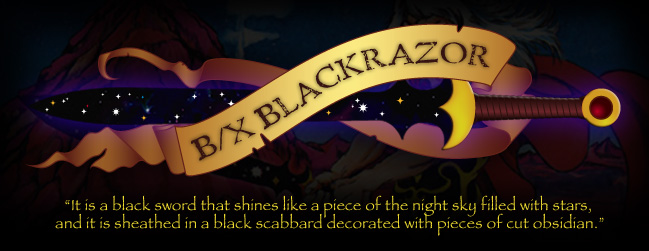
As Schick himself has pointed out, Blackrazor is heavily based on Michael Moorcock’s famous blade Stormbringer.  Actually, I believe his exact phrasing was something like “blatant rip-off.”  

Well, BR may be inspired by Stormbringer, but I see them as two very different swords, and consider them such.

For those who haven’t read Michael Moorcock’s books, his most well-known character outside of Jerry Cornelius is the albino sorcerer-emperor Elric of Melnibone, a tragic character who ends up slaying friends and lovers on his way to destroying kingdoms and (eventually) the world.  He’s one of the earliest anti-heroes found in fantasy literature, and extremely compelling. 

At least, I always found him to be.  Before actually reading Howard’s books, my associations with Conan were more of the bare-chested He-Man/Masters of the Universe image.  The idea of a skinny, pasty intellectual kicking so much ass was music to my young mind (being kind of a skinny, pasty, intellectual myself).  Plus, I find a very angsty-teenager feeling in the Elric books that appealed to me through my formative “grunge years” (15-21 or thereabouts) growing up in Seattle in the 90s.  Vampire the Masquerade only wishes it could be so dark and nihilistic as my man Elric!

Much of Elric’s power came from his sentient blade, Stormbringer. Stormbringer was a demon incarnated in the form of a black "greatsword," covered in glowing scarlet runes.  That’s as much description as is really definitive.  Sometimes wielded one-handed with shield, it is just as often described as requiring two hands to use. 

Stormbringer has the power to suck the soul (utterly slaying) any person suffering the slightest hurt from the blade.  However, since Elric tends not to do “slight hurts” (every described strike with blade seems to be a mortal wound), perhaps this power is only activated on a “killing blow.”  In exchange for the taking of souls, Stormbringer confers upon Elric tremendous strength and vitality.  However, once sated (the blade stops being hungry for souls after a few hours in battle), it ceases to confer extra power.

Stormbringer also has properties resembling a dancing sword from D&D.  Being a sentient being, on certain planes it takes a roughly humanoid shape rather than that of a blade. It is intelligent but neither talks nor communicates telepathically…instead it “moans” or “wails” and communicates with Elric via a kind of deeper/baser empathic understanding.

And that’s really the extent of it…besides the “soul sucking” ability (really not much different from a life draining sword), Stormbringer’s powers are quite a bit dissimilar from Blackrazor.  Only on a most superficial level does Stormbringer’s purpose even resemble that of Blackrazor…Stormbringer has no purpose but to serve Elric and (ultimately) Arioch, Elric’s infernal patron. Oh, yeah…and eventually help Elric destroy the world in the Final Conflict (Moorcock’s version of Armageddon).  Blackrazor’s purpose: to suck souls. No more, no less.

Interestingly enough, there were AD&D stats for Stormbringer at one time, and it was quite a bit different from the write-up of Blackrazor.  Stormbringer was present in the Melnibonean Mythos of the 1st printing of Deities and Demigods, subsequently re-called and re-issued minus the Moorcock and Lovecraft sections.  I had the chance to borrow a copy years ago and even made (un-authorized) photocopies of the relevant pages, such copies being now lost in the mists of time. 

As I recall, Stormbringer converted stolen life energy into both Strength and Constitution for Elric…there were a maximum number of (hit points? Constitution? Levels?) it could drain before becoming satiated, though the number was in the hundreds.  I do not recall if the blade conferred “experience levels” on its wielder like Blackrazor, but it DID have the dancing capability.  It also had a tremendous ego/intelligence.

All things considered, I can truly say I prefer Blackrazor to Stormbringer.  Here’s why:

  1. Limitless versus limited power
  2. Encourages berserking Hand-to-Hand combat
  3. While both names are cool, "Blackrazor" is totally badass

Regarding #1…when I do my B/X write-up of Blackrazor, its power will be slightly reduced due to B/X level restrictions…which will actually make it a bit more like Stormbringer!

Though, of course, Stormbringer had a "sister blade" in the form of Mournblade.