Showing posts with label blueprint. Show all posts

Tuesday, August 22, 2023

Editions & Expectations

The point of this series is to provide an easy-to-follow blueprint for the prospective Dungeon Master to run a game of Dungeons & Dragons that will satisfy them in the long-term. Because D&D is a game that, honestly, requires very little financial investment (meaning you can play it on very meager means) AND can be played even after age and disability limits you from most other activities, long-term is the best way to think about and approach the game. 

But we'll get to that. First we need to temper expectations.

If you are interested in being a DM because you are hoping to be the next Tolkien or something, man you are barking up the wrong tree. If you want to direct film (or plays) or write for television...go do that. If you want to write a gigantic fantasy novel series like Sam Donaldson or George Martin or (God help you) Robert Jordan...then go do that.  Write your books. Write your screenplays. Film them...whatever it takes to scratch your artistic itch...DO IT. Draw your magnum opus comic book with Frazetta-like characters or Aspirin-like situations or WHATEVER. Go do that! Hopefully, you'll make some money on it, but REGARDLESS, you will find satisfaction pursuing your creative endeavor of choice.

D&D doesn't look like that. Oh, I know...there are folks on the internet that play D&D that seem to be creating some sort of entertaining "story." That's fine...that's another form of scripted entertainment, created to entertain the subscribers. That is NOT what D&D play is, nor what it looks like in practice, nor (I daresay) what makes it an incredibly enjoyable pastime.

D&D, in its best form, is a fantasy adventure game, allowing players to experience fantasy adventure. But what does that really mean

It means that it is a game. A game that creates high emotion in its players...fear, joy, excitement, exhilaration, despair, anger, sadness, triumph, etc...emotions that are EXPERIENCED in play, much like a competitive sport or game of high stakes poker. That's what it's like to PLAY the game...that is the "fun" of the game...for the players.

For the Dungeon Master, the satisfaction comes from creating a world and running a game that creates these emotions in players. 

But if you expect players to "perform" in the manner of a trained actor or "behave" in a manner that "befits the story;" no, in most cases that's NOT what you're going to get at the table, even with trained actors for participants. That's just not what the game is built to do...not in ANY edition of the game. You might have a group of very creative individuals sitting at the game table with you...screenwriters and novelists with a modicum (or more) of acting talent, and your game will still fall far, far short of the satisfaction of writing your own novel (in which you can control the content and dialogue) or directing your own show (same).

Trying to administrate these things is missing the point of play. And, over time, you will end up very, VERY disappointed if this is your expectation of play.

In running the game of D&D, the DM presents a world, with various things for players to do. And by "do" I mean Choices that players can make about Actions their characters take in hopes of having an Impact on the imaginary (DM created) World. THAT, my dear friends is the game of Dungeons & Dragons. That is the essence of what the Dungeon Master does...at least, as far as the players are concerned. What happens behind the scenes (and mostly away from the table) is the world building done by the DM to create the dynamic campaign with which the players interact. 

Done right, this creates a campaign the players want to return to and engage with on a regular basis...it is the well-run campaign that creates the drive in players to play.  Which, in turn, provides feedback to the DM that is used for additional dynamic world construction, giving the DM (as Bath wrote) "full reign to his creative genius."

It is this interplay between players and DM, facilitated and moderated by the rules, that govern and express the play of the Dungeons & Dragons game.

So what rule set to use?

Despite all the internet "ink" spilled on the subject, the edition/version of D&D used is of secondary importance (at best) to the play of the game as just described. Every DM will, with time, make adjustments to the ruleset to better suit their needs in play, and EVERY edition requires additional work by the DM to ensure that long-term, satisfying campaign play is achieved.

The various Basic editions (Moldvay, Mentzer, Holmes) provide an adequate introduction to the rules, and are the most accessible way to learn the game system. Coupled with addition of an "Expert" set (Cook/Marsh, Mentzer) they provide instructions for the basic procedures of the D&D game: character creation, combat, advancement, exploration, etc. They are all well written for their purpose and excellent in obtaining their objective: even players as young as nine and ten can grasp the basic systems and processes of the game after a reading of (one of) these Basic books.

The Advanced game (Gygax) in its first iteration provides a more robust system for play that anticipates and addresses many of the issues that might hamper long-term campaign play. This includes a more robust selection of player choices (no less than 35 combinations of race and class, more spells and equipment, and some inherent/integrated world building considerations), expanded rosters of monsters and treasure, and a variety of options and decent advice sections for the Dungeon Master. Gygax's AD&D (sometimes called 1E or "first edition") codifies many of the "best practices" developed over years of actual play and experimentation. The core volumes of play include the Players Handbook, Dungeon Masters Guide, and various Monster Manuals. Later volumes in the 1E series provide additional rules and ideas, but most are fairly superfluous to running the game.

The original D&D game (Gygax & Arneson) provides the basis for both the 1E and Basic editions of the game and for the historic-minded or unapologetic game tinkers, it provides the foundational bones on which the game was built. "OD&D" (as it is sometimes called) along with its supplementary volumes can provide a better understanding of the game's evolution and rules development, but to make the game function requires many choices and additions from the DM/referee. While this holds a great appeal for DMs who enjoy performing their own customization, it is a distraction from the actual creative imperative of the DM (world building and campaign creation). Also, many DMs find that the additions and modification they end up using are already anticipated by the AD&D (1E) version of the game.

The 2nd Edition (Cook) version of AD&D is similar to 1E in most ways, simply streamlining and restructuring many of the disjointed and scattered rules of the system. However, 2E's restructuring of the advancement system (the method in which players earn "experience points" or x.p.) is problematic in that it A) removes an easily understood, objective measure of success, and B) removes an incentive for cooperative and creative play. This has consequences in both the short-term AND long-term campaign play, but can be rectified by reinstating the "gold for x.p." standard (and several published adventure modules for 2E strongly advocate taking this specific action).

Both the 3rd Edition of D&D (sometimes called D20 and currently published as the Pathfinder game system) and the 4th Edition of D&D have multiple issues that make them rather unsuitable for long-term campaign play of the type I aim to describe in this blueprint; they represent their own, very different...and divergent...types of game play. They fall outside the purview of this series. 

The 5th edition is the current and most widely played version of D&D at this moment in time. Its publishing longevity surpasses any edition except 1E and 2E. It has had no less than three introductory box sets published for it, helping to make the rule system accessible for the new player, and is well-supported on-line by both the publishing company (WotC/Hasbro) and a large community. It is largely streamlined and simplified compared to prior "Advanced" editions (1E through 4E) yet enjoys robust player options far surpassing "Basic" editions of the game. And because of its variant rulebooks options, 5E provides a wide-spectrum of ways for the game to be played: it is customizable (like OD&D) and provides the DM with vast means of rewarding players (via fiat or "story awards"). It models a very different game play experience from earlier editions of the game...an experience based on expectations set by standards of video game design...which may have a broader appeal to a younger demographic of participant. Unfortunately, as such it also falls outside the purview of this series; while it's certainly possible the 5E mechanics could be adjusted to make it conducive to satisfying, long-term campaign play, the effort and analysis in doing so is more than I care to perform, given that there are already alternative systems available that provide a more-than-adequate head start on the task at hand.

Aficionados of Dungeons & Dragons generally have a favorite edition, based on the point at which they entered the hobby and/or the point at which they "mastered" game play. Preferences of style and design vary from player to player and (as stated above) almost all Dungeon Masters, with time, will modify the rules somewhat to meet their own preferences of play. As such, I think it's important not to become too distracted from the subject at hand by quibbling over which edition of the game is "better." Each edition can be made to work, and even amongst the older (pre-2000) versions, each will give a slightly different experience or "flavor" of play. 

In the end, we are unconcerned about flavor. We are concerned about long-term play. Choose a rule system and stick with it. As this blueprint continues, adjustments to system will be inevitable. 

Thursday, August 17, 2023

Learning From The Oldest School

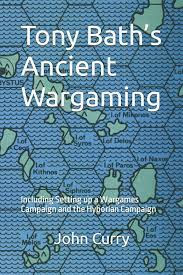
Tony Bath was a British wargamer who founded the Society of Ancients and (in certain circles) is celebrated for his long-running "Hyboria" campaign, based mainly on the setting Robert Howard created for his Conan stories. While Bath died in 2000 (at the age of 74), his writings have been collected and are still published by The History of Wargaming Project (edited by John Curry) under the title Tony Bath's Ancient Wargaming.

Good read.
Bath's writing, especially his 1973 work, Setting Up A Wargames Campaign, is remarkable because despite it being written about wargaming for wargamers, much of it (especially the thought process and philosophy) is directly applicable to Dungeons & Dragons and the burgeoning Dungeon Master seeking to build their own RPG campaign. Conclusions that I've only reached after decades of playing and pondering and reading the blogs/writings of folks much smarter than me, were carefully outlined by Tony Bath years before I ever laid eyes on the Moldvay Basic box.

Of course, it is no secret that D&D was created by wargaming enthusiasts. But when I write that Bath's book is directly applicable to the D&D game, I'm not talking about his rules for conducting tabletop battles, historical or otherwise. While such battles can be a part of one's D&D campaign (see the Gygax novels I mentioned in my last post as examples), the rules of D&D are far more concerned with the small scale actions of individual heroes (i.e. the player characters) then the movements and actions of troops. Instead, it is Bath's procedures and philosophy of creating and running campaigns and world building where one finds golden instruction.

It is only the vocabulary used that needs to be [slightly] altered.
"Almost all new [D&D players] start their careers by fighting a succession of single, unconnected [adventures]; this is inevitable since it takes time to get the feel of the hobby, to learn the rules, etc. But if a new recruit is really going to take up [D&D play], then before very long he begins to feel that something is lacking; that these individual [adventures], though well enough in their way, need some connecting link to make them more satisfying and to give an objective other than just trying to [kill monsters, delve for treasure]. In other words, the desire to [play] campaigns rather than ["adventures"].

"What makes campaigning so rewarding? Why, if you have fairly limited time available for the hobby, should you use time that could be spent in fighting on the table-top in [dealing with the minutia of encumbrance, rations, resource management, etc.]? The answer is that no real-life general could limit himself to the purely tactical problems of the battlefield, and a campaign is the way in which the [D&D player] general widens his horizon. 

"The player who merely participates as a [player character] finds the opportunity to practice strategy as well as tactics. He may find himself having to solve problems of supply and finance, and, if the campaign is a complicated one, matters of diplomacy, etc. as well. He must learn one of the hardest lessons for [of D&D play]: when to cut his losses and abandon [an adventure], instead of fighting to the bitter end.

"The [player] who [acts as a DM] to run a campaign gains even more, for he can give full reign to his creative genius, both as regards the rules he uses and the countries and characters he creates. A radio interviewer once asked me whether the desire to run a mythical continent of my own was a sign of power mania; I replied that this was possibly true to some extent, since most of us like playing God to some degree, but more important was the freedom it gave to a bent for organizing things.

"As your campaign develops, you will find yourself adding fresh angles to it which, while quite unnecessary from a purely practical viewpoint, can add much fun and interest to the proceedings.

"It is however true of campaigning, as of so many other things, that the amount of enjoyment to be obtained from it is pro rata to the amount of effort that is put into it. This will vary from person to person and group to group according to ow much time and interest people have to spare, but the main ingredient necessary is enthusiasm for the project and a sense of responsibility toward the other players. 
"...if you are running a large or complicated campaign it is necessary to pick your players wisely."
[excerpted, with adjustment, from the introduction]

None of which is very new info to longtime readers of geezer blogs like this one...as I said, the remarkable bit is just how much of it is applicable to D&D and how old this material is. 

Following the introduction, Bath gets down to the nitty-gritty of building one's campaign from the ground up...assuming you are creating a fictional setting like Bath's own Hyborea campaign. And, of course you are: you are a Dungeon Master for a D&D game that is going to have magic and monsters and whatnot even if it is set in (a fantasy version of) our real world.  Bath discusses the drawing of maps, the outlining of political borders, the importance of rivers and roads and natural features, the seeding of population centers, and the impact and use of weather. He discusses setting up factions and characters (and their personalities), determining resources and economics of nation-states, and how all these things drive the campaign, creating dynamic environments and providing ideas for situations and scenarios. 

It is all good advice and most of it is readily adaptable to one's D&D game.

What I am lauding here is practical application of Bath's procedures to world-building. This is not about crafting histories and backstories and "plots" or "story arcs." These things are unnecessary to creating and running a campaign that is vibrant and engaging for the players.

What IS necessary is a world with things to do. A world with a degree of verisimilitude, where there are consequences (good, bad, and indifferent) to the actions of the players. A world that gives the players the chance to make an impact based on their own actions. 

Of his own campaign world, Hyboria, Bath writes the following:
"Like all good things, Hyboria had small beginnings. In the early days I had no experience of campaigns and only the vaguest ideas on rules of map movement; things like finances, supply, etc. had not yet reared their ugly heads with all their attendant complications. So we...usually just decided to have a war between two countries and set up one or possibly two battles which decided the result of the war. That was back in the dim and distant past -- in fact the first two or three battles were actually fought on the floor with 54mm solid figures -- a process I definitely don't recommend.

" The long history of Hyboria (which is all recorded in very considerable detail) began with the first Brythunian war when the ambitious King Mamedides of Hyperborea invaded its southern neighbor. This resulted in the Battle of Warrior's Pass, fought under the most extraordinary rules, and the repulse of the invasion. I commanded the Brythunians on this occasion; I then changed and led a second Hyperborean invasion, which was more successful..."
Please take note: the history of Bath's campaign world (which he chronicled in SoA's bi-monthly newletter Slingshot) BEGAN with these first battles. His world was created by adapting various real world cultures (ancient Greek and Roman and Persian, medieval European and Viking, American Indian, etc.) to a fictional map drawn from Howard's tales, and then assigning it characteristics: here is a wealthy country. Here is an ambitious ruler. Here is a mountain pass. How do these things intersect with each other to create an interesting, playable scenario?  

Do we care what has gone before (play began)?  No! What matters is the play of the game. The world-building sets the stage for the play. We may, after play begins, chronicle the history of how play unfolded...how legends arose from our gaming table...if it so amuses us (as, generally, it does). But as players of a game (whether Dungeons & Dragons or a wargame), it matters not a whit to us WHY, for example, a PC became a magic-user instead of a druid or monk. We do not care about backstory or motivation; we are not actors researching a role for a play, nor authors plotting a trilogy of novels. What we care about is the situation at hand and how the game will play out.

Dungeons & Dragons was created by wargamers, and its no wonder: in Bath's writing he constantly name-drops fantasy authors like Tolkien, Leiber, Srague de Camp, etc. (authors found in Gygax's "Appendix N") as being widely read by members of his Society of Ancients and being inspirational reading for wargaming campaigns...even though SoA itself decided very early on NOT to include anything "fantastical" in their rules and games. The idea of "fantasy adventure" fires the passions and imaginations of LOTS of people, not just wargamers. But wargamers, by trade, seek to create rules and model adventure in a fashion that allows its experience in a safe, comfortable environment. Around the gaming table, in other words. 

D&D, and other fantasy adventure games, simply "drill down" to a more specific, smaller level than large scale warfare.  And by doing that, they make the experience of play even more intense and personal to the people involved. Which might account for why the FAG hobby has more devotees than wargaming in the present, even if there is a lot of confusion on the best way to run/play the game.

More blueprint posts to follow.

Tuesday, August 15, 2023

Inspirational And Educational Reading

"Inspirations for all of the fantasy work I have done stems directly from the love my father showed when I was a tad, for he spent many hours telling me stories he made up as he went along, tales of cloaked old men who could grant wishes, of magic rings and enchanted swords, or wicked sorcerers and dauntless swordsmen. Then too, countless hundreds of comic books went down, and the long-gone EC ones certainly had their effect. Science fiction, fantasy, and horror movies were a big influence. In fact, all of us tend to get ample helpings of fantasy when we are very young, from fairy tales such as those written by the Brothers Grimm and Andrew Long. This often leads to reading books of mythology, paging through bestiaries, and consultation of compilations of the myths of various lands and peoples. Upon such a base I built my interest in fantasy, being an avid reader of all science fiction and fantasy literature since 1950. The following authors were of particular inspiration to me. In some cases I cite specific works, in others I simply recommend all their fantasy writing to you. From such sources, as well as just about any other imaginative writing or screenplay you will be able to pluck kernels from which grow the fruits of exciting campaigns. Good reading!"
[Inspirational Reading list follows, then:]
"The most immediate influences upon AD&D were probably de Camp & Pratt, REH, Fritz Leiber, Jack Vance, HPL, and A. Merritt; but all of the above authors, as well as many not listed certainly helped to shape the form of the game. For this reason, and for the hours of reading enjoyment, I heartily recommend the works of these fine authors to you."
Gary Gygax's much lauded "Appendix N" shows up on page 224 of the first edition DMG...a list of fantasy books and authors that EGG held up as particularly inspirational and influential to his writing of the Dungeons & Dragons game. 

Yet, despite being enjoyable reading, none of these books will provide much of a map or outline of how to run the game of D&D or even describe (much) of what a D&D game should look like. Oh, there similar themes, scenes, and events that might be found in any particular game session. But while "Appendix N" may give one a good feel for the fantasy that shaped the imaginations of Gygax, Arneson, etc. they are not instructional when it comes to teaching the game of Dungeons & Dragons. Trying to run your game so that it looks like a Howard or Leiber story will, at best, result in some kind of pastiche or homage to those authors. 

And while creating such pastiche can be good fun, it stagnates readily enough, much as any type of "railroad gaming" becomes (sooner or later) stale and unsatisfactory. In this case, the railroad is one of genre, rather than story...though, of course, hewing too closely to any fictional inspiration can result in the DM using force to that end as well. "Don't let the rules (or dice rolls) get in the way of telling a good story" is an aphorism sadly parroted throughout RPG circles...even those styling themselves as "Old School" gamers.

Despite the long list of monsters and magic and concepts (like "alignment") that were taken from these authors...in much the same way that mythology and books of historic medieval armaments were purloined for the game...Dungeons & Dragons, as a game, neither models nor even attempts to model these stories. And attempting to run one's game so that it looks like a Howard or Leiber or (God forbid!) Lovecraft story is a fool's errand and a disservice to the game itself. 

Dungeon Masters are not authors; at least, not when we are operating in our role as Dungeon Master. 

The job of an author is to tell a story. Short stories provide a problem or scenario for the protagonist to struggle against; long stories (novels) show how a protagonist develops and changes over time given the events of the book. Both of these apply to the Dungeons & Dragons game (our player characters struggle in the immediate term against the challenges set by the DM and over time they grow and change), but in D&D this is done without a directed course. There s no premise being addressed, no theme being explored, no climax that needs to be met. A game of D&D is NOT a story, not in the way the books in Appendix N are. 

It is, rather, the "story of our lives," which is to say the process of living and existing...even though the lives being lived are completely and wholly of our imagination. This may sound ridiculous, but D&D is an experiential (fantasy) adventure game and, in the end "living" an imaginary life is what the game play...for players...boils down to. 

In this regard, I believe that Tolkien's book The Hobbit may be the closest of the Appendix N books to describing a D&D campaign. Yes, it has all the trappings: monsters, treasure, spells, "dungeons" (the goblin caves, the elf king's halls, the Lonely Mountain), swords and wizards and "demi-humans." But the novel is far more than just its recognizable "fantasy" tropes: Here is a world setting, carefully crafted by its maker. Here are events and challenges faced by a group of protagonists, cooperating for mutual success. Here are choices being offered that may lead to peril and/or the possibility of reward, and always with additional, character-driven consequences...consequences which, in turn, shape the on-going campaign and the narrative ("story") of that campaign.

And here, also, are the logistical issues of adventure...those aspects that change the game from a simple fairy tale adventure story, to an immersive experience with verisimilitude. Issues of food and shelter, baggage trains, overland travel, and inclement weather. Relationships with powerful individuals that need to be groomed and/or carefully managed (not just Beorn, but the goblin king, the elf king, the Master of Lake Town, etc.). These aspects of "life" cannot be ignored if one seeks to play D&D over the long-term...the manner of play in which it reaches its highest level.

Conan's episodic adventures, enjoyable as they are, are adolescent at best, in comparison.

In this regard, The Hobbit is highly reminiscent of H. Rider Haggard's classic adventure novel, King Solomon's Mines. Despite its 19th century timeline and lack of "classic fantasy" tropes, Haggard's book has plenty of D&D-style adventure in its pages: exploration and privation, treasure seeking and combat, ancient, subterranean labyrinths (complete with traps), and interpersonal relationships with NPCs both helpful and hostile. Despite its anachronistic setting and the shortness of its scope (the book details only one "adventure" per se...though an admittedly massive one), there is a lot for the DM to learn about crafting a scenario worthy of the long-term D&D campaign.

Haggard's book also demonstrates how much raw power and adventure can be generated just using the history, cultures, mythology and geography of our own world. Rather than invent from whole cloth, or create pastiche of favorite fantasy books and films, most Dungeon Masters will find it more productive to seek out the same sources of inspiration and educational reading that informed the settings and scenarios of their favorite fantasy authors (like those in Appendix N): namely, the non-fiction books concerning our real world. Most, if not all, of the strange and weird cultures and situations described from Bracket and Moorecock, Howard and Leiber, are simple re-skinnings and/or re-imaginings of our own world's past (and, in some cases, its present). Many are the neophyte DM who disregards or downplays the "banality" of our mundane "real world" in favor of "true fantasy," failing to understand that the fantasy authors they best love and admire were drawing directly from real world sources. Before the last century or two, our world  had thousands of years of untamed wilderness, mighty cultures (rising and falling), supernatural beliefs, perilous journeys, and adventurous folk of all languages and skin tones looking to find "fortune and glory." That many of us equate "adventure stories" with European/Western colonialism is a sad commentary on the lack of depth in our literary inventory: we read of crusader knights and gold-hungry Spaniards and completely neglect the fact that there are humans in every corner of the globe and history who have sought to rise above their station through adventurous means. 

"Fortune-hunting adventurer" has NEVER been the exclusive purview of white dudes.

However, let us not digress too far from the subject at hand: creating an easy-to-follow blueprint for running Dungeons & Dragons. The DMG is, of course, a great sourcebook and place to start...kind of like the Bible is a nice book to read if you want to be a Christian. But, just as Christianity (any form) needs a bit more to find a lasting and satisfying spiritual life, you're going to need more than just your copy of Gygax's opus.

As of today, the BEST books I've read that describe a typical "Gygaxian campaign" of the AD&D variety are those written by Gygax himself, specifically Saga of Old City and Artifact of Evil. These are...admittedly...terrible books, but they are EXCELLENT descriptions of what a 1E campaign would look like, especially the latter book (Artifact). They aptly demonstrate the weird, kitchen-sink fantasy of Gygax, show how alignment works, displays the emphasis of mass combat (while still maintaining small-scale, personal action), and pays no nevermind to the various anachronisms of speech and culture that crop up during a game session. D&D play is not about method acting or historical reenactment; it is a game designed to be experienced by the players. Reading these books, while perhaps painful to the more erudite amongst us, does show what your average, competent 1E campaign looks like if you play with all the bells & whistles of the original seven volumes (DMG, PHB, MM, MM2, FF, DDG, UA). 

That doesn't make it a great campaign...but it does make it a great example. And probably the best example in print (apologies to Dave Arneson and his First Fantasy Campaign book).

Now, in my next post, I'll discuss the foundational text for creating your own campaign; not the DMG or anything in its "Appendix N," but a pertinent book written with a similar, parallel objective in mind: Tony Bath's Ancient Wargaming.