Showing posts with label new school. Show all posts

Wednesday, January 25, 2023

YOU Are The Story

Jeez Louise...so many topics to get to (none of which are OGL-related, thank goodness!) and so little time. I'm trying to write a damn blog post about an orc (not just any old orc, but a SPECIFIC orc), and then THIS comes up. Sheesh.

But it's (kind of) important. 

So, Adam (Barking Alien, for those in the know) posted a comment on my last post (Boring Old D&D) saying:
"It's posts like this that confuse me in regards to what it is you enjoy and why you enjoy it. You don't go in for the Story, Narrative driven games but 'it's not just about killing monster and taking stuff'. How does that work? 

"How do you have no story but it's not just a video game with paper and dice?"
For the record, this is (perhaps) the thousandth time BA and I have danced this little dance. He is very much of the (now old) New School of RPG game play...the kind that came out of Dragonlance and 2E-era D&D, the kind that in the '90s led to White Wolf games like Vampire and all its many imitators. Games that wanted to explore story and genre until birthing (and being killed by) the rise of the indie, Story Now (or Narrativist-oriented) games. For those of us who've been around since 1981 (and followed the evolution of the hobby), its pretty easy to recognize the foibles of 5E D&D as the second coming (and rebranding/marketing) of 2E AD&D. 

[that's probably a whole 'nother post. What'd I say? Too many topics these days. However, here's a hint: WotC/Hasbro's quest to "more monetize" the D&D brand has direct parallels with post-1985 TSR]

ANYway. Adam is no 'spring chicken.' He's been playing RPGs nearly as long (or perhaps longer) than I have. He came in with Basic...Holmes, if I remember correctly...long before Dragonlance. Certainly long before 2E. One might jump to the question, "Hey, why isn't this guy on the same page as JB? He's an old geezer...doesn't he have the same sensibilities?" Just remember: the story-centric "role playing" that followed Wargamers Gygax/Arneson initial creation was created by folks OLDER than us. The Hickmans are OLDER than me...they were married adults in their 20s when they were writing epic Dragonlance modules.  This is not an issue of age, generation, or "wargamer background."

[in case anyone's wondering, I don't have a wargaming background]

The way I see it, the problem here is one of confusion and misunderstanding. There is a (LARGE) segment of the hobby that sees RPGs as vehicles for "telling stories." That "telling stories" is the OBJECTIVE of play. "This game [insert name] allows you and your friends to tell stories, just like [insert favorite book, film, or genre one wishes to emulate]."

Before going any further, in this post you need to BREAK that presumption. Even if the game instructions SAY that's the objective of play, you need to nip that right in the bud because there's a good chance that A) the game writer had a poor understanding of what was going on, AND/OR B) was simply emulating prior games description of 'what an RPG is' when they wrote it.

BREAK THAT PRESUMPTION. DO NOT PRESUME THE GAME IS DESIGNED TO TELL STORIES.

Okay. Are we clear? Blank slate everyone? Now we can advance.

There ARE games on the market that are specifically designed to tell stories. Once Upon A Time is a good example. Story Cubes are another. The Adventures of Baron Munchausen is yet another and also includes some elements of 'role-playing' in it. 

There are ALSO many RPGs (and pseudo-RPGs...like Fiasco) that have been published over the years that have the objective of telling stories, using recognizable RPG elements, that can somewhat succeed presuming everyone is on board with genre emulation. The Dying Earth RPG. My Life With Master. New Fire: Temikamatl. OrkWorld (maybe). Dust DevilsPrince Valiant. Maybe Amber Diceless. Christian Aldridge's Maelstrom (i.e. Story Engine) The degree to which the telling stories is supported by the game's mechanics (rules/systems) varies between games, but they are GENERALLY supportive of creating stories...in their particular genre...and they don't do much else. 

[there are other examples...really, too many to list]

Then there are...the other games. Games that are based on D&D concepts, mechanics, and play dynamics. "Role-playing games" they are called...games run and moderated by a game master while the other participants play the role of a single character. Games with explicitly stated (or else assumed) objectives of "telling a story." Of creating a narrative with a point to it. Because OTHERWISE the act of play is deemed to have no point or reason to play

Or, to use Adam's words, "How do you have no story but it's not just a video game with dice?"

This is coming at the game from the wrong angle. It is starting with the presumption that playing the game must be about something (it is), about something meaningful (it is), like creating a narrative with a plot a climax and heroic...or at least worthy...protagonists (it is not).  

Dungeons & Dragons was...originally...never about creating stories in the way an actual story telling game is designed. That doesn't mean stories didn't result from the antics of the players, stories that might emulate much of the genre books that inspired D&D (i.e. the infamous Appendix N). But any story creation was the by-product of play, not the point of play. The point of playing Dungeons & Dragons was playing Dungeons & Dragons.  And any textual statements to the contrary should be chalked up as either:
  1. a failure to understand/grasp the appeal of a very new, very unusual game by the original authors, AND/OR
  2. blatant lies and/or terrible attempts at marketing a game that was poorly understood even by its own publishers.
Later RPGs tried to take the "magic" of D&D into their own genres, settings, with tweaks to the system (as TSR did with Top Secret, Boot Hill, Gamma World, Star Frontiers, etc.). But for a number of reasons (which I might get to in a later post) these were LESS successful...and not just because people prefer elves and swords and magic. 

[like I said...needs its own post]

But SOME folks really still wanted elves and swords and magic but with something MORE. For the Hickmans, they had very specific design goals: they wanted objectives that weren't limited to pillaging and looting, they wanted an "intriguing story" that was "intricately woven into play itself," and they wanted scenarios that could be finished in an evening's play. When the Hickmans were hired by TSR, they incorporated these design priorities into their adventures and when those adventures were successful, the design priorities of the (for profit) company shifted to match.

And all the imitators of D&D followed suit.

Again, realize that creating a story was NEVER the "point of play" for the D&D game. The systems (i.e. rules) it has are there to facilitate playing D&D, not to facilitate "telling stories." People like playing D&D (it's why the game is so successful...and will be explained in that later post), just like people enjoy playing baseball or soccer despite there being no real "point" to the game. The point of play is the play of the game. You are not creating stories...you ARE the story. 

Some of the biggest name designers in the story-oriented RPG industry never understood this. Here's Mark Rein-Hagen, designer of Vampire: The Masquerade:
"I have always been in love with roleplaying. Slap-happy mad over it. Ever since that first Sunday afternoon when my father and I sat down with the church intern and played Dungeons & Dragons, it has been my passion....

"In short order we'd created our characters and begun our adventure. I rolled up a Dwarf and my father made a Cleric...we were prepared to encounter all manner of fell beasts and sinister mysteries, but not to be caught up by it the way we were. The adventure was called In Search of the Unknown. How apropos that title was I was not to realize until much later.

"After a few hours of play we found ourselves hopelessly lost due to a magical portal...(description of adventure follows)...I was so excited that I couldn't sit still whenever the gamemaster rolled the dice...and when we finally got out of the dungeon with our treasure and our lives intact, I raced around the house screaming with relief and exaltation.

"It was wonderful. It was exhausting. It was miles beyond any other experience I've ever had.

"In that afternoon I was transformed, elevated to a new plane. I had a profound, almost spiritual experience. My entire goal in roleplaying has been to once again visit that mystical garden in which I so enjoyed myself, and discover a means by which I might remain there...it is the sort of thing that changes a life.

"But the trouble is, it didn't happen every time I played. In fact, it didn't happen for a very long time...(long description of seven years of gaming, going from dungeon crawling to wilderness crawling to PVP to min-maximing munchkinism)...sure we had fun, but it wasn't exhilarating, it wasn't transforming, and it wasn't what I really wanted....

"Eventually, it grew altogether too wearisome, and I began to roleplay less and less. Roleplaying became a hollow experience, a sad reenactment of the rites of youth. 

"Then it suddenly happened again, while playing Runequest and exploring the ruins of Parvis. An experience just as intense and transforming as the first. All of a sudden I realized what I had been missing, and I was horrified. A skilled and intense gamemaster had brought back the magic.

"These two experiences are what, for me at least, define what roleplaying is about. Is is what attracts me, and continues to compel me."
[all excerpt taken from The Players Guide for V:TM, essay: "A Once Forgotten Dream," copyright 1991]

That's not the end of Rein-Hagen's essay, as he goes on to explain his thoughts about how to create that exciting, transformative experience in your own games. He arrives at the wrong (practical) conclusion despite having the right answers. He gives four simple points to follow, none of which require one to play a "deeply personal," "intense," "story focused game" like Vampire: The Masquerade:
  1. Make you mind as open and receptive as you possibly can
  2. Believe in the world and scenario created by the game master
  3. Identify with your character (the character is your avatar for interacting with the world)
  4. Exercise (grow/develop) your imagination
Of course, all that is just player-facing advice (this is the advice section in the PLAYERS Guide, after all). The part that he glossed over...or ignored/forgot/discarded...was the most important revelation of his essay: All of a sudden I realized what I had been missing, and I was horrified. A skilled and intense gamemaster had brought back the magic.

It's not about creating a story...it's about experiencing the fantasy. And to do that requires a skilled, intense, and committed GM...and players who are open, receptive, and committed to operating in the GM's world. When THAT happens...whether you're playing D&D, RuneQuest, Vampire, whatever...THEN you're getting the point of play. The point of play is the experience of playing. YOU are the story.
: )

Wednesday, January 11, 2023

Live-Action D&D Television

[was going to write something about copyright law, fair use, and game "licenses," but everyone's sick of that stuff, right? Maybe next week...]

So...we watch a lot of TV at my house.

Too much, I'm sure...at least by the standards of a guy who spent several years (in his twenties) not even owning a television, and not missing it one bit. But the wife enjoys it, the kids enjoy it, and it's a (lazy) way to all spend time together as a family...huddled around the video altar for an hour or two every evening. 

The current slate of programming isn't all that great...Wednesday was the last decent series we finished which, for me, was kind of a "light" (or kid-friendly) version of Sabrina. Yellowstone is what the wife likes to watch after the kids go to bed and it's...fine. It's just the same old 'powerful family drama' thing again (see Sopranos, House of the Dragon, Empire, Billions, etc., etc.), just in a different setting.

[I will say that the Kayce character is the most 'Montana' of all the characters written for the series...his attitude, physicality, manner of speaking, way of thinking is very much like any one of my uncles. They don't wear cowboy hats in Missoula, though...I'm guessing that's more of a Bozeman/Wyoming thing]

Current shows watched with the kids are multiple. Ghosts is pretty funny, and while some of the humor is too risque for my children, most of that is pretty over their heads. The latest install of The Mysterious Benedict Society has, I think, ended(?) and it kind of went out with a whimper instead of a bang, though that show has some of the most likable kids in television. National Treasure (based on the Disney film franchise) is...ugh...I'm not a fan. The main character is pretty cool/interesting but all her friends are SO DUMB and the plot is so contrived and filled with coincidence it's like reading a BAD Nancy Drew story (though IS there such a thing as a 'bad Nancy Drew' story...?). I find myself cringing a lot. Some of the Mesoamerican stuff is good...and some of it shows the writers could stand to do a little more research. Yeah...but the kids really dig it (it's a Disney show).

Then there's Willow...or as we like to call it: "D&D the Series." We just started this one last week or so (after rewatching the 1988 film) and, as of last night, we're all caught up with the series (I think the season finale is tonight, but we probably won't watch it till tomorrow). 

Oh, boy...where to start?

George Lucas originally conceived of the idea for Willow circa 1972...long before D&D was a pop culture phenomenon. His idea was to create a kids' fantasy film that (as with Star Wars) incorporated a plethora of tropes from myth and folklore: fairies, brownies, witches, knights, trolls, etc. The idea was always to have a little person as the lead (original title: The Munchkins) as a literal interpretation of the small guy going off into the big world of adventure. Lucas met Warwick Davis when doing Return of the Jedi (the actor's first role...he played Wicket the ewok) who would become a staple figure in later SW films. In 1987 Davis was offered the role of Willow; he was 17 at the time.

Having had a chance to rewatch the film twice now in the last year (coincidentally we showed Willow to the kids over the summer, before we were even aware the series was going to be a thing), I'd call it cute, light-hearted fare, typical of the late-80s and a cut above most kids' fantasy films not involving Tim Burton or Jim Henson. In fact, it might have been the LAST (halfway-)decent live-action film featuring swords and sorcery until the 2000s. 

[when was Legend done? 1985? Yeah, same with Ladyhawke. Highlander, Labyrinth, and Big Trouble in Little China were all 1986; The Princess Bride was '87. After that, there's nothing worth mentioning till Jackson's LotR (2001). Maybe the 13th Warrior in '99? Not much magic in it, though. I LIKE Erik the Viking, but that's more parody and snark than earnest fantasy]

SO...fast foward to the new Willow which is, yet again, another example of Hollywood nostalgia-mining IP from decades past to appeal to the hearts (and wallets) of aging geezers like myself. 

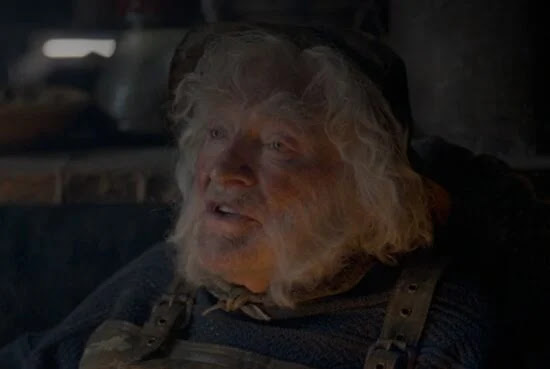
TV's Best Beard
It's...okay. The casting is pretty good. Warrick Davis, veteran actor, is a highlight; so is Amar Chadha-Patel (whose physical appearance will henceforth be the basis for ALL future D&D characters of Yours Truly, regardless of class). Tony Revolori is (surprisingly) growing on me. Elle Bamber and Ruby Cruz seem...fine, I guess (as actors), but their characters (especially "Kit") are written in a way that I find extremely obnoxious and grating. 

*sigh* I'm just not into teenage angst...and it is (for me) incredibly unbelievable given the circumstances in which the characters find themselves. They're just one step removed from "I miss my cell phone!"

Erin Kellyman seems to have already been typecast (after watching her in Solo and Falcon/Winter Soldier) and her emotional range seems...short. I can't tell if she's limited by the writing or her ability; probably a bit of both. But mainly her character ("Jade") is just...boring.

[I also hate Jade's sword; every time I see it on screen I just think of how unbalanced it looks and how many fingers she'd lose trying to wield it. Like, ALL her fingers]

The bit parts and cameos, however, are stellar: Joanne Whalley, Hannah Waddingham (!), Christian Slater (!!), Kevin Pollack, and Julian Glover all make the most of their brief appearances in the show. Adwoah Aboah, too, isn't half-bad, especially considering (I think) that this is her first on-screen acting role (?!). Every time some random human character appears on-screen with more than a few lines of dialogue/action, it's generally a much needed shot-in-the-arm for the series.

The show, Willow, is D&D. But not the good kind of D&D.

"I was once a paladin..."
(yeah, back before
your alignment change)
It was my (non-gamer) wife who first pointed this out to us: "This is just like Dungeons & Dragons!" You have the adventuring party composed of a pretty standard lineup (a couple fighters, a couple spell-casters, a thief, etc) going on an adventure, fighting monsters, looking for treasure, delving dungeons, finding secret doors, facing traps and obstacles, etc.  The classes and tropes are easily recognizable. First level adventurers off on their first real adventure.

But this isn't father's (or geezer blog writer's) D&D. This is D&D with DRAMA, where every character has a "secret past" (backstory!) or closeted skeleton or SOMEthing that is going to get worked out 'on-screen' over the course of the series. 

Because the STORY by itself (um, something-something about saving the world) isn't COMPELLING (or compelling enough) by itself. No. We need to resolve our unrequited love and deal with our murdered siblings and find out about our secret family members and blah, blah, blah.

Hey, remember the original film? Remember the backstory for Madmartigan? Or Sorsha? Or the titular Willow himself? Remember the film explaining why this farmer was interested in becoming a sorcerer? Or how he learned to be conjurer of cheap tricks? Or why his neighbors didn't like him despite him (apparently) being a normal hardworking family man with a decent farm, a doting wife, happy little children? Remember where he received his unbounded courage and tenacity and moral compass? 

No? Oh, yeah: because there wasn't any. Neither was there for ANY of the characters. You have a character, you have a situation (the plot of the film) and GO. Is Sorsha trying to work out mother-daughter issues with evil queen Bavmorda, some rivalry with General Kael, or moon over some lost lover or other? Perhaps. If she is (and that's all certainly possible for the actor to keep in the back of her mind) it isn't played out on the screen...it is simply background motivation that directs the character's actions.

Here (in the series) we have all this...um..."stuff," that is constantly being dragged out and examined and being discussed and worked on. And I suppose that if the series was about one featured character or protagonist that would be okay. But it's not about a single character...it's an ensemble cast, with six or seven (depending on whether or not you count the brother/prince) main figures, all of whom are (more-or-less) on the same team. 

So...this need to share spotlight time (and film minutes) on their various mental and emotional turmoils just feels like...I don't know...some sort of narcissism.

[which, you know, is kind of emblematic of late edition D&D ain't it?]

That and the anachronisms inherent in the show. Not just the dialogue which (again) sounds like typical teenage petulance and smack talk but the damn music. No need for a sweeping, epic score transporting us to a fantasy world like, say, Game of Thrones or Rings of Power or...heck...the original film Willow on which the series is based. Crimson & Clover? Enter Sandman? Good Vibrations?!

Um...okay. So this is a teen fantasy show that would have been at home on the CW ten years ago. Except with a bigger budget.

"Dude, JB is as big a curmudgeon about his fantasy television shows as he is about his D&D! Hey, Old Man, there's more than one 'right way' to create elf-magic-fiction content!" Sure, yep, absolutely. But, watching Willow would be a lot less jarring, less cringe-worthy experience if expectations weren't set based on the very IP the showrunners decided to mine.

[heck, I'm not even dinging the show for sometimes poor pacing and occasional crap editing. Well, I wasn't till now]

"JB, that Willow movie was 35 years ago! Expectations have changed about YA fantasy! Why do you think D&D had to evolve?!"

Mm-hmm. Indeed. Welcome to fantasy in 2023.

Now, I realize that I am hopelessly behind the times when it comes to modern (well, post-modern) sensibilities, but for me...geezer that I am...adventure fantasy is about something like escapism from the petty squabbles and dramas of daily life. Take the character "Kit" for example and her quest to find her father (which seems far more important to her than her initial quest to find her brother)...I'd say there's more than a few people out there who have had their fathers exit their lives in some fashion, and hardly ever is it for some 'heroic' reason. It might be inoperable cancer or a sudden heart attack that leaves a kid half-orphaned at the age of 12 (as happened to my buddy, Matt) . It might be the guy walking out on the family with no warning (as happened to my brother and I). Hell, I know two different guys (John and Ben) who BOTH had their fathers leave their mothers for some hippy-dippy commune before either was born. 

This kind of thing happens. Worse things happen with parents. I knew a guy who had a real problem with his mother because she sold his younger sister to a couple guys in order to finance her crack habit. There's some fucked up shit in this world...lots of reasons to want to escape reality for an hour or two on a regular basis. Do I need to have a fantasy setting, with magic and monsters, in order to deep dive the emotional wreck of human relationships? Isn't there therapy for that? Support groups to join? Books to read? 

How about a subplot related to the story at hand: for example, Kit has been trained to be a warrior/knight type but pretty obviously has been pretty sheltered up until the events of the story...how about dealing with the emotional baggage that comes with murdering sentient beings for the first time in her life.  She's having a semi-polite conversation with some hairy trolls one moment, and then whetting her blade in their lifeblood the next. And everything is still like "Oh no big deal. How can I get my romantic interest to not still be mad at me?" 

But, okay, maybe we want to de-emphasize the emotional consequences of murder and bloodletting in this "fun adventure fantasy." How about dealing with the issues of duty versus love with regard to her betrothal to a political ally who happens to be on the same adventure with her as with her lover. Instead, she pretty much ignores the man she's supposed to marry, as opposed to A) trying to get to know him, or B) arranging for some fatal "accident" that will remove an unwanted complication from her life. You know?

[can you tell I'm not a big fan of the writing?]

This is adolescent, narcissistic D&D. We are on an adventure, killing monsters, surviving dangers, and working on our (young adult) emotional baggage. We don't have to particularly get along or cooperate to survive because, you know, "plot immunity." Not a lot of fear or real stress, except for the stress of meeting expectations ("Will I ever learn magic? Jeez I was happier just baking muffins!"). This isn't swords & sorcery...it's High School Musical with Ren-Fair costumes and less singing. 

*sigh* I know...I'm an ass. My family's enjoying the show, and the thing has some stylish touches that are entertaining (really dig on the bits of psychedelia scattered about the series, as well as the occasional steampunk flourishes). But, for the most part, its style without substance. The substance of the show is...for my taste...rather bland. Not "vanilla" (pains have been taken to make the show very NON-vanilla in fantasy terms). But bland. 

Ah, well. One episode (I think) to go. We'll see if the finale changes my mind.

Tuesday, September 20, 2022

"Let's Go D&D!"


FOR IMMEDIATE RELEASE: 

I've got your 6th Edition D&D rule system RIGHT HERE. Free of charge! Feel free to play-test to your heart's content! Totally compatible with 5E!

[disclaimer: you will probably find it useful to own a copy of the PHB (just until the new 6E version comes out), but splat books with your favorite new classes, races, etc. will work in a pinch]

STEP 1: CHARACTER CREATION
  1. Choose a "class" from any that are available; right it on your character sheet. If you don't see one that suits your character concept, make your own.
  2. Choose a "race" (i.e. species, ancestry type) from any that are available. If you don't see one that suits your character concept, make your own.
  3. Choose a character "background." The 5E PHB has a list of different ideas (the 6E PHB will have a longer list), but you can do anything that pops into your imagination. Go wild! Try to sum it up in a few words (write the elaborate backstory in your spare time), and jot it down on your character sheet.
  4. Write down your character's "best ability" (strength, intelligence, wisdom, etc.). 
  5. Write down your character's "go to skill," some special feat, cool power, or awesome spell that can really save your bacon. 
  6. Give your character any type of equipment that seems reasonable for his/her class, race, and background...it must be noted on your character sheet! Use the lists in the PHB if you need ideas.
  7. Give your character a name. Write "health" somewhere on the character sheet. Your character starts at Level 1.
STEP 2: GAME PLAY / SYSTEM

Gameplay is much the same as it ever was: the Dungeon Master describes the situation, the players describe their actions in response to the situation.
  • Some actions taken by players will automatically succeed ("I enter the tavern." DM: okay, you do).
  • Some actions taken by players will automatically fail ("I fly around the village like a great eagle." DM: no, your character is not a bird and has no magic that would allow such action)
  • Some actions taken by players will have a chance of failure ("I want to fight the orc: to the death!" DM: ok); these are called CHALLENGES and require a die roll to determine the outcome:
    • In a challenge, the player always rolls a D20; a "20" always succeeds, a "1" always fails.
    • The die type rolled by the DM is determined by the relative difficulty of the challenge: very simple/easy (d6), relatively straightforward (d8), burdensome (d10), very difficult (d12), very "iffy" or low chance of success (d20)
    • If the character's "best ability" would play a factor in the challenge (for example, Intelligence for a riddle contest, Charisma for seduction, Dexterity to dodge a trap, etc.) the DM should lower his/her die type by one (so a D20 becomes a D12, or a D6 becomes a D4, etc.).
    • The player's D20 roll must EXCEED the DM's roll to succeed at the challenge; remember a "20" always succeeds and a "1" always fails!
  • If a player does not wish to risk the chance of failure, they may use one of their character's class features to automatically succeed. "Features" of the character include its class, race, background, and go to skill. The player simply describes how the feature causes the character to succeed at the challenge, and then writes a check mark next to the feature. No feature can be used more than once per game session!
For example: Priscilla the tiefling paladin is fighting an owl bear in single-combat (a very difficult challenge!). She could use her "paladin" feature and explain how her training allowed her to suss out the monster's vulnerable spot; or her "tiefling" feature to shoot flames at it, scaring the creature away; or her background of "orphan growing up on the streets" to play some underhanded trick on the monster.
  • Some challenges (notably combat) carry a risk of injury. Every time the PC fails such a challenge, they must reduce their health one step: 
    • Battered: the character looks like they've been in a fight (mussed and tussled)
    • Bloodied: the character is visibly nicked up, bruised, and scratched
    • Beaten: the character has "lost their mojo" and is on the verge of collapse
    • Broken: the character has been knocked out, injured, and/or so traumatized that he/she cannot continue without healing and recovery
  • For D&D campaigns that wish to include a higher level of lethality, add one more level of hurt (Buried) indicating character death, but clerics of 5th+ level are able to bring such characters back to life, providing their bodies are more-or-less intact. In general, it takes one "game day" to heal one health level; however, a cleric may magically heal a character (challenge level determined by extent of injury: d6 for battered, d8 for bloodied, d10 for beaten, d12 for broken); no cleric may heal the same character more than once per game session, except by expending a feature.
  • Enchanted items provide extra features to the PC that owns it and (possibly) extra "automatic" abilities not otherwise available. Permanent magic items (weapons, armor, etc.) last from session to session; temporary items (potions, scrolls, etc.) are removed from the character sheet after use.
For example: a potion of healing could be expended to automatically increase a wounded character's health one step. A potion of flying could be expended to allow the character to "fly around the village like a great eagle." Magic armor could be used to automatically succeed in a combat ('the orc can't penetrate its enchantment!'). A rod of resurrection could bring a single character back to life, once per session.
  • All enchanted items of a permanent nature must be attuned to a character to be used. A character may attune a maximum number of permanent magic items equal to its level of experience; each item attuned to a character should be of a different type (no more than one sword, or one suit of armor, for example).
STEP 3: CHARACTER DEVELOPMENT

Characters advance in level based on achievement of milestones. Milestones are determined by Dungeon Masters based on story consideration or (More Often) are already set based on pre-packaged storylines provided by The Company. 

Gaining a level entitles the character to attune more permanent magic items and provides ONE of the following benefits (player choice):
  • Add an extra Bloodied health level (so the character would need to be "bloodied" multiple times befor becoming "beaten").
  • Add an extra Go To Skill to the character sheet.
  • Change the character's Background and/or Best Ability (based on the new background); for example, a PC that wishes to leave their "orphan" background behind to become a "guild master" might change their best ability from DEX to INT. A "soldier" who becomes a "nobleman" might change STR to CHA...or might not.
In addition, each character receives a "Special Benefit" upon achieving 3rd level, and another at 5th level; these benefits are determined by the character's basic class TYPE (priest, rogue, warrior, or wizard) as determined by the Dungeon Master:
  • Priests: reduce challenge die when dealing with undead (3rd level), raise dead characters (5th level)
  • Rogues: miraculously escape death/injury 1/game session (3rd level), automatically defeat opponent using guile 1/game session (5th level)...assassin types might reverse the order in which these benefits are granted
  • Warriors: attack two opponents with single challenge (3rd level), attack three opponents with single challenge roll (5th level)
  • Wizards: affect multiple opponents with single spell (3rd level), create permanent/lasting affects with magic spells (5th level)
6th level is the suggested maximum for all character types; mandatory retirement is expected for any character that has achieved seven milestones.

THE END. Adventures and additional "character option" books to be published soon!
; )

Wednesday, September 29, 2021

Justification

Yesterday, the Seattle Mariners won again and got within half a game of a playoff spot...a playoff spot that has eluded them for two decades. They are currently vying for one of two open "wild card" spots along with Toronto, Boston, and the Yankees. Those teams have respective run differentials of +167, +72, and +49, a number that means how many more runs have they scored over their opponents for the season. The Mariners? Their run differential is -50. Throw out Monday's 14-4 win over Oakland and they'd be -60. Generally speaking, they haven't won games by blowing out other teams...the M's don't have the Big Bat offense other teams have, and their starting pitchers have been UGly. They've just been a scrappy, never-say-die team that's managed to gut out a bunch of 1 and 2 run games with clutch hitting, lights out bullpen, good defense, and inexplicable lucky breaks.

It's ridiculous. I'm still wearing my Mariners ball cap, and with four games to go in the season. Still not quite buying in...but I am watching. The kids and stayed up way past bedtime last night.

The school soccer team I'm coaching is struggling. We've been blown out and blown out and blown out, and unlike the M's, we don't get a 162 game schedule. Although we are playing in the 5th grade boys league, almost half our team are 4th graders. Only five of our 15 players have played together. Only a couple kids played any type of soccer last year (when the schools were closed for the pandemic), and for several kids this is their first time EVER playing soccer. Every team we've played against has been bigger, stronger, and faster than us...many have had multiple kids known to play on "select" or "premier" teams. 

This weekend, our best player (my son) has a schedule conflict: his premier team is playing at the same time on the east side of the water. While my plan was to have him go to that while I coach the school team, he has asked if he can skip his premier game in order to play with our band of misfits. See, he's scrappy, too. And even as he gets frustrated with the school's team to execute even simple concepts (he refers to them as a "dumpster fire"), even though there's less than half a dozen kids on our team that he's even known, and only three that he'd really call "friends"...he feels a duty, a responsibility to helping them out. He knows what he means to their team and he doesn't want to give up on them, let them down, pick your pithy phrase to reflect "loyalty" and an unwillingness to quit.

The other day, Havard was reflecting on the "edition wars," the pointlessness of...and the wasted time spent...bashing other folk's preferred versions of the Dungeons & Dragons game. In his view, those who engaged in such grumpy bickering should look at their actions with embarrassment. Instead of "focusing on the negativity and the things that divide us," Havard urges us to...um...have fun experiences together? Remember that "we have a hobby that we love?" Something?

I guess he's not urging us to do anything except to NOT be negative. To be open-minded about other's preferred editions and welcoming to their preferred style of play. And (if I'm inferring correctly) to be glad and grateful that this is growing the hobby (i.e. getting more players into it).

So, okay...I have a different take on the "edition wars" from Havard.  For one thing, if it is (or ever was) a "war" it's one that my side LOST a long, long time ago. Circa 1986. The "war," if one would call it that, was over about the time Lorraine Williams took over TSR and changed its focus from creating games to publishing books. When 2nd edition AD&D was published in 1989, replacing Gygax's byline with Zeb Cook's, the war was officially, completely lost.

Folks like me have just been fighting guerrilla actions since then. 

My bitching-and-moaning about new style players and my criticisms of 2nd or 3rd or 4th or 5th edition D&D isn't a "war." Really. It is an attempt to keep alive an older style of the game that some folks might prefer to be relegated to the trash bin. Because it's one thing to say:
Hey, there are older editions of D&D and, here, you can buy copies of it on eBay, or PDFs from DriveThru and isn't that an interesting curiosity / piece of history? You can really see the war gaming roots and how funny, strange that style of play once was (not to mention how misogynistic, racist, and unenlightened the gaming community might have once been)....
And it's quite another thing to say:
Hey, there was this game that was new in the 1970s that blew people's minds and that was really fun to play, so much that it grew into a phenomenon that had profound effects on games and culture, and while it changed substantially some fifteen years after it's creation, maybe there's something to its original game play that's still fun and profound and exciting and worth playing, not just watching as a live-streamed "show."
See, I'm scrappy, too. And while I'm smart enough to know the "war" has been lost and times have changed, and more people would rather be shown or informed by others than take the time to educate themselves (by reading books, for example)...while I'm smart enough to see "times have changed" I'm stubborn enough and squeaky enough to keep shouting "hey, but don't forget..." 

And sometimes I say (or write) things in an incendiary way in order to get forgetful folks' attention.

Last week I wrote a post that declared there is only one, true edition of Dungeons & Dragons, and that the particular edition in question was Advanced Dungeons & Dragons, the first edition, penned/compiled by Mr. Gary Gygax. This...predictably...ruffled feathers, but as the point of my post wasn't about justifying the position, I didn't take the time to elaborate on my statement. 

Here, then, is the elaborate justification; we'll try to take this in order:

OD&D (the original Little Brown Books) was a proto-version of Dungeons & Dragons. It is not and was not "complete," crystalized, or a fully formed vision of game design. Its own creators (Gygax and Arneson) did not agree on how it was to be played, and had wildly divergent styles. Until it ceased being published, it was in a constant state of evolution, each new supplement adding or changing the original rules. Other gamers ended up creating their own versions and variant designs: Warlock, Arduin, Tunnels & Trolls, etc. It is amorphous. It is imaginative. It is wonderful...but it is not a single, concrete game. It cannot function without addition. AS A GAME (not "as a concept" or "in spirit") it is not "true;" in many ways, the LBBs themselves were supplementary material for the Chainmail rules that only (later) evolved into a distinct form of play.

Basic (Holmes edition) D&D was designed to be introductory, specifically introductory, to the game of Dungeons & Dragons, and is thus far from complete. It draws parts from OD&D, the first supplement, The Strategic Review, Chainmail, and the Warlock variant. Its rules diverge from the AD&D game it was written to introduce and is not compatible with that, nor with "official" OD&D rules.

Advanced Dungeons & Dragons (first edition): this is the TRUE version of D&D. It took what had come before then adjusted, edited, and codified it into a singular vision of game play with rules covering every anticipated potentiality of game play. Note: not "every potentiality," just what was judged as being part of the scope of game play. Folks interested in "coloring outside the lines" would certainly be allowed to do so (outside of official, sanctioned tournament play), but were adjudged to be be playing something other than "standard" (i.e. "true") Dungeons & Dragons.

B/X(Moldvay/Cook/Marsh) D&D: another introductory game; it is a streamlined version of OD&D + Supplement I that leaves out some of the stickier complexities (race/class separation, weapon adjustments, AD&D ability score modifiers, 9-point alignment) in favor of simplicity. The best introduction to "true" D&D and nearly fully compatible with AD&D...so much so that many folks in the 1980s were able to combine the two editions into a single mishmash with varied results. It sacrifices complexity and nuance for accessibility and ease of play.

BECMI (Mentzer) D&D: yet another revision of the introductory game; not only was it written for an even younger audience (complete with solo tutorial adventures), but it was written in such a way as to NOT include monsters, spells, and content specifically designed/developed for Advanced D&D. It became its own separate line of play, though again designed for simplicity, lacking the complexity, nuance, and interlocking of systems found in AD&D. While it is designed as a "complete" line (taking player characters from level 1 all the way to immortality through discreet rule systems) it deviates far from the singular vision found in "true" version of the game. Played straight, BECMI D&D does not call to mind the fantasy literature or pulp fiction that inspired the original game; instead, every player is on a quest for legendary power and (eventual) godhood. It is staid and mechanical, less organic, and in an effort to be more "family friendly" (or less controversial) has lost some of its original character...and thus some of its potential game play. The original game may have accounted good stronger than evil, but evil (as a player choice) was still a possibility. That possibility was all but excised in the presentation of BECMI.

In terms of the Seven Elements identified for "true" D&D game play, it begins to fail on both the "magic is limited" and "economy is present" scale. BECMI D&D lacks the various checks-and-balances for both magic and wealth found in AD&D; as a consequence, long-term game play turns into something very different from "true" D&D (see the Principalities of Glantri and Thyatis/Alphatia gazetteers for examples). 

[just like to note that I spent a couple hours yesterday combing through some 100+ pages of Frank Mentzer interview notes to find his own preferred version of play. As of the early 2000s he was still running his home game with what he referred to as AD&D 1.5 (AD&D + the Unearthed Arcana) in combination with his own Immortal set rules. His reasons for including the UA was fairly simple: he'd compiled and edited much of the work himself and was quite satisfied with its usability in terms of the D&D game. He also did not favor the totally "humanocentric" vision that Gygax did, and so liked the extra power given to demihumans in the UA]

Second Edition Advanced Dungeons & Dragons: while mechanically very similar to 1E, it lacks the original vision of the "true" game's designer (evidenced by many stylistic changes) and begins to fall down in both the "economy is present" and (mainly) the "cooperation is necessary" categories; the latter because the default reward (advancement) system of 2E has the character classes pursuing disparate goals from one another. The shift in tone for supplementary material (especially "module" adventures) starts to break the elements of "PCs are heroic" and "the Universe does care" as more and more railroad-y or excessively moralizing texts are published, forcing PCs into certain avenues of play.

Third Edition Dungeons & Dragons: moves farther from the game as originally designed, overemphasizing "violence is inherent" (through its reward system), breaking "cooperation is necessary" (by de-emphasizing asymmetry), and paying only lip service to "economy is present" with rule stipulated treasure/monetary amounts at every level for both PCs and NPCs. On the adventure front, more of the same trends as from the mid-1980s (see 2E above).

Fourth Edition Dungeons & Dragons: extreme over emphasis of "violence is inherent" coupled with extreme DE-emphasis of "magic is limited" and "economy is present." Interestingly, there is a return/resurgence of "cooperation is necessary" but NOT via asymmetry so much as specific "adventure roles" needing to be filled for successful endeavors...still this is more of an aside, and adventures can certainly be written for specific groups lacking particular role characters. The same issue with published adventures continue.

Fifth Edition Dungeons & Dragons: extreme de-emphasis of ALL elements EXCEPT "PCs are heroic" and a warped/twisted version of "the Universe does care" which does its best to coddle the players rather than challenge them in any meaningful form. Even the idea of "D&D is a game" (element #1) is de-emphasized, as the idea that D&D is an amusing pastime, performance/show, becomes ascendant and character advancement is no longer tied to character's pursuit of specific objectives but is instead linked to how well the players perform the story being told. The singular vision that once guided the GAME of Dungeons & Dragons has been cast aside for a "do anything you like" attitude...objectives of play, mechanics and rules, all are meant to be changed and discarded as whim (and "fun") dictates. The term "D&D" doesn't refer to a specific game but, rather, a particular brand/IP that has been purchased...ostensibly to be "played," but what that play looks like will vary from table to table.

"Sixth" Edition Dungeons & Dragons: are you serious?

Harsh, harsh words, Old Man (actually, I'm trying NOT to be harsh in this post but, whatever...). JB, you're telling folks there's only one way to have D&D fun, and if it's not the same way as yours, then they totally suck. 

No, I'm not.

At least up until 1985 or so (i.e. about when the "war" was lost), the D&D game still had a uniting, singular vision that people could fall back on REGARDLESS of the rule set that was being used at the table. That vision, clumsily stated in the original Advanced D&D game allowed all players, regardless of system, to get on the same page when it came to the question of "what is (D&D) game play all about?" Some folks didn't like the answer to that question, and handled their dislike in different ways (drifting the system, changing games, quitting the hobby, whatever). Some folks just took a break for ten or twenty or thirty years, either because they either A) didn't see the potential promise of game play or B) didn't feel the effort needed to reach that potential was justified, and they could get their "kicks" somewhere else. 

[you can count me as one of the latter folks who first kicked AD&D to the curb in exchange for other games (a LOT of other games) and then spent a decade plumbing B/X and finding its depth (as designed! and well designed!) to be less than satisfying]

But that singular vision, incorporating those seven elements (to a lesser or greater degree) was a unifying force and you can SEE that in, for example, Prince's recent "No ArtPunk" adventure design contest: adventures were written for AD&D, B/X, BECMI, OD&D, retro-clones, ACKS, etc. but all finding a way to create interesting "dungeon" adventures suitable for their particular systems. Dungeon crawling by itself is NOT indicative of "true" D&D play, but it IS an important portion of the game aspect of D&D...and recent adventure offerings (both 5E and "OSR") seem to have very...mmm..."strange" ideas of what such design entails.

The point being: *sigh* yes, you're still playing "D&D" even if you're not playing AD&D. But if you want to play the game in its "highest expression," you have to start with AD&D. Other versions...especially pre-1985...have similar guiding spirit/principals and (more usually) recognizable tropes. But you can't play post-1985 editions of D&D as they are designed and written in the same way that the game was originally set down and codified.  Sure, you can take a late edition version and twist it or tweak it or drift it or whatever...you could also just run GURPS or write your own damn game.

OR...you could play the TRUEST version ever written and just spend your free time designing a fine campaign that is supported by the rules.

That, I guess, is my "scrappy" message. If you've never tried it and you find "old" D&D objectionable for some reason (it was written by white American men for white American men, or it exhibits too many colonialist sensibilities, or whatever)...I get it, I sympathize, I understand. Try giving it a chance. Try giving the crazy-ass rules a chance. If you're an "OSR" aficionado who prefers something lighter, rules-wise and are turned off by the opaque, clunky writings of Gygax...I get it, I sympathize, I understand. Try giving it a chance. Try reading it and parsing it and running it.

If you've run or played AD&D before, and just can't understand why anyone would still want to play the game based on that particular antiquated/clunky version of the rules anymore (or for WHATEVER reason)...I get it, I sympathize, I understand. I do! Really! But did you really give it your best shot? How long ago was it that you tried running it? How have you grown/changed since then? I know technology has changed a lot since the 1970s...the ability to create easy-to-use spreadsheets and play aids is incredibly simple. And it makes it O-so-easy to run the crunchy bits with just a little time and energy.

Maybe...try it one more time?

All right, that's all I have time for today. Have to go pick up the kids from their (club) soccer practice. Which they are doing in the pouring rain. Like troopers.

Go Mariners. Keep proving me wrong.
: )

Monday, June 24, 2019

For the Love of God...

...please, PLEASE stop using "ability checks."

Ability checks are nothing but sheer f'ing laziness, whether we're talking "roll under" or "roll versus target with ability bonuses." Just stop it. StoooooOOOOP IT, please!

Stop mistaking characters for something other than the player who's playing the character. Just stop. Stop now. If I am playing a character with a high Intelligence score that doesn't make him a frigging genius...and if he has a low Intelligence score it doesn't make him an imbecile. Nor does a specific Charisma or Wisdom score represent aspects of my personality (i.e. the player's personality) that I am obligated to play. It doesn't! It is unfortunate that the name carries connotations that expand the mechanic beyond the scope of what it's intended for but...well let's just talk sense for a moment.

Let's start with "Intelligence." Forget the name for the moment. Just forget it. Call it something else...anything! Call it "Wizard's Prime Requisite" (which it is...originally anyway). Call it "ability X" for all I care. Just divorce the mechanic from the connotation that comes with naming it "intelligence." Let's just call it "X" for now...or, better yet, call it "INT."

INT is a random attribute that determines how skilled a magic-user character is at learning his or her craft. That was the thing's original definition. Later, this wasn't simply designated mechanically with the acquisition of experience points (bonuses and penalties to XP) , but also included how well the magic-user learned spells (chances to learn, minimum/maximum numbers per level). Parenthetically it also provided a number of extra languages the character might know, presumably because it represented some sort of scholarly pursuits, even if the character was not trained specifically in the skills of a magic-user.

That's it. It doesn't mean a character is more perceptive: lots of well-read or knowledgable individuals are hopelessly obtuse about all sorts of things. A high intelligence doesn't equate with the ability to solve riddles or craft wooden furniture. Having an INT of 18 doesn't make someone "MacGuyver." It doesn't even mean the character is a particularly good student...except insofar as we're talking about being a student of magic. But you can be a stupid, stupid person and still great at your job. Happens all the time. D&D is not about "renaissance men (and women)" skilled in a variety of tasks and careers.

Wisdom isn't a stat that measures how "wise" or "intuitive" or "insightful" is your character. It's a measure of your character's ability to advance as a cleric. Again, forget the the word "wisdom;" it's a short-hand term, and a confusing one. Just call it WIS. Later editions provided that it made clerics even better (by giving them additional spells). For the non-clerics it acted as an adjustment to saving throws versus magic (though why exactly was never really made clear...certainly this was a late development in a game that mechanically went nearly unchanged between the mid-70's and 1999). You can be an extremely devoted zealot, well-versed in the tenets of your religion...or a doubter and closet agnostic who nevertheless has a firm grip on the ways of "universal (divine) law." Despite the name given to the ability, an 18 WIS doesn't make you wise; there's nothing "wise" about being an adventurer. There's nothing "wise" about joining a band of cutthroats and delving into ancient mines and tombs full of horrible ways to die. It is a MECHANIC with an unfortunate name, nothing more.

Charisma? It's not a measure of your personality. It's a measure of your abstract "it" factor, how much people naturally trust you and your immediate likability. It gives a bonus or penalty to reaction, something only checked in an initial encounter...your ability to make a first impression, probably based as much on your carriage, manner of speech, and straightness of teeth as much as anything else. Why do some people attract sycophants and fantastical followers while others have a tougher time making friends? Why do some people get elected president despite being eminently unqualified for the position? Why are some people blessed with popularity even when their words and actions are sheer nonsense? Eventually, all but the unfortunate few will see through the facade to a person's true worth based on his or her actual actions...and the length of time that takes to become disillusioned can be slowed or speeded depending on the depth to which that initial first impression got made. But it happens eventually...and probably sooner if the person shows herself to be a monster right from the get-go.

The same holds true of all the ability scores. Strength is a measure of fighting ability, not athletic ability. Originally, dexterity measure only marksmanship; later it was used to measure thieving ability (both as a thief's prime requisite and in bonuses/penalties to thief skills). Constitution adjusts a character's ability to withstand damage, not her ability to resist disease or hold her breath or sustain a sprint over distance.

I'm sorry, but I'm irritated. Hell, I'm angry. I'm mad at 5th edition and 4th edition and 3rd edition and 2nd edition (with its non-weapon proficiencies) and BECMI's "General Skills" (from the Gazetteers and, later, the Rules Cyclopedia). Hell, I'm mad at Tom Moldvay's admonition on page B60 of the B/X (Basic) Rules that:

"The DM may want to base a character's chance of doing something on his or her ability scores...to perform a difficult task (such as climbing up a rope or thinking of a forgotten clue), the player should roll the ability score or less on 1d20."

Bullshit. Bullshit, bullshit, bullshit!

Characters are trained in the skills of their class. They're not "renaissance men (and women)." They are not taking night courses at community college. They're not hitting the gym or practicing aerial aerobics. They're not shelling out money at the hot yoga studio to increase their flexibility and focus. They're not researching the internet for the best diets to and exercises to maintain health and fitness, nor to see how to build a rowboat from scratch or live off the land or fletch their own arrows. WE can do that...even in the days before the internet we had libraries and city colleges and trade schools and a military industrial complex capable of churning out trained soldiers from hopelessly soft civilians in a matter of months based on carefully crafted science of physical and mental conditioning. But that's us...21st century people.

Stop using ability scores to define the character holistically. It's a terrible simplification. Gygax would have done well to have NEVER suggested the inclusion of "secondary skills" in AD&D, but even he provided a near-20% chance of a character having NO SKILL OF MEASURABLE WORTH. A fighter is trained to kill people, not forge and repair armor, not execute standing broad jumps or pole vault or climb like a spider. Thieves are trained to steal (in various ways); they are not tumblers and acrobats, no matter what their DEX score is. Acrobats are trained to do these kinds of things, and I encourage anyone to add such a class to their game if they find those skills desirable (I even wrote up an "acrobat" for The Complete B/X Adventurer). But don't look at a 16 dexterity as an 80% chance to perform such feats. Knowing one set of skills doesn't translate to another set (see professional soccer players versus professional baseball players versus professional ballet dancers).

Stop with the ability checks. Your wizard's 18 intelligence means she's an impressively knowledgable wizard for her level of experience. It doesn't make her an impressively intelligent person. It doesn't make her better at finding secret doors or sussing out ambush's or identifying things she's had no experience with. Your cleric's 18 wisdom makes her an impressively accomplished cleric for her level of experience...it doesn't mean she's wise. She's only as wise as YOU, the player, make her. If you decide to open the chest without searching for traps or decide it's a good idea to make a deal with a greater demon, there's ZERO RESPONSIBILITY on the DM to have you reconsider these un-wise actions. The stat is called "wisdom" but that's just a word; stop thinking of it as more than a term.

I'm sorry. I'm sorry to irritate people. I'm sorry to once again yell about things that are indelibly ingrained into some (most) D&D players' psyches, wasting everyone's blessed time, especially my own. But I was once again reading some blog on which someone was (once again) complaining about some aspect of 5E ability checks they didn't like...as if some checks were "good" and others were bad...and just, no. No. Stop the madness. There are no "good" ability checks. There are no good "skill systems" for D&D. Your character class tells you what you can do. Your ability scores might adjust some aspects of effectiveness. But YOU, player: YOU are the one responsible for working with what you've got. I don't care what your character's Intelligence or Charisma is. Your Strength and Dexterity scores mean jack-all to me outside the adjustments the game rules explicitly provide. If you can't figure stuff out, tough shit.

You need a boat? Buy one or pay someone to build it for you. You're not boatbuilder. This isn't MacGuyver; it's D&D. Boatbuilder isn't an available character class.

Stop with the ability checks already.
[vented at 2am]

Saturday, January 5, 2019

We Don't Care

[I'm actually back in Seattle now, eagerly awaiting the start of playoff football. This is a post I wrote while winging my way back from Mexico]

Somewhere over North America…

Several weeks ago I had the chance to watch Dan Collins (Delta) and Paul Seagel in their first livestream video about "old school gaming" in which they discuss some of the concepts that distinguish the "old school" from the "new school" (cue the usual groans and rolled eyeballs). Around the 23 minute mark of the video they start talking about high death count as one of the usual indicators of old school play. And while I don't entirely agree with that, Paul has a quote about two minutes later that really struck a chord with me...one that I've been rolling around in my mind ever since:

"I have had moments with players being more used to 'new school' games being taken aback, and needing an adjustment of 'Oh, really? I can die this easily? Well, why do I care about this character?' And the answer is, well, you don't. Like, maybe get attached to them after they've lived through a few things..."

This is literal truth. We DON’T care about our characters…not at first anyway. 

Allow me to walk through character creation, B/X style:

I roll my six ability scores, then take stock of what I have and what looks like a good option for a possible class, probably leaning towards something I think I’ll enjoy playing (*I* tend to be partial to fighty types). Based on how those ability scores look (in relation to my character class and, possibly, my presumed role in the party) I start to form an idea of my character. Then, because of the randomly determined gold I possess, I choose equipment I feel will be suitable for my character and the adventure at hand. At this point, I might (if my imagination is working good), start to form an image of my character in my mind’s eye…though not often.

Finally, I roll hit points, make some notes about armor class and whatnot, give my character a name that feels appropriate, and pick an alignment based as much on whimsy as on setting, image, and/or idea. Alignment gives me some guidelines for how I might play my character, but if I haven’t formed a really solid concept in my head, I’ll probably just pick “neutral” as a default.

At this point, I am ready to play. There is nothing more I need…no background, no backstory, no hometown, family, allies, enemies, blah-blah-blah. None of that matters. It is helpful if I’m familiar with other players at the table, and it’s definitely useful to know what kind of characters they are running, but these things can be picked up on the fly once play begins. Social dynamics are going to morph anyway once the game commences, based on player personality, scenario/situation, and reaction to situation (based on player personality).

If the DM is doing his/her job, I will become immersed in the game world, reacting to situations as they arise, based on my personality, the resources available to me on my character sheet, and the actions of my fellow party members. Depending on the outcome of party member actions, social dynamics might change, and things may develop that impact future play. But when I am fully immersed in game play, all thoughts of character “image” or “concept” melt away…in my mind’s eye, it is me (JB) wearing armor or wizard robes, swinging a big axe or a holy symbol, dealing with monsters, exploring dark dungeons, etc. The personality of my “character” becomes my own, with all other directional pointers (like alignment) simply fading away.

Let me reiterate that last point: when I am immersed in playing, the character has MY personality, and makes decisions as I would, regardless of alignment. A couple of examples:

- A PC who stumbles across an opportunity to steal a bit of decent treasure (say a fist-sized diamond), unbeknownst to the rest of the party, is as likely to do so as the player playing, REGARDLESS of character alignment.  The lawful character might feel (selfishly) that this is something to be used for the good of her cause, church, etc. and best kept from the hands of her dastardly compatriots. A chaotic character might feel it’s best to share such a find with the other party members because the party is the character’s best ticket to survival (and eventual wealth and power). 

- A lawful character might feel it is best to put captive creatures to the sword as it benefits “the greater good” of protecting civilization from the monsters’ degradations. A chaotic character might feel that captives spared might make fine recruits for a motley horde at some future point…barring that, they may prove useful in some more immediate fashion (information or hostages, for example).

There is no rule that says a lawful character can’t act cowardly in the face of danger (despite what Moldvay writes…see page B11). There’s no rule that says a chaotic or neutral character cannot have a personal sense of honor. And even though the rules state “alignments give guidelines for characters to live by,” in my experience player personality trumps alignment every time, and it is always possible to justify one’s actions later, if and when called to do so.

The same holds true for ANY attempt to artificially create a fictional “persona” based on backstory, secondary skills (1stedition), kits (2ndedition), backgrounds (5thedition), non-class professions (0-level DCC), etc.  Assuming the DM is doing his/her job, my attention is going to be held by the game, and I will act and react to the events of the game based on my personality, and the resources I have available. 

Playing D&D is not the theater. I have no need to understand my character’s background or motivation because I am not acting out a script and I am not reading someone else’s lines. In theater, these things (background, motivation) are immensely important to help put yourself in the headspace of a character, in order to deliver a performance that feels authentic. Acting always filters a character through the actor’s own person, but to get the right emotional beats, actors need to recreate (in their own mind) the circumstances that have led to the on-stage actions they are taking.

Playing D&D is not about delivering an “authentic performance;” that isn’t the objective of game play. The objective is to have one’s character survive and thrive in the imaginary environment provided by the DM. And if the DM is pressing the players hard, providing situations that make survival difficult and thriving complicated, then the player is likely to experience the immersive type of game play that is unavailable in any other medium, outside of certain “First Person Shooter” games (and those only provide a similar experience in a limited, restricted sense). When players experience this type of game play, all the pseudo-storytelling write-ups in the world have little impact on how a PC behaves. 

Why do we care about this character? The answer is: we don’t. At least, not for a good, long while. After a few game sessions…depending on the particular inclination of the player…we start to identify more and more with the scribbles and numbers on the character sheet as being “me,” i.e. ourselves. And it is at that point players start to form an attachment, sometimes a deep attachment, to this alternate identity we’ve created. Even our fellow players may begin to look at the character sheets as “us” (at least at the table) alternately calling players by character names and referring to characters by the names of the player.

But it’s never really the character that we care about. When the DM is doing their job, what players care about is the game being played. And the character as a vehicle is our means of interacting with that game. As characters develop over time, we players become more and more attached to the character sheet that represents ourselves in the game world…not only because of the character’s increased effectiveness (fighting ability, spell inventory, magic item stockpile, etc.) but because of the character’s impact on the campaign itself…the creation of a shared history for the fantasy world based on the adventures experienced, and the stories of past exploits experienced by members of the gaming table.

Losing such a character…this fantasy avatar to which we’ve formed a deep attachment…can be a devastating blow. Having that character diminished (in any number of a variety of ways) can cause us to suffer real anguish, even in those of us who don’t usually feel terrible losing a game of, say, Uno or Monopoly. And from my own experience as both a DM and as a player, I can say that the loss of a long-term character (beloved or not) can have a dramatic impact on the other players at the table as well, not just the player whose character was lost.

Personally, I think that all the additions to character creation over the years...additions that draw out the chargen process…has been done in part to facilitate us becoming attached to our character sheets, trying to make us care about these scraps of paper from Session 1. Yes, I know there are other reasons the designers will cite: providing players more options, adding interesting systems, giving players a means to distinguish themselves from the other characters at the table. Those things are part of it, sure. But really, that's all in aid of trying to make us CARE from the get go…and the thing is, what we truly cared about was never the character itself. What we cared about was what the character was allowing us to do.

And that only occurs with a competent DM and long term play.

All right, we’re preparing to land at SeaTac, so it’s time to put away Ye Old Laptop. I’ll post this to the blog sometime tonight or tomorrow. G’night!
: )

Monday, July 23, 2012

The Virtues of "New D&D"

My wife just got back from Paraguay. During her many hour flight she had the opportunity to view The Hunger Games as an in-flight movie. She and I have both recently read the book (on the recommendation of a friend) and she remarked how amazing it is when casting choices for characters end up being completely different from the image you picture in your head when simply reading text.

Imagination is a funny thing that way. I do this double-take all the time. Especially when you spend as much time reading blogs as I do, you get funny images of what you think folks look like, especially when they don't have photos of themselves attached to their forum posts. And who knows why exactly we picture the people the way we do. I mean, other than simply associating them with what they write.

For example, I've never met Mike Mearls, and have no idea what his real life appearance is, but I pretty much picture him as kind of Mario Brothers-like figure. A bushy dark mustache, a battered painter cap, a kind of pudgy/dumpy appearance...basically a shmuck. I realize that's not very complimentary, and that it's probably a far cry from what he actually looks like, but I'm just being honest. Whenever I read something Mr. Mearls has wrote...or something someone has written about him...I picture a human version of Luigi. And I can only theorize this is because everything I read about the guy makes me think of him as a putz, and the original Mario Bros. were kind of putzy little icons.

The most recent example of this was Steveman's comment on yesterday's post:
I've been following the 5E playtest, not playing it...I get the distinct feeling that 5E is a stalling tactic and this rerelease is kind of "testing the waters". D&D brand manager Mike Mearls has made it exceptionally clear that he loves classic D&D, and would love nothing more than to put AD&D or the 1991 Rules Cyclopedia back on the shelves in packaging that would sell in today's market.
I don't know if that's true, but if it is that's just stupid shit. It may be time to take another hard look at this game called Dungeons & Dragons.

For reference, you might want to read (or re-read) Ron Edwards's essay "A Hard Look at Dungeons & Dragons." There's quite a bit of good insight in it, even if it's not always strictly accurate (Moldvay wrote his book in 1981 and has sub substantial differences from Mentzer's 1983 version, for example) and even though it wanders into opinion and perception of D&D and its degeneration both as a hobby and subculture. For my two cents, here are the important things to take away from the Edwards article:

1) Up until a certain point in time (Edwards lists that point as 1989 by pinning it on the Advent of 2nd Edition AD&D, but I think it was true even earlier for some by as many as four to six years)...up until that point, D&D texts were reflective, not prescriptive of actual play.

2) Game play evolved in individual groups over time (the "Cargo Cult" phenomenon), and was played in wildly different fashion even when using the same texts as a reference for play.

3) Part of the fun and popularity of the game (at least in the early days of the hobby) can be attributed to each group individually forging Social Contract while working out exactly how they were going to manage to play this game; i.e. figuring out (through actual play and rules tinkering) what exactly role-playing meant to them and how it got done within their particular circle.

Now Edwards was writing prior to the rise of the OSR and certainly had a different agenda from being an Old School (or "old edition D&D") historian, regardless of any statements to the contrary in his essay. Consequently, I feel there's been a lot more ground covered (historically and philosophically) about Dungeons & Dragons subsequent to his essay. But these three points I list are still valid and important ones to remember...and all too often we (OSR folks) forget them when we get all ranty about which edition is our favorite or preferred version of a fantasy adventure game.

My own D&D upbringing was as much a mishmash as anyone's. Starting in 1981 or '82 with the B/X set, we quickly added the Monster Manual and DMG to the mix and played with just those volumes until circa 1984 or so when we discovered the PHB and switched over to playing "AD&D only." However, our AD&D play was mostly informed by the simpler, more stream-lined rules of B/X (so much so that whole swaths of the DMG were "cut" save for random tables)...and round about '86 we added rules from Mentzer's Companion set to our games, specifically domain and mass warfare rules, plus new magic items and high level monsters.

Our game group...which lasted up until 1988 or so...also made use of a variety of Dragon magazine articles and (very rarely) non-TSR publications (like Sechi's The Compleat Adventurer). Our campaign world was half-Greyhawk and half-homebrew and our adventures ran on for so long that we considered adapting the Mentzer Immortal rule set (one character in our campaign was already seeking divinity a la the Deities & Demigods guidelines, and Mentzer's book seemed to provide a way to "continue play" even after achieving godhood). Texts for play (i.e. rule books and magazines) were passed around between players, and those with the most books (and thus with the most rules/references) tended to get the responsibility of being Dungeon Master...though all adventures took place in the same campaign world (and the results of one DM's adventure would impact another).

It was a hot mess in other words...but a helluva' lot of fun for all of us (or most of us, anyway). I think I'm probably the only one from the old game group that still plays D&D (or any role-playing game) anymore, and while the others may still pursue creative pursuits (fiction writing, for example) I think there's a real sense of finality one feels when they realize that the magical moment of their past just cannot be regained, because you've lost too much, learned too much over the years. As with other pastimes, you have to find a different way to play (like playing flag football after your full contact days are over or transitioning to a teacher rather than an active participant)...which isn't a terrible thing, by the way (life is about growth and development and change); but if you can't accept it, you're in for a world of hurt.

But I don't want to digress too much: our games were a hot mess because AD&D (and all it's associated books up until about the time Gygax left) were a hot mess. Players were role-playing in SOME way, shape, or form and they were using the texts to help them, but it was fairly haphazard stuff. Talking with Heron the other day, he reminisced that the D&D games played by girls he knew featured "a lot of druids and unicorns" which were quite different from his own games. My buddy Steve-O told me they really had no idea how to play the game: his DM just had them pick monsters out of the Monster Manual to be their characters and they went a-bashing and a-thrashing for treasure. My own game group (in my youth) tried to adhere as closely to Gygax and AD&D as possible, even using speed factors, helmet rules, weapon vs. armor tables, etc....and we still dumped rules or changed things we didn't like (for example, making clerics memorize their spells at the start of the day like a wizard just seemed dead wrong).

Which is why Mearls attitude (if reported accurately) is so putzy. This is why republishing the original three AD&D volumes (which I still haven't removed from shrink wrap, by the way) is such a win-win-win for WotC:
  • Cash Cow: people who played the original game will purchase it for nostalgia or a collector's item; players who missed it will buy them out of curiosity and/or as a collector's item.
  • Good PR: smooth over some of the hard feelings from the hard core grognards who've been angry since 2000...or even since 1989!
  • No Competition: people without a basic understanding of D&D, or years of social contract creation, or the benefit of older "teachers" will look at these rules and say WTF? How do you play that?
Because that's the problem: it is so crazily organized that few folks with 21st century sensibilities are going to have the patience to make such a thing work. Even though these three are (as I told the cashier at Gary's the other day) the only things you need to really play AD&D...heck, they're all we used for a number of years...that's NOT true. You need to pour your own heart and soul and imagination into it to make it work. You need to be willing to adjust and kitbash and house rule the thing...you have to be able to create social contract within your group, coming to a consensus on how rules will be applied so that everyone can have fun and enjoy the thing. No, you don't need any more texts, but the texts alone do not suffice to teach the game.

And so it is we come to the title of this post: the virtues of "New D&D." Some of you are old enough to remember the introduction of New Coke into the market (circa 1985...I had to look that up), and the backlash that led first to "Coke Classic" (my preferred drink of the late 80s...God, even then I was resistant to change!) and later a simple return to the original brand/formula as the flagship soft drink of the company.

I don't want to get into drawing any parallels between D&D and Coke, except to explain my phraseology: I'm tired of referring to post-2000 D&D as 3rd edition, 3.5, 4E, etc. From now on, I'm going to refer to ALL "new" D&D editions, from 3rd edition forward (including Pathfinder) as "New D&D" because (as with New Coke) these later editions represent a new formula for the company.

Please understand that New D&D and "D&D Classic" (for pre-2000 editions) is NOT the same dividing line as Old School and New School. 2nd edition AD&D is definitely of the New School of role-playing games, for example, especially with its rules supported emphasis on player characters as heroic protagonists as exemplified by the attention to character "bloat" (and I'm not just talking about the infamous Players Options book, but instead the various "kit books" and the change in experience points and advancement), not to mention New School sensibilities when it comes to an emphasis on coherent IP-protected settings. However, despite being "new school" AD&D2E is easily recognizable as the same "classic" D&D rules found in earlier editions...it plays the same, uses the same or similar tables, has the same magic system, etc., etc.

New D&D had wholesale changes from the way D&D was played in the past. The D20 system is a radical departure, as is the "all numbers ascending" philosophy. Skills and feats, monsters that use the same system as player characters (i.e. having skills and feats and ability scores), unified experience point tables, a three-prong saving throw system, unified ability score adjustments, etc...this is a sweeping sea change in design philosophy for the Dungeons & Dragons game line. And I'm going to write something now you might not have previously read on this blog:

The designers' basic idea was a pretty good one.

That is to say that the philosophy that led New D&D's designers to adopt a radically different system for Dungeons & Dragons (rather than reiterating all the prior tropes found in AD&D and 2nd Edition and BECMI/RC, etc.) was both GOOD and ADMIRABLE. Not just the intention...I've written before (and recently, though I can't find the post) that I think the intention of each edition has been to make each new edition BETTER than the edition before. But here I'm talking about their actual strategy: reconstruct the game from the ground up, make it coherent and consistent in both structure and system, provide a complete system of rules that both A) explains how the system is to be played (complete with plenty of good examples), and B) requires no other text or periodical or mentoring to understand gameplay or "make the game go."

These people, ace designers who I have derided in the past for their execution of the rules (because of the effect it has on-play and the way the mechanics turns the game into soul-less number crunching, etc., etc. cue standard rant)...these ace designers had the right idea. They took a hard look at Dungeons & Dragons and decided the game needed a complete over-haul, NOT just a face-lift. And they were right. Just as AD&D2's designers were right that AD&D 1 needed a reorganization for ease of comprehension (even though they neutered the game in the process...cue that standard rant), it was perfectly commendable for New D&D's designers to take the approach they did.

And they did a GOOD JOB, too. They accomplished their design goal. Yes, New D&D IS over-long, over-complicated, mechanically soul-less, clunky, and spits on many of the original parts of what made D&D great (like challenging the player rather than the stat block), but it does provide a game that explains how to play, provides consistent rules, a fairly coherent system, and a lot of nifty, internal consistency without a lot of controversy or argument or house rules needed. You can pick up D&D3 (and presumably D&D4) spend a few days reading it and then sit down and play...without any prior experience being necessary. It even provides plenty of flowery prose explaining individual classes and races raison d'etre for adventuring. All in a "far and balanced" way.

That Mike Mearls (who was Lead Developer for 4th Edition(?) according to his wikipedia article) loves the "classic" edition of the game and would like to see them again on the shelves, presumably as an existing, living line of gaming shows a remarkable lack of understanding of his own brand's history of design. We DO have to adapt to the 21st century; this IS a different world/society/time in which we're living and those who cut their teeth on the early editions aren't getting any younger. The way I see it, bringing back "the old line" really isn't an option...at least not if one wants to grow the hobby (or at least keep it alive and thriving). Truly, I really only see three options for this concept called "D&D:"

1) Build Your Own: the tactic I've decided to take (writing my own version of D&D, i.e. "D&D Mine"). I've already explained (at length) why one might choose this route and you can still play D&D while cutting WotC completely out of the mix. Fire up your word processors, folks.

2) Keep On Keeping On: WotC will continue to mismanage the brand, drawing some fans, alienating others, while people who prefer older editions play those or retroclones or mishmashes of editions. Basically allow the game name to become a caricature while maintaining the "spirit of D&D" in the same Cargo Cult fashion with which it entered the world back in the 1970s.

3) Epiphany & Apotheosis: WotC can tear it all down and rebuild it (again) from the ground-up taking a "new classic" approach to its design parameters. Using 21st century design sensibilities with regard to organization, layout, and explanation (of role-playing, how-to-play, etc.) while reverting to the Old School Art of imagination (leave the skills and computer game sensibilities behind) and player challenge. I know this probably won't happen: too many designers are married to the idea that these mechanical systems are necessary and expected in a table-top RPG these days, even though A) many of them are hand-waived or treated with laissez faire attitude at the game table, and B) the best thing to emphasis in an RPG (in my opinion) are those things that a computer game cannot do...the free-thinking, the imagination, the social negotiation of "what happens" in the fantasy world. Take the New D&D approach but wrap it around the nuggets of gold that once fired the imagination (and enthusiasm) of players from many walks of life.

But that #3 probably ain't going to happen. I know, I know I've said mean things about a guy (Mr. Mearls) who I've never met, don't know, and is probably a perfectly fine and dandy human being (he's a gamer and game designer so that's a big plus anyway) based on hearsay of what he might or might not think. The truth is, I sincerely doubt that Mearls (or anyone currently tied to the WotC company) knows who I am, and if they do I doubly doubt my opinion means anything or makes a difference in any of their choices. As people working for a corporation, their main concern is (and should be) the company's bottom line and marketing strategy...and if that strategy says "involve on-line followers with the play-testing and design of D&D5 because that's our target market (i.e. people who follow WotC on-line forums and articles)" then So Be It. We'll end up with a game that appeals to a small segment of the population (if they can do so in a way that doesn't alienate their fan base for some unfavorable misstep or other).

The POINT of this long-winded post is that, after consideration, much as I prefer "D&D Classic" to "New D&D" (due to my Old Fart sensibilities and history with the game) I don't think it would be a good idea to start republishing the AD&D game (1st or 2nd edition) as a living, breathing game line. I think that there is actually some virtue to NEW designers looking at an old, beloved system and saying, "wow, this just really doesn't WORK" when it comes to creating an actual game you can play out-of-the-box. And the hobby NEEDS that if it's going to be sustained over the long haul.

We need a New D&D approach with Old School sensibilities. Unfortunately, what we seem to be getting instead is an Old School approach (grass roots play-testing) with New School expectations. From where I'm standing, it looks destined to end in more ugliness.