Showing posts with label chainmail. Show all posts

Sunday, October 19, 2025

Cauldron 2025

I have a feeling this is going to be a long one. But people don't come here for the Tl;DR version of things, do they?
; )

Cauldron III took place at Hofraithe Rosenthal this year...a switch in venue mainly made to accommodate more people. The con had 81 registered attendees, whereas prior years had been capped at 50...a more than 60% increase but it didn't feel particularly larger until you walked into a gaming room during the middle of a session (or if you were late getting to a meal and looking for a seat). Still, it felt more cozy than crowded...although some of my larger games got a little tight, space-wise.

And large my games were. Thinking about it just now (at the con, I never took the time to reflect on this) I'm fairly sure I've never DM'd for so many people (and so many DIFFERENT people) in my life. In fact I'm 100% sure of it.

We'll get to the games in a moment. The facilities were fine, though perhaps not as nice as the previous place (the bathroom for the room...which I shared with five other people...was a large step down, though it was fine, utility-wise), and there were some very large, very crowded queues when it came to signing up for some of the sessions. The "club rooms" which were used for gaming were, on the other hand, quite nice...not just serviceable, but atmospheric and comfortable.

So many stairs, though. So many. And I LIKE stairs (and I'm in good enough shape that it wasn't an issue, even carrying gear). But I imagine some folks had to huff and puff a bit...especially if they ended up in a 4th floor room (as I was). Still...a little exercise is good when you're spending so much of the day sitting on your ass and drinking beer.

Yes, again the beer was free, excellent, and plentiful (God bless Germany!) and even though I've been OFF beer since July or thereabouts, except for the mornings, I drank continuously throughout the con (as did many)...and as far as I could tell, we didn't make much of a dent in the stockpile of 22 ounce bottles. An upstairs kitchen, stationed strategically between the club rooms, seemed to have Bucknard's Everfull Beer Fridge...it was never empty. Great when you didn't want to go down a flight of stairs in the middle of a game.

As usual, the "unsung heroes"...the volunteers and family members of the Con organizers...were spectacular. Asked if there was any decaf coffee at breakfast Saturday morning (and getting a negative reply), I resigned myself to a cup of the regular stuff. However, it wasn't 10 minutes into my first gaming block of the day that a friendly con organizer showed up at my gaming table, unasked, with a French press of decaf specifically for me...they went out and found me decaf coffee! This little spectacle was repeated during Sunday morning's game block. Can you say "fantastic service and attention to detail?" Germany!

The surroundings, by the way, were quite beautiful. Fresh, crisp October air (no rain, just sunshine) made it a pleasure just to step outside and breathe and stretch. And the venue was picturesque in the way these small German towns tend to be (at least all the ones I've visited). Delightful.

Food...especially the crisped, roasted whole pig...was, as may be imagined, delicious, as were the sausages, the sauerkraut, the fresh veg (I must have ate a plate of bell peppers myself), the fresh daily bread. Water, both sparkling and still, was available at all times.

While I'm discussing food, I might as well get around to the drink...I mean, the REAL drink. Some engineer of clever bent had rigged up a small, portable fountain of wine that had a constant stream of wine or red liquor spurting from a goblin's nose...that was amazing. There were plenty of bottles of wine as well, for the non-beer drinkers. Many folks brought their own spirits (of course) and the hootch started to flow in earnest Saturday evening...just in time for the post-dinner live auction. Seated with the indomitable Magyar contingent, I was again fortified with many shots of their Hungarian palinka...however, this year I was able to return the favor with a bottle of cask-aged, 116 proof whisky from Orcas Island (bottle #62 of 78). An incredibly large bottle of Jameson Irish Whiskey also joined the table (I assume a contribution from Irish companion and former Cauldron roommate, Lynchpin), and we really had the chance to double-down on the boozing. I know MY bottle was killed before the sun came up...though the last shot wasn't poured till after 3 in the morning.

Good times.

Back to the gaming: Cauldron 2025 had a total of 54 pre-registered games over six scheduled game blocks. Other games were played that didn't make the registry, of course, but I was a little busy to track those. No less than 26 different Dungeon Masters ran games of AD&D, OD&D, B/X, and various retroclones, but the majority of games (38 of the 54) were 1E. 17 different DMs...including myself...ran the King of Games.

And...wow.

Last time I went to Cauldron, I waxed enthusiastically about the joy of playing AD&D with people who know and love the game, who have travelled from all over to a convention specifically for the chance to participate in the game. I talked about how wonderful the FOCUS was, and how engaging it was to play with people who were focused on actual play of the game. 

Well, two years later, they've gotten better. 

Whereas Cauldron One had many players who were new to the game or who had never played 1E (and wanted to learn) or people who came from other RPG backgrounds (WotC-stuff, the "OSR," 2E and trad gaming, etc.), these folks were dialed in. They knew how to play and they'd COME to play. I'd lay out my 2-3 house rules and away we'd go and questions or pauses to provide for explanations/answers were few and far between. Just gaming...glorious gaming for hours at a time. 

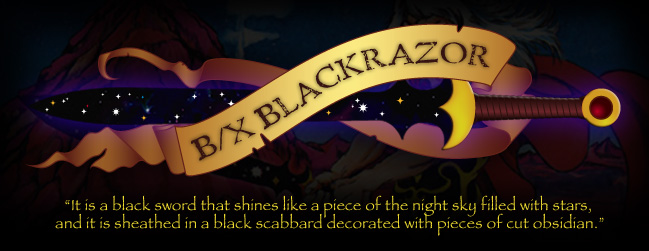
My Blackrazor Cup tournament adventure was, again, one of the high points for many con goers, and THIS year I got to see what that looks like. Eight different DMs ran the adventure...most everyone who wanted to had a chance to participate. Top prize went to the group that managed to pull 390K in gold from the dungeon, but there was a pretty broad range of play with much death and hilarity (one group saw every single one of the ten tournament pre-gens killed). My own table, which included the infamous Prince of Nothing (we'll get to him) caused me to laugh so hard, so many times (at their expense) that I nearly fell out of my chair. Just gluttons for punishment. They ended up with 88K (second from the bottom in rankings), but they had a good time and I can honestly say they did a LOT better than either of the prior two groups I'd play-tested the adventure with.

[it is my suspicion that some of the DMs are a little more lenient than I am when it comes to their running of the game...and that's fine, I'm totally okay with that. But I think that might account for some (not all!) of the discrepancies in results]

Prince's own "mini-tournament" adventure, Assault on the Becker-Drome, was likewise a big hit and much hilarity was had over the three sessions of that. I did not have the chance to take part (and I didn't find out who won the prize he was offering...maybe the Sunday group?)...but he has promised to provide me with a PDF copy for my own entertainment. Can't wait.

The only game I actually played in was con-orgnizer (and Best DM of Cauldron 2024) Settembrini's Chainmail recreation of The Battle of Emridy Meadows. Greyhawk aficionados may recognize this as the original final battle between the forces of Good and those of the Temple of Elemental Evil. I, of course, chose to play on the Temple side and was graced with an evil high priest and a couple units of ogres. Unfortunately, Chainmail took place in the Friday Night block (the day of our arrival) and by that time (9pm) I'd already been up for some 36 hours. I lasted till midnight or so before I became in danger of (literally) collapsing with exhaustion. However, I will take some credit with the Temple's eventual (and non-canonical) triumph, as it was my priest's summoned fire elemental that eventually killed Prince Thrommel and routed the forces of Good...even if I wasn't there to see it.

[ha! and Dreadlord had been trying to convince me to take "bless" as my one spell. No way, man! Go big or go home!]

But that game...which featured four players versus three with Settembrini acting as referee...was the only game session I failed to get through. By Saturday (with a little more than six hours of sleep and plenty of good food in my belly) I was able to go the distance with my games...including my "mystery," Saturday Night block which didn't finish till after 4:30am and had, in the end, only three players at the table (only two of which had still-living PCs).

I will write a follow-up post with "after action" reports of the various games I ran. Suffice is to say they all went well, and it was a joy to see so many familiar faces (like Mike and Michal and Sönke and Ollie and Prince and Tom and the Hungarians) all sitting around my table, rolling dice, cursing their failures, celebrating their successes, and having a hell of a good time. I ran five games and had full tables every session. Well...except for that Saturday Night Block (I ran an adventure that accommodates up to 16, but only NINE showed up to play...).

I am told that the sign-up sheets for my games usually filled up fast.

However, I was NOT to be awarded with the prestigious Best DM of the tournament this year (although I tied for second place in the voting along with Philipp). Instead that went to the to the ever-energetic, Con-Meister General, Grützi. The man is a beast...he ran five sessions this year (as he did last year, too!), the only person other than myself to spend so much time in the Captain's Chair. A much-deserved win as he scored in 11 of 16 qualifying categories, as judged by his players (Philipp and I only scored in 10) and I have no qualms about him taking home the trophy...especially since Grutz and his buddy Alex were the ones who picked me up from the airport and drove me the 90 minutes to the convention!

Alex and Grutz were also kind enough to drive me to the hotel in Frankfurt where I am currently writing this post, while I slept in the back seat. As I mentioned, Saturday's Night Block went long...but my night went longer still as several of us stayed up, kabitzing and drinking into the early morning hours. Truth be told, I was trying to outlast Prince (the rapscallion!), but eventually pulled the trigger on going to bed  around 5:50am. I was walking back to the building where my bedroom was (at the top of four flights of stairs) as Settembrini's wife was crossing the other way to start the kitchen duties for breakfast. While I could have gone longer, I felt I had a responsibility to be awake for the players at my final game session of the morning.

[Prince, gosh darn it, didn't sleep till 7:30am made the breakfast call an hour later, AND ran his last game. But he's 20 years younger than me...]

SO...incredibly exhausted, and more than a little hungover, once the post-convention high had worn off, I was ready for a nap in the car, drowsing off to the soothing sounds of excited, German banter and Alex's quietly playing death metal.

What a blast.

It is hard to overstate how awesome this convention is. I mean, Dillon (a Canadian who goes by the online handle "Terrible Sorcery") best expressed it with his repeated exclamation of the phrase "Hell yeah!" in response to...well, pretty much everything. He apologized for his excited enthusiasm, but I think he was simply expressing the same emotion that ALL of us were feeling (with slight variations). Everything about Cauldron is worthy of such exclamation: the setting, the victuals, the gaming, the camaraderie. 

So many people brought their CHILDREN to the thing, older teens (boys and girls) who are playing the Old School games of their parents. I have already told Diego I will take him to the next one I attend (when he's 16/17), and I can see I'm not the only person who finds the con worthy of generational sharing. 

In fact, it was Settembrini's older son (who, if I remember correctly, was unable to attend Cauldron I due to illness) who won the "MVP" trophy of the tournament. That trophy happened to come with a good bottle of German gin, which the boy doesn't drink, and Settembrini kindly passed it off to me as he'd heard I'm a gin enthusiast (I am). It's one of many souvenirs I have filling my bag, including the "official Cauldron boardgame," designed and hand-crafted by the Nexus gaming club (or, at least, Settembrini's family). I haven't opened it yet...like the gin, it is carefully packed in my luggage...but I look forward to reading it. Hopefully the instructions are in English.

[though, of course, I have Google translate]

[***EDIT: I have been informed by the illustrious and award-winning Settembrini that it was actually his YOUNGER son, Valez, who won the MVP award. My bad!***]

This, I'm quite sure, is a poor review post. It's early in the morning, I've been up for a while, and I'm still a little loopy. I'm just gushing about this and that and every little thing that pops into my head in something very different from a coherent order of tale telling. But that's because I'm not really trying to "sell you" on Cauldron...I'm just trying to convey something of my experience here. I've been to gaming cons before Cauldron; I've been around friendly, happy gamers all bubbling about what a grand time they're having, socializing with like-minded folks about their particular jam...it's what I imagine most "themed" cons (comic cons, Lego cons, Sci-Fi cons) are like, as people can feel free to let their hair down and "nerd out" with each other.

But Cauldron IS different. Probably because it is such a smaller, more intimate affair, or perhaps because of the ever-present Setti family members, you feel very much like a part of this organization's family. These are brothers and sisters, nieces and nephews, uncles and aunts. It's not just camaraderie and shared fandom (though that's there, too)...there's real and genuine love. Love for the games and love for each other and for each other's love of the game. It's not just about "acceptance" or being accepted: it is ACTIVE. People want to GIVE. They want to do for others, they want to share. Some people work out trades but there are many more gifts that are given. People volunteering to do chores: washing dishes, serving food, hauling beer (and crates of empties). One guy does all the grilling/roasting. People are giving each other books that they have extra copies of, people are given small tokens of appreciation, people want each other to have mementos and remembrances of their time here, together. Yes, it's fun, yes, it's a good time. But when I leave, it's not just walking out the door of a convention...I feel much the same as when I leave Montana after a stay with my relatives or after leaving my wife's family in Mexico after an extended visit. We linger. We hug (probably too many times). We talk about when we hope to see each other again.

That's very cool. Very cool indeed. One kid came up to me (today, as folks were packing to leave) and shyly asked me if I could teach him how to write adventures. "Of course!" I gave him an overview and told him to hit me up with a direct message so I could put it in writing for him. He seemed very grateful/appreciative...like I was doing him some huge favor to tell him "Moldvay's a good place to start."

Yeah, it's like family at Cauldron. I find myself asking how a person's doing with their new baby, or asking how's the married life treating a new groom. People ask me about my kids' soccer playoffs (because they read Ye Old Blog). People care. They were engaged with each other, both in and out of games. It was so refreshing to see and be around, because it's so unusual these days. So unusual. Especially with the crisp October air, it brought back memories to me of childhood Thanksgivings when my family would always return to Missoula, Montana...my mother's hometown...and spend many days with the extended family. Those were the best holidays of my life (probably why I love Thanksgiving) filled with food and drink and laughter and games. Very similar vibes.

Yeah, Cauldron may be becoming my new favorite holiday.

All right, that's enough for now. I'll be boarding a plane home to Seattle in a few hours and I'll have plenty of time to write more. But for now...rest and decompression.

Monday, July 27, 2020

Regulating Chaos

*sigh* Down the rabbit hole again...

I've been doing a lot of "work" on movement and encumbrance the last few days. Turns out, I'm just not satisfied with the rules as written.

Which rules, JB? Well, here I'm mainly considering OD&D, AD&D, and B/X. Holmes Basic has the fewest rules on encumbrance and movement, but may actually be closer to accurate.

Why does any of this matter, JB? Okay, it probably doesn't matter especially. Dungeons & Dragons is a game, and playability is as important...if not more so...than accuracy. "Playability" doesn't necessarily mean "easy," but it does have to promote a challenging, engaging experience for the players. We provide challenge so that the game does not become so easy as to become tedious. We provide engagement to spark interest so that players care and bring their "A" game to the table.

I wrote about the importance of encumbrance to the game a couple weeks ago. Encumbrance provides a third dimension to game play. Folks aren't just worried about choice of weapon and armor for how much it costs them (in imaginary gold coins), but about how it impacts their character's movement and ability to carry other gear/treasure. Without encumbrance, "cost" eventually fades (experienced adventurers have plenty of imaginary gold and often acquire magical equipment for "free" anyway), and "choice" is limited to a question of "effectiveness" (i.e. what weapon does the most damage, what armor gives the best protection)...which is too easy a challenge to provide engagement to a mature, seasoned player. Fine for kids, not so much for adults.

[yes, yes story gamers...y'all don't care about "accounting exercises." You play a different version of D&D from what I do. This post isn't for you]

So how do encumbrance rules, when used (they are OPTIONAL in the B/X system, probably because it was scaled for kids), impact the game?

  1. The rules restrict what gear can be carried by a player's character by placing a hard limit on carrying capacity. This requires players to make choices as to what is necessary for an adventure, especially as acquiring treasure is the objective, and treasure found will need to be carried as well.
  2. The rules restrict movement in two different ways: First,  it restricts the distance that can be covered over time, which creates more opportunity for wandering monsters to appear (wandering monsters being a drain on party resources while providing no great reward...they don't carry treasure!). Second, it reduces the distance one can move in encounter situations, impacting the ability to maneuver and, thus, succeed at tactical objectives (whether that means destroying one's opponents or fleeing to fight another day).

Note: there are some adventures where rule situation #1 doesn't apply: in many time-sensitive missions (say, rescue the hobbit captives from the orcs, deliver the message of the impending invasion, destroy an evil artifact before it falls into the wrong hands, etc.) acquiring treasure isn't a goal. As such, rule impact #2 (limiting movement) must still be important...or even more prominent!...in order to provide the appropriate degree of stress to the challenge.

Here's the thing, though: being encumbered doesn't have nearly the impact on an individual's movement as the rules state.

Let's be perfectly clear. I am, by my own admission, both overweight and not in fantastic shape...not even good shape, really. The rest of my family (especially my skinny, athlete son) is in far better shape...and none of them are carrying the extra belly and jowl fat I am. Even so, I can still outrun, out-hike, and out-bike them. On the soccer field, my kid can do all sorts of fancy moves and has a dead hard shot, but I can still outmaneuver him...and out-quick him...to beat him in one-on-one games (and my victories are even more decisive when we play on a larger field, rather than our front yard). I'm bigger, stronger, and faster, despite being an old fat man with bad knees, a bad ankle, and back pain.

Unencumbered, I can advance in a straight line, weapon(s) in hand(s), and cover 40' of ground in approximately ten seconds. If I do a "controlled charge" (i.e. moving as quickly as I can to engage, while taking care not to trip over my own feet or impale myself on something), I can cover the same ground in half the time (approximately 5 seconds). Having actually worn armor a time or two in the past, I know that it would not affect my ability to walk hardly at all, and would only slightly impact my ability to charge...probably not enough to make a substantial difference, especially in an actual combat situation with adrenaline pumping through my veins.

How do I get these figures? I spent a couple day running simulations with my kids. Yes, folks, all sorts of Covid entertainment at the JB household. My boy, by the way (who's a foot and a half shorter than me), advances and charges at about the same rate, maybe slightly slower due to stride length.

But let's talk encumbrance, shall we? I had the kids fill their backpacks with all sorts of "adventuring equipment" in order to run tests on speed and movement. The original impetus for this was wanting to see how fast one could retrieve a specific item from a filled pack in a chaotic, stressful environment (like combat) because I'm tinkering with the combat turn ("round") structure of my game. However, my kids were "all in" on this experiment and insisted on outfitting themselves in full-on regalia, including armor, weapons, etc. The results were interesting.

[I took pictures, but my spouse does not want me posting photos of the kids on Ye Old Blog. Not that this stops her from putting their pix on Facebook, but whatever...]

Not my children...just
some kids on pinterest.
My boy's "kit" included multiple layers of padding and plastic "armor," a shield, a wooden sword (long sword equivalent), a bow (no quiver), helmet (plastic), and a 20# backpack. My daughter was wearing an ankle length wizard robe (over clothes), pointy wizard hat, along with a 15# backpack (contents included a thick hardcover to represent her "spell book"); in my daughter's hands she carried a (plastic) sword and an actual camp lantern (battery operated). Although the weight was only a small fraction of what a "real" adventurer would carry, the bulk was certainly equivalent. And the weight they were carrying was more than a third their actual body weight...closer to 40% for Sofia. If I had been proportionately geared, I would have been carrying closer to 70#. And, of course, actual mail weighs a lot more than my kids' thin plastic and padding.

However, even burdened as they were, the kids weren't especially slower. What they were was uncomfortable and in pain from shlepping so much weight on thin shoulders. They couldn't wait to shrug off their backpacks...which they were able to do fairly quickly given a "combat situation" (me shouting "go" and starting the stopwatch). Carrying a bunch of weight...especially weight they're unused to and untrained to carry...did NOT slow them substantially. But it DID tire them out...cue my typical rant about the lack of proper fatigue rules in D&D.

That's my takeaway from our "experiments:" Movement is far more affected by bulk and distribution of gear than from actual weight carried or an individual's strength. It's tough to move quickly when you're worried about tipping over from an unbalanced pack. Or (as my daughter told me) "I actually run faster with my backpack because it pushes me forward!"

[this appears to be a literal truth; walking WITH his pack (only), Diego shaved half a second off his time...same when he was running]

But fatigue IS real...despite being faster and stronger than my family members, the old man gets tired. My son can play soccer all day (comparatively), whereas I cash in my chips a lot sooner. Likewise, my wife doesn't run the 5Ks half-marathons she used to, but she can still go twice as many laps around Green Lake (at least!) as yours truly...though to be honest, I was never a fan of distance running. Ever.

SO...how to model this in the D&D game? Well, what does the D&D game model anyway? Depends on which edition you're tweaking. Assuming a 10 second combat round (as in B/X), 40' per round (encounter speed for a 12" movement) seems plenty fair. The OTHER speeds, though (30', 20', 10' for 9", 6", and 3" movement, respectively), seem grossly inaccurate. Even for a fat adventurer.

Where do these movement rates come from? From OD&D originally...although the idea of a 10 second round is from Holmes Basic ("Each turn is ten minutes except during combat where there are ten melee rounds per turn, each round lasting ten seconds."). But as with many of the mechanical bits found in OD&D, these rates are adapted directly from the Chainmail wargame.

Chainmail provides rules for "medieval miniatures." It uses a time scale consisting of 1 minute turns (just like the combat turns of OD&D and the combat rounds of AD&D) and a distance scale of 1" being equal to 10 yards. Different movement rates are given for different troop types in Chainmail; for example, "heavy footmen" can move 9" (12" when charging), while "armored footmen" only move 6" (whether charging or not). All reports of Gygax state that he was a voracious reader that enjoyed researching old history books for information to add to his games (in an age where there was no internet), but games that attempt to regulate the chaos of war require a certain amount of abstraction to ensure playability...it is difficult to know, just from reading Chainmail, what was thought to be an accurate model and what was considered an expedient necessity.

Attempting to find field movement rates for medieval troops using the internet alone has been difficult. Most rates are given only in miles per day which, admittedly, is probably more than most people need for their history lessons (it's enough to know who fought whom and where and how many died). However, what IS clear is that with regard to troop movement (soldiers marching in groups), distance traveled over time comes down to a combination of organization, discipline, and baggage carried, coupled with the terrain traversed. Ancient troops could make 10-25 miles per day with decent (Roman) roads, while medieval foot troops (up through the 17th century) only moved 7-15 miles per day. A troop could be "forced marched" at double that rate, but risked being too fatigued to fight effectively upon reaching their destination.  Medieval soldiers generally marched in their armor and carried at least a hand weapon or two; gear (everything else a soldier might need) was "baggage," carried in carts or hauled by a soldier's wife or girlfriend (camp follower). But none of that tells me how far or fast the soldier could move on the battlefield...and anyway, battlefield movement would have been in formation, with a pace set by the force commander and the necessities of battle.

Gygax's Chainmail movements appear to be an estimation based in part on how one assumes these forces to behave as a troop/group. Light footmen include peasants, noted as being "unreliable" and "unwilling" warriors: they only move 9" (12" charging) despite probably having the lightest loads (in terms of arms and armor)...of course they would be an undisciplined mass to bring to a battle. Armored footmen with their 6" movement includes "dismounted knights;" Chainmail notes that "feudal knights were ill-disciplined and generally refused to take orders from anyone -- even their liege lord;" presumably by the time they were dismounted the battlefield mud would have already been churned up, making the footing even more difficult. Meanwhile, the fearsome Landsknechte troops are given a move of 12" (charge 15") apparently to model their superior discipline and training...this despite many of their troops (certainly the zweihander-armed frontliners) being dressed in plate armor!

Wives have advantages
over other henchmen.
A party of D&D adventurers...even one with a number of retainers and henchfolk...isn't the same as an unwieldy mass of hundreds or thousands of troops. Training and discipline should be assumed to be at least as good as elite mercenaries and house troops...this is, after all, what the PCs are supposed to be. In Chainmail, both heroes and superheroes (the basis for the 4th and 8th level fighters respectively) have movement of 12" (charge 15") regardless of armor wornWizards (of any level), likewise have a move of 12" (though no charge). When mounted, these fantasy fighters have the same movement as medium horseman...again, regardless of armor. To me, it's clear something other than encumbrance is being used in these calculations.

The D&D movement rates are even more strange when used in conjunction with dungeon or "exploration" movement...in ANY edition of the game. There are many subterranean caves and cavern trails available for hiking in the United States, most with surfaces and elevation changes far more difficult and treacherous than the smooth 10' by 10' corridors found in your average D&D adventure. Trail times seem to be pretty universal: individuals can expect to hike about 1.25 miles per hour in such environments. The most difficult "hike" I could find on the internet was the Wild Cave Tour at Mammoth Cave in Kentucky. This physically grueling tour requires hikers to spend a lot of time crawling on their belly, wriggling through tight spaces, traversing sharp, uneven terrain, and dealing with water and subterranean canyons. It is guided by professionals and there are breaks (for rests, instruction, and lunch), but even so it's a six mile tour that requires six hours to complete.

Not a 10' x 10' corridor.
How fast is that in D&D terms? Well, one mile is 5,280 feet, so that would be our hourly "rate" of travel. Assuming the usual five (ten minute) turns of movement followed by one (ten minute) turn of rest, we can see the party making about 1,056 feet per turn; there is, presumably, no "running" during the tour, but no mapping necessary either (since the party has an experienced guide). With normal caution being exercised we can translate that to game movement as follows:

OD&D: 52" (two moves per turn)
AD&D: 21" (rate of travel divided by 5 for "following a known route")
B/X: 106" (158" if movement rate considered 2/3 for being "broken terrain")

Even presuming "unencumbered" movement (hikers aren't carrying any more than a hardhat, flashlight, and sack lunch), these rates far outstrip the 12" movement rate found in the D&D texts. The speed is more than double the rate given by Holmes for an "unarmored, unencumbered man" that is "moving normally" in a dungeon (480' per turn). An adventuring party moving this slowly and this cautiously should probably be discovering every trip wire and loose flagstone in the dungeon!

So, yeah. Movement rates as given are too slow, and carrying a bunch of weight doesn't make you all that slower if all you're doing is walking/marching. What encumbrance does is tire you out (fatigue) making rest more important.

I spent a lot of time yesterday watching videos of Medieval MMA and IMCF combat. Despite the limitations of sport combat, I find these to be instructional especially this M-1 championship bout in Moscow. Three minutes of fighting per round, followed by one minute of rest, and both these dudes are completely gassed after three rounds. And they are, presumably, wearing lighter gear than a true medieval warrior and have all the benefits of modern sport science (including nutrition and cross-training regimes). Turns out that Chainmail's fatigue rules seem a fairly close approximation of how melee (by itself or in combination with movement) can tire you out...even for lightly armored fighters (who would, I assume, need to work twice as hard as their heavier armored counterparts).

Beating on each other just plumb tuckers you.
Yes, yes, I know...everyone hates fatigue rules. And we already have an (imperfect) model of fatigue in the form of hit points. And, in the end, this discussion seems to be aimed in the direction of rebuilding the game from the ground up, which is really NOT what I want to do.

I just want something that won't bug me and be a constant source of irritation.

But let's go back to the premise here: the rules as written provide two different means of challenging/engaging the players of the D&D game: they add an extra consideration to choices made with regard to logistics (carrying these iron spikes and a crossbow are going to cut down on how much loot I can haul), and affect the character's ability to maneuver tactically (not only in combat, but in evasion/pursuit situations). Both become an issue of resource management, the particular resource being time...precious time that will necessitate additional wandering monster checks that carry the possibility of fatal attrition for little/zero reward. Game-wise, these are not rules to chuck with abandon, as they are fairly imperative to running the game in the manner intended!

Still, as mentioned, logistics become far less important when characters have a mission that promises reward after the adventure (return the captives and get paid! Bring me the head of the bugbear chieftain to the Duke for a chest of gold! Etc.)...and even less so as characters rise in level and acquire gear that offsets logistics (the sword +3 that is unbreakable, the flaming sword that takes the place of torches, the slippers of spider climbing that replace 10 pounds of rope, the decanter of endless water, etc.). When logistics fail to matter, only tactical issues need be considered...and time can continue to be a manageable resource with the use of fatigue and mandated rests. More so, it becomes an additional area of player engagement if parties can choose between RISK (pressing their luck, losing effectiveness by acquiring fatigue) in exchange for REWARD (making better time, rolling fewer encounter checks).

Sorry, folks, but this is a line of thought I want to continue following for now. I'll probably have at least one more post on the subject (in which I'll lay down some concrete rules for "testing"), but it's important to me to get this stuff right. NOT because it is so all important to be accurate or "realistic" in modeling this stuff...but because, well, hmm.

Because (I suppose) it's important to not be wrong. I say hit points are an abstract measure of staying power and that's fine and dandy; that's defining a game mechanic (we're not trying to model rules for broken bones and pints of blood in the body). I say 15 gold pieces buy a decently-made sword and that is fine, too...that's the fantasy economy in this particular region at this particular point in time.

But I say a human with a 40# sack of gear only moves a certain distance at a brisk pace, well, then it better be damn close to the laws of reality. Because time and distance and weight on a planet with Earth's gravity is something that can be measured. And because D&D isn't a board game, and it's not a wargame, and we're attempting to simulate an experience, there's SOME reason why carrying heavy stuff is detrimental, but it better be a real reason...and not a "wrong" reason, not just for the sake of adding options. The choices have to be valid, and valid choices do exist...so why not use them?

All right, that's enough. I've been writing this for four days, and it's time to get on to the next thing.

Friday, October 18, 2019

Fatigue - An Example


So there's this fairly memorable scene in the first Game of Thrones season (also in the first novel) where Tyrion ("the Imp") is captured and taken to the Eyrie (one of the "seven kingdoms") where, in order to escape execution, demands a trial by combat. The sellsword, Bronn, offers to champion him against the knight, Vardis Egen. Despite wearing only ringmail armor (disdaining even a shield), Bronn manages to best the plate-and-shield armored knight by dint of being younger (about fifteen years) and faster and fighting in a craven-like fashion that tires out Ser Vardis. Finally wearied by chasing the spry mercenary around the battle chamber in his encumbering armor, the knight slips to one knee and is wounded by Bronn...after which the end (from weariness and blood loss) is all but inevitable. In the eyes of the attending nobility, the sellsword fights without honor; and yet, it is his canny choice of tactics that allows him to prevail with ease where he might otherwise been hard-pressed to achieve victory. Bronn was never interested in a "fair" or "honorable" fight, only in winning and being rewarded with Tyrion's gold.

I find it difficult to model this with AD&D. And it bugs me.

Unless I am completely missing something (entirely possible since I'm semi-new to this "AD&D thang"), there aren't any specific rules regarding fatigue; Gygax explicitly writes in the DMG:

"No rules for exhaustion and fatigue are given here because of the tremendous number of variables, including the stamina of the characters and creatures involved...Fatigue merely slows movement and reduces combat effectiveness. Exhaustion will generally require a day of complete rest to restore exhausted creatures. Always bear in mind that humans inured to continuous running, for example, can do so for hours without noticeable fatigue, i.e. those such as Apache Indians, Zulu warriors, etc. Do not base your judgment on the typical modern specimen."

This is written with regard to pursuit and evasion and is incredibly frustrating, as what I am most interested in is fatigue with regard to minutes (i.e. one minute rounds) of hand-to-hand fighting...an incredibly stressful and tiring exercise even for the most hardened warrior.

B/X doesn't hand wave fatigue; it has specific rules (including penalties to "combat effectiveness") in two different places (page B19 and B24). These are an adaptation of the rules found in OD&D (page 8 of Book 3) requiring a ten minute rest break in every hour of activity, and a "double rest period" after any bout of flight/pursuit (B/X changes this to ten minutes after three turns, with a double penalty the consequence for failing to rest). Still, this doesn't address combat fatigue per se...though this is mitigated somewhat by B/X shrinking combat rounds to ten seconds with any encounter being considered "to have lasted one full [ten minute] turn. The additional time, if any is spent resting sore muscles, recovering one's breath, cleaning weapons, and binding wounds." (Moldvay, page B23).

Yes, yes...I'm aware that hit points are (in part) a model of fatigue and the ability to withstand fatigue in combat. And that makes perfect sense in the abstract: a trained fighter should be more resistant to the rigors of melee than a spindly thief or wizard, and an experienced one even more so. But hit points don't take into account encumbrance...nor movement/activity that has occurred before. And hit points are famous for not diminishing character effectiveness even as they're depleted: a character may be down to half or a quarter of her stamina (hit points) but that doesn't slow her sword arm (there's no penalty to attack rolls).

What's particularly maddening here is that CHAINMAIL actually had the most comprehensive rules for fatigue. Under the Chainmail rules, a model becomes fatigued after any one of the following:

1. Five consecutive turns of movement.
2. Two consecutive turns of movement, followed by a charge, and a round of melee.
3. One turn of movement, followed by a charge, and two rounds of melee.
4. Three rounds of melee.

A fatigued combatant faced the following stiff penalties:

- Attacking and defending as "the next lower value."
- Morale dropping by one point (using a 2d6 roll, much like B/X).
- Slowed (to one-half) "uphill movement"

"Next lower value" is a pretty beefy penalty in Chainmail, but modeling it to AD&D it works out to about a -2 penalty to AC and (probably) attack rolls.

[why -2? Because an "armored" represents a figure in plate-and-mail, a "heavy" represents a figure in chain armor...which in D&D is only a 2 point difference in armor class]

All penalties are removed after the character has had a chance to rest one full turn...the turn in the Chainmail game being one minute long. A "round" of melee in Chainmail is an exchange of blows (one side attacks, then the other side attacks) and is contained within the standard "turn" but, as no more than one such round may be fought in a turn, it can be presumed to approximate an OD&D (or AD&D) round with regard to engaged figures.

Thus, it would not be a great stretch (if relying on Chainmail, the basis of OD&D and, thus, the basis of AD&D) to give characters an AC and attack penalty after three rounds of continuous fighting (or after two rounds for characters that charged), perhaps mitigated by a high Constitution score, and perhaps adjusted by encumbrance. If one wanted to add an extra level of complexity to their game.

OR...we could just ignore the issue altogether and simply allow tireless combatants to beat each other senseless for hours, perhaps fueled by adrenaline alone. In which case, why would you never carry a shield and the strongest armor available when offered? Right?

Pop goes the weasel.

Wednesday, April 27, 2016

Thrones of Chainmail

I have a lot of stuff on my mind (as usual) and no idea how to go about blogging it, nor why I have no idea. I suppose I'll just say that when you've been out of practice posting (the A-Z stuff really doesn't count...really), and your mind has a constant influx of thoughts and concepts, it just creates a logjam that's kind of the opposite of "writer's block." Perhaps the solution would be to simply post and post and post random shit until my mind gets "emptied" again, but...well, I'm not sure if that's really the best way to go about my business.

[my "business"...ha! That's a funny one]

*AHEM* Still, before I get to more serious topics (or not), let's start with something easy and (for me anyway) more recent. Had a chance to catch episode 1 of the new Game of Thrones season Monday night. I'm aware that a lot of folks find the series (and the books) disagreeable for one reason or another...I've written myself about how I find the novels a depressing slog that I'm not interested in finishing. But Martin's world is deep, richly textured, and interesting, and the GoT show is what I call "television crack," no different from Sex and the City (which series I've viewed in its entirety) or True Blood (which I watched with reckless devotion until the birth of my first child made late night viewing something that neither my wife, nor I, had the energy to pursue). I could do without the soft-porn fan-service that that the creators insist on including in every episode, but the writing is interesting, the acting is excellent, the production values are spectacular, and the subject matter...courtly intrigue and medieval warfare in a fantasy world...is right in my wheelhouse.

As a result, I'm a fan of the show, and as a long-time acknowledged "killer" or "adversarial" Dungeon Master, I take a perverse enjoyment in the way beloved characters get killed/maimed/degraded with rather reckless abandon. To be clear, I'm not especially happy when one of my favorites gets the ol' "Charley Manson Special" but at least its a refreshing change of pace to know that the protagonists are operating without the magical shield of "plot immunity." It's a schtick, sure, and one we've seen before (the reimagined Battlestar Galactic, which also made for compelling television BTW) if not quite so brutally.

I've lost more than one character to PVP.
[oh, and just so everyone knows, I am aware there are far more important things to talk about in the world today, like Venezuela's current economic collapse. But that shit is absolutely depressing. However, I might make some observations about Argentina in a later post, just to "keep it real"]

D&D, of course, is neither television nor literature and longtime players are probably inured to the idea of a protagonist being slain by bow or blade. How many times have we not seen our own "main character" fall beneath the spears of gibbering goblins or cackling kobolds? And though Game of Thrones IS television, presumably following an overarching plot of some sort (though the casual viewer might be forgiven for not being able to make heads and tail of it), it's hard NOT to equate the game with a fantasy RPG, seeing as how it shares so many tropes found in the hobby...unsurprising given the current state of fantasy these days (largely inspired by D&D and its associated fiction) nor the fact that its author (Martin) has a background in gaming.

[rangers? come on, man]

I've also written before (after my first exposure to the Game of Thrones series) that while some aspects of it are reminiscent of of my old, latter day AD&D campaign, it's hard to imagine anyone using the D&D system (any edition) to run a campaign truly resembling A Song of Ice and Fire...which is probably why Green Ronin (the series's license holder) opted for a completely new system when developing the RPG, rather than building on D20 or something. Heck, that's the main reason I was 'porting the setting into the Pendragon system last year (see my Buckets of Blood posts if you missed 'em)...a little side project that, at this point, I'm not terribly interested into getting back into, new GoT season or not.

[though someday I probably should get around to posting the last couple pages of notes concerning the alternate ASOIAF timeline that's supposed to be used in place of the Pendragon Arthurian/Camelot one. *sigh* if only I slept LESS hours in the night, right?]

Ah...civilization.
Thing is, I was considering that, all soap opera bits aside, a lot of Game of Thrones resembles a war-game campaign more than anything else. Pretty obvious considering Martin cites the English War of the Roses as a major inspiration for his novels. There's a number of large-scale battles in the series, and this is yet another reason why the story seems like a poor fit for a D&D system, where combat is prevalent but based on small scale skirmishes in subterranean environments...NOT open warfare on the field of battle.

And yet...

And yet, I can't help but consider that D&D itself has its roots in a war-game, specifically CHAINMAIL, and how much of the setting...much of the story...could be modeled fairly easily using a Chainmail system with only slight tweaks. Chainmail may have billed itself as "rules for medieval miniatures," but its system encompassed a historic range that encompassed about 1000 years (from the 400s to 1500s).  This could easily be tightened up to account for the specific ASOIAF setting. And if one replaced the Tolkien-based Fantasy Supplement with one based on Martin's supernatural elements (easy enough as they are so few), it's easy to imagine a tabletop campaign based in large part on Martin's books. Just imagine an army of 15mm knights painted in Lannister gold and crimson riding out to battle the armies of the North...

Throw in some Braunstein-like sub-plots and secret missions involving special "character" figures and...well, with a few random tables, one could probably recreate a pretty reasonable facsimile of the series.

It's actually a pretty interesting idea for a gaming project (I've never written/designed an actual war-game before, though I've played more than a few)...especially given my recent research/interest in the origins of the hobby (not yet blogged about) and some thoughts I have on "forward compatibility" (as opposed to backwards compatibility).

But I'll write about that more later. Time to get the kid for soccer practice!

Wednesday, April 13, 2016

Armor Thoughts

The following is a bit of a thought exercise.

There are lots of different ways to handle personal (body) armor in an RPG. Most folks probably already get that, but...well, it feels like a necessary disclaimer before I start. D&D's "armor class" concept is a popular one (at least judging by the number of system knock-offs that continue to use it), despite certain problematic aspects of the mechanic.

Conceptually, personal armor is supposed to prevent personal injury. The usual way this gets modeled in a fantasy game includes one (or some combination) of the following mechanics:

  1. Reducing the chance that an opponent can inflict injury at all.
  2. Reducing the actual injury inflicted by an opponent's successful attack.
  3. Providing additional "health levels" (whatever form that takes) to the person wearing it.
  4. Providing a "saving throw" against damage to the person wearing it.

Additional considerations include how the use of a shield or personal agility/prowess might factor into armor, the deterioration of armor from wear-n-tear, specific hit locations versus general defense, and the usefulness of armor in preventing non-combat type injuries (like falling off a cliff, or protecting its wearer from traps and hazards).

[I may be forgetting something...it's 2:30am my time...but that's about all the iterations I can think of at the moment]

All armor systems "work" (i.e. they are functional game mechanics), but folks have different preferences when it comes to picking a specific system. System preference is based (or, IMO, should be based) on a combination of two things: personal perception of armor (perhaps changing with regard to genre), and playability (how easily it works as a game mechanic).

D&D's system (a "Type 1" mechanic) has a long history of eliciting gripes and complaints from people who have a different perception of armor and how armor should function/model. However, D&D's system is eminently playable...from a mechanic standpoint, it is incredibly simple to use in play, incredibly easy to grasp (even for new players), and incredibly quick to resolve. Its playability...and familiarity...are what has led to its staying power and proliferation across other fantasy RPGs.

Heck, its playability is probably what led to it supplanting the Chainmail combat system as the default combat system for D&D; the "D20-versus-AC" system was an alternate combat system in the pages of Men & Magic, remember? But Chainmail's personal combat system was an add-on to a mass combat war game...an afterthought for occasional "small battles and castle sieges" (when, I presume, you would have narrow battlements ramparts to defend).

But let's, for a moment, consider another fantasy RPG with war-game roots that does armor in a different flavor: Warhammer Fantasy Roleplay.

Where "dungeon crawl" =
"pub crawl" + weapons
While WFRP contains elements of Dungeons & Dragons, I think it's pretty clear it's descended from different roots than Chainmail/D&D. Sure it has elves and dwarves and halflings and orcs...these are things taken from Tolkien (the same place D&D gets them). But nearly all of its systems come from (or have their genesis in) the Warhammer Battle war game, just as D&D takes its cues from Chainmail (including magic, saves, attacks, monsters, etc.). Combat in WFB is D6 based and WFRP is D% + D6 based (if I'm remembering correctly). However, it has quite a few steps compared to the standard attack mechanic of D&D. Whereas D&D does an attack roll + damage roll (if successful), sometimes followed by a saving throw (for certain special attacks), Warhammer goes:

  • Roll to attack
  • (if successful) Roll to wound (Strength versus Toughness)
  • (if successful) Defender rolls to save (using armor)

And there are sometimes additional effects that need to be determined; in some editions, a failed save requires a random number of wounds (damage) to be rolled, depending on the strength of the weapon. While it seems like a lot of steps, in practice it's fairly quick and easy because of the limited range of probabilities and the ease of rolling multiple D6s and removing "dead" models. Playability, again, makes it a popular system for wargaming. The translation to RPG is a bit more clunky in execution, but because combat tends to be over quickly (with a high degree of lethality), it's fairly forgivable.

The "armor as saving throw" is the part that I find most interesting, as well as its translation to the RPG. In WFB the armor save is (was? I haven't kept up on recent editions):

  • 6 for light armor
  • 5-6 for heavy armor
  • +1 if using a shield
  • +1 if unit is mounted

That means a guy using plate and shield has a 50% chance to resist (D6 roll of 4+) any wound that would otherwise by inflicted on the character...unless struck by a weapon that ignores or penalizes the armor save (some magical or especially strong attacks).

WFRP does not have an armor save; instead armor worn reduces damage inflicted to the tune of 1 point for light armor and 2 points for heavy armor. It seems like a strange choice (to interpret the save in this way) until you consider that damage in WFRP is on a 1D6 scale...which is to say that, like OD&D (or Holmes or default B/X), all weapons in WFRP do 1D6 points of damage towards a target's wound total (hit points). If you subtract 1 point from the D6 roll (as with light armor) that means you have a 1 in 6 chance of taking no damage; if you subtract 2 points, that chance of "no damage" goes up to 2 in 6...both of which matches the save percentages of light and heavy armor.

'Course it also has the benefit of reducing damage from the blows that do land which, coupled with the multiple wounds PCs carry in WFRP, gives characters a chance to show-off some of that "heroic sticking power," even if its not as much as your typical D&D character (characters in WFRP have nowhere near as many hit points as even a mid-level PC from D&D).

Had some neat ideas.
D&D has, on occasion, provided similar alternate armor rules where armor reduced damage sustained rather than chance to hit (see the BECMI Gazetteer Dawn of the Emperors: Thyatis and Alphatia, for one example. I believe I've also seen something in a past Dragon magazine). But doing this...removing the "armor" part from "armor class"...really requires a re-tooling of the whole combat system from the ground-up. And THAT is something I haven't seen for D&D.

WFRP, like other systems that use armor as "damage reduction," has a straight skill roll based on a person's combat ability...you see similar systems like Chaosium's BRP (Stormbringer, ElfQuest, and Pendragon as three variant examples). But those systems also get caught up in granularity...the one attack equals one swing thing (followed by a defensive dodge or parry...and possibly a riposte). While that way lies madness (I'm not interested in that type of granular scale for D&D) the point is somewhat moot, as D&D does not measure combat ability as a skill in the same way as, say fire-building or rope-tying or whatever. Not even in later editions.

Do I have a problem with the D&D combat system, with the way armor is handled? I'm not sure I do. I do like the idea of making armor a bit more important, as the ability to wear heavy armor is one of the fighter's main advantages in early editions of the game. And there are problematic aspects of the AC-system (which I've written about before). Still...this is just "thinking out loud" at this point. I'm certainly not interested in sacrificing playability, just to skew a system to match my own perception of how armor should function.

Friday, January 29, 2016

Assessing Damage

Jonathan N. posted the following comments on Wednesday's post regarding the B/X battle axe:
Huh. I would have made the battle axe just do 1d4+4 damage instead. Actually, 1d6+2 is probably more fair. Same average as 1d10.

Indeed, it IS the same average damage. But it's not the same range of damage, which for my game is the important part of the design model.

Back up for a moment. Recall D&D's original roots in CHAINMAIL, a tabletop war-game. It included a man-to-man element, but it was still of the "one hit equals one kill" variety: with a war game we are much more concerned with the movement of armies as a whole, not individual melees. Weapons were on a human scale, and humans (with the exception of some fantasy hero-types) of the "grunt" variety, regardless of arms and armor. One man = 1 die roll = 1 hit absorption...the standard unit of play from which all other units derive.

[a "hero," as an example attacked as four units, i.e. four humans, capable of rolling four dice to attack and absorbing four hits of damage. A "superhero" was the equivalent of eight units]

When you get to Men & Magic (volume 1 of OD&D, from which B/X is, more or less, directly derived), this standard unit mentality is still present. Heck, CHAINMAIL is the default combat system (with the "roll-D20-versus-AC" being an "alternative" option). The new game, however, is concerned with a smaller scale of action...heroic individuals operating at the skirmish level...and thus a more granular approach to combat is needed. Players aren't using armies in D&D, but individual characters...and losing one's character is the equivalent of losing one's entire army.

Enter hit points: the granular solution that fits the war gamer's paradigm. If your character is your "army," than each hit point represents a "grunt."  On the battlefield scale we're concerned with how one force attacks another force, and standard units (i.e. soldiers) are removed depending on the results of the attack. On the small scale we look at attacks on an individual (man-to-man) basis, to see how many hit point "units" are removed as the result of an attack.

Now, as I said, weapons are based on "human scale;" originally (in CHAINMAIL) a successful attack resulted in the removal of one unit, i.e. one soldier. But now that we are looking at a granular scale, we need to determine just how granular (that is, how many hit points) are possessed by a "standard unit." And the OD&D answer to that question is D6. That is how many hit points a one HD human soldier has in OD&D.

[remember that the D8 hit points per HD thing in B/X was a later adjustment in Supplement I (Greyhawk) that was carried over to Basic, AD&D, B/X, etc.]

One unit has 1 to 6 hit points. Thus, one human scale weapon inflicts 1 to 6 hit points of damage...this is the origin of the "all weapons do D6 damage" rule of OD&D and its descendants: Holmes, Moldvay, etc.

Once you know the "standard" elements involved, you can tweak and adjust. You can say that a heroic fighter PC (who starts with the lofty title of "veteran") can have MORE than the standard HPs: in OD&D it's 1D6+1; in B/X, it's 1D8. You can say that a 1st level magic-user only has 1D4 hit points (no doubt due to being a pasty academic) but that an experienced 2nd level magic-user has 2D4...she's been hardened by adventure and hiking in the wilderness. You can say that an ogre, a creature capable of sustaining damage enough to kill four men, receives 4 dice worth of hit points.

And you can adjust weapon damage appropriately as well. A dagger is capable of killing a sedentary citizen within 10 seconds (the length of a B/X combat round), but generally takes longer against a trained fighter, except under extreme circumstances (the fighter is weak and/or injured, the weapon is enchanted, etc.).

SO NOW (having got the preamble out of the way), let's look at the battle axe again. An attack roll is a check to see if an opponent can inflict damage in the round; the damage roll provides an indication of HOW that damage was inflicted based on the amount of the result.

A battle axe has a good range of damage (1 to 8...enough to kill a trained veteran with a perfect blow). Let's break that down in granular fashion:

1 point - a blow from the weapon's haft, the kind that will leave a nasty welt or bruise.
2 points - a severe blow from the weapon's haft to a vital joint or organ (like jamming the butt of the axe into the diaphragm like a blunt spear).
3 points - a concussive blow, capable of stunning the person with pain or blunt force trauma.
4 points - a strike with the axe head, causing a major laceration and probable blood loss.
5 points - a strike with the axe head that tears muscle, breaks bone, and/or severs major arteries.
6 points - a deep blow to the body, causing massive internal damage and blood loss.
7 points - a severing blow to a vulnerable joint or a full-on strike to the skull with the business end of the axe causing immense damage and probable death.
8 points - a wicked blow to the neck causing decapitation and immediate death.

This is a good range of damage, easily scalable to an opponent. For example, a concussive blow (3 points) versus a normal citizen who only possesses 3 hit points, might be a blow that puts the guy into a permanent coma. On the other hand the 3rd level fighter on the receiving end of an 8 point decapitating strike can consider that she just dodged a bullet (or, rather, an axe) and that her luck (those extra hit points from her greater experience) won't last forever.
Darkwolf's rotoscoped axe-work is pretty good.

Decreasing the range from 1-8 to 5-8/3-8 as Jonathan N suggests decreases the range of possibility inherent in a weapon like the battle axe. What's worse, it's no longer "human scale:" a weapon that inflicts a minimum of 3 hit points of damage (let alone 5!) will automatically kill three-quarters of the "normal human" population found in B/X. It leaves no room for the possibility of a glancing, non-fatal blow from a weapon that has more attack surfaces than just the axe head.

The +1 attack bonus I gave in Wednesday's post ("Can-Opener") stems from the ideas that A) a wedge-shaped axe-head delivered forcefully is good at penetrating armor, B) a mass weapon like an axe delivers enough concussive force to inflict damage even when failing to penetrate armor, and C) the battle axe is light enough (compared to other two-headed weapons), that A and B aren't offset by the weapon's overall lack of maneuverability compared to light, one-handed weapons (5 pounds versus 15 pounds).

[a +1 attack bonus is also enough to offset the +1 AC bonus provided by a shield, and "hooking" shields was a well-documented tactic of axe-use by Viking warriors and others; however, I know there are more than a few people who disagree with the amount of protection offered by a shield in B/X]

These are justifications to my overall design goal of making the battle axe a viable weapon choice in B/X, based on the B/X system as it exists. Increasing the average damage doesn't fit into my particular paradigm, but increasing the range of weapon damage (via the use of the variable weapon damage table) does.

For me, anyway. Plus it gives me a chance to roll dice of other shapes besides the D6. I've got them on-hand anyway.
; )

By The Way: I personally don't think this is anything that needs to be pointed out in a game text. The designers of Monopoly don't bother explaining why you receive $200 for Passing Go, after all. I realize that it's kind of "the thing" these days to include handy little sidebars in texts explaining design choices (boy, role-players sure are an over-analyzing bunch, aren't we?) but is it really worth it to make a cramped layout and increased page count? Well...that's a rant for another day.

Wednesday, April 8, 2015

Trying For Dwarves-Sake

I like dwarves. I hate dwarves. I want dwarves in my game. I want all fantasy dwarves I've seen in the last 25 years to burn in their campaign setting's lowest ring of hell.

What exactly is going on here?

When it comes to fantasy mythology there are dwarves and then there are dwarves. I'm inclined to draw a historical delineation across whatever year it was that J.R.R. Tolkien published his Lord of the Rings trilogy. After The Hobbit. Maybe even after The Fellowship of the Ring. Gimli the dwarf, while most assuredly the main culprit responsible for the dwarves downfall from fanciful fairy tale creature to hardened badass warrior wasn't all that bad prior to the Battle of the Hornburg ("Helm's Deep") where his portrayal goes from dwarf companion to "orc-slaying-axe-machine." Where he shows that a dwarf is some kind of melee titan of destruction.

Ugh. Ugh. Ugh,

Okay, just please stop for a second. Lots of folks hate on Tolkien's "vanilla-flavored fantasy" and its influence on D&D. People have been trying to re-skin D&D dwarves in all sorts of ways for years. Gygax's dwarves (see his Gord fiction) have been reviled in some circles, but at least they're deemed to be somewhat different. As an archetype, the D&D dwarf usually ends up looking something like the dwarves in DragonLance...well, they did prior to 3rd edition and the advent of their ascendance as fighters par excellence.

Let's set aside the game for a moment. As a a child, I loved fairy tales. As an adult, I still do...though I'm hard-pressed to find the same sort of magical worlds I did when I was younger (I don't know if this is because of my adult outlook, the lack of decent fairy tale literature at my disposal, or some combination of the two). Fairy tale dwarves...whether they're little miners found in Snow White, sinister wish-granting types like Rumpelstiltskin, or Unseelie faerie-folk...are cool. Even if I set aside my normal shtick of dwarves as inhuman aliens, giving them human-ish traits and personalities (for the purpose of taking up the role of "adventurer"), I like the idea of these little guys with beards that possess their own brand of "earthy" magic. Certainly, all fairy tale dwarves seem to have a "thing" for gold (a relationship with it and ability to produce it, if not the outright avarice depicted in many tales). And "treasure-seeking" has always been the heartbeat the propelled adventurers into the wonder and mysteries of the fantasy RPG.

Well, originally, anyway.

Thorin Oakenshield of Tolkien's The Hobbit is one such adventurer. Yes, he's got human traits...a little arrogance (a sense of self-importance), desires for wealth and revenge, a loyalty to his people and kin, etc. But he's still just a little dwarf. Not a great hero nor a great warrior, though an experienced one. He manages to bash a troll in the face with a log, but he doesn't go armed until after finding an elven sword (and later, after putting on the still-remaing armor of his people lying in Erebor). He has to be told by Gandalf to turn, draw sword, and do battle with the goblins during the dwarves' flight below the Misty Mountains, and it is only the treasure-inspired avarice (and madness) of the dragon hoard that compels him to gird for war against the humans and elves that lay siege to his mountain.

And this is an experienced dwarf...one that fought against the goblins of Moria. The rest of the dwarves in his company are far less fight-worthy, simply fleeing from one opponent after another (as they can), until cornered and compelled to make a stand. These are not warriors. They are not useless, mind you, and they show great courage in facing the perils and travails of their venture (not to mention skill and cunning at times and an ability to loyally stick together even through hardship that might drive them apart). But warriors-born? No.

And this is reflected in the original version of D&D. Men & Magic (volume 1 of the little brown books) allows characters to play dwarves who advance as fighting men with a maximum level of six. 6th level ain't much of a step up from hobbits (er...halflings) or elves, both of whom are limited to 4th level fighting ability. A 4th level fighter uses the exact same save tables as a 6th level fighter; if using the variant combat system presented in OD&D (as opposed to the Chainmail combat system), they have the exact same attack chance (which, incidentally, is the same as a 4th-6th level fighter in B/X). The only advantage a dwarf receives from their two extra levels is an extra 2D6 worth of HPs (plus bonuses if the dwarf has a high CON score). This is nothing compared to the human warriors who can reach the breakpoint of 7th level with its +3 bonus to attacks, +2 to all saves (except dragon breath, which is +3), and an extra D6+1 hit points. And, of course, human fighters have no restriction on levels and can reach those even loftier breakpoints at 10th, 13th, and 16th levels.

Greyhawk (Supplement I) extended dwarves abilities considerably by allowing them to advance to 7th and 8th levels (with a STR score of 17 or 18), as well as allowing dwarves to roll D8s for hit dice. However, the latter isn't that fantastic a bonus...ALL fighting men (including Hobbits and Elves) receive D8s for hit dice in Greyhawk; there was no cursory restriction placed on them for their species as occurred in the later Basic volumes. In many ways, I see Greyhawk as a response to the (perhaps unforeseen) popularity of the game...people were playing a lot of D&D and working their characters characters into the stratosphere, level-wise. These level extensions (along with the unlimited leveling of the Greyhawk-introduced thief class) allowed demihuman PCs to "keep up with the Joneses." A concept (the dwarf) that had been conceptualized in a particular way was slowly morphing into something else.

Consider the dwarf soldier of Chainmail's fantasy armies. The dwarf figure is very much of Thorin's ilk: a 2 point figure, it attacks as Heavy Foot, but only defends as Light Foot. Against giant-sized humanoids (specifically trolls/ogres and giants) they only count half the number of kills (they are twice as hard for the big guys to catch). The only other advantage they have is an ability to function equally well in night and day, and they are drawn to immediately charge/attack goblins, regardless of orders. They are also slower than normal heavy foot (who also cost 2 points to field). Oh...and their morale is no greater than normal heavy footmen.

Yes, they hit hard with their two-handed mauls and axes, but these are not thick-skinned, iron-boned juggernauts; they break easier than men (except when their size gives them an advantage; i.e. versus the "big guys"). They are not "heroic," possessing none of the elves' ability to affect fantasy monsters when armed with magic swords. They're just little fantasy soldiers...though well-modeled by Tolkien standards (if you're just looking at The Battle of Five Armies).

Holmes Basic doesn't address dwarves past level three, but it does "nerf" elves and halflings by reducing their HD to D6s for no given reason. My assumption is that this is a simplification based on the ubiquity of multi-classed fighter-thieves (halflings) and fighter-mages (elves) making "D6" an average of the D8+D4 that these class combos carry. But that's just speculation. Thing is, it ends up having the effect of making dwarves look hardy in comparison to their fellow demihumans...equal to the superior human fighting-man...which wasn't the case before.

[hmm...okay, just perused my Holmes and I do see reasons given for the HP reduction: elves because of their class-mix, but halflings due to their "small size;" though this is in spite of the halfling having the same CON requirements of a dwarf and the same saving throw bonuses. To me, that says "equal stamina" and simply allow the extra levels allow the dwarf fighter to outpace the halfer...but that's just me]

"Our build might be the same, but I get an extra two hit points thanks to my nose and beard, you fool!"

AD&D comes next and here we just see the logical progression of power increase six years into play: dwarves now have a "natural" level restriction of 7 (not six) and can reach as high as 9 (not 8) with an 18 strength. Considering fighter breakpoints for attacks/saves went from every three levels to every two levels in AD&D, this is a considerable improvement in fighting ability for our little fairy tale miners. Unearthed Arcana (1985) took this farther with the inclusion of "mountain dwarves:" a superior brand of dwarf with superior fighting ability based on...well, who cares.

[actually, "mountain dwarves" as a concept of superior dwarfness was introduced in the 1977 Monster Manual. Released prior to the AD&D PHB, it presumably works off the earlier (OD&D) books, as it states that mountain dwarves are superior and can work up to 9th level with an 18 STR. In other words, it appears the dwarves of the PHB are "mountain dwarves" while the dwarves of the LBBs are the inferior "hill dwarves." Unfortunately, this appears to be contradicted in the AD&D text, first by the PHB (who states PC dwarves may equally be either of the hills or the mountains) and then by the already mentioned new rules in the Unearthed Arcana]

Next we come to B/X which gives dwarves the ability to advance to level 12, flying in the face of all that's gone before. I can only assume this is an early attempt at "game balance," as a 12th level dwarf is remarkably similar to a 14th level human fighter (the maximum printed level in the B/X books). Maximum hit points are only one point off from the human fighter at level 14, and a slightly lesser attack ability is balanced by superior saves and additional special abilities. Where the idea of a 12th level fighting dwarf came from is totally beyond my ken...this is double Gygax's original 6th level limit. Crazy.

Tordek. I hate this asshole.
But not as crazy as the 21st century dwarf. Since the advent of D20, dwarves have become the archetypal fighter of latter edition D&D (including Pathfinder). A CON bonus that adds to staying power (particularly since HP bonuses from CON don't "cap" as they do in earlier editions), at the cost of dump-stat CHA? Sure they lose the bonus feat of the human fighter, but their darkvision ability, racial saving throw bonuses (equivalent to feat save bonuses), stackable dodge bonuses, heavy armor movement, exotic weapons, and racial attack bonuses makes them first choice for a badass fighter. Whereas Thorin and Company lamented the fact that they hadn't brought along a "hero" to slay the dragon, any such dragon slayer hired in D20 would have a high percentage of being from the line of Durin.

[since when did humans get upstaged in the arena of bloody warfare? I mean, isn't that humankind's claim to fame...killing folks? We used to be bigger, stronger, and better than it than any other species in the D&D game world...now we've been relegated to the role of "utilitarian dude." Oh, yeah...you get a bonus a skill point every level and can treat any class as "favored," but you run in 3rd place behind dwarves and half-orces when it comes to fighting prowess]

20th level dwarf fighters. Bite me.

And yet, this is now the expectation. "I want to play a dwarf" is the phrase heard by the player who wants a tough as nails, badass fighter. Even in B/X play, where a dwarf's level is capped (at 12!) it's not an unusual request, because it's so rare for campaign play these days to progress beyond the point where the demihumans lose viability. It's not impossible, mind you...just unlikely. Folks these days have a lot more to distract them from the table-top gaming experience than they did in the old days.

So what's the point of this post? Is it that I hate this expectation? That I want to somehow derail it (or kick its teeth in) so people don't have it? That ain't very likely to happen. Do I want to go back to a time when dwarves were stilted at 6th level and were barely mechanically different from hobbits? If I wanted that, I could just play OD&D (or Swords & Wizardry...I own copies of both).

No. I guess I just want to say that dwarves...fairy tale, fantasy dwarves, an archetype that I love...have been completely ruined for me. They simply don't fit into any RPG that I want to play, no matter how interestingly they might be re-skinned. They just don't fit for me, not in any version of the game (D&D) that I'm interested in running/playing. The Lord of the Rings isn't a sandbox world of adventure. The Hobbit isn't much of one either. Both are good reads (the latter more so, for my money), but they aren't suitable to the type of gaming I have in mind. Maybe if dwarves took over the niche currently reserved for the B/X halfling (i.e. re-skin the "halfling" class as a bearded little dwarf)? Maybe. Then again, didn't I already re-skin halflings to get a wood elf class? Maybe I need to have one "catch-all" demihuman class with options to build the weird little fey of your choice...elf, hobbit, dwarf, whatever. But my most recent fantasy projects haven't had settings of the fairy tale variety...so why bother?

*sigh* I need to go to bed. I've got a loooong three days ahead of me.

"What? You expected a resolution to this mess?"

Monday, October 20, 2014

Revisiting Variable Weapon Damage

Let's see...where was I? Oh, yeah...basic weapons.

[I suppose I should extend a congrats to the St. Louis Skaven this week...those tricksy, tricksy rats. Congrats. I was smart enough to only have a couple Fullers on hand this weekend so as not to get too tossed. Ugh...]

Taking a look at the Moldvay list, I find that I want to talk about variable weapon damage. Back in 2009, while working on my B/X Companion, I thought it would be a great idea to vary weapon damage by character class instead of by weapon (an option I included in the book), in order to allow PCs of any flavor to use whatever gear best suited their personal taste. Over 18 months later, after many actual games of awesome B/X play I came to the conclusion that I really preferred straight, Rules As Written, D6 damage for ALL weapons (with minor bonuses for two-handed weapons). I wrote why here, and have been using some variation of "standard D6 damage" ever since.

However, with some evolving ideas I have regarding the nature of hit points, I'm starting to reconsider my stance. Yes, it's easy (for me) to roll D6s when it comes to damage...but then, I've been working on getting rid of damage rolls, anyway. With that in mind, does a six point range of damage make sense?

So we come to that wonderful unit of measure, the hit die, and what it represents. Simply put it is a measure of attacking power, equal to one human scale soldier.

The ashcan that started it all.
There are no "hit dice" in Chainmail; at least, the explicit term is not used. The number of dice rolled for attack (and the target number needed to "kill") depends on what type of troop attacking and the type of troop being attacked. Hit dice, as explained in the second book of OD&D (Monsters & Magic) is described in terms of the default combat system (Chainmail, remember?) so that an ogre (with 4+1 HD) would roll 4 times, attacking the same as 4 men, and requiring the equivalent of 4 wounds (four successful attack rolls) to kill. The +1 gives the ogre a +1 on one of these attack rolls and +1 to the number of "hits" (i.e. HPs) possessed.

Again, these attack dice are not as straightforward as they might appear, as they depend on the type of troop being attacked to figure their relative value. Chainmail is explicit that an ogre fights as "heavy foot." With 4 HD, these attack dice look like the following against various defenders:

vs. Light Foot: roll 4d6, any 5+ kills.
vs. Heavy Foot: roll 4d6, any 6 kills.
vs. Armored Foot; Light Horse: roll 2d6, any 6 kills.
vs. Medium/Heavy Horse: roll d6, any 6 kills.

[remember, the ogre receives a +1 bonus on one die roll, so (for example) really only needs to roll a 5+ against a medium or heavy horseman]

Using OD&D's alternative combat system (the D20 system in place with every edition since, and which is the base for D20 in general), hit dice transforms to a probability of inflicting damage within one round of combat, and a measure of vitality (HPs) for a creature, each HD being equivalent to a single fighting man...the latter being made clear with the advent of Supplement I (Greyhawk) when both fighters and monsters were awarded D8 hit points per HD (and non-martial adventurers/humans being awarded fewer).

Here in Greyhawk we see the first "variable damage by weapon" chart, which is generally adapted in Moldvay. The only differences found (at least where the weapons on the two lists match) are the pole arm whose D8 damage in OD&D increases to D10 damage in B/X (matching the missing "halberd" damage type), and the spear which, in OD&D, has 3 different damage ranges depending on how it is used. Both sword and battle axe are given D8 damage...though note that a battle axe does not carry the "two-handed only" restriction found in B/X.

Just for review, here's how the variable damage types break down (in B/X, which contains a better "dungeoneering weapon list"):

D4 damage: torch, dagger, sling stone ("rock"), club ("stick")
D6 damage: arrow/quarrel, hand axe, mace/hammer, spear, "short sword"
D8 damage: battle axe, "normal sword"
D10 damage: pole arm, two-handed sword

The more I stare at this list, the more sense it starts to make for me...but only with a changing idea of what hit points are.

See, before I was looking at the D6 damage thing in light of the idea that all normal humans have D4 hit points...a range of 1 to 4. But this isn't entirely accurate. A human being in B/X (or OD&D + supplements) has a HP range of 1 to 8 (with a single hit die); however, most humans encountered aren't "worthies" sporting more than four. Allow me to break it down (a little different from my D6 post):

  • 1 hit point: an individual on death's door. Any damage will slay this person. True invalids, babies, people without the will or strength to stand on their own. Such individuals may take no action in combat, save to crawl around on the floor.
  • 2 hit points: small children or the elderly. People with diminished capacity, suffering from severe illness, or wounds. Such an individual might survive a weapon wound...if they're very lucky. Such individuals suffer a -2 penalty to attack rolls in combat.
  • 3 hit points: a "deficient" person...someone who's out of shape, lacks energy/vitality or a "will to live," but who is otherwise capable of normal (if weak) human action.
  • 4 hit points: a normal person in full health.
  • 5 hit points: a normal person in full health but one who is exceedingly healthy/strong in body OR incredibly strong-willed and spirited (able to fight through pain/illness, etc.).
  • 6 hit points: a normal person in full health who is both exceedingly strong in body AND in willpower/spirit.

To this range of 1 through 6 use the following adjustment:

  • If a character has had formal fight training (professional soldiers, noblemen, etc.) add +2 hit points.

This gives us the full range of 1 to 8.

This is what I'm currently using, by the way, to calculate HPs for creatures of all shapes and sizes (and by reverse applying these principles, for finding out what kind of monster is encountered based on the average number of HPs per HD the thing has). A normal "orc soldier" would have 6 hit points, for example...an exceptionally strong or cunning one would have 7, while a leader type with both size and an iron will would have the full 8 hit points. A soldier "past his prime" (perhaps retired based on injury in battle) would still have 5 hit points (3 HP category + 2) while even an elderly chap (if he can carry a sword) would still have 4 hit points.

12 to 14 HPs
This is per hit die, you understand. The aged gnoll warrior would have 8 HPs (2 HD at four each) compared to average adult warrior, who'd have 12 (6 per die). If they were hardened veterans, they'd have 14 apiece, while elite types (the chief's bodyguards and such) would have 16. A gnoll child would be pretty tough (4 hit points), but would not fight as well as a human warrior (-2 penalty to attack rolls, reducing Base Attack Bonus to +0).

OKAY...having given you an overview of this "HD reinterpretation," let's look at the weapons and their damage maximums.

First, change the term "short sword" for one-handed sword, and "normal sword" for longsword. Then consider the following:

  1. Remember that damage range is based on "roll over" attack number and so die type (in this case) equals "maximum rollover" (i.e. maximum damage).
  2. Battle-axes and longswords (both with a maximum length of c. 4') can be used one or two-handed.
  3. When used two-handed (and only when used two-handed) these weapons bump their maximum damage from 6 to 8.
  4. True "two-handed" weapons (zwiehanders and pole arms) have additional penalties when used within the close confines of a dungeon environment (even in a wide chamber, you're often dealing with a low ceiling, precluding the full range of motion...poleaxes and two-handed swords inflict their greatest damage when being swung downwards on an opponent). Personally, I would probably model this with a -2 penalty to both attack and maximum damage...but in an open space/chamber, these weapons could prove devastating).

Here we see the damage range of all weapons is enough to slay an adult human at least 50% of the time with anything bigger than a dagger, stick, or rock (these "lesser" weapons can still inflict death on a healthy adult person with a perfect strike of "4 over"). A perfect blow with a one-handed weapon will slay even a trained warrior ("6 over") and a perfect strike from a two-handed weapon will slay even an elite fighting man ("8 over").

The "Big Boys" (two-handed swords and pole arms) have the potential to deliver significant "over-damage," but rather than giving them a ten point damage range, this might be better modeled by having them decrease the effectiveness of armor by 2 (a +2 bonus to attack individuals wearing armor) and leaving their maximum damage at 8. Remember, wearing armor not only makes it more difficult for your opponent to inflict damage but reduces your opponent's ability to inflict significant damage (because the "roll over" target is higher). A +2 bonus to attack armor reduces armor's effectiveness, and increases the chance of doing good (i.e. "killing") damage.

Okay, that's about it for this series...though there might be a slight addendum tomorrow.