Showing posts with label orcus. Show all posts

Monday, April 11, 2016

Musty Tomes

Let's just fire this one off.

I mentioned in a recent post that I find M.A.R. Barker's Tekumel setting to be an "infuriating" one; that is to say, "it makes me angry." Anger is perhaps, too strong of a word, but irritating certainly fits the bill. And why does it irritate? Because of its weird linguistic mumbo-jumbo? Because of its lack of elves? Because of its mix of science fiction and fantasy?

NO. It is irritating because it is too good; too excellent...so much so that most any cool campaign setting one wants to create is going to feel trite and/or derivative after reading Tekumel.

At least, any campaign setting that aspires to the depth of quality and cultural/historical weight that Barker creates. What he does in a dozen pages of descriptive text (and then backs up with setting-based systems) is simply remarkable, a true high-water mark for high fantasy. Which means, dear readers, that anyone interested in...say...writing something similar for publication is going to have a helluva' time doing anything close to as cool.

Which is a bit depressing. I don't particularly want to run a campaign set in Tekumel (though I sure wouldn't mind visiting as a player), but to develop something with the same depth as Barker? Well, he started working on his "world" in high school, putting me about 25 years behind the curve if I was to even start today. And he already ripped off many of the best parts of Mesoamerican and (ancient) Mid East cultures...what's left for me to do? China I suppose...but (even if I had an interest in their multi-millenial history, which I don't) anything I did with that still living culture would probably end up looking like a lot of appropriation.

Aside from which, I am incredibly shallow in comparison to the esteemed Mr. Barker: I'm no linguist to develop my own unique languages! Even when doing Five Ancient Kingdoms (which, as a setting, has some concepts reminiscent of Barker's EPT...though that was unintentional) about all I could manage was anagrams and pseudo-anagrams of real word terms and places. That's about as ambitious as I get with "developing linguistic concepts."

SO...very rough going to do anything like Empire of the Petal Throne now that Empire of the Petal Throne already exists. Sure, not everyone is familiar with it...but I am. I can't "un-see" what I've seen. I can only strive to make something that is, well, as neat (or close to) without being derivative. Which is tough. But I had an idea and I started working on it...

...and then I realized it wasn't really something I really wanted to put the effort into. Dammit...it's not something I would have ended up playing. Which is kind of the point, right? I mean, in addition to exercising our creativity and making a buck, actual play is the reason we're in this hobby, yeah?

Yeah. And I realized something yesterday, something that's been lacking for me for a while now (we're talking years) something that even B/X has been unable to give me, despite the ease and beauty and familiarity of its system. I miss the style, the implied setting and cosmology, of early D&D...specifically the setting depicted in the adventures and artwork of product pre-B/X...pre-1981, in other words.

Actually, "style" may not be the right word. How about "tone." There is a tone in old AD&D (and to be clear, I am talking about AD&D here) which I use in both the visual and musical sense...something that sets up a resonance in the fibers of my being. While Moldvay/Cook/Marsh were my first steps into the realm of Dungeons & Dragons, it was those musty old AD&D tomes...acquired from used bookstores or the older siblings/relatives of friends who had "grown out of the hobby"...that truly fired my imagination. Just paging through the old DMG, it is illustrations like the ones on page 24, 31, 48, and 68 that have stayed with me for years (not to mention Emirikol the Chaotic). But it really is the adventures...the old adventure modules, that is...and the potential adventures to be found using the monsters and treasures of the Monster Manual and DMG (and, yes, the Fiend Folio) that excites me in a way little else can.

I came to this realization when reading Tim's posting on the Bloodstone modules, and examining my (fairly negative) feelings towards these adventures that I've never run nor played. I've read them, I've heard about them (from players who ran and played in them), but I have no first hand knowledge of how they play...I only know that I find nothing in them that inspires me. And while Tekumel is incredibly awesome and inspiring as a piece of work (and, let's be honest, as a creative piece of art), it doesn't inspire me to run a campaign in its world.

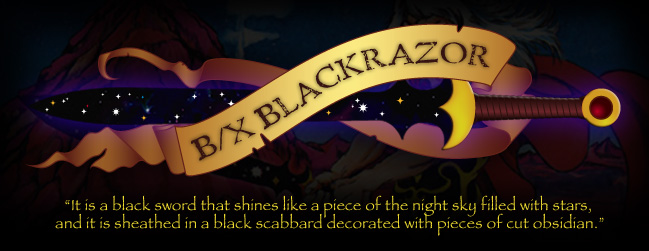
You know what inspires me? This does:
You know what else? This passage:

"...and the two strong slaves lifted it [the Codex] from the back of the Beast. Thereupon I commanded the Brazen Portals to be brought low, and they were wrenched from their hinges and rang upon the stone. The Efreet howled in fear and fled when I caused the page to be read, and the Beast passed into the City of Brass. Now was I, Tzunk, Master of the Plane of Molten Skies. With sure hand I closed Yagrax's Tome [the Codex], dreading to -- "

- from the AD&D DMG, Codex of the Infinite Planes, page 156

This fragment that describes the final actions taken by the High Wizard-Priest of the Isle of Woe prior to his mysterious disappearance...well, do you really need to hear anything besides "High Wizard-Priest" and "Isle of Woe?" I don't.

Look, folks: I have no intention or desire to go back to playing AD&D...it's a rotten system in a lot of ways. And despite my recent love affair with "Holmes-ian theory," I have some serious issues with some of its mechanics (like individual initiative). But I guess I AM finally starting to get old and nostalgic...and I'm looking at "nostalgia" as an indicator of where my interest lies...at the direction I need to take that will inspire me to hang on for the long haul. That will allow me to enjoy a style or tone (or whatever) of play that appeals to my psyche. Who cares if it's "bankable?"

[that is, who cares if there's a way to make a buck off it?]

Remember this little system?
If the name of a particularly powerful demon is spoken there is a chance that he will hear and turn his attention to the speaker. A base 5% chance is recommended to the referee. Unless prepared to avoid such attention -- or to control the demon -- the demon will thereupon immediately kill, by whatever means are most expeditious, the one pronouncing his name.
- from the AD&D Monster Manual, page 16

Now there's a good way to get a demon prince into your boring little campaign...just chant his name a few times until he shows up. See, there was a time when Orcus wasn't just another Big Boss for high level characters to team-up against in some set-piece combat. There was a time when players wouldn't even dare speak his name...

My Orcus. Just feels right.
I miss stuff like that...the horror, not of an eldritch, Lovecraftian, tentacled-type (though of course that's in there, too) but of a Satanic, Saturday Night B-Movie, black-Mass-and-bloody-candle type. The kind of horror that needs to be hewn with axe and sword...

*sigh* I know, I know...I'm probably being silly and I'll probably snap out of this "nostalgia funk" and get back to work on trying to make something "new" and "innovative" in a few days rather than desperately attempting to conjure the shadows of the past (if only there was a way I could). But that's where my head's at, right this moment anyway.

More later.

Saturday, October 3, 2015

Delving 4E (Part 5)

It's only fitting that this fifth post be the last installment in this series, seeing as how there's only five editions of Dungeons & Dragons. What - there's more than five editions? Well, the most recent one appears to be something called "fifth edition" and Wizards of the Coast (current holders of the brand name) has an official forum for "Fifth Edition" D&D, so I'll defer to them as the experts on the matter.

Point is, I think I can finish up this series on 4E in one more post. Yes, it will include my (positive) thoughts on the DMG and MM. Maybe some of the less than positive ones, too.

First, the combat/adventuring system found in the PHB: meh. Compared to the other sections I've discussed, there's not a lot here that I find all that cool, interesting, or portable (other than things I might have mentioned in earlier posts). I've seen tactical rules like this before...3E had plenty...but while my impression is that 4E is a simpler system, it sure appears to be complex (talking about presentation here).

I'll reiterate again that I'm kind of intrigued by the way 3E "saving throws" have been rolled into "defenses" and how the actual 4th Edition "save" works. It allows for some interesting effects (like catching hold of something when knocked off a cliff...that's neat). The whole defining action thing (standard, move, and minor) and the currency between them is pretty tidy, if only necessary due to the general excessiveness of combat (appropriate, mind you, due to the emphasis of the game). I like the "shift" action as an evolution of the fighting withdrawal (used to move without provoking an attack of opportunity). Opportunity attacks seem a little simpler than 3E, but it's been a while since I read the 3rd edition...

And that's pretty much all I need to say, with the exception of healing (surges) and the art of dying. Man, it is hard to die in this game...or, rather, it should be hard given the system. I'll admit that I'm not a fan of the three-step death process with saves and whatnot...a (for my money) overly complex system for a pretty faulty concept. Just take death off the table, if that's what you want: PCs reduced to 0 hit points or less are simply knocked out or incapacitated, not killed.

OR (if you want to retain the slim chance of death), simply have an incapacitated PC roll a D20: on a result of 1 or 2 the character dies. That is a fair representation of the character's chance of dying using the 4E system. As it is, you need to fail an unmodified "death save" three times (rolling less than 10 on a D20) in order to give up the ghost...45%x45%x45% equals 9%, the equivalent of rolling a 1 or 2 on the D20. Hey, designers: it doesn't have to be so hard.

The healing surges are another matter. Yes, there are probably too many of them, especially considering how they interact with the short rest and long rest systems. BUT the 4E designers have really just run with the whole concept of abstract hit points, an idea I can get behind. Keeping HPs an abstract measurement of PCs' "staying power" (as opposed to actual measurement of health) allows you do do all sorts of neat tricks: like allowing a PC to gain a few bonus HPs from quaffing a vial of holy water (presuming they're not Chaotic), or granting a PC an extra D4 hit points from downing a jug of wine ("Dutch courage"). It allows my warlord character to give flagging companions a boost by righteously pounding the crap out of someone, and it allows fatigued individuals a chance to recover their second wind in the middle of a fight.

For the record, I like the second wind concept (the ability to expend a healing surge once per encounter to recover one-quarter your HPs mid-combat). I think using it in conjunction with an abstract vision of HPs is about the only way to model someone gaining a "second wind" in the midst of strenuous activity (fighting, in this case). However, as executed, it's excessive...how many times can one really "dig down" for that extra resolve? I'd say once per day with the exception of some fairly unique individuals (modeled with an appropriate feat, perhaps).

No player character in 4E begins with fewer than six healing surges, a number I'm sure is based on the game's paradigm of "two encounters per session." At that rate, even the weakest (in terms of healing) party member can count on two second winds per session (one per encounter), plus as many as four between the encounters to heal HPs back to full for encounter #2 (since each healing surge heals a character one-quarter its HPs). If the final encounter of the day depletes the character of all HPs (and surges), they can still count on ending the session with a long rest to recover all lost resources (HPs, surges, and powers) setting a "fresh slate" for the next get together.

There's not a lot of risk there.

But there's another point to such "safety mechanics" besides simple survivability. Perhaps, they exist to allow longer, deeper delves...bigger adventures without the need for constant retreat and recovery. I mean, that's a positive thing to shoot for, yeah?

Except the 4E DMG belies that presumption with the basic setup of adventures and encounters. Things are built with an eye towards balancing encounters against each other and against the player characters in a manner that provides a steady rate of mechanical challenge at an estimated pace of one hour per encounter. Maybe that's a conservative estimate...especially at low levels when opponents should be fewer, smaller, and possessed of lesser special abilities...but I can also see the possibility of encounters taking longer, especially in situations where PCs have expended their "finishing moves" earlier (or ineffectively) or due to higher numbers of adversaries (on either side) or higher complexity in the numbers of creature roles.

Complexity. Man, that is a key word, here. I've now read the DMG a couple times and I've got to wonder again at the design choices, especially in light of what I know of the designers' objectives. Here's the specific quote I'm thinking about from 4E designer Andy Collins:
People today, the young kids today, are coming into exposure from D&D after having playing games that have very similar themes, often have very similar mechanics ... they understand the concepts of the game. So in some ways they are much more advanced as potential game players. But in other ways, they are also coming from a background that is short attention span, perhaps, less likely interested in reading the rules of the game before playing.   
And I'm not just talking about younger players now, but anybody. I know when I jump into a new console game, for instance, the last thing I want to do is read the book. I want to start playing. And that's a relatively new development in game playing and game learning. And we've been working to adapt to that, the changing expectations of the new gamer.
First of all, I realize there are people like Mr. Collins...my brother, for instance...who can't be bothered to read the instructions on their video games. I'm not one of them. And because I prefer to read the instructions first, I tend have an easier time and excel faster then the dudes that just "jump right in." But, okay, whatever...say stodgy old me isn't their target demographic. Say their game (4E) was designed for the impatient, energy-drink-swilling, short-attention-span kid. How the holy fuck could they expect such a person to digest and run a game of the complexity that is 4E? How are they going to put together adventures and interesting encounters just "off the cuff" with the careful balancing act required for the gig?

It's taken me quite a bit of brain power to parse out the (adventure) design structure presented in the DMG, to the point that I think I could put something together, and I'm no rank novice when it comes to D&D or DMing in general. And I think the 4E DMG is pretty well-written...some of the stuff in here on running the game, designing campaigns, and advice on being a DM is quite good, perhaps the best I've seen in any edition of D&D. I especially like the section on the D&D world and the "core assumptions" of the game...it goes a long way towards creating a coherent gestalt of the kitchen sink fantasy elements that have crammed the game's pages since the beginning.

Could a complete newbie to tabletop role-playing just sit down, open up the 4E DMG and MM and craft/run an adventure for a few friends? I guess anything's possible, but it's hard for me to see it. In my estimation 4E requires a greater degree of sophistication than earlier editions. I had no problem DMing B/X as a nine-year old, nor AD&D as an 12-13 year old...but 4E is a very different animal. I think it is safe to say it's built to emulate (in many ways) MMORPGs like World of Warcraft. The difference, though, is that WoW has a host of programmers building a world for exploration and adventure for the people that pay to play, while D&D's "world" is supposed to be built and run by the same people that put their money down for the books. With the level of complexity 4E presents, the level of study required to make it accessible, I just can't see how this meets the designers objective of appealing to "the new gamer."

[maybe the idea was to sell a lot of pre-written adventures?]

OKAY. Things, I liked. Much of the writing, non-specific to the mechanics (just advice information on running a D&D game) was "good stuff." I like the core world assumptions. I like how they handle artifacts in 4E, and the idea of concordance, though I initially liked BECMI's universal method of handling artifacts also (as a repository of power points) and in practice found it pretty boring...artifacts should break some rules.

I think that the direction 4E went with monsters and monster scaling is actually more versatile and less complicated than 3rd edition...which, all things considered, is pretty impressive. Even so, the monster roles are pretty bland, even if they're descriptive of the way creatures are used in play. The idea of elites (double power monsters) and solos (quintuple power monsters) is a concept I recognize from MMORPGs, of course, but I wonder if it isn't something that couldn't be adapted to good effect. It's certainly easier (and more sensical, IMO) than "adding levels" to monsters. It reminds me a bit of the rules for gargantuan monsters (Mentzer's Companion set) and paragon monsters (Mentzer's Immortal set).

I do like the D6 die roll for recharging monster powers...makes it easier for DMs to be objective when it comes to hosing players with an adversary's best powers.
; )

If only I could grok his stat block.
Oh, yeah...I quite like the way 4E has taken Orcus and made him a focus, arch-antagonist of the setting. But that's something (along with the 4E cosmology) that I want to talk about in a "non-4E" post.

And that's about it.  I'll check the DMG2 later to see if there's anything else I'd like to note. Expect a follow-up addendum to this series.