Showing posts with label i2. Show all posts

Tuesday, November 16, 2010

Final Thoughts on White Plume Mountain


I have written more than once that S2:White Plume Mountain is one of my favorite adventure modules of all time, not to mention one of the best examples a “true” D&D adventure/dungeon. There’s almost no “plot” to the adventure, save what a DM might want to give it…really, it’s little more than an adventure scenario: go find some missing artifacts and bring ‘em back for a reward.

The small scale of adventure – 27 numbered encounters, a wandering monster table with 6 entries (and the dead ones stay dead), plus an optional “final encounter” – make it one that can be completed in a single looong weekend, or over just two to three evenings. Ours took longer (5 sessions) as we had many players that were new to the game (not to mention I was challenged to wrangle so many players). But a short adventure like this means a LOT less prep work for the DM.

At the same time, the players were plenty challenged by the encounters presented. The frictionless room, heat induction plates, ziggurat/aquarium, boiling bubble, and mud cavern all proved to be exceptional challenges for the players…not just their characters. And there were several encounters they missed completely…the floating river, the spinning corridor, and the riddle of the globes…all of which would have produced additional consternation I’m sure.

The “S” series of modules (Tomb of Horrors, Expedition to the Barrier Peaks, Lost Caverns of Tsojcanth) carry the designation of S for “Special” and they certainly are…all four modules are filled with unusual challenges and non-standard monsters. S1 and S2 are two of the shortest modules ever published by TSR, and yet there is plenty in each to make even the most experienced players pause for a moment.

Not that experienced players don’t have a leg up…the eight guys sitting at my table had a fairly easy-breezy time with some challenges; for example, all the riddles got knocked down quickly. Several times, one player found him idea stymied by the module, but a second player would offer an alternate idea that worked just fine. There was a lot of “brain power” at the table, and that made it possible for the PCs to do quite well over-all (well, except for that final challenge).

If anything, the characters’ own ability scores got in the way of their ideas. My inclination…or crutch, really…is to use ability scores (strength, dexterity, intelligence, etc.) as the equivalent of “skills” for adventurers. There’s no “grab the swinging chain” skill, so make a Dex roll. There’s no “underground direction sense” skill, so make an Int roll to see if you recognize this stretch of corridor.

Actually, I suppose I’m not THAT bad…generally, I allow any hare-brained scheme to work if it makes sense (the weird, rope pulley thing just took awhile for me to grasp). And anyway, the abilities are there to represent SOMEthing (the characters’ abilities…duh!).

However, players sometimes looked annoyed when I’d ask “what’s your strength” to try something and they only had an “8.” I suppose it’s tough to get in the mind of your Halfling character sometimes…especially when you yourself are 6’+ tall.

[interesting that I’ve also found the opposite to be true…my petite wife often had difficulty getting into the mindset of a hardy fighting man]

Regarding the challenges (and the monsters) in the adventure…I was constantly amazed at how different encounter strengths turned out to be the exact opposite of how I anticipated them. Partly this is probably due to memories of prior “runs” through White Plume Mountain. For example, I’ve always considered the Whelm section to be a pushover part of the dungeon, and here it resulted in a TPK (ok, technically there were “survivors,” but if we hadn’t been out of time the remaining three would never have made it past the mud room…).

But having no magical means of bypassing the mud cavern…no fly, levitate, dimension door/teleport, winged boots, etc…made the chamber a near-complete stumper for the party. The explosive geysers do a ton of damage (based on proximity) with no “to hit” roll or saving throw needed. There just weren’t enough resist fire spells to go around! In the past, parties have always circumvented this far easier than the frictionless room or the heat induction corridor.

And then Ctenmiir…wow! I have never seen him (or any vampire) kick so much ass. Of course, I’ve never seen any party stand toe-to-toe with him; in general, they would Turn the vampire, get the treasure, and leave. Our clerics both had the opportunity to Turn the creature, but neither tried (I’m not sure why…maybe they felt their chances weren’t good enough). Raise dead was actually an excellent spell to use, though looking back I’m sure Luke would have preferred to use Dispel Evil (it also destroys undead but singular targets receive a saving throw penalty). There was certainly some bad luck involved (Ctenmiir hitting Alster’s incredible armor class and dropping him to 5th level put a stop to the cleric as a threat, and his hypnotizing of Sexy Kevin sealed off any help from their “back-up cleric”). Without a cleric, vampires are dead-hard monsters in D&D…they WILL eventually hit you and that (ultra-fast in B/X) regeneration makes them a recurring nightmare.

[tell you what: I2:Tomb of the Lizard King looks a LOT harder than its “mid-level” range would indicate. If I were going to convert it to B/X play, I think I’d have to make it 14th or 15th level!]

Even fleeing immediately, the characters would never have made it across the mud cave before the flying, regenerated Ctenmiir arrived and cut their little rope line. Those guys were goners.

Anyway, contrast HIM with the giant crab. Sure, there was a timer-based “auto-kill” effect in play, but I figured the crab itself would kill at least one character (15 hit dice monsters tear through plate armor like tissue…and those claws averaged 10.5 damage each!). However, such was not the case…the monster didn’t hit all that much and didn’t do all that much damage (damn random rolls). I suppose in that situation the party had a little “good luck.”

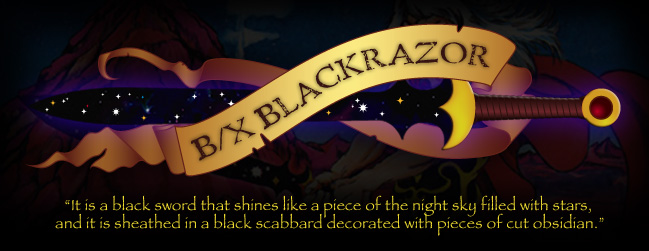
Personally, I figured that Quentin and Blackrazor would be the real “party killer” of the three guardians, but he really wasn’t “all that.” Perhaps, if I had NOT allowed the scarab of protection to save Sweet Tito’s soul (and thus added the elf’s hit points and level to Quentin)…or perhaps if I’d allowed the extra levels to mean multiple attacks for Halfling (as they would have meant to an AD&D fighter)…maybe then the Halfling would have finished off the entire party. But that sure would have cut the adventure short! As it was, I was quite pleased with how that particular encounter resolved itself.

Boy, those halflings sure did prove to be resilient little cusses, huh? Like cockroaches…fairly impossible to stomp. The combination of good armor class and good hit points made them Tiny Tanks…and unlike the big fighters, they were far less often targeted in combat. The elves and clerics often suffered from a lack of hit points…there’s no minimum Constitution requirement for these classes (unlike Halflings) and several of those PCs were scarce in the HP total because of it.

And the thieves…whoa, poor little guys. Once again proving that they are NOT lightly-clad fighters. They are THIEVES…and hand-to-hand melee was a very bad idea for these chaps. Magic-users would have been even worse, of course…but none of the players played a magic-user so it’s hard to tell how THEY would have fared.

All in all, I have to say I was quite pleased with the over-all adventure, and quite happy that I had a chance to run it again with a new set of players. Even considering it a “fun house” adventure I think the module has a nice set of teeth, and certainly provided the group with mucho entertainment value. I don’t know the next time (if ever) that I’ll get a chance to run White Plume Mountain again…perhaps for my own children someday. But this was a lot of fun for a “one-off” adventure, and it sparked a ton of ideas…on the use of monsters, challenges, and intelligent artifact weapons…that I’m sure I can adapt to later adventures.

Hell, some of the stuff found in White Plume Mountain – Wave, Blackrazor, Ctenmiir, “Quentin” – would be entertaining things to have “pop-up” in other campaigns. Certainly, I could build an entire campaign setting around ANY one of the three magic weapons…if I’d had the chance, I think I would have given Whelm a cranky, dwarven personality.

Hmmm…many ideas to consider.
; )

Friday, November 20, 2009

A True Expert: Dave Cook Kicking Ass (Part 2)

[sorry, my earlier post was about to explode into an unwieldy amount of text...figured I'd break it up]

Let me just quote a paragraph from the text or two, so you can see why I just saw more and more awesomeness in the X4 and X5 modules:

In encounter 2 of Part 4 (X4:The Master of the Desert Nomads), the adventurers are relaxing with some caravan buddies, elated from an earlier victory over an attack by bandits (by the way, Cook makes good use of all the human "monsters" of B/X...bandits, Normal Men, nomads, dervishes, etc....not just character classes).

If the party remains, they will be the guests of honor at the night's feast. After a thick, syrupy coffee, the merchants will carry in a large platter of camel meat (still on the bone) laid on a bed of rice. Over this will be ladled burning hot grease and melted camel butter until it flows over the side of the tray. Lamshar will then invite the characters to eat. They will be expected to dip their fingers into the tray and pull out balls of meat and rice, dripping with grease. Lamshar and Khel will dine with them, offering the player characters choice bits of camel meat that they have pulled out. After the characters have had their fill (and to only eat a little would be insulting), the other merchants will take their place at the tray. The meal will finish with somewhat green dates.

!!!

Now all that text is DM's Eyes Only stuff...this is not boxed text to be read to the players (though both X4 and X5 include some boxed text). Cook creates a whole culture and adventure EXPERIENCE in under 30 pages of text.

Some might think, that with this kind of loving attention to the background material, the adventure would be short on action. No way. He still has room for a full set of wilderness encounters and a 60+ encounter dungeon (the Evil Abbey), as well as including half a dozen new monsters, pregenerated characters, and mini-mass combat rules. And that's JUST X4! X5 is another great 30 pages...this is practically a mini-campaign setting between these two modules.

X4 was published in 1983, the same year Mentzer's Basic set was coming out. X5: Temple of Death was also released in 1983. This is before Mentzer's Expert set or Companion rules hit...

X4 has no shortage of interesting tricks and traps (here come some spoilers folks). For example, back to the previously quoted encounter: all PCs taking part in the feast have to make a save versus poison ("I don't know if it was a piece of under-cooked camel or the green dates, but I'm not feeling so hot..."). Those that FAIL are up all night with indigestion. However, those that are AWAKE get a shot at stopping a sneaky little critter that ransacks the camp that night.

How cool is that? The characters that SUCCEED get to brag about their iron constitutions, but the ones who FAIL get a shot at being heroes later on!

There are a several of these kinds of switcheroos...an ancient Champion of Law that is so obviously the inspiration behind the Scorpion King of The Mummy Returns film (yep, it's now gone bad...)...others friendly NPCs that aren't what they seem (similar to The Jade Empire video game)...plants and double-agents. And am I the only one that sees the Nagpa monsters the direct antecedent of Games Workshop's Lord of Change greater daemon?

Cook also corrects one of the issues I have with X1: The Isle of Dread, though it sets a bit of a bad precedent to later adventure modules. In X1, adventurers can wander around a huge island wilderness for days or weeks without encountering anything but wandering monsters due to encounters being in certain set locations. Players (and the DM) basically have to get lucky (or fudge) if they want the party to run into a particular set piect. In X4 and X5, the wilderness map is set, but the location of the encounters are not...players will experience each encounter when the DM deems the time is right.

Now when I say this is a dangerous precedent I say it comes dangerously close to a linear railroad type adventure...where the only thing that can happen is "players succeed at encounter and move onto next" OR "players fail at encounter and die ending adventure." Adventure path or "story path" in the end all you're doing is living the author's fiction...with widely varying degrees of control (depending on the level of authored NPC involvement). When this happens, it doesn't matter how cool and interesting an adventure...your game play is no longer a collaboration between creative minds, and that's a shame.

Cook avoids this pitfall, and he does so through a number of ways:

1) With a couple exceptions, wilderness encounters need not occur in a particular order. The DM is just ensuring they occur...that's part of the adventure (just like dealing with the throne room or the demi-lich is part of the Tomb of Horrors...there are specific bottle-neck points).

2) Success or failure at a particular encounter does not necessarily derail the adventure. For example, in X5: Temple of Death players don't HAVE to get into the flying ship (flying ship? Yeah, as I said, both these modules are frigging awesome). And in fact, even though it would expedite some things, doing so leads to its own dangers (I shan't elaborate for the benefit of folks that haven't played).

3) In both modules there is a centerpiece dungeon that players will eventually find, and unlike, say other modules, there is nothing linear or pre-scripted in what happens once "on-site." Hell, the dungeons don't even include the boxed text that is present in the wilderness encounters! They are wholely Old School dungeons, complete with Gygaxian ecology and wide open for exploitation by creative adventuring parties.

4) There is no force used upon the PCs through the machinations of NPCs. Players are still calling the shots about what happens in the adventure.

For all these reasons, I don't feel the modules are forced or contrived. Heck, they're even less so than the Desert of Desolation series, with which they share certain superficial traits. Despite the lower production value, Dave Cook's two-part series may actually blow the Hickman and Weiss masterpiece out of the water. Well...it's hard to say, though, as I've had such a love of the I3-5 series for so long.

As far as a B/X adventure? It is easily the best pre-packaged adventure I have ever read for B/X or BECMI. Hands down...it is head-and-shoulders above both B2: Keep on the Borderlands and X1: Isle of Dread. And seeing as how THOSE two made my Top Ten All Time list...well, I might just have to re-do the list.

The thing is, Cook's modules are not designed for kids. Or maybe they are, but they have a very mature, adult sensibility. The power of organized religions? Demons and possession? The need to use wits and stealth over hack/slash/fireball tactics? This ain't no pick-up game for ten year olds, no matter what the Expert set box says.

Of course, we ARE talking Dave Cook here. The designer behind I1:Dwellers of the Forbidden City and A1:Secret of the Slavers Stockade. Snake people and slavers? The guy has a Swords & Sorcery mentality that doesn't quit.

And he brings that S&S style to both X4 and X5. THESE are the potential of the D&D Expert Set...THIS is the kind of mentality I am trying to bring to my Companion set. If Cook had written the sequel to B/X instead of Frank Mentzer, I might have never moved over to AD&D. And, heck, I HAVE made B/X my game/drug of choice after all these years...

Dave Cook is my F'ing hero. Like Gygax and Arneson he should be up on the pedestal of RPG Masters. And, yes, I do realize the total irony with which I write that given his spearheading the design of 2nd edition AD&D leading to the saturation of TSR with sub-mediocre material...but you know, anyone who could take the original mishmash of AD&D and re-organize it has got to be appreciated for design chops regardless of how one views the end result...and I DO appreciate it, even as I loathe the game itself.

Mr. Cook, even as I try to dissuade folks from playing 2nd edition, I will heap praises on your name for your Expert work. And X4 and X5 are shining examples of why B/X is indeed the best version of the game to play. Bravo, sir.

Um...but one, little, tiny issue, Mr. Cook sir. Encounter #2 in the Catacombs? In X4 on page 28? There's no such thing as a "permanent Magic Mouth spell" in B/X D&D...there's no Magic Mouth spell at all.

But one flaw in two modules (for a guy publising in two editions at the same time), is pretty flawless in MY book.
: )