Showing posts with label bronze. Show all posts

Thursday, November 18, 2010

Campaign Ideas

Tuesdays and Wednesdays have turned into some of my loooongest “work days” for a variety of reasons…mainly that there are other commitments that I have AFTER work that keeps me busy all the way up till bedtime.

I say this simply to preface the following: I’m a bit un-prepared for tonight.

Tonight my Baranof group will be meeting for the first time since completing White Plume Mountain, and I know folks are going to be looking forward to starting SOMEthing. The idea is a decent campaign (or rather, “creating characters with the possibility of some long term serial play”). But I’ve got no idea what kind of campaign I want to run.

Fortunately, there was an “all staff” meeting for two hours at the office to discuss “combating stress” in the workplace. Since I’m a pretty stress-free guy, I was able to do a little notebook brainstorming for some possible campaign options. The only reason I’m posting ‘em now is to give my players (probably reading the blog) something to think about before we meet this evening.

None of this is set in stone. These are not listed in any particular order of preference.


Option #1: After the Goblin Wars. Already discussed in recent posts.


Option #2: Adventuring in the world of Krull. See the much earlier posts.


Option #3: Mythic Norse adventures. Harkening back to VERY early posts inspired by Elizabeth Boyer and Viking lore. Classes available to PCs include:

Fighter, Magic-User, Thief – as per B/X
Dwarves – as per B/X but able to craft magic items as a magic-user
Fighting Wizards – as per B/X elf class, withOUT the infravision/languages
No Clerics or Halflings
Skalds – as per the B/X Companion “Bard” optional class

Special Rules
“Binding Wounds:” characters can bandage themselves, healing D6 hit points, once per day. This can only be used immediately following a fight during a restful period of at least one turn.
“Broken blades:” non-magic weapons break on a roll of a “1.” Better carry a back-up axe!
“No plate mail:” sorry.
"Human or Elf:" aka "Scipling or Alfar;" they're the same thing.


Option #4: Bronze Age Heroes. Again, going back to my earlier musings on the “Bronze Age” nature of the D&D universe (monsters of ancient Greek and Roman myth, etc.). Characters will be the equivalent of a small party of Roman Legionnaire adventurers, exploring the ancient kingdoms of North Africa…desert, jungle, mountains, and pyramids. Classes available to PC include:

Cleric, Fighter, Magic-User, Thief – as per B/X
Dwarf – “throwback man” (Neanderthal-like, no weapon restrictions, but no infravision…a member of a northern culture enslaved by these mythic Romans and adopted into the army).
Halfling – “miniature savage” (like a mythic pygmy or Pictish warrior; same story as the “neanderthal” but class is EXACTLY the same as Halfling).

Special Rules
“Roman deities:” clerics worship the ancient Roman pantheon (pre-Christ) and may need to make occasional sacrifice. Mithras is a good sponsor for the excursion.
“Lorica Segmentata:” there IS plate mail. However, the slave classes (“Dwarf” and “Halfling”) are not allowed to wear it; only human fighters and clerics.
“Far from Rome:” most plunder found will be sent back to the Empire (via ox cart or whatnot) rather than hauled around; XP is gained for all treasure found, despite these donations of tribute.


Option #5: Warhammer Europe. As per WHFRP using the B/X rules. Chaos is encroaching from the north. The orks take the place of the Huns. Much of the continent has been developed by kingdoms that war with each other. Skaven lurk in the sewers. The usual…plus black powder weapons. Classes available to PCs include:

All standard B/X classes. Might modify them somewhat using my random B/X class mods.

Special Rules
“15TH Century Technology:” All gunpowder rules apply.
“Mordheim as a Mega-Dungeon:” You better believe it.
“WHFRP Critical Hits?:” Might be added to my own Random Death table.


Option #6: Run something other than B/X.

Here are some other games I’d be interested in running that I think would work with this particular group. In no particular order:

- Trail of Cthulhu: GUMSHOE is sooo much cooler than Chaosium for this kind of thing

- Boot Hill: because Boot Hill is the BEST; might also be interested in running my steampunk version, Clockwork (still un-published…could sure use some play-testing!

- Hollow Earth Expedition: I might need to modify the system A LOT, or at least boost starting characters somewhat, but hunting dinosaur with an elephant gun in the lost ruins of Atlantis is just so damn awesome…ugh, chalk up another much needed B/X adaptation to the growing list!

- Pendragon: A Chaosium game where I don’t mind the system (for whatever reason). I only own the 3rd edition, but I’d love to play this game with a group of 6-8 and see how their different characters develop over time.

The following games I would be interested in running “someday” in the far, faaaar future…though my players MIGHT be able to talk me into it now:

- Some Supers game (Superworld, Heroes Unlimited, TSR’s Marvel, or Godlike/Wild Talents). MAYBE…but only just maybe (I don’t feel like making a comic book campaign world that has any semblance of “sense” right now).

- Some Rifts-based game (specific interests: Mexico, Atlantis, Russia, or Wormwood…MAYBE, maybe Pac NW or Canada; everything else, setting-wise tends to be a lot of dog-shit). I would be more likely to adapt a Rifts setting (if the players were interested) to a B/X-based campaign. Yeah, it’s not as hard as it sounds (Palladium already heavily rips off Gygax and Arneson). Of course, anything I did in THAT arena would go un-posted on the blog…can’t have Siembieda suing me,right?

- Star Wars/Space Opera: Still working on my own game (that’s what I’ve been doing with my free time this week!) and it’s not ready to play. But I MIGHT be tempted to playtest it. MAYBE.

All right…that should give everyone plenty to think about. We’ll see what they want to get up to tonight (see y’all at 8pm!).

; )

Tuesday, July 27, 2010

Badass Holmes

This post goes out to all those sexy players of “Original Basic.”

Holmes D&D, or “Homes Basic,” or “Blue Book Basic,” whatever you want to call it…is the sole edition of Dungeons & Dragons I haven’t played. Well, except for “4E,” but as I’ve written before, I don’t really consider this an edition of D&D.

Holmes, despite its idiosyncrasies (five point alignment scheme) definitely qualifies as D&D in my book, and not just because it has “fantasy characters fighting fantasy monsters in a fantasy world” (which I don’t think is a proper definition of D&D anyway). And with all respect to those fighters out there, I think most Holmes edition adventurers will be doing what they can to AVOID combat if at all possible.

But we’ll get to that in a second. As I said, this is the one edition of “true” D&D I’ve never played. Heck, I’d never even seen a copy of it till I was able to buy TWO boxed sets from my local game shop last year (and cool beans I did, as I got first printing of B2: Keep on the Borderlands and a sepia cover copy of B1: In Search of the Unknown along with the books). I’ve read the rules a couple times, but as my gaming time is limited these days anyway, I prefer to stick to my beloved B/X when I game D&D. Still, I would LOVE to play (or run) a games of Holmes. Every time I skim the rules, it brings up a particular itch that I just keep wanting to scratch:

The need to be a badass.

That’s right…BAD ASS. Right on the cover of Homes it states, “the original ADULT fantasy RPG.” It might as well have the sub-caption, “Only Badasses Need Apply.” Because I am utterly convinced it takes Big, Brass Balls to play Holmes D&D.

Unless you’re some sort of masochist.

Let’s break it down with the basics:

Presumed Assumption #1: RPG designers know what they’re doing and designers do things for a reason.

Presumed Assumption #2: A game is a game, regardless of how it looks. There is no preconceived notion of how an RPG should appear.

Presumed Assumption#3: While there may be multiple editions of a game system, there are certain recognizable facets of a game that mark it as part of a family, even if it is its own edition.

[just go with me here for a couple minutes]

OKAY…so if you take these three presumptions to be facts, we can define Holmes as a pretty interesting animal.

Exhibit A: Holmes is D&D. Just having the name slapped on the front of the book doesn’t mean it’s D&D, but having those “recognizable facets” does. See my earlier nerd post: Holmes meets the criteria in every regard, and under presumption #3 we can say, “this IS D&D.”

Exhibit B: Holmes is its “own” edition. Holmes has rules that are different from every other edition of D&D. 5-tier alignment, certain combat systems (like initiative), functioning of particular magic effects, etc. If we see a game that doesn’t synchronize with any other game, and we agree with presumption #1, than we must acknowledge Holmes as its own edition…it is neither a precursor to AD&D, nor to the Cook/Marsh Expert set, though it states it is the former and is semi-adopted in the introduction to the latter. Holmes exists outside of the general space-time continuum of D&D, even though it is readily recognizable as D&D (see Exhibit A).

Exhibit C: Holmes the Badass Edition. If we operate under presumption #2 (practice non-attachment to how the game is “supposed” to look); Holmes is a self-contained game. After all, it is designed how it’s designed. It doesn’t go “with” anything (see Exhibit B). It is what it is.

And what is it? A world where your characters go from 1st level to 3rd…and yet the monsters range from goblins and kobolds up to purple worms and vampires. This is a brutal, brutal world…one where poison means instant death for an adventurer and one in which there is no cure for that poison. Fighters never reach “hero” status (per other editions, that would be a 4th level fighter, and Holmes fighters never get there), and magic-users never gain more than a (small) handful of spells. The only wizards with any power are NPCs…and they are probably of the ancient, stooped and wizened variety to have gained so much power.

Now I’m not the first blogger to suggest Holmes be treated as its own game…one crazy, gritty, nose-to-the-ground game that only goes to 3rd level. I’ve read other Holmes enthusiasts who suggested discarding any pre-conceived notions that Holmes players MUST graduate to AD&D or an Expert set or one of those home-made-internet-downloads-that-continue-Holmes. This is an Old Subject in the realm of Old School blogging.

But instead of looking at THAT particular glass as half-empty (“imagine a D&D campaign where your characters are always eating dirt”), I prefer to remember that adventurers in a D&D game are already a cut-above the Normal Man. Holmes adventurers ARE heroes, even if they aren’t capital-H “Heroes” or even superheroes…but they are heroes. The best kind of heroes. The badass kind.

What is a hero? Well, if I skip the historical definition (of the mythological, half-divine individual), the American Heritage Dictionary defines a hero as “any man noted for feats of courage or nobility of purpose.”

In general, adventurers in D&D are not marked for their “nobility of purpose” (they are adventuring for money after all; i.e. trying to make a buck). So what exactly is a feat of courage? Well, the AHD defines “courage” as:

“the state of mind or spirit that allows one to face danger with self-possession, confidence, and resolution.”


If I’m an adventurer…whether 1st level or 3rd level…and I’m going up against a 6+ Hit Dice troll, you better believe it takes courage to even step in the room. Sure there’s trepidation and a jack-hammer heart beat, but that’s the game. At least, it’s the Holmes game.

Adventurers in D&D are a cut above the non-adventuring “normal” folk. But Holmes adventurers are certifiable. They had better be smart, tough, and have a large dose of good luck on their side…especially considering “ability bonus inflation” is non-present and magic items found aren’t going to give you much bonus. You better be both resourceful AND on top of your game if you’re going to face down a gorgon or basilisk with your Homes character!

Adventurers in Holmes are a cut above normal folk, NOT just by their class, but by their HEROIC SPIRIT: the confidence and resolve to face immanent, mortal danger every time they step into the cave entrance. No matter how great they grow in power (um…3rd level?) a strong blow from a giant will crush the stoutest fighter like…well like a giant crushing a mortal man. And you’re going to seek out THAT guy’s treasure horde? You better be prepared in every way possible…you’re going to need a healthy helping of brains to go with your Big Balls. If you survive to 3rd level, you should be expecting some pretty epic songs to be sung by the local bards…and even in your old age, you’ll probably be called upon (like Beowulf) to fight some massive (and certain-death-dealing foe).

How creative do you think PLAYERS have to be to survive Holmes Basic? Talk about serious mental boot camp: if you’re tired of getting your characters gaffled by bugbears and ogres (not to mention black puddings and purple worms), don’t you think you’re going to have to learn how to use every possible advantage? Unlike other editions of D&D, Holmes does NOT have raise dead as a readily available spell. Oh, so sorry…you only live once. Just like, say, Stormbringer?

[at least in Holmes you don’t have to worry about getting critted and killed in your first fight. Instead, you just have to worry about getting hit twice and killed!]

This IS gritty fantasy. This is fantasy with balls. This is an RPG that, if the players are COMMITTED to it, will force you to step up your game. And it’s one where retirement should be viewed as a welcome reward from an extremely dangerous lifestyle. Holmes dungeon delvers are coal miners. They should be coming out of those caves covered in dust and blood and cobwebs…and definitely ready to fire up a smoke and pour a drink on the ground for dead companions. Now THAT’s D&D without artificial sweeteners. I love it.

Welcome to Holmes Basic. Only the Truly Badass need apply. For those about to die: we salute you!
; )

Tuesday, July 7, 2009

The Riddle Of Steel

One thing I do enjoy in James Silk's retro-pulp Death Dealer books (aside from the Frazetta covers and the grim textual depictions of “axe work”) is the treatment of metals. The culture of his novels is ostensibly Bronze Age, but here and there some of the “bad” guys have developed steel, and their weapons and armor are shown to be uber-superior to the poor-ass barbarians.

I’ve seen this similar theme of “emerging technology usurping prior technology” in films like Pathfinder (Vikings!) and 10,000 BC, as well as literature. And I like it…by which I mean, I like it for something to add to a D&D campaign.

AD&D introduces the concept of “magic metals” in the DMG when it starts discussing how +4 weapons need to be made from mithril and +5 weapons need to be made from adamant. But interpolate the concept a bit…if one’s D&D campaign is set in a Bronze Age society, wouldn’t steel be the magical metal of the gods?

I’m not a metallurgist, but I know a bit about swords and such just ‘cause I’m a big nerd. And bronze weapons and armor were incredibly durable, stronger than natural “wrought iron” which was present in greater abundance than tin and copper (the two materials necessary for smelting bronze). The Iron Age which follows the Bronze isn’t about folks up and discovering iron; they had it already. It was instead about folks learning to smith at higher temperatures, so as to incorporate carbon into their iron, thus creating steel… a metal as light weight as bronze but many times more durable.

Here’s how I see it: a Bronze Age campaign is totally consistent with OS D&D play. For one thing it is both pulpier and Classical (in the ancient Greek sense of the term…Medusa? Pegasus? Cyclops?). For another it skirts the whole issue of “why is there no gunpowder?” (give it a few centuries, folks). Personally, I think a lot of the illustrations of characters in AD&D look more Bronze Age anyway (more loin cloths, less hose). Plus making steel a “magic” metal affords some cool opportunities for your game.

Like what? Well, like readily identifiable magic items, for one. Anyone can see that a shining steel blade is superior to its Bronze Age equivalent.

What else? Putting the old school alchemy back into the wizard’s handbook. If magic-user’s create magic weapons, then they’re going to be the ones with knowledge of metallurgy and smithing (after 9th level, of course).

Which also means? Dwarves once again become makers of magic arms and armor, even without the ability to use magic or cast spells. Wizards will be indenturing themselves out to dwarfholds (or at least going on quests) in order to learn the secrets of steel from the dwarves.

This is the way I’d work it: Bronze Age arms and armor are the default. These are readily identifiable by anyone. Arms and armor of shining steel are +1…also readily identifiable, and creatable only by a dwarf, elf, magic-user, or skilled blacksmith (a Normal Man) with the required training. Arms and armor of superior craftsmanship (identifiable by a fighter, dwarf, elf, or blacksmith) are +1 as well…combine the two and you have +2 equipment (steel of excellent manufacture).

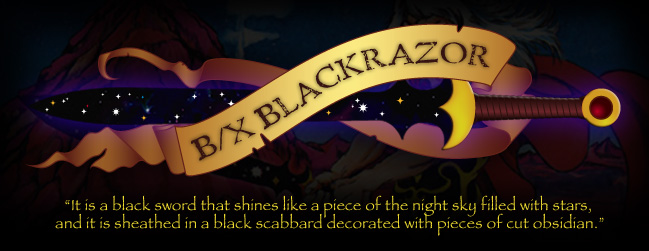
So what then are +3 items? Well these are the obviously enchanted items. Stormbringer or Blackrazor (made with alien black metal and covered in glowing runes or starry constellations). The golden armor of Mordred from the film Excalibur. That kind of thing. Only dwarves of the greatest ability (i.e. 12th level in B/X) can manufacture items with true enchantments (for example, additional bonuses against giants), and mundane blacksmiths cannot manufacture them at all. These items of power may be obviously magical, but the identification of their powers will need to be accomplished in the “normal” (D&D) fashion.