Showing posts with label torture. Show all posts

Friday, May 15, 2020

Rooting Against the Players


I am not a thirteen year old boy anymore.

But I remember being a 13 year old (barely) and having friends who were 13 year old boys and what our D&D games were like.

*sigh*

As usual, apologies for the lack of posting. I've been in a bit of a...a what? Malaise? Is that a word?...lately that I just can't quite shake. Activity, keeping busy (running errands, gaming, working around the house) helps. Sitting in front of the computer, writing, does not. Not that I have excessive amounts of time to do that...the kids, when awake, need near constant attention, and when they're asleep, the malaise is generally pulling at my eyelids, too. Daily naps have become, more-or-less, a necessity simply to retreat and recharge my batteries from the constant interaction with my family.

Ugh...apologies. Didn't want to get into all that. Just wanted to offer a reason why it's hard to bring myself to the keyboard recently.

Back to the kids...while it's certainly interesting to be involved in campaign play with children, I can't say I'm finding it especially enjoyable. There's so much that children just don't know, so much information they don't have. Not just life experiences, but knowledge and ideas. Hell, vocabulary.

But, that's the bed I've chosen to lie in. And regardless of the sophistication (ha!) of any adventure design or narrative prose I might contribute to the mix, in the end things generally come down to a D6 roll for initiative, a D20 roll for attack, and...well, you know the rest. Basic arithmetic.

The kids, being of different ages (and, thus, different stages of life development) provide an interesting snapshot of different approaches and priorities in gaming. The six year old is most likely to think out-of-the-box in terms of game play; her grasp of the rules isn't strong, and she approaches the game with her imagination, often trying to befriend or communicate with monsters. The nine-year olds are straight-forward game players: their first instinct is to go for the sword (if they think they can beat an opponent) and loot the bodies. One exhibits more caution than the other, though this manifests as "hanging back," not in taking any separate or different approaches to encounters and challenges.

[interesting that the "cautious" player is a fighter while the the "gung-ho" player is a magic-user who hurls one dagger before charging into melee with his second. Seems to work for them, though]

The thirteen year old. Mmm. I ask him to roll for initiative and he asks what die to roll; same with attacks. Told there's an evil high priest bent on taking over the world and he wants to find the guy and join his cause. Capture a band of mercenaries via a sleep spell and he wants to tie a guy up, pour oil on him, and light him on fire. Just to watch him burn. Find some mysterious cave fungi and he wants to try eating them; same with dead insects. Find a cold, natural tunnel covered in a thin layer of frost and he wants to get on his shield and see if he can "sled" along its length; failing to scoot more than a few inches, he decides to pick up shield, move a few feet, and try it again. And again.

Having been a thirteen year old once upon a time, I understand about the need/desire to push buttons and boundaries, to experiment with what is possible. I get that. Some folks might even feel that it's appropriate (or important!) to engage in some "asshole behavior" not only to assuage curiosity but to "try on" the behavior and integrate the experience into the developing psyche. I'm sympathetic to this point of view myself (I'm of the belief that repressing developmental experiences can lead to worse behavior in adulthood...and that being an asshole in youth doesn't mean you become an asshole in adulthood, so long as you have the proper guidance, teaching, and parenting).

But, as I said, I'm not thirteen anymore. And I'm not terribly interested in indulging in bad behavior, or having it indulged in at my gaming table.

This is the problem with having a mixed-generation group like this. When I was a young teen, I was gaming with other young teens (boys and girls) and, out of the sight of any parental supervision, we explored our own imaginary transgressions. Pushed each others' buttons. Acted like assholes. Laughed uproariously. Eventually, somehow, still growing up to be well-adjusted members of society.

That's not where I'm at anymore. And it's irritating to have to pause the game and explain why, no, it's NOT a good idea to murder the matriarch to whom you owe 10,000 gold pieces for a raise dead spell because, A) you might need her services again, and B) she's a respected figure in the city that you use as a base of operations, and C) the temple is full of under-clerics, followers, and temple guardsmen.

I haven't done a whole lot to curtail the bad behavior, other than letting the chips fall where they may, but it's hurt and frustrated the other players...in our last session (yesterday) the boy's nine year old sister did not attend (claiming excessive school work) and I'm not so sure it didn't have something to do with the prior session's incident of torturing a prisoner to death for no reason. I find myself rooting against the player, hoping karma catches up to him before he causes more harm (to his own party)...and THIS is a bad place to be in as a DM. Not when it's already a challenge to maintain one's impartiality.

At the end of our last session, heavily wounded and burdened with treasure, the party decided to make a three day journey through the swamp in which the adventure is located, back to the tiny village that was the nearest "civilization." I explained that this wasn't the best idea; that they should try to stay on dry ground, at least to heal up a bit, rather than drag their wounded (at at reduced pace) through knee-deep water, infested with mosquitoes and snakes and whatnot, risking infection and disease. The magic-user was too weak to even walk (having been reduced to exactly zero hit points), and the kid didn't even want to spend the time to build a litter for him, preferring to sling him over his back, risking further injury or reopening of wounds. In the end, they compromised, building a litter with broken spear shafts, but deciding to make the hasty journey regardless.

First instance of
disease rules.
This morning, I decided to check the chance of the party contracting an illness or parasitic infection. Because I find the Blackmoor (Supplement II) rules to be both less informative and too specific for my tastes, I went with the more abstract rules in the DMG, as they are familiar to me; as I've written before, we were pretty By The Book back in our AD&D days. While I gave all the characters (except the paladin) a chance of contracting an illness, only two did: the party's dwarf henchwoman and the thirteen year old's fighter. Both earned gastrointestinal disorders: the dwarf's mild and chronic, the fighter's acute and fatal...karma indeed.

Of course, the party's paladin can cure disease once per day, so normally this wouldn't really be an issue. But would she use it on such a despicable human being who engages in torture and mayhem? Should she be allowed to? A lawful cleric might not even be granted the ability to heal such an individual, but paladins' powers are largely undefined (they appear to come from the character's own "innate goodness"). Since I do use alignment and class strictures, I had toyed with the idea of removing the character's paladin status for standing by while the fighter burned the mercenary alive (only dismissing the penalty as there had been nothing the paladin could do to prevent it from occurring at the time).

Mmm...decisions. I have a few days to consider before our next game session. In the meantime, I've introduced the classic BattleTech role-playing game to my kids and the children are having fun managing a mercenary company (lot of nice economic nuance in the old Mechwarrior RPG).  More on that later, perhaps. Turns out that my giant pile of hoarded role-playing games is a nice resource for a cloistered family. I'm debating if, perhaps, I should pull Boot Hill from the pile.

Anything to stave off the malaise.

[thanks for reading, folks]

Sunday, April 14, 2019

L is for Luln

[over the course of the month of April, I shall be posting a topic for each letter of the alphabet, sequentially, for every day of the week except Sunday. Our topic for this year's #AtoZchallenge? Revamping the Grand Duchy of Karameikos in a way that doesn't disregard its B/X roots]

L is for Luln, the original "suggested home base" for players in B/X. I've posted the description in a prior post, but I'll quote the text again for convenience sake:

"Composed primarily of persons who have fled Black Eagle Barony, merchants who have come to trade with the Baron, and some non-humans who have left the wilderness, Luln is a base town for adventurers exploring the Haunted Keep, also called Koriszegy Keep and the surrounding land. Somewhat lawless and open, the town can provide most of the basic needs to any group of adventurers. The town is poorly defended, relying on the goodwill and capabilities of both the Baron and the Duke for its defense. Approximately 500 people live in the town."

(from Cook/Marsh, page X60)

The text in Mentzer's expert set is mostly the same, though any suggestion of Luln being a "base town" has been removed (that honor falls to the idyllic "frontier town" of Threshold).

I'll admit that I've never used Luln in any way, shape, or form: my first campaign started after acquiring the Moldvay Basic set (which has no mention of Luln), and by the time I acquired the Expert set we were not interested in "starting over" in Luln (we did visit Specularum, though only en route to The Isle of Dread). The next time my group started a campaign, it was with AD&D in a home-brew world of our own design. And years later when I actually ran a BECMI campaigns for a short while (in Mystara), I used Threshold as the starting location...in fact, I started two or three campaigns that originated out of Patriarch Sherlane's barony. My own B/X campaigns over the last decade have only ever been home-brew worlds.

Might leave the windmill, might not.
Reading over its description now, as part of my research into Karameikos, I can't help but feel rather charmed by the town's description. Somewhat lawless, outside the jurisdiction of both Duke and Baron, comprised of a small community of mixed humans and "non-humans," this is the perfect type of "fantasy western" village for starting off a band of adventurers. Maybe they're refugees or escaped slaves, maybe they're outcasts from their own communities (possibly by their own choice). Being on the edge of the wilderness, located in the foothills, but close to forest and swamp, the village seems an ideal place for starting a campaign. I would be strongly tempted to start any Karameikos-based group in Luln.

[you know, I should have mentioned back in my Indigenous People post that on first pass, I kind of liked the whole "shearing ceremony" idea, as a way for young people to become adventurers. A little closer examination though brings me to the conclusion it's a little too cutesy fantasy, and depending on the "grit level" of your campaign it doesn't make a lot of sense...what farmer wants to see their child, finally grown strong enough to work the fields, to up and leave? What noble wants to see their potential heir strike out into danger on their own? I would think most parents would have beat a sense of duty and responsibility into their children during their formative years to prevent this type of behavior. A place like Luln makes for a satisfying, alternative reason to start an adventuring career. The version of the "shearing ceremony" Allston wrote for his Thyatis gazetteer (Running Away from Home) makes a bit more sense, especially in the more civilized setting of the Empire]

However, I would probably dispense with the GAZ1 description of Luln. The population increase...eh, I'd probably play fast and loose with the population regardless. But the whole Mistress Sascia character? No, I don't think so. Much as I kind of love Luln, I kind of hate the Protector of Luln, someone who turns the place from a nice little hometown into an adventuring hook for tourist PCs. Here's the history of Luln's townmistress ("mayor"):

"Sascia was born 28 years ago in Luln, the unhappy town near the Black Eagle Barony. Like the younger Yolanda of Luln, she gradually developed a fierce hatred of the nearby barony -- a hatred of its occasional raids into surrounding lands (including Luln), a hatred of seeing the infrequent bands of hollow-eyed escapees just escaped from that territory. But unlike Yolanda, Sascia was very strong and convinced that she could make a difference right here in Luln. She learned the ways of the sword and of military tactics. She persuaded the leaders of Luln to set up sentries in the forest who could warn of an impending raid. She fought the raiders when they came, and inspired others to do the same. Eventually, when the last town master stepped down from his post, she took that position."

Allston cut his teeth writing for the Champions RPG long before working for TSR and this reads like nothing less than your average superhero origin story. Forget (for the moment) that Luln was a village of a few hundred souls comprised of discontents, wanderers, and refugees...a pretty loose community at best. Imagine for a moment that the cartoony Baron Black Eagle suddenly had this 12th level (!!) fighter-chick suddenly on his doorstep, organizing a defense against his "raids"...what do you think would happen? I mean, what's the story of Robin Hood suddenly becoming a nuisance to the good Sheriff of Nottingham? Except that instead of living like a bandit in the woods, she's sitting in a town of people trying to eke out a living in an area largely unprotected (due to it being outside the boundaries of any particular dominion).

Look, I realize GAZ1 is written for a particular brand of "heroic fantasy," but this is even more fanciful than usual. The only reason I see Baron Ludwig allowing the existence of Luln at all is that it isn't an inconvenience to him. 16 miles down the road from Fort Doom (just over the border of the barony) there is an unsanctioned, un-fiefed, vassal-less community? To the baron, it's useful to have this place there as someone to trade with, that he doesn't need to administer, and that can house merchants that he doesn't want to deal with (or that don't want to deal with him...at least not up close and personal). Plus, it's a place to occasionally raid for slaves and whatnot.

But Luln isn't under the Duke's protection...there's nothing preventing the Baron from just marching in and annexing the place. And IF the baron got word back from his spies and raiders that some warrior was organizing an armed resistance and building up the defenses of a town located a day's ride from his castle, you think that wouldn't give him cause for action? Especially if his agents in Specularum heard any whiff of the Duke considering Sascia for a knighthood (or even worse...a baronial title!), you don't think he'd act immediately?

Here's exactly what would happen: 200 elite Black Eagle guardsmen, all mounted with chain and shield, would ride into town led by Baron Ludwig himself, and backed up by the baron's 15th level pet wizard. "Mistress" Sascia, who appears to have never been outside of Luln on an adventure (and whose AC is calculated wrong in GAZ1...just by the way), wouldn't stand a chance even in single combat against Ludwig. But with Bargle hitting Sascia with power word stun (she only has 47 hit points), let alone disintegrate?  All zeroes.

[and, no, I don't think the townspeople would be any help. Bargle has protection from normal missiles and invisibility. In a world of magic, there is a gross advantage to the side of any battle that has has access to high-level wizardry]

We tend to frown on
organized resistance.
No, the only reason I'd include Sascia in a campaign is to have her executed in some spectacular fashion. Crucified on the Western Road perhaps, or drawn-and-quartered with her various parts mounted outside the walls of Luln. Definitely posted as a warning to the adventurers that the Black Eagle is not to be trifled with. Peasant hero indeed...sheesh!

But OTHER than the whole "Mistress Sascia" subplot, I'm digging the whole vibe of Luln. Perhaps some player character will decide to take up the same cause as Sascia (though with similar consequences), but I prefer the place to be a bit less of a town and more of a place to meet mercenaries and buy adventuring gear (from the wandering merchants camped there). I think Luln is plenty interesting as is, with a lot of B/X potential...especially if you knock down the nearby fort (Radlebb Keep).

Better yet, it would be easy to convert Luln with some AD&D goodness. I've been thinking a lot about the Village of Hommlet recently (by which I mean "for the last several months"), and can see resigning Luln as the nearby village of Nulb (described in the "super module" T1-4: Temple of Elemental Evil). I would not re-skin Luln as the titular Hommlet...I see Luln as too mean and miserable a place. But I'd be VERY tempted to place Hommlet near Luln/Nulb just southeast of Radlebb Keep. Instead of being the guard house for "Hell's Jailers," Radlebb would be re-skinned as the half-constructed fort of Rufus and Byrne, now being built (on Duke Stefan's command) to keep a "watchful eye" on the Black Eagle Barony. The ruins of the Temple would replace Koriszegy Keep (i.e. "the Haunted Keep") and be an afterthought to the duchy outside of Luln/Nulb...after all, it was destroyed decades before when Stefan/Thyatis was first conquering the region. Bandit raids and slaver kidnappings would be blamed on Baron Ludwig, not any kind of resurgent cult activity...right? Right?!

Thinking about this possibility, the idea of starting an adventure campaign in Nulb (as opposed to Hommlet) has its appeal. Nulb might not be quite so evil, Hommlet might not be quite so good...and with all eyes focused westward on the Black Eagle, it's easy to see how the higher powers of the region could have missed the renovated moathouse (or monastery) and the evil rising again. Perhaps instead of repurposing Duke's Road Keep as the new "Keep on the Borderlands" I could set Castellan Keep in the closer Riverfort Keep (in the foothills just north of Riverfork Woods, about 50 miles north and west from Luln). This puts the Caves of Chaos much closer to the player characters' starting location...but I don't know. That might be too many "chaotic outposts" in too tight an area.

Still a cool cover.
Nah. Best to just go with one or the other. I've run T1 before, but while it's a good starter adventure, the module lacked a bit of "oomph" as a campaign starter. For all its accolades, T1-4 is really a product of its time, and that time was 1985 when TSR really started to push the idea of players running company produced stories. And I don't really want to do a whole campaign based solely on this (or any) single concept. I'd rather run B2 straight and give Luln/Nulb as the "hometown" the PCs return to after adventuring in the Caves. Hommlet, down the road, is little more than a soldier's camp being led by self-righteous prigs ("the Duke's Men") threatening to catch the PCs families between the hammer and anvil of Stefan and Ludwig. The "Village of Hommlet" with its petty religious squabbles doesn't exist; the "moathouse" doesn't exist (or has been cleaned out and its foundation stones used to build the new keep). The ancient Temple of Evil could exist, and might still exert an influence on the area (explaining both the madness of Baron Ludwig and the misery of Luln/Nulb)...but the shape it takes may be very different from the one presented in Mentzer's super-module.

Considering this as an adventure for B/X (and not BECMI) I'd certainly hope such was the case!

Friday, March 29, 2019

Re-Working The Black Eagle (P.2)

Before I continue, allow me to take a moment to address the question "Why bother?" Am I simply writing to denigrate these products of 20-30 years ago? To show how I could have "done it better?" No, not really. I actually believe you can still get use out of these products...they provide a ready-made campaign setting to start with (as my friends and I used the Greyhawk maps in the past: we kept the geography and city names and made up all the rest). But more than that, there WAS a lot of thought, effort, and creativity that was poured into these books (the Gazeteers especially), and while I might not have the same taste for the material that I once had (if I ever did), I can at least APPRECIATE the work that was done even as I mine what material I can from the writings. At least these booklets are spurring my imagination; they're making me think.

[and some people, upon reading these ideas, might actually WANT the Disney-ish cartoon villains for their own campaign...perhaps they, like me, have small children they want to introduce to D&D. If any of this encourages people to go back and acquire these old books, maybe even run an older edition of D&D...well, so much the better. And if they still want to adapt the material to their own 5E or Pathfinder campaign? Well, at least I'm encouraging folks to read and think and explore and experiment and we definitely need more of that in our world, IMO]

So picking up where I left off: here are a few ideas I've had for re-skinning the "Black Eagle" to make the character more interesting to me. I write these down to record my ideas (so I don't forget) and to offer possibilities for others. They may be just as trite and tropey as what TSR did back in the day, but at least they're different...and I like these ones better.

Baron Black Eagle as Vlad the Impaler: Karameikos has a certain "Hollywood Transylvania" vibe going on with its nosferatu lords, misty forests, and forbidding mountains. Why not go whole hog and model Ludwig after the voivode of Wallachia himself, Vlad Tepes? I've read more than a couple books on Vlad over the years (fiction and non-), but I find his most colorful portrayal in the film Bram Stoker's Dracula. The man was indeed cruel and bloodthirsty, with a penchant for torture and brutality; Ludwig's "depredations" positively pale in comparison.

Blood drinking? Sure.
Vlad ruled Wallachia during the 15th century, a border territory of the Holy Roman Empire that changed hands with the Ottoman Turks multiple times. He spent most of his adult life in battle, mostly on the side of Christendom (as a youth, he had been a political hostage of the Turks, from which he learned their language fluently and achieved his first reign in Wallachia at the head of a Turkish fighting force). There are many posited reasons for his terror tactics, but from his own words a good portion of this was to inspire fear in a tremendous enemy against whose might he stood little chance (also fear in his own people, who might well have preferred religious conversion to destruction and bloodshed). He was killed in battle with the Ottomans, who hacked his body into small pieces.

It would be very easy to reskin the "Black Eagle" as the "Young Dragon," using the monstrous humanoids of western Karameikos as a stand-in for the Ottoman Empire.  A strong warlord would be considered a necessary evil by Archduke Stefan, and model why Ludwig is allowed to operate in the fashion he does. Keep in mind the reason (in B/X) that a fighter is granted the title of "baron;" the character must be of sufficient level (9th) and be able to keep a territory controlled and cleared of monsters. As the Halag was awarded to Ludwig/Vlad as a fiefdom, he must have demonstrated sufficient ability to the duke.

Baron Black Eagle as Aethelwulf: now that it's available for streaming (and my wife's gotten into the show), I've finally been able to get back to watching the television series Vikings. Despite some historical inaccuracies (mostly the specific timeline of events; for example, Ragnar's first attack of Paris in 845 was basically a "walk-in touchdown" while the famous siege when Count Odo successfully repelled the Norsemen was 40 years later against the historic Rollo) I find the show both fascinating and interesting, especially the way it dramatizes the events of the 9th century in light of the politics and (especially) religion/faith of the time.

Banner still has
a black eagle.
Aethelwulf, son of the scheming King Egbert, is another excellent inspiration for a Black Eagle reskin. In this case we have another brutal warlord, faced with repelling invasions of humanoids (this time a stand in for the Norsemen), but here we have a motivation based as much on piety and faith as on the need to stem the invasion. Only humans can become clerics in B/X...this is a little explored concept in most campaigns. While Ludwig/Vlad is a sadistic tyrant fighting for his life, Ludwig/Aethelwulf sees himself as a holy crusader, battling the enemies of the Lord. Note that he is no "paladin" (such do not exist in B/X anyway), but a devout soldier tasked with a bloody mission. While Vlad would be a tool of the archduke, Aethelwulf is a tool of both his sovereign and his church...and which side will win out in the end (if either)? Note also that demihuman characters (dwarves, elves, halflings) would fall into the "nonhuman" hatred of such an individual...the refugees found in Luln would be demihumans driven from the Barony and their human friends ("sympathizers"). The Black Eagle would see himself as a "good" person, doing God's will, and even if he had the ambitions of Egbert, he'd more likely be going about them in the usual fashion (i.e. making political alliances through marriage to the Archduke's daughter, rather than open warfare).

Baron Black Eagle as King Haggard: as I've written before, I love Peter S. Beagle's novel The Last Unicorn, and for whatever reason I am particularly fond of the animated version of King Haggard (voiced by Christopher Lee). I wouldn't mind adopting the character wholesale to replace Baron Ludwig, age and all. Halag would become Hagsgate; "Fort Doom" could keep its name (a fitting euphemism for Haggard's dire keep), though it would retain the witch's curse from the novel. Heck, I'd probably add the Red Bull and adopted son Lir to the mix. I like a little fantasy whimsy (as I've written before), and King Haggard is plenty callous and dangerous without making him all mustache-twirly. He should be more of a "force of nature" in the campaign than an outright antagonist.

Described as "seventy
years old, or eighty,
or more."
I'd probably put him back about 10-15 years before the events detailed in the novel. Lir would be around, but only a small child; Haggard and his retainers would still be old, if maybe not quite so ancient. Hagsgate would look more like Nulb than a post-apocalyptic, almost-ghost town. And, of course, Haggard would still possess his "magician's magician" Mabruk, replacing Bargle in the campaign. Perhaps Mabruk would still possess the power to delight the grim lord with his magic. In such a scenario as this, the dynamics between the barony and the capital would probably need to change: I see Haggard as having come to the region many years before Archduke Stefan (though probably still from Thyatis)...an appointed governor/sentinel/warlord who chose to live far outside the bounds of the more populated Specularum due to his particular misanthropy.

Will not be driven away
by halflings. He eats halflings.
Baron Black Eagle as Gregor Clegane: this one is pretty easy, though the stat line will need to change a bit (I'm fine modeling "The Mountain" as a 12th level fighter, but Strength 18 is definitely required...possibly more). Once again we go back to the "brutal but necessary" warlord protecting the Grand Duchy's border, but here's a villain that everyone can really hate, as he's so hateful. In this incarnation, Duke Stefan plays the role of King Robert "Look the other way" Baratheon (or Tywin Lannister if you want your Archduke to be a scheming manipulator). Clegane is the worst kind of robber knight; he is a man without code or honor, with no sense of duty, paying only lip service to liege and faith as it allows him to do that which he wishes to do. He has no loyalty, not even to his own family or retainers (he murdered his own father to assume his title; he killed his own man for snoring too loudly). Clegane lives only to fulfill his basest passions and momentary whims. He slays his warhorse, a very expensive piece of horseflesh, in a flash of anger at losing a joust.

And yet, Ludwig/Clegane has the title and power and fighting prowess that allows a man of such horrible character to not only survive but thrive in a savage, brutal world. Other lords and would-be kings WANT him on their side, because of the terror he instills in their enemies, because of the threat he poses, should they decide to let him off the leash. Like star athletes that have committed despicable acts off the field, people still want The Mountain on their team; definitely better to have him on your side than fighting against you! However, he has no designs on the throne...I prefer this option for the Black Eagle if there are other vying factions in Karameikos (allowing Ludwig/Clegane to act as wild card). He's a man of "simple pleasures," after all.

Beloved by all...except
the French.
Baron Black Eagle as Black Prince Edward: finally, we have the idea of the Black Eagle as an actual, honest-to-goodness hero (or whatever passes for one in a pseudo-medieval period)...a warlord trying to be chivalrous even as tries to be a strong leader for his people. All those rumors about the Black Eagle? Slander. "Fort Doom?" Called that because every prior-appointed baron met their deaths fighting humanoids. Reputation for cruelty? He is hated and feared by his enemies because he is O So Good at what he does. The "black eagle" is simply his banner...or perhaps the baron is a black (i.e. dark skinned) man who happens to use an eagle in his heraldry. Ludwig the "black" Eagle...get it?

In this scenario, Baron Ludwig gets his bad press from his rivals at court (i.e. other barons, nobles of Karameikos) who are vying for the attention/largesse of the Archduke. Alternatively, the rumors could be spread by Duke Stefan himself, keeping in mind that he's ruling a conquered people who have no great love for him (oh, wait...I haven't gotten to that post yet). Maybe the Black Eagle is descended from Traladar nobility or perhaps he is "half-blooded." Maybe he has married into a once-noble Traladaran house, despite his Thyatian roots, "going native" and earning the epithet "black eagle" (like "black sheep") based on the Imperial crest of Thyatis. Such an individual might be loved (or better respected anyway) by the indigenous people of the region, and a focal point for rebellion and the eventual overthrow of Duke Stefan. Being from Luln, the player characters might have more reason to discern truth from the scandal (Lulnish refugees either being from other areas of Thyatian control or victims of humanoid raids and looking to the Black Eagle for protection). That would make for a more interesting campaign then simply overthrowing "Bargle's boss."

But then, I find ALL these alternatives "more interesting" (which is why I bothered to write them down). Derivative? Sure...but fun in a way that "Bwahaha! I'll throw you in my dungeon and feed you to Bargle!" just isn't. Not for me, anyway.

[hmm...I don't think any of these guys are the type to even use dungeons. Torture, sure, but generally "to the death" and in spectacular, public fashion. Only Ludwig/Haggard is likely to drop a character in an oubliette...and then just to forget about him]

Friday, December 7, 2018

Kids on Bikes

So I was down at Cafe Mox yesterday, AKA Card Kingdom, AKA what passes for the WotC retail store in Seattle these days. After my last post, I thought I'd just take a quick look at what RPGs were out on display, and it wasn't a terrible selection (though not all of the books were recent releases) spanning a variety of genres, game companies, and layout style. A couple even caught my eye enough to make a purchase (a semi-regular occurrence, given my penchant for a) collecting RPGs, and b) supporting independent and small-press game publishers), and while I came close to picking Tiny Frontiers: Revised, it ultimately remained on table. After all, I've got my own micro-space opera game, right?

[maybe I should polish that up one of these days]

Instead I picked up Kids on Bikes.

[as I started digging into the background of this game, I found a lot to pique my interest...enough that I'm considering a sequel, biz-related post. No promises]


I picked up Kids on Bikes for a number of reasons. It is a beautiful book, first and foremost. Small, 80 pages, soft cover, and beautifully illustrated by Heather Vaughan (really...fabulous stuff). Just about the perfect shape and size for a game of this type with the scope of what I expected/hoped from it.

Which is why I am so frustrated by the actual game itself.

Yeah, it appears I'm going to be that guy this week: Mister Cranky. Ah, well...no such thing as bad publicity, right? Besides, it's not like they didn't get my money.

The game is weak. I guess that's my final, pithy analysis of it. It's a lot weaker than it could have been. And I'm not talking about the system (which is of the "rules-light" variety)...character and setting creation is actually fairly robust for a story-telling game of this type. And the resolution system, while simple, uses failure and adversity in a nice way that I don't remember seeing before (though there are certainly shades of it in games like Capes and With Great Power...). No, it's the execution of the concept that comes up short for me.

Mm. Let me just go through the thing and give a capsule review.

Here's the description from the back cover (repeated on the first page):
In Kids on Bikes, you'll take on the roles of everyday people grappling with strange, terrifying, and very, very powerful forces that they cannot defeat, control, or even fully understand. The only way to face them is to work together, use your strengths, and know when you just have to run as fast as you can.
In their kickstarter video, the creators explain the game is their "homage to all the really great stories about young kids going on big adventures...things like Goonies, or Stranger Things, or E.T., or Paper Girls." From the kickstarter, it appears the game may have originally carried the subtitle Strange Adventure in the '80s, but that has been dropped and the game's scope widened to pretty much "any point in history before everyone had a video camera in their pockets." Indeed, nothing stops you from setting the game in an urban environment (as opposed to rural small town) or in our cell phone-equipped present day...the game simply suggests that might not yield the type of game you want.

Okay...so, great. It's a role-playing game that's trying to capture all the magic of the Stranger Things series from Netflix. Totally understandable...after all, Stranger Things achieved a huge degree of success, not only for its rich story-telling, wonderful ensemble cast, and trope subversion, but also for the nostalgia being mined from its setting, style, and subject matter. Tales from the Loop has attempted to capitalize on Stranger Things as well (I've had multiple people pitch me TftL as a "Stranger Things RPG"), even though it was developed separately, and from the paintings of a concept artist, and that it's premise bears more resemblance to the old SciFy show Eureka than anything Stranger Things draws from.

[heck, Tales from the Loop might make a good inspiration for a Kids on Bikes game...if you didn't dig the TftL system, I mean]

But broadening the scope of Kids on Bikes beyond Stranger Things gets you plenty of grist for the mill, especially just diving into the genre stories that inspired Stranger Things. Personally, I think the heart of these stories...and what makes them so powerful and entertaining...is that we're talking about kids. Being a kid can be awful, even for the most fortunate of us.

My childhood was pretty damn idyllic. My family was stable and "nuclear" up until age 17. My father was always employed; my mother stayed at home till I and my brother were older, then went back to work. There were no instances of death or tragedy in our family or immediate social circle; there was no substance abuse, or domestic abuse, or sexual abuse, bouts of homelessness, or mental health issues, or even bad blood with the relatives or neighbors. We went to good schools, where we did pretty good; we had active social lives and friends and a non-crazy church and team sports and Boy Scouts and family vacations and bikes and books and TV and movies and (of course) role-playing games like D&D. And, of course, I grew up white and straight and Christian and male in the United States...doesn't get much more privileged than that.

And yet even with all those blessings, there were dark times for me in adolescence...times I considered the idea of killing myself. Just sadness...or depression. Or being overwhelmed by shit. Or...I don't know, probably hormonal imbalances (I never exhibited behavior that would cause me to get taken to a shrink so I was never diagnosed or analyzed, so who knows). I can remember thinking of ways to commit suicide that would be quick and easy and...well, whatever. I never actually got around to doing it, and I eventually grew up and became a bit better adjusted to handling life: both its rigors and its sadness. I think most folks do.

So...childhood can suck. And many of these "adventure shows" feature the sucky-ness of childhood: the bullies, the broken homes, the unfortunate "adult issues" that end up spilling down to (and greatly impacting) the child protagonists. The "strange," "terrifying," and "powerful" forces that conflict child protagonists are an additional complication in their already complicated lives..something that causes them to (momentarily) transcend their mundane issues to confront a more pressing, menacing one.

And in a way this is wonderful: it helps us lose ourselves in the escapism, identifying with the young protagonist (for whom we have sympathy due to the character's brutalized innocence) who can momentarily forget dad's out of work or mom's drinking problem or the classroom bullies or the handsy uncle or whatever is the trauma they were dealing with in order to deal with a REALLY BAD PROBLEM and perhaps, maybe get a win for once. And if not...well, at least it was a diversion (hopefully the kid doesn't get eaten or maimed too badly).

So, I was expecting something of THIS kind of thing in Kids on Bikes...something of the darkness. Something to help tell cathartic stories, build a little inter-player empathy, pull out these nasty parts of childhood and explore them in the safe environment that is tabletop role-playing.

Nah. They don't do that.

The designers' choice was to deliberately shy away from anything sticky or messy or painful. The first page is devoted to "setting boundaries;" it is, in fact the first true part of play (immediately preceding the collaborative world building and character building), and while I'm a fan of Ron Edwards's "lines and veils" (and think the whole idea of an "x-card" is generally a good thing), for a game of this type I find it all...well, inappropriate. A game of this type should be pushing boundaries, not setting them. Carry a "trigger warning" label or something on the front cover ("this game carries the possibility of Very Bad Things happening to humans, especially children") rather than requiring the game be played  "in a way that will be comfortable for everyone." I want the game to make me uncomfortable...to me that's part of the genre.

[I understand about not throwing terrible stuff at children, by the way...this, to me, isn't really a kid's game. I have met very few kids (none, off the top of my head) that ever wanted to play children in RPGs, not even teens. Not even something bizarre like Teenagers from Outer Space ("Why would I want to play that I'm in high school? I AM in high school!"). I realize there are RPGs (like No Thank You Evil) designed for kids where the PCs are kids, but I've never played with children who this kind of role-playing appealed to]

The designers might say that I am welcome to play the game however I want, but that some people have limits they want to respect and honor. The text discusses setting the tone of the game from dark to "lighthearted." To which I say: okay. But if I wanted lighthearted, I'd probably be playing Bubblegumshoe; I thought I was getting an RPG designed to model Steven King's IT.

[you just can't do Steven King with Nicotine Girls]

It is fine...it's just a little weak (as said); I'd prefer stronger design choices. The "tropes" (character classes) of the game are fairly "eh." The Plastic Beauty. The Wannabe. The Bully. The Popular Kid. The Brilliant Mathlete. These don't do much for me. I would have liked to see you forced to play as outcasts types...where's The Gimp? The Fat Kid? The Delinquent? The Tramp? The Foster Kid? Etc.

The system already thrives on adversity (and, for my money, it looks like these characters are a little too competent, though it's hard to judge without playing) and I would have like to see a razor-focus on "building the failure" so that the players could have bigger (more dramatic) successes later on.

ANYway...the game is weak in other ways, too. Despite its collaborative world building, Kids on Bikes does have a game master who facilitates play and, presumably, sets the conflict and runs the antagonists. I say "presumably" because the game advises the GM to cede narrative control, at times, to the players. It doesn't give specifics as to when or why this done, just that it is "typical" of the way the game is played and that the GM should "whenever possible, try to encourage players to create the story with you, not just react to what's going on around them." Again, I find this to be weak design, not because of the shared narrative control, but because of the utter lack of guidelines and loosey-goosey-ness of it. The game points out that dice rolls DO take the narrative control out of the hands of all parties (players and GM)...but as dice results are negotiated (especially in combat/opposed rolls) and target numbers are set by the usual GM fiat, well...

Kind of weak.

Then there's the fact that the rules actually provides little in the way of ideas, and nothing at all for pre-generated antagonists (no examples of those "very, very powerful forces" from the introduction). Unlike a game like, say InSpectres, where only the players are rolling dice, the PCs here are making opposed rolls every time they are in a combat situation, rolling their stats against an opponent's opposing stats...but no such stats are provided, and no guidelines as to what would be appropriate for modeling a government spook versus a bumbling thief versus some Demogorgan-like creature. There are no sample adventures in the game (which makes sense due to the collaborative nature of the setting creation), and while there are many, many examples of how the few systems in the game are executed (I reckon about 25% of the rules text proper is taken up with example text), there are no examples of how to actually run a session, introduce conflict or twists, or bring a session to a close (other than "work together as a group to find a suitable coda")...just some faint advice about paying attention to what interests your players and riffing off it.

That's real weak.

There's also the bit about introducing and playing a "powered character" that just pops up in the middle of the book (page 41...right before the beginning of the GM section proper). The gist is such a character becomes a shared character with each player getting to control various aspects. There are pretty specific rules regarding control and use of the character's powers and aspects, but no information about how such a character is created, let alone why, how, or when to introduce such a character into one's game. Presumably these six pages of rules (and seven pages of appendices! Appendix B, C, and D all relate to powered characters) were added to account for characters like Eleven, E.T., and Sloth showing up in one's adventure.

"Baby Ruth!"
[again, I say "presumably" because it's not really explained why this section suddenly appears, and there's certainly no examples provided (I just pulled those three from my knowledge of the films the creators cite as inspiration). The book could sure use a bit of a "suggested reading/watching" list...I think that in many sections the authors are simply making assumptions that the reader is going to grok what all this is about]

It's not a bad way to handle such a character, and it's a versatile enough that I can see it working to model everything from the aforementioned characters to, say, The Iron Giant, or that witch-lady in Troll. I'm making an assumption here that the "powered character" is always an ally/companion/friend of the player characters, though the text isn't explicit about this. All it says is:
Players cannot create a character with powers to play throughout the campaign. But, early in the first session, the GM will introduce a powered character that will then be co-controlled by all of the players.
Which aspect covers "floating?"
I don't imagine the authors intend the powered character to be a villain (like the monstrous Pennywise in IT) that is co-controlled by the players (rather than the GM)...though I find that thought somewhat amusing. There are no rules as to how to run a powered villain (no examples, remember?), certainly nothing like the Psychic Energy Token system found in this section. Nor are there any rules given for introducing an additional powered character (like Eleven's "sister," Kali) who might become another companion.

I'm also not sure I dig the choice to not allow players to run powered characters. While I don't think Kids on Bikes is the proper vehicle for a "young X-men" style campaign, something like the film Chronicle wouldn't be a terrible fit, and I can certainly see using it for something like the new Netflix series Sabrina, which has a mix of witches and muggles (er, "mortals").

SO...yeah, overall I'm pretty frustrated with this game. Mainly because it's so damn beautiful. I can think of a lot of ways that I would re-design it, but I can't see how my poor publishing ability could match the sheer quality of the book. And, yes, there are a couple-four nice system pieces here. But even if you dig its overall aesthetic and "safe" play, Kids on Bikes as presented doesn't have quite enough meat on the bones. I understand the publisher has an "adventure book" for sale that may provide a bit more guideline to actually running the game (in addition to "20 unique towns?" What about the whole collaborative-setting-building thing?). However, since it's advertised as "non-core" and I can't imagine my self playing this sucker anytime soon, I'll probably hold off on buying.

All right, that's enough.
Saturday, April 23, 2016

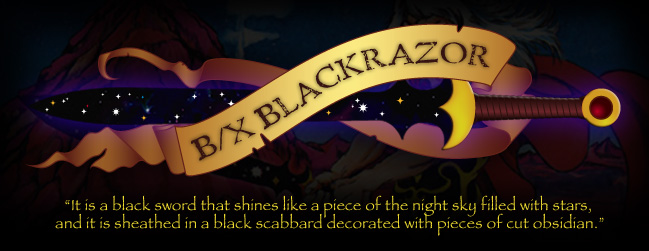
T is for Trident of Torturous Tears

[over the course of the month of April, I committed to posting a topic for each letter of the alphabet, sequentially, for every day of the week except Sunday. While I was sorely tired of the challenge after only 15 days, I am trying to "stick to it." Our topic this month? Magical weapons for a B/X campaign. All such weapons are +1 to attack and damage rolls unless, unless specifically noted otherwise. Each of these weapons should be considered unique items]

T is for Trident of Torturous Tears.

A trident is a two- or three-pronged spear, wickedly barbed. In most ways, it conforms exactly to a B/X spear (although, it costs five gold pieces to purchase); it may be thrown and is sometimes equipped with a line to retrieve the weapon; however, this is usually removed by adventurers as it is easily tangled in the cramped, close-quarters combat of a dungeon expedition.

Any attack roll with a trident that exceeds the target "to hit" number by 4 or more results in the weapon being firmly lodged within the target. While the weapon can be broken off and easily removed once the combat is finished, removing the barbed weapon quickly during a fight requires a successful open doors roll and results in the target taking an additional 1D6 damage (the same rules apply for an attacker who wishes to dislodge the weapon, though if removing a trident from a dead opponent there is no need to break the tines...the dead don't mind chunks of flesh being pulled from their corpse).

The trident of torturous tears is the weapon of a sadist who enjoys inflicting pain and agony. Any damage roll of 3 or more indicates the target has suffered a painful, bleeding laceration that burns like fire. In addition to losing one extra hit point per round from blood loss, the victim must save versus paralysis or advance through one of the following stages of pain, suffering the listed results:

  • Stage 1 - Extreme Discomfort: character suffers -1 penalty to attacks and saving throws until finding time to bind wounds (after combat) or receiving magical healing.
  • Stage 2 - Distracting Pain: characters suffers a -2 penalty to attacks and saving throws; NPCs must pass a morale check or break off from combat. Spell-casters lose concentration of sustained spells.
  • Stage 3 - Burning Agony: character must make a save versus paralysis to take any action at all; those that do face the same penalties as for distracting pain. NPCs must pass a morale check (at -1) or surrender.
  • Stage 4 - Excruciating Torment: character falls writhing to the ground. No action possible.

Please note: in order for a victim to progress to ANY of the stages (including Stage 1) two things must happen: the wielder of the trident must inflict a wound in which the damage roll is 3+ AND the target must fail a save versus paralysis. Each application of magical healing (even a cure light wounds spell) will reduce the pain by one stage, or by all stages if the magical healing takes the victim to full hit points. Alternatively, once a victim is removed from combat, she may make a full recovery from any stage of pain with liberal application of wine (both ingested and to her wounds) and wrapping the injuries with clean bandages.

The scratches and cuts from the trident of torturous tears leave permanent scars, even if magically healed.

Ideally, this would be covered all
over with fantasy barbs and spikes.

Tuesday, April 7, 2015

Mutilation

I can recall watching the 1970 film Cromwell (Richard Harris, Alec Guinness) on television at my grandfather's house in Port Angeles, Washington. I don't remember how old I was...I would guess somewhere between age six and nine. I remember that I watched the entire movie and enjoyed it (lots of battle scenes contributed to this) even if I didn't understand what the hell was going on (for the most part). I wouldn't mind watching it again sometime, but that'll probably have to wait till I get back to the USA. Even then, it's not the kind of thing you can find in RedBox, is it?

The reason I bring up Cromwell is that it's been so long ago since I watched it that there are only a couple scenes/images that remain in my memory with any clarity. The second image is the sad, yet dignified Guinness (as King Charles) with his children right before his execution by beheading: even though he is the "bad guy" in the film, I remember this as depressing and wishing he wouldn't get the axe. But the FIRST scene I remember is one earlier in the film when Cromwell is confronted with some dude who's had his ears cut off, presumably as some sort of royal "justice" of the kind that Cromwell & Co. rebel against.

[look, I know I'm doing neither the film...nor history!...any justice here. Oliver Cromwell is not a subject I've made much of a study of. It seems that I've read before that Cromwell's roundheads were fairly brutal themselves when it came to the English civil war...but as usual, I'm digressing]

The dude with the ears removed is something that (to this day) springs immediately to mind whenever I consider certain aspects of role-playing...specifically mutilation as a form of deprotagonism. The common thought around deprotagonizing player characters (PCs being the protagonists of an RPG "story") is: don't do it. Player characters have enough to worry about in a game without an All Powerful GM doing terrible things to their characters to "suckify" them. A GM should not, for example, capture the PCs by throwing them against an undefeatable number or orcs and then have the orcs cut off their ears...or noses, or hands...and then drive them out into the wilderness, naked and maimed for fun. Because even should the PCs survive, no player wants to be forced to play a character that has been made into a parody of the heroic persona it once was.

"Your ears you keep and I'll tell you why: so that every shriek of every child at seeing your hideousness will be yours to cherish..."

[there are other forms of deprotagonization, of course, but here I'm only talking about the wrecking of the character's imaginary physique, such that the player is unwilling (or feels the character is unable) to continue as a protagonist of the game at hand]

Of course, it's not unrealistic to think that adventurers in a fantasy RPG will become maimed and mutilated in the course of play; this IS a game that deals with sharp weapons and monstrous opponents, after all. But while those GMs (and players) who like this sort of "realism" have created a variety of neutral (i.e. disinterested, random, and "non-malicious") workarounds...critical hit tables and damage by specific location (see OD&D's Supplement II: Blackmoor)...what about the non-combat carving of individual player characters? Is it right for some sort of "plot immunity" to exist for PCs? Even in a setting where the IP protagonists have no such plot immunity?

I am, of course, referring once again to Martin's A Song of Ice and Fire setting. Putting aside (for the moment) the rather gruesome portrayal (in television) of major character Theon Greyjoy's torture, degradation, and castration at the hands of his sadistic captor, and also let's ignore the crippling of the child Bran (since he's really too young to be a player character in the sort of game I imagine, even if he is a Point of View character in Martin's books). Let's take for example the major character of Jaime Lannister, one of Westeros's premier knights and warriors who, while being transported as a prisoner, has his sword hand removed with a cleaver.

[gruesome video clip from the television show, for interested folks]

Consider, for the moment the situation from a fantasy RPG perspective. Lannister is the equivalent of a high level fighter in (what amounts to) a magic-light fantasy world...something akin, perhaps to Pendragon, the system I'm using for Crowns of Blood. There's no clerical magic to speak of, nothing like regeneration of lost limbs or magical healing, no blue crystal staffs to provide this miracle. Characters that get limbs sawed off are SOL...and taking away a fighter's sword arm is a pretty stiff penalty for a guy who only really knows how to fight. NOW consider the "in-game" circumstances: here is a character that has been captured, is unarmed, chained and helpless. He is at the mercy of his presumably NPC (thus, GM-controlled) captors...and NOW you're cutting off his arm?

Realize that this isn't terribly unusual (i.e. uncommon or unheard of) in the fiction of Martin's world. Orys Baratheon (ancestor of King Robert and right Hand man of Aegon the Conqueror) was captured in battle, during the first Dornish War along with most of his knights and banner men when the Dornishmen (mainly of House Wyl) laid a clever ambush for his force. Aegon eventually agreed to the stupendous ransom demanded by Lord Wyl - each man's weight in gold - for the return of his loyal men, but Wyl had all of the prisoners sword arms chopped off (not part of the original ransom negotiation, mind you) so that they "might never raise swords against Dorne again."

Thirty years later Lord Wyl's son, Walter Wyl, fell into Orys's hands (er...hand) during the Vulture King's Uprising (a bandit-lord who managed to gather a huge force of Dornish nobles while Dorne proper ignored his brigandage). Before sending him back to his father, Orys chopped off the captive Walter's sword hand in retaliation...plus cut off his other hand and both feet, calling it his usury.

Note that these mutilations all happen outside of normal combat: they are atrocities committed against prisoners. In a game context, they might be considered the depredations of a sadistic GM...but then consider the thief who is arrested (captured) for practicing his craft in the city where the penalty for theft is the removal of a hand? And consider if the thief's fellow adventurers are unwilling (or unable) to enact a jailbreak? What about the town where the punishment for the crime involves other mutilation...perhaps facial branding of some sort. What if the crime is failure to pay the local tax man (something D&D PCs have been known to avoid)?

Certainly, such things can be hand-waived or ignored/neglected by GMs...often are, in fact, to avoid PC deprotagonization. In a world of men (like Westeros) where it is a common practice to surrender/give oneself up for ransom rather than fighting to the death, is it unreasonable for players to expect maltreatment should they fall into the hands of a family known for flaying its enemies?

Stats same as a hairless bugbear.
Maybe it is. I know for myself that...regarding the hand-chopping thang...I've always been a fan of the guy with a hook (or other sharpened weapon) at the end of his arm. Maybe it's a childhood fascination with the dastardly main villain of Peter Pan. I don't know...for all the ridiculousness of the latest Hobbit movies, the idea of a giant albino orc with a hook arm is fairly cool (I'd peg him as a three HD monster in B/X terms). I've been using the name Berek the Half-Handed for years (as a character in D&D, Ars Magica, DragonQuest, etc.) just because I like the name and the concept of a one-handed sorcerer. The name is, of course, taken from the Stephen Donaldson books, but the concept is taken from an MZB Lythande story (specifically, a sorcerous opponent of the title character). These characters of mine, though, have been maimed before their careers start (they start out "one-handed" and, as wizard-types, don't have as much need of both hands), so there's no deprotagonizing that takes place at the hands of the GM.

Anyone who's played a lot of Chaosium's ElfQuest (especially of the Goback-Troll conflict style of play) will have seen a lot of PCs lose limbs in play because of the combat system which features strike rank-based initiative (elves, as shorties, often attack last in combat) plus damage location with individual limb HP (elves' skinny arms and legs tend to get butchered). I've talked before about games featuring one-armed PCs walking on two (literal) club feet. As long as they could still shoot a crossbow, my players didn't seem to care all that much...but then, at the point it becomes ridiculous, the game loses a lot of its luster, too.

And yet...there's a lot of talk about inclusiveness these days, and writing inclusiveness into RPGs in a way that people of all sorts can see themselves in the heroic personas at the table, and yet it's fairly hard to model folks with physical impairment that don't get mechanically short-changed. In Ars Magica, my one-handed wizard (a flaw that gave him a couple extra points in chargen) spent points on a merit ("subtle magic") that allowed him to be unaffected by the disability...in fact, he was better off than most magi who needed to use gesture in their spell-casting. In D&D, of course, there's no real issue since nothing explicitly states you must have the use of both hands to cast spells (the limitation resting on being bound and restrained).

[while I realize he was a villain in the book, the minor character Steel-Toe from the Dragon Lance novel War of the Twins was one of my all-time favorites, not only because he was a half-ogre but because of the way he weaponized his disability]

Your Hand = Tasty Chew Toy
But, again, I'm digressing...this post isn't about "inclusivity" it's about mutilation...specifically, GM-directed mutilation of helpless player characters. Is there ever such a time when this type of deprotagonization is good? How about "acceptable?" There are some GMs who feel their duty, their responsibility, is wholly to be of service to their players, and perhaps such mutilation is completely unacceptable outside the realm of "if you commit THIS crime in THIS environment and are captured you WILL be subject to THIS corporal punishment." There are other GMs who might create "random degradation" tables to inflict on players who are taken prisoner by orcs and other brutal creatures. And maybe there are some GMs who like giving PCs hard choices to make: "Are you willing to sacrifice your hand to bind the Fenris wolf?"

I'm just curious to hear folks weigh in on this subject. It's something I've found myself thinking about a lot lately. Losing extremities is something I've written about (briefly) in the past... I guess I just want to hear from some other perspectives (player and GM alike) on the idea, possibly as a different type of "character loss" scenario, as opposed to character death.

[and, no, I don't want to hear anything with regard to Star Wars or games where bionic replacement is an option]

Thanks!

Sunday, March 4, 2012

Tarnsman of Gor

Just finished reading Tarnsman of Gor, the first book in John Norman's 30+ fantasy book series begun in the 1960s and still being written today (Mariners of Gor was just published in 2011 and Conspirators of Gor planned for 2012 according to wikipedia).

Norman's books are technically of the "science fiction" variety, though there are a lot of the trappings of sword & sorcery fantasy in them. In the tradition of Burroughs's protagonist John Carter, Norman's character Tarl Cabot is a man of earth who is frequently brought to another planet (in this case, Gor or "Counter-Earth," a planet that shares the same orbit as the Earth but on the opposite side of the sun). On that planet he is a great warrior, or "tarnsman," trained to ride the gigantic hawk-like birds called tarns and becomes embroiled in the politics and sword-wielding adventure of that world.

Now, Norman and his books has received a lot of bile and revulsion over the years due to his subject matter; critics have panned his books for outright misogyny and gross tastelessness due mainly to its depiction of women as slaves and masochists and the "rightness" of the slave-master dynamic as a social system. I first got a sense of that from the description of the series in Fantasy Wargaming (published 1981):
Unfortunately, John Noman suffers from a deeply rooted bondage fetish which he obviously expects his readers to share, for all of these books are full of nubile slave girls who are forced to call men, "master," who are kept permanently chained and whose erotic instincts are usually aroused by a touch of a whip.
[this passage comes from the chapter on inspirational reading material for possible fantasy settings]

I'd read other reviews (prior to acquiring the book) that described Tarnsman as "the epitome of misogyny" or "having horrendous levels of misogyny." Apparently the series as a whole is responsible for inspiring a niche subculture of the BDSM community.

Well, maybe that's true of the later books, but I've only read the first one and I don't find any of that.

Yes, there are slaves, male and female. The male slaves feature most prominently as resources used during the siege of a major city. The female slaves are dealt with more explicitly because Cabot (the main character) interacts with them in the story...usually finding their treatment abhorrent and spending his time freeing them and rejecting Gorean society.

To me, the books read more as a "stranger in a strange land" type of story. The book, narrated in the first person by Cabot, often has the character not just questioning but outright rebelling against the values of an alien culture when they fail to match his own civilized Earth values, which are pretty standard 1960s American/British and male...perhaps a bit chauvinistic (though less than, say, Jack Hamm's character on Mad Men) but certainly he falls on the side of "right," decrying Gor's customs as "rude" and "barbaric" most of the time (and while he comes to take up their warrior code as his own, he is happy to question it and modify it when it doesn't suit his personal ethics).

The one female character portrayed as (perhaps) having a mild fetish for bondage is only that: a single example...and she herself is a free woman who gleefully admits to abusing her own slaves. Another female character, while accepting of her slavery as part of the tradition of Gor (whereby prisoners of wars and raids are enslaved) is still happy to have her freedom and leave her shackles behind given the chance. There's no promotion of slavery being a "happy state of affairs" by the author, speaking through the protagonist's narrative. One gets the impression that Tarl would, if permitted, attempt to overthrow those parts of Gorean society that oppress others...which is why he's returned to Earth, unhappily, at the end of the novel.

But as I said, maybe the later books are different. For me, Tarnsman of Gor is a fairly good book if you enjoy pulpy, sword-wielding fantasy, though I get tired of the first person narrative and the 1960s moralizing...again, I find Cabot to be a bit of a goody-two-shoes (more on that in a bit). For being a 45 year old book, it still holds up remarkably well...it doesn't feel as dated as say, some of Heinlein or Bradbury. And part of that has to do with the setting which, from the snatches of description provided, seems to be well-thought out and fairly rich, containing social structures and traditions, language and politics, alien flora and fauna (much more than just the giant tarns), and an interesting premise: alien "priest-kings" abduct earth humans and strand them in this Lord of the Flies situation for their own whimsical amusement.

The priest-kings...who are never actually encountered, only described through hearsay in the novel...are fascinating individuals. They provide the humans of Gor with a certain level of high technology (for example, electrical lights and lifts and doors, high caliber structural engineering, and medicine and medical advances that exceed 20th century earth medicine), but forbid the use of any weapon of greater technology than a crossbow, and do not even allow the crafting of chain mail armor. The penalties for trying to break these taboos is pretty severe: offenders are incinerated in a ball of blue fire by the unseen priest-kings.

Not a bad little mechanism for enforcing arbitrary conventions in an RPG: yeah, your magic-user can't wear armor or wield a sword because he'll be horribly and immediately destroyed by the local divinity. Nice. Despite the lack of supernatural magic, the world of Gor would make an excellent campaign setting for an RPG. The Gorean caste system is a good basis for character class archetypes (ha! there's even an "assassin caste"), and there are more than a few adventure ideas in the game. Plus, the premise provides a way to include 21st century Earth personality and morality in a pseudo-primitive/medieval setting, something that might be fun around the gaming table ("yes, you know what a car is but they don't have them: you can ride a giant bird or a giant lizard"). Oh, yeah...and impalement is the main form of Gorean justice/punishment for criminals, which I found amusing considering my own posting on the subject a few months back.

There are a couple thoughts that came out of reading this book that I'd like to elaborate on, both regarding elements of the writing/subject matter and how they apply to (role-playing) game play, but those are going to have to wait for separate posts. Tarnsman of Gor wasn't "the best" fantasy book I've ever read, but it was a good read, and the quality of the writing was a big step up from some of the other fantasy series on my book shelves (sorry, James Silke, Steve Perry...). It made me put my reading of David Chandler's trilogy on hold (I'm currently on the third book of his Ancient Blades series), though I'll probably return to that before starting Outlaw of Gor.

Probably.
; )

Monday, April 11, 2011

I is for Impalement

[over the course of the month of April, I shall be posting a topic for each letter of the alphabet, sequentially, for every day of the week except Sunday. Our topic this month? Things necessary to take your D&D campaign from “eh, fantasy” to “kick ass.” And who doesn’t want that?]

I is for Impalement, and other gruesome forms of torture/execution.

Besides cannibalism and the thought of bungee jumping, I’m nothing freaks me out quite as much as impalement. I mean, it’s one thing to have a nail (or bullet) pounded into your brain…or be castrated and left to bleed out. Both these are horrific and traumatizing to the soul I’m sure. But being left to linger in suffering for hours, dying an excruciatingly painful death, unable to actually pass-out from the pain or loss of blood, every few minutes sliding deeper onto the stake and feeling MORE pain in different levels/layers of your body, being unable to DO anything about it…

Ugh. Double ugh. TRIPLE ugh even!

How will including impalement in one’s D&D game make your game “better?”

Um…that’s a good question. I’m not sure it does make your game better. Certainly, I’m not recommending impaling your player characters, nor am I saying one should provide graphic depictions of live impalements within one’s narrative.

However, in aid of ENGAGING one’s players, impalement (and other forms or torture) can serve two functions: firstly, it displays abomination (especially when such tortures are used to condemn or kill innocents or those whose crimes do not fit the form of “justice”); secondly, it should put the fear of consequences…not to mention the fear of de-protagonizing…into players.

For example, no player wants their character hung up on a stake to die (I hope not anyway!). KNOWING that this is a penalty in town X for crime Z (perhaps by prominently displayed “criminals” at the city gates) is one way to drive this message home to players. Also, most D&D campaigns are fairly uncivilized (that is, the imaginary world is…I’m not talking about unruly behavior at the game table!), and law and justice…even Lawful alignment justice may be hard and harsher than our 21st century society’s more “enlightened” penal codes.

After all, the law is The Law and Lawful characters, especially, should be aware of it. It will depend a bit on the edition you’re using and its particular interpretation of alignment…for example, I always considered Lawful Neutral types to be right bastards in AD&D…and yet “Lawful” in B/X is equivalent of ALL good alignments of AD&D rolled into one (Lawful Neutral would be straight Neutral in and Chaotic Neutral would be straight Chaotic). The LAW, however, should be as strong as necessary to maintain order in towns and villages so close to the edge of Chaos.

Whether or not impalement is a suitable offense for skirting one’s taxes and tithes is up to the individual DM.

As far as “torture as abomination,” that much should be a fairly easy sell…the time not fitting the crime, as it were. Historically, impalement was more often a terror tactic than a criminal punishment (natch) but it was also used as punishment for adultery (ow!), insurrection/treason, and witchcraft (the latter coupled with burning the stake upon which the victim was impaled).

This can certainly set up some interesting choices for characters to make…in a realm where the unjustly harsh laws exist, how does a law abiding citizen react to someone being condemned to death?

Hell, in a “magic poor” campaign setting with reactionary authorities, how do players keep their own characters from being burned at the stake or stuffed into the iron maiden?

What? You think the idea of such a setting ain’t "D&D enough," what with the default ampleness of clerics and wizards and magic items? Ever hear of Dragonlance? THEY were all about burning “witches” (false clerics, and wizards included)…at least according to the campaign background material and novels/short stories. And that’s an official licensed campaign setting for the D&D game; get your medieval punishment on!

Anyway, D&D is not an exercise in (or substitute for!) Amnesty International…it’s about roguish treasure hunters and fantastic adventure. But things that help engage the players in the game world APART from and OUTSIDE of the normal game mechanics helps create a richer experience. Imagine the characters defending an NPC (or fellow PC) in front of the Inquisitorial Court or the Witch-Finder General. Imagine having to plan a jail break for a companion sentenced to a horrible public execution (even for a crime that he most assuredly did commit…nothing says all executions have to be “unjust”). Imagine the player characters’ first impression upon arriving in a barony on the edge of the borderlands and finding several hundred impaled humanoids (orc and goblin) lining the road. What does that say about the ruler? What does it say about the state of affairs?

And what does it say about being a half-orc in this particular realm?!

As I said, there’s no need to go into gruesome horrible details of a character’s excruciating demise (be in NPC or PC)…but neither is there reason to shy away from the barbaric “justice” of primitive lands. Even though D&D is set in a "neverwhen" time period, we can still tell some things about it…for instance, people are allowed to walk the streets armed to the teeth, all a-clanking in mail. That’s not going on because it’s a particularly “enlightened” or “civilized” age that the PCs live in. Drive that point home!

Um…so to speak.
: )