
Showing posts with label barbarian. Show all posts

Tuesday, December 17, 2024

*sigh* Cavaliers

This post is going to address several "bad ideas" found in the UA;  I mean, might as well get them all out of the way at once, right?

Weapon specialization is a VERY bad idea...it falls under the category of "how much have you been drinking, Gary?" Len Lakofka first introduced the idea of an archery specialist (character class) along with a lot of really crunch missile fire rules in Dragon #45; it's not terrible (we had an archer PC back in the campaign of my youth), but most of the crunch only serves to slow down the game (worrying about whether actions occur at the beginning, middle, or end of a segment? Come on, dude...we don't need to micromanage more than we already do). And it introduced the idea of "point blank range" (*sigh*), to Gygax and got him thinking about OTHER possible types of specialists. Hence, weapon specialization.

One can see the appeal in an existing (long run) campaign: high level fighters are watching all the other character classes get fancy spells and abilities for achieving those 'teen' levels and, yet, they're doing the same-old-same-old since they picked up that frost brand sword back at 6th level; 'where's the love?' they cry. Unfortunately, implementing weapon specialization wrecks the combat economy from the very beginning. A normal party generally has a potential damage output of 4.5 damage per PC (roughly) with the high strength fighter types making up for low damage wizard types. But this goes off the rails with weapon specialization and (especially) double specialization (both available at 1st level). A fighter with an 18+ STR (up to 18/50...achievable for most fighter types) and double specialization in longsword strikes with a +4 to hit and +6 to damage, as well as getting two attacks every other round...a potential average damage output of 21 points in round one (25 against a large sized creature). Average hit points for an ogre are 19...for a bugbear 15. First level fighters should not be able to chop down gnolls and hobgoblins with impunity, and if the DM ups the challenge of monsters thrown at 1st level groups, the other party members (who have the same combat abilities as ever) are far more likely to suffer. Plus PBR rules means that same fighter, even without double specialization had a potential average damage output 34 damage per round, due to double damage and adding STR bonuses (all part of the PBR rules) for shots fired within 30'. Back when we used the UA rules in my youth, we saw a LOT of bow specialists. 

Bad Len. Bad, bad, bad. 

Next terrible idea to discuss is the Method V version of generating ability scores. Ostensibly restricted for human characters, this method of ability generation all but assures you of achieving the scores you need to take whatever particular class you desire to play. Having also used this a bit when the UA first came out, I can tell you the PCs end up having a LOT of high scores, not just in the ones they need...far more so than any of the other methods found in the DMG. Rolling 9, 8, 7, 6, and 5 dice (and taking the best three) for the five most important abilities of a particular class are going to give you much better scores than the DMG's Method I which has you roll 4d6 across the board...and who cares if MV makes you roll 3d6 for one (ONE!) ability score when that ability is, more often-than-not, Comeliness?

Method V appears to have originated in Dragon #63 with the introduction of the barbarian class. Originally, the barbarian had NO minimum ability qualifiers (probably a good thing, considering it's supposed to replace normal man types like the nomad, caveman, tribesman, etc. in the MM), but instead determined its abilities through a new method: 9d6 for STR, 8d6 for CON, 7d6 for DEX, 3d6 for INT and CHA, and 4d4 for WIS. The sea change here, however, is the choosing of the class before rolling the dice (i.e. before seeing if the player has achieved the dice rolls needing to qualify for the class). Gygax discusses this decision in Dragon #67:
A few wondered why a decision to be a barbarian character had to be made prior to rolling dice for attribute scores. The answer is simple: The game is based on role-playing principles, and it is easier to do so with a course determined in the first place. Method I of Generation of Ability Scores encourages the player to choose a character profession from a predisposition rather than dice determined statistics. It is but a step removed from there to deciding on play as a barbarian subclass fighter and rolling dice accordingly. Frank Mentzer suggests that the 4d6 system could be employed with minimum score requirements of 16 strength and constitution, 15 dexterity, and a maximum wisdom of 15. That will work, but it seems to beg the question. Playing as a barbarian is a determined choice, not as one of several possibilities -- or a mere afterthought. This is a part of the whole concept...

...In all truth, the sub-class is not too powerful. It is, in fact, under-powered unless some very good rolls are gained in the areas of strength, dexterity, and constitution. To have real prospects for long-range play, the character must have 18, 16, and 17 respectively. That, Gentle Readers, is why they are given 9d6, 7d7, and 8d6 for those categories. A low-level barbarian has a better than average chance of survival without such high rolls, but at higher level, he or she is not going to do well unless strength, dexterity, and constitution combine to give high hit points, low armor class, and superior punishment potential.
Indeed. So the lesson, Gary, is "don't play a barbarian if you can't roll the high stats," NOT 'give the players the ability to play whatever they want.' Sorry. After 40+ years of game play (more than Gygax had at the time he was writing), I've seen what coddling does to one's game. That ain't the way to go.

So, now we turn our attention to the cavalier...a class that may have had an interesting kernel of an idea, but then worked hard to make it work with these other concepts (like weapon specialization) to its overall detriment.

I mean, that's sugar-coating things. The class is a travesty.

Here's what you get with the cavalier in its FINAL presentation (i.e. as it appears in the UA):
  • It is not a subclass of fighter, but its own class...and it puts the paladin subclass beneath its banner (more on this later).
  • STR, DEX, CON of 15+, INT and WIS of 10+ to enter; however, Method V in the UA makes these quite easy requirements (with 8d6, 7d6, and 9d6 dice rolls).
  • Open to humans, high elves, gray elves, dark elves, and half-elves with NO LEVEL LIMITS. That's right...you don't like being limited to 6th or 8th level fighter? Be a cavalier (who still fights and saves as a fighter), and achieve whatever level you like.
  • Hit points start at 1d10+3 at 1st level with D10s up through 10th (note: fighters only go through 9th) with +3 hit points thereafter (same as a fighter).
  • Progressive "to hit bonuses" in lance plus two other weapons of choice (one a sword, the other a horseman weapon like a flail or military pick). This bonus starts at +1 and increases by +1 every six levels with no end. This bonus can be used defensively as part of a parry (and can also "parry" with a shield at the same time). Cavaliers may make multiple attacks as a fighter 5 levels higher than their actual level with these weapons of choice. High elves would be advised to select longsword.
  • A bunch of horse/riding related skills that no one cares about in a dungeon.
  • Each of STR, DEX, and CON are assigned a % number (similar to exceptional strength) and every level the cavalier rolls 2d10 and adds the number to the current percentage; when the number exceeds 00, they move up to the next number, eventually topping out at 18/00 in all three abilities (the percentage doesn't mean anything for DEX and CON, but an 18 is still an 18). How this interacts with the CON reduction from a raise dead/resurrection spell isn't stated, nor if these numbers can exceed racial maximums.
  • Immunity to fear, +2 bonus to save versus illusions, a bunch of 90% chances to resist mind-effecting magic, etc.
  • Ability to continue functioning at negative hit points (though cannot continue to fight).
All pretty swell, right? Like a fighter except more powerful (and potentially a LOT more powerful). You'd probably be thinking, man, that cavalier cat must need a ton of experience points to level up (as the barbarian does). HA! That's the kicker, son...the cavalier needs LESS x.p. to level up than the 'lowly' fighter...at least into the teens:

9th level --    fighter: 250,001       cavalier: 220,001
10th level --  fighter: 500,001       cavalier: 300,001
11th level --  fighter: 750,001       cavalier: 600,001
12th level --  fighter: 1,000,001    cavalier: 900,001
13th level --  fighter: 1,250,001    cavalier: 1,200,001
14th level --  fighter: 1,500,001    cavalier: 1,500,001

So, sure...after reaching 14th level, the cavalier will need more x.p. per level than the fighter to level up (an extra 50K per). But his 300K per level is still a damn sight faster than the ranger (325K), paladin (350K), or barbarian (500K). And to out-pace the fighter? With all those additional benefits? I mean, just what the hell was Gygax thinking? 
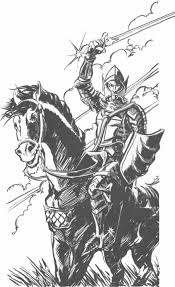
Elf? Probably.
This cavalier class makes the fighter all but meaningless in an AD&D campaign. It wrenches humans from their proper place at the center of the universe and allows elves to be ascendant (what is the incentive to play a human cavalier over a high elf?). Of course, it also radically changes the paladin class (now open to half-elves) giving the pally ALL the abilities of the cavalier PLUS all the abilities of the paladin (listed in the PHB), plus the ability to raise the character's CHA every level in the exact same manner as their STR, DEX, and CON.

This is not a complaint about "power creep;" this is simply stabbing the character economy in the heart with a red-hot (lance) point.

SO, NO. There will be no cavalier in my games, sir...not in the way they are detailed in the UA. Neither will there be any weapon specialization or "point blank range" for missile fire. Nor, will I be using Method V for the generation of ability scores (I remember axing that waaay back in high school...and having fierce arguments with my brother over the subject). No sir!  Method I will (continue to) do us just fine.

However, I might very well include the barbarian class...I'll just remove all minimum ability requirements for entry. You want to be a sickly member of your tribe/village, that's okay by me.
; )


Tuesday, December 3, 2024

Unearthed Arcana Revisited

From Dragon Magazine, issue #59:
What follows is strictly for the AD&D game....

With plenty of labor and even more luck, there will be an ADVANCED DUNGEONS & DRAGONS expansion volume next year. It will be for both players and DMs, with several new character classes, new weapons, scores of new spells, new magic items, etc. What will follow here in the next few issues is a sampling of the material slated for inclusion in the expansion.
E. Gary Gygax, March 1982

There would be no expansion volume in 1983. Nor in 1984. The "next book of monsters" (also mentioned in the article) which was to be released afterwards, instead appeared in 1983 under the title Monster Manual II. Presumably, being mainly a compilation of new monsters appearing in prior publications...especially TSR adventure modules...it was a much easier matter of transcribing existing creature entries in alphabetical order. 

Unearthed Arcana, the 'Book That Was Promised,' was finally published in the summer of 1985.

Pause for a minute. Why am I writing this? Just what is this all about?

Let's talk some straight talk for a moment:  as long time readers know, I got back to playing AD&D again in November of 2020. Since that time, I've introduced a lot of young 'uns to the game, written a lot of adventures, and spent a bunch of time spreading "the Good News" of the game (as I see it). However, in all that time...now entering my 5th year of 1E campaigning...I've limited my game to the only books I consider good and essential, namely the PHB, the DMG, and the various monstrous manuals (MM, FF, and MM2). The adventures I've written (approximately 6 or 7) have all carried the notation that I strongly recommend against using the rules in the Unearthed Arcana.  I haven't even cracked the UA in front of my kids; I've mentioned the book to Diego, but given only a cursory (and negative) overview of the tome to him. Neither of my kids know much...if anything!...about it, which should come as a surprise considering just how much lore they know of the history of the D&D game, its publications, and the various changes its seen over the decades.

[f.w.i.w.  my kids get curious about stuff and I tend to be a wind-bag of a talker]

Just why have I excised the Unearthed Arcana from my 1E table? It's not like I never used it...as I mentioned the first month I started this blog (!), we absolutely adored the UA, back in the day, and implemented every rule it had: Comeliness, traveling spell books, social standing and birth order, bronze armor, etc., etc. If it was in the UA, it was in our game. Chain lightning was a staple spell. Heward's Handy Haversack was a staple magic item...as were magic quarterstaffs (had to have something for all those thief-acrobats in our game). My brother ran multiple barbarian characters. We used weapon specialization; maybe even double specialization. There were Hierophant Druids. We replaced the unarmed combat system in the DMG with the simplified version found in the UA. I mean, we used it all.

So why have I not used it at all since returning to the King of Games, four years ago?

There is a stigma to the UA these days. The Grogtalk folks refer it as "The Book That Shall Not Be Named." Published in 1985 it is deep into the decadent years of TSR (post-Mentzer Basic, post-cartoon, post-DragonLance)...the years that led to the spiraling issues that would (eventually) cost Gygax his company. There is a commonly held belief that the Unearthed Arcana was solely cobbled together from past Dragon magazine articles in an effort to bring one more Gygaxian cash-cow to the table to save the company from debt. This idea is echoed in the Wikipedia article on the book:
The original Unearthed Arcana was written by Gary Gygax with design and editing contributions by Jeff Grubb and Kim Mohan, respectively, and published by TSR in 1985. Gygax reportedly produced the book to raise money as TSR was deeply in debt at the time. He announced in the March 1985 issue of Dragon magazine that Unearthed Arcana would be released in the summer of that year. He proposed the book as "an interim volume to expand the Dungeon Masters Guide and Players Handbook", as the information was spread out in several places and difficult to keep track of. Unearthed Arcana was to include material previously published in Dragon, written by Gygax and updated and revised for the book.
While the latter part of that quote is indeed from Gygax's own pen (in March of '85), the inference is clearly inaccurate...as stated at the beginning of this post Gygax had already planned on an expansion volume in 1982, and the articles he penned over the next many issues (which would compose the bulk of the UA) were written expressly for the book that was coming. This was not some sort of cash grab...THAT statement in the wikipedia article is accredited to a 2006 article in The Believer magazine, in which the author (Paul La Farge) asserts:
By 1984, the company was $1.5 million in debt, and the bank was ready to perfect its liens on TSR’s trademarks: in effect, to repossess Dungeons & Dragons. Gygax got word that the Blumes were trying to sell TSR, and he returned to Lake Geneva, where he persuaded the board of directors to fire Kevin Blume and published a new D&D rulebook to raise cash.
But La Farge's research is suspect. He notes in his footnotes that the book was Unearthed Arcana, a tome that "introduced the gnome race;" a gross misstatement (the gnome had been around since the 1978 PHB), done mainly, I believe, for effect (the gnome race was rather reviled by 2006, due to changes of characterization over the years). But I draw this conclusion because much of the article seems snarky and sensational.

While TSR was definitely facing financial difficulty due largely to mismanagement, it is a fact that Gygax had every intention of publishing Unearthed Arcana long before 1984. His time spent in California (which would result in three seasons of the Dungeons & Dragons cartoon...from '83-'85) was the main reason for any delay in publishing the projects that envisioned...and I believe that, and the personal issues he had during this time (his 1983 divorce and his new "Hollywood social life") contributed as much as anything to the declining quality of the products with his name on it post-1983.

But much, if not MOST, of the UA was created before 1983. Not only that, much of it was play-tested...if one is willing to believe the statements/updates given in Dragon magazine in 1982.

And so...perhaps this material is worthy of the game?

That's the conclusion that I am...slowly (and somewhat reluctantly)...beginning to come to. Why were the acrobat, barbarian, and cavalier featured in the D&D cartoon (first airing in September of 1983)? Because, they provided a good advertising vehicle for a planned book that had already published and tested said classes (the last one, the cavalier, being found in the April '83 issue of Dragon). I have no compunction with the feelings that the UA, as published, was somewhat rushed, slap-dash, and error-riven. But much of the stuff in the book...both its ideas and its mechanics/rules...were far less so. 

Rather, they were thoughtful or interesting...and worth a gander.

What took me down this particular rabbit hole? Well, a couple weeks ago I had this "great" idea of statting up the "D&D kids" for the 1E system. But while most every one of them is easy enough, Diana the acrobat was throwing me for a loop. And since I certainly didn't want to use the UA (because of the reputation the thing is currently carrying), I figured I'd 'go back to the source' and check out the original Dragon article that had been "ransacked" for Gygax's "company needed cash infusion." And what I found (in issue #69) was an article, pretty much word-for-word the same as in the UA, and written by Gygax himself (whereas, I had assumed most if not all the UA material had been culled from the work of other authors). There was also this introduction:
"This time, rather than reveal a new sub-class such as the Barbarian, I though the Enlightened Readership of this splendid vehicle might enjoy another concept. What you are about to read is the information so far developed pertaining to a split class. This a first. To my knowledge, such a possibility has not been expressed before in any similar game system. There is nothing similar to it in the AD&D game system although choosing to change from one profession to another is not too unlike the idea. Let us then get to the business at hand. I bring you, without further ado, the official new split-class for thieves."
"This time?" "The information so far developed?" "Official new split-class?"  This was not some highlight piece deemed to have enough traction for inclusion in a cash grab book...this is a sneak peak at mechanics already in development! By Gygax himself! In January of 1983!

I quickly found a copy of Gygax's "barbarian" from July of 1982 (issue #63); more information helped crystalie the picture:
"As usual, I am working on too many projects at once, and each gets a bit of attention but seems to never get done. At some point quite a few should suddenly be completed, and my productivity will seem great indeed. Meanwhile, I have dusted off the barbarian character class which the testers have enjoyed the most of the new classes I have proposed for the expansion of the AD&D rules. While the other classes seem to need more work, barbarians were instantly used and enjoyed by those eager for a change. Now you, Gentle Readers, have a chance to test the class for yourselves and see if you agree."
Okay, so...wow. This was a project in active development since at least 1982. It was being worked on in conjunction with other projects (in issue #59...March 1982...he details these as including the Monster Manual II, the never-would-be-released T2, The Forgotten Temple of Tharizdun (WG4), and yet another adventure called "Wasp Nest -- The City State of Stoink" which I don't think I've ever heard of). It is being tested in play. It is to be part of an actual, planned expansion to the AD&D rules.

And what, exactly, was my problem with this rule set again? Re-reading the barbarian entry, I don't see anything terrible with it. Nothing over-powered, considering the x.p. cost...and while the magic item restrictions can be 'bought off' at higher levels (the levels where those restrictions can really matter), doing so negates many of the barbarian's special abilities. And above 8th level, a normal fighter will be going up TWO levels for every ONE of the barbarian. 

No looking back, my main issue with the barbarian appears to have been all the "world building" required to use the class effectively...and that's exactly what I like about it now, in my (more mature) elder years. This bit (from the UA):
Cavemen, dervishes, nomads, and tribesmen (see Monster Manual, "Men") are now considered barbarians.
...is, frankly, amazing. And says a LOT about how Gygax expected DMs to approach the AD&D campaign in their individual settings.  The standard classes are all a part of a civilization; and everything outside of that civilization are considered superstitious, magic-fearing savages. Political correctness be damned; in a post-apocalyptic fantasy setting, I kind of like this...a lot!  And it makes the humanoid tribes even MORE savage. Something to think about.

But...okay. The barbarian is cool. The thief-acrobat is cool. What about the other stuff: things like comeliness, weapon specialization, and the (*shudder*) cavalier class? 

Here's the thing: going through these Dragon magazines, issue-by-issue, it's clear that not al of the items that ended up included in the Unearthed Arcana were created equal. The new attribute Comeliness, which I detest immensely, was simply a rambling thought exercise by Gygax as part of an update/letter to the "Loyal Readers" regarding the state of the project (see issue #67). Weapon specialization, another poorly thought out concept, is simply mentioned in passing (after a larger section featuring new illusionist spells) as a conversation Gygax had with Len Lakofka with some hastily sketched out (and un-tested) rules, based on Len's unofficial "archer" class. There is no "double specialization" mentioned. 

[sorry, folks, I'm not a big Lakofka fan]

And the cavalier? It was not an off-the-cuff musing like some of these other articles. But it IS different from how it finally appears in the Unearthed Arcana. For one thing, the cavalier is a sub-class of fighter...as it should be!...a horseman specialist based on the chivalric knights of myth and legend.  It is, however, generally a mess, trying to shoehorn the half-baked weapon specialization rules with the theme-specific weapon restrictions, and focus on mounted (i.e. lance combat). Except that elven cavaliers (another concept I abhor) get archery specialization because...elves?  It's pretty dumb/bad, though perhaps not as terrible as the UA version which changed the nature of the paladin class, all for the bad.

However, Gygax admits the cavalier is only half baked; again this is April 1983 and life was pretty complicated (he'd just finalized an acrimonious divorce with his wife of 25 years in March); in his intro to the class he writes:
"As usual, your comments are invited. Input is most desirable, for what appears here is the basis -- not the final form -- of the sub-class. As is also usual, it is unlikely that comments sent to us will receive a direct reply -- there just isn't anyone on staff at this time to handle such work. While I am working to put together AD&D material, and Frank Mentzer is engaged in the revision and expansion of the D&D game system, the Industrious Staff of TSR are seekingpersonnel to fulfill the needs of you, the Understanding Readers. Thus, we should soon have the wherewithal to respond properly to all correspondence. Meanwhile, suffer along and accept my general thanks to all of you."
Sure, Gary. On to California.

So, the Unearthed Arcana is a mixed bag. New weapons, spells (perhaps), barbarian and acrobat classes? Good. Cavalier, comeliness, and weapon specialization? Frigging awful. Yes, the thing was rushed to production without adequate play-testing (or, even, proof-reading) probably because the company was strapped for cash to pay the bills. But this was a planned project, and much of it has Gygax's imagination and good design work imprinted in it. 

And, for me, that's enough to give the UA a second try. Not the whole book, mind you, but much of it. I will, of course, want to go through the old Dragon magazine articles and see which ones need pruning, which ones are unworkable, which ones were 'good enough' before other fingers stepped in to "help" get the book together. It isn't a big deal...something to amuse myself (culling these idea). And, hopefully, something to amuse my players.

[it is, perhaps unfortunate that I have altered the 1E magic system for my home game, as the plethora of new spells and the spell book rules (not to mention cantrips and apprentice MU mechanics) would be far more useful with "standard" 1E. But my system works too good to change it just to add a handful of beloved spells (like dismissal, chain lightning, and teleport without error). Well...we'll see. We'll see]

All right, that's enough for now. My expanded mind has been emptied, and I'll try to get some sleep. Signing off from Mexico!
; )
Just look at this geezer...


Friday, April 19, 2019

Q is for Quasqueton

[over the course of the month of April, I shall be posting a topic for each letter of the alphabet, sequentially, for every day of the week except Sunday. Our topic for this year's #AtoZchallenge? Revamping the Grand Duchy of Karameikos in a way that doesn't disregard its B/X roots]

Q is for Quasqueton, the mysterious fortress featured in Mike Carr's adventure module B1: In Search of the Unknown.

Many folks have cherished memories of B1; a lot of first-time D&D players cut their teeth on the module. Personally, I've only run it once: with my brother back in 2010 after modifying the content substantially for mid-level play. I'll probably get around to running it again some day, and properly (maybe for my kids), but it's tough when the adventure needs so much prep from the DM to work (as a teaching module, B1 leaves many encounter areas to be stocked by the new DM).

The reason I don't have much experience with the module is because I never owned the thing until recently. B2 was my "introductory adventure;" B1 was written for (and included with) the ORIGINAL D&D Basic set, the edition we Bloggers refer to as "Holmes Basic." My copy of B1 was acquired back in 2009 when I came across a (used) box set of Holmes (no chits) that contained the adventure (my initial thoughts are here, for the curious). As a Holmesian relic, the module is not entirely suited for B/X play (though it's easy enough to convert), and some readers might be wondering why I even bring it up for this particular series, as it antedates the publication of Karameikos and the Known World by half a decade (a lifetime in terms of the hobby's primordial origins).

Once again, we can hold Mentzer responsible: his re-printed wilderness map of the Known World in BECMI's Expert set included the location of (what I assume are) all the then-published "B" and "X" adventure modules. B1 is located deep in the northern foothills of western Karameikos, near the mountain origin of the Achelos River, which flows to the coast (eventually emptying into the Bay of Halav by way of Blight Swamp).  Fortress Q is not shown on the GAZ1 map, nor is it mentioned in the text of the Gazetteer, but it's clear from the landmarks on the Expert map where the "hidden" stronghold is located.

"Hidden" is a pretty relative term, in this case. The text of the adventure states the hidden fortress of Roghan the Fearless and Zelligar the Unknown was located "far from the nearest settlement, away from traveled routes, and high upon a craggy cliff" specifically because they were not interested in unwanted visitors. However, it's clear from encounter areas strewn with recently deceased bodies and the relatively picked over nature of the site that there are at least a few adventuring souls that have found their way to the fortress. Heck, the adventure starts with the PCs acquisition of a map to the complex!

Not sinister enough for
Zelligar and Roghan?
Which is fine...it helps make some sense of the adventure (and gives plenty of justification for the "low level" nature of the site...the biggest treasures and monsters have already been taken out, both literally and figuratively). As usual, I advise folks to check out GusL's excellent review/analysis/ideas for this module. Despite his critique, he provides a great blueprint for how to run the adventure in a way that's both sensible and properly challenging/rewarding.

So let's talk about the adaptation of B1 to the Karameikos setting. The first thing one needs to grok is that In Search of the Unknown is NOT a "generic" site for exploration...it contains a lot of background material and setting information in its pages, some of which doesn't jibe with the history of the region as presented in GAZ1:

- Roghan and Zelligar only ceased 30 years prior to the start of the adventure. That means they disappeared to fight "northern barbarians" around the time Duke Stefan, Baron Ludwig and all the rest were moving in.
- Prior to this (and within living memory...certainly for elves and dwarves) they had been "heroes of the people" having fought off a large barbarian horde that attacked the region.
- The construction of their fortress, even before their fight with barbarians took over a decade "and the work of hundreds of slaves and laborers." After the defeat of the horde, they worked for several years more, adding to the fortress, and presumably continuing to use additional workers. Many of these would still be alive, or have drifted into communities.
- While the pair took "most of their henchmen and associates" with them into the wilderness (when they disappeared), many they did not, including Roghan's mistress, their advisor, the captain of the guard for the fortress, etc. It's clear from the text that these individuals and other servant types (I doubt they used their menial orc servants for cooking, but who knows?) eventually left when R and Z failed to return. There aren't a whole lot of places they could have gone, especially not without an armed escort.

One more thing to realize: this adventure was NOT originally written to fit with the Known World ("Mystara"). At least in MY copy (the monochrome cover) there is a note on page 6 stating:

"In the mythical WORLD OF GREYHAWK (available from TSR) the stronghold can be considered within any one of the following lands -- the Barony of Ratik, the Duchy of Tenh, or the Theocracy of the Pale."

This note is removed from the later, "brown cover copy." Reviewing mine, I can see it clearly appears written to work in the AD&D system, based on the NPCs of different race-class combinations (dwarf thieves, elven fighters, etc.) that were later edited out of the "straight Basic" version. Also, certain titles in the NPC names ("Servant of Saint Cuthbert," etc.) implies use in the Greyhawk setting. Concepts like "The Great Church," "The Secret Church," and "The City Afar," sound cool, but don't really work with Mystara as written, except perhaps as euphemisms.

So I'd probably change that, and let the "fluff" of the module fill out game world.

[here's a different question that really nags at my brain: Who are all these berserker guards that are in charge of the place? If they've been waiting 30 years (because they're fantastically loyal to their masters or something) doesn't that mean they're all well past their prime?]

There are plenty more unanswered setting questions that arise from this pair of adventurers who were "dedicated to perfecting their craft." From whence did they come? Where did Zelligar receive his magical training? Who is this demon idol that they casually worship (it's not an extravagant temple...more of a personal shrine)? Roghan has a brass dragon skin on the wall (brass dragons were a part of Holmes, not B/X or BECMI)...where did this come from and what does it imply? Magic mouths? Not a spell in ANY form of Basic.

In a BECMI setting, with its "everything is codified" sensibilities, this weirdness doesn't work great. In B/X, it works but just becomes "weirdness," which may not be what you want.

"Raaargh!"
And dammit, who are these "barbarians" supposed to be? The Republic of Darokin with its disciplined, Swiss Pikemen-like army is hardly what I call a "savage horde" (and neither does frothing halflings from the Five Shires). Another invasion of humanoids? That doesn't really work with the whole Song of Halav legend (it's not like King Halav returned as foretold). *sigh*

So here's the idea that comes to my head for revamping B1 for use in a B/X Karameikos:

Fifty-some odd years ago, the wizard Zelligar "the Unknown" arrived in the region of what would someday be called Karameikos. Perhaps he was encouraged to adventure in the land by his patron demon; perhaps he was expelled from his country of origin (Darokin? Glantri?) because of his necromantic practices. Perhaps it was simply a teleportation mishap.

Regardless, he found himself in foothills of western Karameikos. Turns out there was an indigenous population prior to the coming of Stefan and his Thyatia cronies...a hardened, iron age culture living in small agrarian communities...more tribal clans based extended families than anything that would be called villages. Here was a superstitious lot, easily cowed with displays of magic, easily manipulated...and Zelligar found it the ideal space to create a base of operations.

But one "barbarian" showed no apprehension of the strange wizard. Roghan (later called "the Fearless") was more intrigued by the stranger than worshipful. Desiring companionship and needing an interpreter (not to mention a strong right arm), Zelligar adopted the young Roghan as a protege, gifting him with enchanted armaments the likes of which had never been seen by the primitive hillmen. So equipped, the two began to explore the wilderness, especially the northern mountains, that were full of both fell beasts (like dragons) and treasure hoards built from mineral wealth of area. Successful in their undertakings, they eventually came to build Quasqueton as described in the module background.

Unfortunately, their relationship with the hillmen of the area were far from amiable. To the hillmen, the pair's worship of strange and foul gods was despicable, as was their taking of slaves from the hill tribes, forcing Roghan's own people to work alongside orcs taken in raids. What was worse, Roghan's and Zelligar's own henchmen and soldiers were drawn from the most vicious and violent of the mountain tribes, people who were known to practice human sacrifice and cannibalism. Eventually, the hillmen rose up, united, and marched on Quasqueton, only to be brought low by the martial might of Roghan and the sorcery of Zelligar. Much tribute was taken from the defeated tribesmen, not the least of which was the beautiful Melissa, eldest daughter of a great chieftain of the hillmen. Roghan was smitten at first sight and, bringing her to his stronghold used much of his wealth to construct suitable accommodations for his most cherished prize.

Fair Melissa, on the other hand, saw Roghan as a traitor to his own people and looked for a way to revenge herself on the adventurers. Knowing that murdering the warrior would do nothing to remove the pair's tyranny (would not Zelligar simply find another man of greed and ambition amongst the hill tribes?), she instead endeavored to seduce the wizard himself, with Roghan none the wiser. Thus manipulating both men, she arranged for the pair to embark on a dangerous venture from which they would never return, due in no small part to her sabotaging of their gear and poisoning of their supplies.

It was shortly thereafter that Stefan and his ilk arrived in the region. Searching out potential rivals for his control of the land, the archduke's henchmen made forays into the north, following rumors of a "secret fortress." However, none who found it actually lived to tell the tale, as the hillmen still secretly guard Quasqueton, regularly posting their strongest warriors (the berserkers) to prevent other adventurers from discovering and "setting up shop" in the fortress. The hillmen remember the past, and while they are content to let the "Archduke" and his pet barons rule in the south, they want no more foreign lords exercising their will over their lands.

Been watching too much GoT...
[by the way...Happy Triduum to folks that celebrate the Easter holiday! I shall be pretty busy the next couple days (aren't I always?) especially as it's my daughter's 5th birthday. I might not get around to my "R" post till Sunday night]

Thursday, June 9, 2016

The Barbaric Edge

All right, you guys finally broke me. You don't know how tempted I've been to break my self-imposed "blogging ban" this last week. Clerics! I want to write shit-tons about clerics! But I've held off and held off. I cannot, however, maintain silence in the face of a really, really good idea, even if I dislike its execution...especially when it fires my own pistons.

So it is with this latest post from John Slater over at Land of Nod regarding the "edge" displayed by the barbarian protagonists of Bob Howard (and emulated by pulp S&S writers everywhere). The idea that such rugged individuals, by dint of their hard lives and uncouth nature, are a cut above civilized folk is a standard fantasy trope...and one that begs for the modeling and re-modeling (or at least re-examination) of a "barbarian class" time and again. And again.

*Bleah* (that's the sound of me gagging)

I know I've taken a couple-three whacks at the idea over the years, though none of them have "stuck" in my own campaigns...though perhaps that's as much influenced by my personal bias (I like the standard B/X classes) and/or folks' aversion to the idea of playing some primitive malcontent stereotype. Regardless, having a barbarian "class" hasn't worked for me. It just comes down to a set of particular themed bonuses or abilities, and the CONCEPT of the character gets lost. This is why the barbarian class of 5E is so stupid. It's not about someone wanting to model a "barbarian;" it's about wanting a rage bonus in melee combat.

[yes, yes...for some of you it MIGHT be about playing a barbarian. Shouldn't it be a background than? Something to be added to ANY class...barbaric shamans, thieves, etc.? And just what background is a barbarian supposed to take, anyway? Aside from outlander, it would take a bit more effort to work with most of the other 5E backgrounds...but I digress]

The word "barbarian" comes from the Greeks, which they used for all those "uncivilized" Germanic tribes that lived north of their ancient empire. The word means "bearded guys" or hairy ones or something, but it's really a derogatory term for people who don't speak Greek. In other words, "I see you are talking, but all I hear is 'bar-bar-bar.'" Still, though, "beards." We see that today in Romance languages (barba means beard in Spanish, for example). It doesn't mean indigenous American, or spear-chucker, or "savage" (though these things can be inferred from the use of the term). It simply means, someone from outside our polite society.

Howard was a Texan and a bit of a misfit to boot, giving him real issues with regard to "polite society." This he communicated through his stories, both in the attitudes of his heroes and the circumstances in which they generally found themselves (strife and turmoil in the land caused by the decadent machinations of people in power). It's not surprising that a man who felt himself an outsider would write about outsider heroes, nor is it surprising that his characters would resonate with those seeking escapism from "real life" in the fantasy fiction of pulp stories. Anti-authority is a fine attitude to have, until and unless you need your streets paved, your police and firefighters to arrive in a timely fashion, or your post office and DOT office to be well-staffed and helpful.

But D&D is fun for the same reason: escapist fantasy (how often do PCs need a post office?). And PCs are fairly "outside normal society" by their acts and profession anyway, so it's fine and fair to indulge in a little fantasy barbarism of the Howardian staple...the hard dude (or dudette) that sneers at polite society, that solves problems in Gordian fashion, that has an aura of primal leadership (or animal magnetism). A type of character that has an edge, in other words...something gained by dint of their upbringing and uncivilized attitude. Here's how I'd implement it, mechanically, for B/X (or similar "basic" games):

1. To be from a barbarian tribe, you must be a human character, though you can be a cleric, fighter, or thief (magic-users, even those from barbaric backgrounds, have too broad a perspective to carry the disdain of barbarians...their arrogance is of the magician to the mundane and their "edge" is their spell-casting powers beyond that of mortal men). Your character must have a CON of 9+ to reflect the fantasy trope (in a sense, you are playing a new type of demihuman race).

2. Your "barbarian" begins with the following restrictions: you receive one-half the normal starting gold at first level (roll 3D6x10 as normal, but divide the amount by two). Your character speaks your own language (as "Human Dialect," see page B13) fluently, but can speak only broken, accented common (the "civilized" tongue). You begin with no other languages known, regardless of INT.

3. When dealing with civilized individuals of authority (gate guards, tax collectors, nobles, etc.) your character receives a -2 penalty to reaction rolls unless the person in question speaks your character's native language.

4. If your character has an INT of 13+ you may choose to learn a new language (up to your maximum additional languages known) every time you earn a new level of experience. Learning a language implies fluency and capacity for writing as well. Common may be chosen as a language. Being able to speak fluently in a person's language removes the reaction penalty above.

5. Your character gains the following bonuses as his/her "barbaric edge:" +1 to melee attack rolls, +3 hit points, +1 save versus mind control magic, +1 bonus to hear noise, +1 bonus to detect traps, +1 bonus to retainers' morale score.

6. Success and soft-living will gradually remove your character's edge; every time you go up in level, remove one of your edge bonuses (your choice of which is lost). By the time most barbarians reach 7th level, they are thoroughly "civilized."

7. A player may stave off the eroding effects of civilization by disdaining its decadent trappings. This includes taking following actions:
  • Never sleeping indoors unless the weather is bad (and even then, preferring a hard, bare floor to a cushy bed and soft pillows).
  • Eschewing wealth; discarding 90% of all monetary treasure (giving it away, blowing it in taverns/brothels, etc.), and never retaining more than can be carried on one's person and/or horse. Equipment purchased must be of the most practical type: no fancy clothes, decorative armor, etc. Most fantasy barbarians (either sex) never bother wearing pants.
  • Maintain a healthy respect and distance for enchantments; never possessing more magic items than the character has hit dice (so maximum of nine at levels 9+).
  • Display nothing but contempt for the decadence of civilized folks: sneer at their pointless politics, their indulgent foods, their polite manners. Character should be forthright and blunt in interactions and avoid slyness and dishonesty. 
  • Your character's word is his/her bond. Never break an oath.
This issue provides a good model
in the erosion of "barbaric virtue."
So long as the character abides by these restrictions, her barbaric edge is only lost every two levels gained (so at 3rd level, 5th level, 7th, etc.). No spartan lifestyle can completely halt the erosion of one's edge!

[if a character "falls off the barbarian wagon," she may jump back on upon reaching a new level of experience...i.e. after losing one edge at the standard rate...by reconsidering her decadent life and "getting back to her roots" (vowing to follow all strictures). However, only one such attempt at "atonement" is allowed...if the character succumbs to the temptations of civilized life a second time, there's no third chance!]

All right...we now return to our self-imposed silence. Shhhh...
: )

Thursday, September 2, 2010

Barbarians & Fighters (yeah, this again)

AKA Making Your Game More Fiddly
AKA The Great Hit Point Debate


Boy, I sure do blog a lot about barbarians for a guy who (historically speaking) hasn’t liked ‘em, hasn’t used ‘em, and haven’t played ‘em. I am sorry for grinding the same axe AGAIN but I keep going back and forth on the subject in my head. And now that I’m working on my book, I once again find myself looking at the subject and flipping back into the category of “barbarians need their own class.”

Ugh! The problem really is a two-fold one.

Problema Numero Uno: Give the fighters their due.

Fighters in B/X play have a limited number of advantages. They can use any weapon and armor. They use D8s for hit dice. Their attack chance and saves progress faster than other classes. They go to level 36. At high levels, they may make multiple attacks.

Barbarians (who would also be human and so should ALSO go to level 36 for the sake of design consistency) have historically owned the abilities of fighters PLUS possessed other additional advantages. This was balanced out by giving fighters additional abilities (weapon specialization in AD&D, bonus feats in D20) or by making pre requisite restrictions and slower advancement (AD&D only).

Now requisite restriction and slow advancement is a 0 incentive to play a fighter over a barbarian. Leaving aside the fact that many people aren’t running long term campaigns anyway (one-shots and pre-gens for limited sessions has been all I’ve seen), at the higher levels, the rate of advancement tends to even out anyway. And pre-reqs can always be fudged (“just roll until you’ve got ability scores you want to play”).

As for ADDING special abilities to the fighter: no. Flat no. A fighter fights…those are his abilities and advantages. I’m not going to institute a whole class or feat or weapon proficiency system into B/X JUST SO THE FIGHTER DOESN’T SUCK IN COMPARISON TO THE BARBARIAN. That’s f’ing ridiculous. Jesus!

Anyway that’s #1.

Problema Numero Dos: Friggin’ Howard and Leiber.

Nevermind the imitators (including James Silke’s literary version of Frazetta’s Death Dealer). Robert Howard and Fritz Leiber created two extremely noteworthy “barbarians;” each one exceptionally worthy of “adventurer status” in any D&D game. Hell, they’re practically the archetype adventurers.

Conan and Fafhrd

While both Conan and Fafhrd have the trademarks of standard fighting men, they share several abilities that are NOT standard to the D&D fighter class.

- Heightened senses, generally attributed to a non-civilized upbringing
- Climbing ability (again learned in the wilds) that translates directly to action unobtainable by lesser men…Mouser can match Fafhrd but he is, after all, the archetypal thief
- An ability to track and sense direction in the wilderness
- An ability to move faster and/or with more stealth than “civilized men”

Other abilities…such as their robust stamina, great strength, and catlike reflexes I attribute to normal ability scores and character advancement. Obviously these guys have a high Strength, Dexterity, and Constitution, as well as a good number of hit points and several levels of fighting ability. These things don’t have to be modeled in a barbarian class, per se. They’re already modeled in the game (Howard and Leiber just “rolled up” exceptional characters). But the other abilities are new and would appear to need modeling.

That’s problem #2.

See the conflict? The “heroic barbarian” archetype of literature requires a few “extras” that distinguish it from the typical human fighting man. However, stacking those “extras” on top of a fighter’s ability fails to give the fighter his due…it upstages him, over-shadows him. Why would anyone want a fighter when they could play a badass barbarian instead?

So it comes to this…basically, I am working on my 3rd (4th? Maybe…) attempt at creating a B/X Barbarian. Maybe I should leave well enough alone, but so far I’ve been un-satisfied with the results of…well, with all my prior attempts to date. Here’s what I’m considering:

A) Barbarians are a Class (i.e. classification) of humans…like fighters, clerics, and thieves. As an ambitious, adaptable human, barbarians may reach 36th level (so no, no knock-offs of the dwarf or halfling class).

B) Barbarians have the same ability scores (Strength, Intelligence, Constitution) as any other adventuring class and there are no pre-set restrictions (for example, barbarians don’t have to be illiterate unless they have a low Intelligence…like any other class). Like all B/X classes, they have one or two Prime Requisites; they also have minimal requirements to choose the class (probably Constitution 9). You can have scrawny, malnourished barbarians or fat and clumsy barbarians.

C) Barbarians are NOT fighters: they have some additional abilities not available to the standard fighting man.

D) Barbarians are NOT fighters (redux); fighters fight and are the best at it over the long haul.


For the most part this early stab (or maybe I should say “axe swing”) at the class was…well, it was okay. The problem I have with it is over the long haul the barbarian’s hit points (D6 up to level 9, +3 hps per level after Name level) far outstrip any other class, including the fighter.

Recall my perspective on hit points? An abstract measure of how much DAMAGE a character can absorb…not just physical punishment, but combat prowess, endurance, luck, and canny fighting ability?

It appears to me that fighters and monsters (including, yes, the beastmaster) should own this category. At least over time.

But at low levels? Well, the young barbarian is a fairly fit and robust specimen of human, able to give any low-level fighter a run for his (or her) money. At the higher levels, yes, the fighter has “seen it all” and the canny vet knows the best way to spit the charging bull before he himself feels the axe bite. But that’s in the future…when the barbarian’s harsh lifestyle starts catching up with him (the savage life is nothing if not short and brutish).

Here’s what I’m thinking:

Barbarians roll D10 for hit dice up to 9th level, and then add +1 hit point per level thereafter. All other things being comparable, the barbarian will have better hit points than any other class up to level 17, equaled by fighters at 18, and surpassed by fighters at 19. Master thieves will equal their hit point average at level 36 (only) and clerics and magic-users will never come close.

Heck, it’s even reminiscent of AD&D and D20…where barbarian hit dice are one class up from fighters (D8 to D10, though, as opposed to D10 to D12). The difference is that HERE the pure fighter will grow to out-class the brute over the long haul.

Damn that arthritis from sleeping outdoors!

[having said all THAT, I am thinking of upping the Beastmaster hit point bonus from +2 to +3 per level after 9th. Why? Well, remember that the beastmaster uses D8 hit dice just like any other B/X monster…I don’t really want to up the hit dice type. On the same hand, Tarzan-ish beastmasters don’t wear armor…the hit points, representing his (or her) innate toughness and grace in combat is the beastmaster’s MAIN DEFENSE…and they are hand-to-hand combatants for the most part (Prime Requisite: Strength). Unlike a barbarian, I don’t think there’s any chance of a beastmaster out-classing a high level fighter, given the latter’s superior defenses and multiple attacks…in the end the beastmaster is, for all practical purposes, another humanoid monster to be put down by the fighter’s axe and blade]

Wednesday, April 28, 2010

A Barbarian Alternative

Of course, I realize AFTER posting my barbarian rant I realized I had already posted my own B/X version of the barbarian. Obviously, Blogging & Beer don’t always mix.

Well, in defense of my reverse stance on barbarians, I will say that PREVIOUSLY I was caught up “in the moment” when everyone was high on Pat’s excellent B/X Sword & Sorcery mix. However, even in B/X there’s very little reason to have a barbarian “class.” For reasons already cited, I feel that “barbaric” is a descriptive term that is easily applied to any of the original archetypal classes, and a barbaric fighter makes a fine “barbarian.”

That being said, the REAL REASON for my barbarian rant was as prelude to THIS post wherein I give an alternative class that, while perhaps non-archetypal, doesn’t seem to fit anywhere else.

The Beastmaster.

Now I’m sure plenty of you are rolling your eyes and recalling Marc Singer’s bronzed perfection and vapid/obtuse face from the 1982 film, but give me a moment or two to make my case.

Yes, I too have seen the (TBS Beloved) film about a hundred times on television, and Singer makes me wince a way Schwarzenegger never did (at least in the original Conan the Barbarian). But the story is pure fantasy…there’s no “real world” equivalent of the places or cultures in the film and the thing could easily be translated as a straight D&D adventure (with about as much “story” as usually comes from such adventures; i.e. not much), including the “dungeon setting” (temple) that the title character has to navigate towards the end of the movie.

Characters that communicate with beasts and birds…and who use those alliances to overcome obstacles…are nothing new in fantasy literature or film. Tarzan is, of course, the ultimate “beast master” character, and Sheena: Queen of the Jungle is his female counterpart. But other characters with animal buddies can act as inspirations for a beast master character from Kipling’s Mowgli to James Silk’s version of Frazetta’s Death Dealer.

Would Disney’s Cinderella or Snow White be considered beast masters? Quite possibly…and it doesn’t get much more fairy tale than that.

Unlike the barbarian, there’s really no archetypal equivalent of the beastmaster in D&D as written. Hmm, I may need to elaborate a bit so you folks know exactly where I’m coming from.

BY CONTRAST:

The “barbarian” ALREADY has an archetype in D&D. It is called The Fighter. Not true, say some, the barbarian class of AD&D provides better hit points, freebie bonuses, class restrictions, and a number of “skills,” none of which are possessed by the fighter class. HOWEVER:

- Inflating hit dice or additional ability bonuses are not a “change of archetype.” They’re simply “grade inflation.” If you want every barbarian to have a huge number of hit points & cat-like grace say “your fighter needs a DEX and CON of 13+ (or 16+) to be considered a barbarian.”

- Class restrictions are artificial impositions that can be placed on any character class by any player. The DM can say, “To be considered a true ‘barbarian,’ you may not wear armor heavier than X.” Alternatively, the DM could say, “To be considered a true ‘barbarian,’ you may not start with more than X gold at 1st level.”

- Skills? Skills?! This is D&D, not D20! Characters have ability scores, and per B/X, ANY character can try to climb a rough, rock wall with an ability check. If you want to climb a sheer surface, play a thief. It’s not like there are giant sheets of marble for ‘barbarians’ to practice on “in the wild.” Don’t be ridiculous.

[by the way, the same thing goes double for the Cavalier class. There is already a cavalier archetype in D&D. It is called The Fighter. Write your OWN “Code,” folks!]

That being said, there’s NO equivalent of the beast master, despite the character’s presence in fantasy fiction. Yes, a high level cleric can “speak with animals”…but a beast master is NOT a cleric. They’re usually scantily armored (hello, Marc Singer!). They don’t have any truck with the undead. They don’t “pray” or “worship” (most appear to be fairly animistic if anything). Often, they use edged weapons (knives and spears). They aren’t granted other spells by a deity.

But really it IS the communication with animals that truly sets the beast master apart from other characters. The beast master doesn’t cast study or cast spells; hell, they can get by being illiterate pretty easily. But the ability to speak with animals AT WILL, and be listened to and gain the trust and friendship of animals…now that really is a special attribute of the beast master “class” that is unavailable to any other class.

So now we really come down to it: what the hell got me thinking about the beast master in the first place? Well, the Compleat Adventurer, of course. Of all the character classes in the book it is, interestingly enough, the beastmaster class that I’ve always remembered (its presence and its accompanying illustration) all these years. While we never had a “beast master” back in our old campaign, this is the kind of character that WOULD HAVE fit right in with the house-ruled weirdness we did have!

Not that I’m totally satisfied with the beastmaster class as written in the CA. It’s a little too convoluted and “record-keepy” for my taste; though it would be about on par with your standard AD&D character class (no more than, say, the assassin or monk). But AD&D, while definitely my “first love” in RPGs, is a game I’m no longer interested in playing, and so I’ll have to do some condensing and tightening to make it fit for my preferred B/X play.

Hmmm…level titles will be tricky. I don’t want to get stuck with terms like “man-cub” or “monkey boy.” I suppose I should read Burroughs to get some more flattering ideas for a beastmaster character class.

; )

The Barbarians Are Coming!

Speaking of my brother, I’ve completely neglected my earlier intention of blogging a bit of AD&D ramblings this week.

The Unearthed Arcana was released in 1985 and I had mine by November of that year. How do I know this? ‘Cause I still own my original copy, and inside the front cover in the huge cursive scrawl of my 10-year old brother is written “Happy 12th B-Day Jonathan!” At the time, I was pretty angry that he would desecrate an otherwise pristine and newly minted AD&D hardcover with such terrible hand-writing. Now…well, I’m appreciative that it gives me an excellent anchor point in time when considering my AD&D evolution.

[which, by the way is a totally different blog post…I started writing out my personal gaming history a couple weeks ago, but put the project on hold when I got to page 7 or so]

While many folks have bad-mouthed UA over the years, it was probably my hands-down favorite TSR volume between 1985-88. In fact, my original copy is so worn from use that you can’t even read the writing on the spine. It just opened up so many possibilities to our evolving AD&D campaign at the time, including and especially (bleah!) Comeliness. Ha. My co-DM Jocelyn picked up her UA before me, and she had us all roll up the new stat for our existing characters prior to even telling us what we were rolling. While this would color much of the campaign for years to come, I was fortunate enough to actually roll an 18…not bad, JB!

HOWEVER, as I’ve gotten older more grognard-ish, I find myself pretty much distanced from AD&D in general and the Unearthed Arcana in particular. My 36-year old eyes peruse the pages and find most of it elicits a big “eh,” even from things that really got us cranked as youngsters.

That being said, one thing that generally failed to energize us, even in our wide-eyed youth, were the new character classes.

Oh, well actually that’s not entirely true…those of us with thieves (or thief multi-classes) weren’t against throwing the occasional acrobat in the mix…after all, many of the standard thief skills remained the same as did the attacks, saves, hit points, etc. But for the most part, all the players in the campaign were satisfied with the “basic” classes present in the PHB…fighters, clerics, magic-users, and (of course) bards. None of us played those goody-goody paladins, and the cavalier’s Code of Honor held even less appeal for us (back in the day, munchkinism wasn’t much of a factor and role-playing alignment and class restrictions was fairly strictly enforced, so the Cav code was a pretty big deterrent from adding percentiles from all the ability scores).

And the barbarian, sheesh!

Only one player ever brought a barbarian to the table and that was my younger brother, no doubt influenced at least in part to the Bobby the Barbarian character in the Saturday morning D&D cartoon, as well as the rest of the group’s perceptions of my younger brother (again, influenced in part by the D&D cartoon). To us, barbarians were not some powerful character class with D12 hit dice and bonuses up the wazoo…instead, he was some nut job that didn’t use magic items(!!) and who lost that fine Dexterity bonus if he strapped on plate mail armor!

In a long-running campaign that had plenty of high-level characters with a ton of magic items bulging from their pockets, the barbarian character looked pretty pathetic by comparison. Especially since those “double ability bonuses” didn’t apply to the barbarian’s Strength attribute (sure you could hit a monster only affected by magic weapons…but wouldn’t you prefer to simply use a magic weapon that increased the to hit and damage of the weapon in question? I sure would!). Even my brother would eventually chuck the idea of a barbarian, falling back instead on the fighter character who (especially with weapon specialization) was a much more formidable character in combat than the primitive, magic-hating barbarian.

[years later, my brother would tell me that he chose the character in part because the IDEA of playing a barbarian appealed to him; it was the concept, not the class as designed that was interesting. OH…and also the influence of my friends and I]

As a DM, the barbarian was a pain in the ass for young kids who were not interested in creating “barbarian cultures” for our game world. Our adventures took place in cities and kingdoms…civilizations with nobles with plenty of gold. Why would we want to play some spear-chucker or axe-wielder…especially when those weapons have so little damage potential compared to the ubiquitous swords of the AD&D world.

[I guess there was a LITTLE munkinism in us]

Yes, this was long before my personal fascination with Viking culture and axes and my plethora of “concept characters.” As kids playing AD&D, we weren’t interested in “gritty” or “mundane” adventures. We wanted high fantasy, not drab and shabby.

And looking at the evolution of the barbarian class in the latest editions, it seems clear I wasn’t the only one “not feeling it” for the barbarian. This whole Rage ability and the Uncanny Dodge (hell, the whole flat-footed, etc. rules) seem specifically designed to “spice up” a drab character concept.

Of course, it just makes that concept even more ridiculous.

I mean, really…what the hell is the barbarian supposed to be? Ancient cultures considered outsiders to be “barbaric” and “un-civilized” but within their own cultures, these people considered themselves plenty civilized. Certainly the barbaric Northern hordes were wearing the same armor and wielding the same weapons as their civilized southern neighbors. And “savage” American Indian had no issue with adapting the “magic” of guns and horses once they were introduced (and once they were able to procure them for themselves...shout out to the Apache!).

If the barbarian class is based on Conan, then it is a flawed concept based on a flawed premise. If Conan had a distaste for sorcery, it was because the entire mundane civilization IN THE HOWARD STORIES had a superstitious fear of magic and witchcraft…NOT because he was some un-educated buffoon. If he is strong or agile or hearty, it is because he is strong, agile, and hearty (in game terms, he has high ability scores), not because of his “class.” The guy is a fighter…he fights. He wears armor (and clothing!)…the best he can find/afford.

[yes, yes…I’ve hypothesized Conan as a thief in the past. I’m allowed to change stance. And anyway, either fighter OR thief work better as concepts than “barbarian”]

I hate the barbarian as a class. Oh, yes, I had a 3rd edition Wood Elf barbarian character because AS A CONCEPT I liked the idea of a two-fisted, hand axe wielding elf looking to go out in a bloody haze of glory (and there’s no berserker Feat). In fact, the concept was totally based on a cool Magic card illustration called “Elvish Rage,” coupled with my own contrarianism (“what?! Why an elf and not a half-orc? That’s stupid!”).

But IN GENERAL, I hate the barbarian as a class. It is inappropriate to the game setting. It is unnecessary as a class distinction. It is ridiculous and un-wieldy to play. And (in my experience), it was pretty much UN-loved by everyone with whom I played.

For the most part, character classes in D&D (at least the pre-2nd edition editions) are ARCHETYPAL. Which is good as they are called “classes,” after all. There’s nothing archetypal about a “barbarian.” Barbarian is an adjective changed into a noun. You can have a barbaric fighter, a barbaric magic-user, a barbaric cleric, or a barbaric thief. Trying to distinguish the class by giving it a few bennies (extra hit points and such) doesn’t change the fact that all those barbaric idiosyncrasies can already be accounted for with simple character choice, ability scores, and role-playing.

And I really mean that. Your character has a 5 Constitution? Call him a “malnourished” barbarian. He has a 16 Constitution? Call him a “robust” barbarian. Or even BETTER…you have a character (any class) that rolls only 1 hit point? Call him a Robust Barbarian…that just happens to have bad-luck and suffer a career ending death from the first wound he receives!

The numbers are just numbers to be freely interpreted by the player (in conjunction with the DM, of course). Do you really need boat-building skill? Is the DM really going to fault you if you want your character to be able to whistle like a bird?

Well, maybe he/she will…if you’re playing AD&D with the Unearthed Arcana (or any later edition utilizing skills or non-weapon proficiencies). But that’s why I’ve moved back to B/X play!
; )

Tuesday, September 15, 2009

B/X Barbarians

I spent a lot of time this morning trying to come up with how I wanted to handle assassins in my B/X Companion. Not as a character class, nor as a monster (a la the headsman of BECMI). No, but as a specialist hireling. I have some ideas (kind of a combination between AD&D and BECMI actually), but I’m just trying to figure out the minutia.

Of course, then I thought up this little number.

I don’t intend to add any new character classes to my B/X Companion (so no, don’t expect to see the paladin, druid, or monk). Part of this has to do with space considerations (the book is already filling up quick); part of it has to do with personal insecurities (who am I to suggest a new class when I’m simply trying to fill-in a companion supplement to an already excellent game system?).

Mainly, though, it is a conceit of principle on my part: most every character archetype of B/X play can already be created with the classes available. Let others house rule new character classes (monks, half-ogres, etc.) that will better fit into their game world concept. I just want to add some supplemental rules (levels to 36, monsters, treasures, spells, mass combat and dominion rules, etc.). Yes, I’ve got plenty of ideas that I COULD throw in, but a 64 page Companion is my aim. Maybe someday I’ll throw out MY own character guide.

However, I HAVE been reading a lot of Howard recently, and while I’m positive the character can be effectively modeled using the B/X Thief class, I figured I’d throw out a little something-something for those who cannot stand the idea (there IS a barbarian “fighter variation” over at Pandius Vault, but I don’t think it accurately models the classic pulp barbarians of Fafhrd and Conan).

There is no intention for this class to be included in the B/X Companion.


BARBARIAN

All barbarians are human but they are of a hardier stock than normal men, growing up in the savage wilderness, outside of civilization. Born warriors, they do not have the same martial training as true fighting men; however they have other skills that compensate for this.

To be a barbarian, a character must have a minimum Constitution of 9. The barbarian has two prime requisites: strength and dexterity. Barbarians with both a strength and dexterity of 13+ gain a +5% on earned experience; barbarians with a dexterity of 16+ in addition to a strength of 13+ gain a +10% on earned experience.

Barbarians may use any weapon and may wear either leather or chain mail armor; they may not wear plate mail. A barbarian can use a shield. They may use any magic item not restricted to another class. Because barbarians are new to society, 1st level characters only receive half the gold of a normal starting character (divide gold rolled by two).

Barbarians have a maximum level of 36. They roll 1D6 hit points per level up to level 9 (Name level). Barbarians receive +3 hit points per level after 9th level. They use the same attack and saving throw matrixes as Thieves (however, see special abilities below).

Level..........Title..........XP Needed
1..........Savage..........0
2..........Brute..........1600
3..........Scout..........3200
4..........Protagonist..........6400
5..........Nomad..........13000
6..........Raider..........26000
7..........Marauder..........52000
8..........Scourge..........105000
9..........Chieftain..........210000

Barbarians require 130,000 XP for every level after 9th (Name level).

Barbarians have several additional abilities learned from their upbringing in the wilderness. As a thief of the same level, barbarians can climb sheer surfaces, move silently, hide in shadows, and hear noise. Wearing chain mail does not affect the use of these skills. Barbarians also have the same percentage change to track and find tracks that a thief of same level has to “find traps.” If a barbarian wishes to hide his or her own tracks from an adversary, he can do so with a successful “move silently” roll, though the barbarian cannot do this when moving faster than normal (i.e. when running). Literate barbarians (Intelligence 9+) also gain the thief ability to read languages due to their long wanderings, but the ability isn’t gained until 5th level. Barbarians never learn to read magic.

Barbarians are ferocious hand-to-hand combatants, gaining a bonus of +1 on their melee attack rolls. Missile attacks and damage rolls are unaffected by a barbarian's berserk frenzy.

A barbarian traveling on-foot, either alone or with other barbarians, moves faster through the wilderness than other characters. The barbarian treats woods and hills as clear terrain, and jungles and mountains as woods and hills, respectively. A barbarian travels no faster than any other character through desert or broken terrain.

Barbarians never build strongholds, though they may live in a castle or palace if they can take one by force. At Name (9th level), barbarians have the ability to call together a barbarian horde made up of many tribal clans banded together. It takes 1D8 weeks to gather the horde, and the total number of warriors gathered will be 10-100 per level of experience (though the DM may limit the number available). Use the berserker statistics in the Basic rules for individual horde members. This horde can be used to attack or defend a territory, but will only stay together a maximum of 1D4 months unless regularly plied with loot and treasure (2 gps per horde member per month; greater rewards may improve morale of the horde).

Thursday, September 10, 2009

Conan the Barbarian, B/X Thief


One of the books I picked up at the used bookstore this weekend was the Gregory Manchess illustrated Conquering Sword of Conan, the third volume in a collection of un-edited Howard writings, apparently compiled by Patrice Louinet. Yes, I realize I should probably be reading Sallinger before I dive straight into the “fun” literature of Conan…sue me.

This particular collection showcases Howard’s works in the order that he published them, culminating in his (recently reviewed) masterpiece, Red Nails…which I have never read, by the way. I’m looking forward to it.

Anyway, as I read ol’ REH’s wonderful description concerning his most well-known protagonist, I can’t help but come to the conclusion: in B/X terms, Conan is a thief.

Not a fighter. Certainly not a demi-human or spell-user. But a thief.

I know I mentioned this (briefly) before, but it was more an off-the-cuff remark (I have a tendency to make those a lot). But I am totally 100% in bed with the idea now. If I was modeling a character after Conan for B/X play, the Cimmerian barbarian (rolls off the tongue, don’t it?) would totally be a D4 hit dice thief.

Of course, he’d be a D4 hit dice thief with an 18 constitution; that much is clear. Everything in Howard’s writing details how healthy and wholesome (and ironed stamina) Conan’s constitution is compared to civilized folk and men of lesser stature. He out-lasts and out-paces everyone…that is the mark of a solid 18 in Constitution. And with +3 hit points per die, he’ll have a better hit point average than a standard fighter (5.5 per level as opposed to 4.5). Once he hits name level, of course, his hit points increase just as any other fighter (+2 points per level).

In fighting ability, being a thief doesn’t make Conan much less than a fighter in the hand-to-hand department. In B/X play, a fighter’s chance to hit increases by 10% every three levels, a thief’s increases 10% every four levels. A name (9th) level fighter and a name level thief have the exact same chance to hit. After 10th level, the hit differential is separated by at least 10%. However, I’d argue the strength of Howard’s Conan is at least 16 (forget Schwarzenegger for the moment) which provides a +10% bonus to hit, allowing our thief to keep pace up until level 22.

Of course, if one looks at the opponent’s Conan fights, one doesn’t see many of particularly potent armor class anyway…if all you’re fighting are dudes in standard armor, a high level thief will need the same to hit in melee (“2”) as a fighter.

Conan uses any and all weapons, just as does a B/X thief. Contrary to his film depictions, he generally goes clothed (often wearing a shirt), though he is more likely to wear little or no armor when adventuring (in warfare he wears mail and carries a shield). This latter IS a bit of a sticky point as B/X thieves are not allowed to wear any armor other than leather. However, I don’t have references to Conan using any of his thief skills while "armored up"…perhaps in his DM’s home-brew the price one pays for violating class restrictions is an inability to use special class abilities? This makes a bit of sense when you figure anyone can “wear” a chain shirt (but you’ll end up a D4 hit dice fighter with neither thief nor magical abilities).

And Conan DOES exhibit thief abilities. Sure, he bludgeons his way out of prison in the story Rogues in the House, but that’s only because he was jailed without lock-picks! In The Servants of Bin-Yatkin he shows his ability to climb sheer surfaces and read languages as a high level thief (in fact, the description of the latter ability perfectly jibes with its explanation in the Cook/Marsh Expert set). If Conan doesn’t “pick pockets” it’s only because he’s a character more prone to the “direct approach” (I know the feeling!). Even so, he still moves with cat-like stealth and often ambushes opponents from the shadows.

His attitude is certainly one of the opportunist and adventurer, not the fighter. Howard’s Conan isn’t motivated by honor, duty, or loyalty (except to his men…see below). In general, he is motivated by sheer greed and looking for an easy score. Even though he eventually becomes king of Aquilonia, it is through assassination and usurpation, rather than carving out a dominion and building a castle (the way for a B/X fighter to obtain a baronial title). More often than not, Conan is a thief, outlaw, pirate, highwayman, and bandit lord. The dude is a thief.

Let’s talk about his other abilities. He is certainly literate (Intelligence of 9+) but speaks only a smattering of many languages, not being necessarily fluent (depending on how one runs a campaign with multiple human/”Common” tongues). Wisdom he does not possess in bulk, except for the wisdom of experience. This he gains quickly which would indicate a high Dexterity (the Prime Requisite of the thief class). As Howard most often describes Conan as panther-like in grace, movement, and reflexes (as well as possessing the speed of a striking cobra), I think it safe to assume he possesses a 16+ in this attribute.

As a leader of men, Conan is described as having a very magnetic personality…a high Charisma, able to inspire his followers by his own deeds and actions, if not any particularly flowery speeches. This and his usually favorable reaction from the lady-folk indicate that he has at least a 13+ in Charisma and quite possibly 16-18. There is, of course, no requirement of being a fighter in order to lead mercenaries in B/X play (oh, and though Conan never creates a “thieves guild” there are instances from the stories that might be considered the establishment of “hide-outs” and the attraction of 1st level thieves, i.e. “bandits”).

Personally, I can’t think of any other genuine way to model Conan in B/X play other than as a thief. At least not given the rules as written (I mean, one could house-rule a bunch of “barbarian abilities” but this simply pre-empts the thief…you know, the way the cavalier class one-upped the fighter in AD&D?). The more I read of his exploits in Howard’s original literature, the more convinced I become. To me, it simply exemplifies how versatile the B/X rule system is…not every thief has to be some glib-tongued con-man a la the Grey Mouser. A brawny, taciturn Hillman from the North makes a fine thief as well!