- The idea with funnel system is that playing multiple characters will ensure some survival over time to higher levels, where your character will no longer suck, in the process developing a background and emotional attachment to the peon that had the fortune to survive.
- Unlike B/X, initial viability of characters is NOT a concern, due to the funnel system...which means that unless one is fortunate with the random dice rolls, each individual character rolled tends to look like a walking meat puppet. Viability is thus determined "in play" (if a character is viable, it is assumed he or she will survive to 1st level).
- B/X, on the other hand, provides some basis for viability in its chargen process. Ability scores are subject to some adjustment (based on prime requisite), class (and thus prime req) is chosen by players based on those scores, and "hopeless characters" may be discarded. Two of the characters above (Bill and Yorin) would be discarded as "hopeless" under the usual terms given in B/X (all ability scores are below 12 with multiple scores in the less-than-nine range), and Orin would definitely fit the rules-given criteria as well (as a character with both a below-average agility and a 3 for stamina), though his 18 in personality might make the character a fun challenge to play as a very sickly priest.
- Even should these characters survive to 1st level, I'm not sure they would suddenly become "viable." An extra +1 or +2 hit points probably wouldn't make up for the character's other deficiencies, and if my reading of the DCC rules is correct, then Orin would be forced to become a Dwarf due to his initial occupation (dwarven herder). A dwarf with a strength of 11 and a stamina of 3? Such a stat-line would not even have the option of being a dwarf in B/X; but assuming it did, one could at least "sell down" personality to raise strength. Here the character is left with a high score in an ability that is of little use to his class, and no choice in class due to the random nature of the DCC occupation system.
- Because of this (the lack of potential viability), the game would seem to defeat its own purpose with its "funnel system;" having multiple characters is supposed to (in part) take the sting out of death and allow one to be a bit more cavalier and adventuresome with characters. Not worrying if one or two bite the dust. And yet, with only one real candidate with decent future prospects, the temptation would be to play UBER-cautious with that single fragile character, "guarding" him with the three other "meat shields."
- Even should Derrick reach 1st level, my choice of class is somewhat constrained by his ability scores; again, in B/X I have the option of adjusting the character's abilities based on Prime Requisite. If I wanted to play a fighter, I could reduce his personality score to 9 (average) and raise his strength to 13 (bonus to combat and earned XP). This is not an option in DCC...I can play a cleric, or I can choose to suck in a different class - and NOT a demihuman class, as I did not roll the required occupation type.
- With average (or less) scores in Luck, it would appear the only thing the score is good for is "burning" to gain bonuses, and the random birth aspect is of little use.
Tuesday, August 9, 2011
These Characters Suck
Monday, August 8, 2011
Genre Conventions & PC Death (Redux)
Let’s start out with a different tact: if there are rules incorporated in an RPG for characters to DIE (say, for example, when they reach 0 or -10 “hit points”), then there should be no bones made about characters dying. It’s part of the game.
Don’t bitch at me that your character died. And please don’t save my character because he only died due to “unlucky chance.” If unlucky chance is part of the game, and I die because of that, then that’s part of the game.
Don’t save me (or fudge death) until I “do something stupid” or “make some critical mistake.” That’s just saying, “wait until the GM decides you are deserving of death.” And what the hell kind of arbitrary rule system is that?
SO…
If you don’t like that a poisoned arrow or dart or spiked pit or spider hiding in the bed sheets bit you and you failed your poison save (and thus are foaming at the mouth, dying in agony), then don’t play a game that has poison saves. If you don’t like being surprised by a pair of medusa and failing your “turn to stone” save, then don’t play games that have petrifaction. If you don’t like a pair of random spear hits reducing you to zero hit points and killing your second level character…well, shit, you are probably playing the wrong damn game.
Now having said that, for some genres it may be inappropriate to make death a part of the game. If you watch a James Bond movie, you don’t expect Bond to get greased in the second act…and if you’re watching an action TV serial like Burn Notice, you don’t expect the principle characters to die unless it’s a “very special episode” or the series finale or something. After all, if a member of the A-Team got axed every episode, well, it would be a pretty short season.
For other genres, character death is totally fine and expected. If you’re playing a game based on the film Red Dawn, one expects the occasional PC to die in order to emphasize the tragedy of the situation and the horror of war. Otherwise, the themes of the game become comical or (at the least) lose their gravity…and then why even bother playing?
In the typical Western genre, the default trope is one where life is cheap and enforcement of the Law is a matter of personal responsibility (taking down outlaws because the sheriff can’t or riding posse as a deputized citizen or acting like a Clint Eastwood-style bounty hunter). When these tropes are used, then it must be possible for PCs to get killed…both by well-placed shots or random-flying bullets. If your Western is NOT typical, and about something other than casual lead poisoning, then you need other rules…and probably ones that don’t require dying mechanics at all (or where the dying only occurs in the context of something greater: see Dogs in the Vineyard).
Here’s the thing, though (and the point of my prior post): RPG design tends to include rules for killing folks or getting killed, even when that’s NOT what the game is supposed to be about. Is ElfQuest really about fighting and killing? I don’t think so (in the comics, the violence was generally incidental to the rest of the story). But the EQ RPG had an elaborate Chaosium-based combat system built in…and whenever we ran the game, combat became the centerpiece of the game play (as did PCs getting their limbs hacked off).
I think it’s silly that RPGs just don’t come out and say “players don’t die.” The original (D6) Star Wars system basically tells GMs that PCs should never be allowed to die…so why put rules for “mortally wounding” player characters in the game. I mean, ANY wound takes out a stormtrooper and other extras; the main reason for an elaborate damage table is determining how badly hurt a PC is...and it's pretty pointless to list "mortal wounds" and provide rules for how long a character takes to die if the GM isn't supposed to let 'em give up the ghost anyway.
What I’m asking is: should we (designers) really be slaves to the old chestnut that “well, death has to be modeled SOMEhow in the game.” Does it? Does it really?
I don’t think so.
Genre Conventions & PC Death
- Superhero
- Space Opera
- Anything that might be a WB show (witches, vampire hunters, etc)
- Super Spy (of the James Bond, Avengers, Mission Impossible TV series variety)
- Pulp serial (modern day, like Lost, or early 20th century)
Sunday, August 7, 2011
Captain America
Two Fridays ago, I had the opportunity to see the new Captain America film.
Back On-Line, (Near) Awards, and Reflections
Friday, August 5, 2011
Breaking on a High Note
Welp, we gamed again at Café Mox (where the food, beer, and service were all exemplary…as usual) for what will be our last B/X game for the foreseeable future (we will be trying the Beta of DCC beginning next week). Fortunately, it was a pretty good session.
Pretty damn good, actually…I have few complaints this week, and the session featured some of my favorite things: player character death, energy drain, inter-party conflict (and combat!), adventurers running scared from encounters, negotiations with demons. I mean, really, what more can you ask for?
There was also a lot of laughter and smiles from the players, which is probably the thing I most enjoy hearing and seeing.
In fact there were so many highlights it’s tough to single out a person for the XP bonus. Andrew’s play of Normal Man-turned-Fighter would be pretty deserving for his fearless confrontation of the cambion-minotaur…if he hadn’t died (thus rendering his character ineligible). Stanley the thief would be a shoe-in for his attempted waylaying/sacrifice of Randy’s retainer, but unfortunately his grand scheme failed. Randy/Orestes’ misfiring sleep spell and the protectiveness he showed for his Halfling, um, “friend” was pretty good, but he got the bonus last week so he’s ineligible this week. Greg’s smuggled whisky flask puts him in the running, but for now I’m going to confine bonus considerations only to IN-game actions. Zeebd didn’t shoot any of his fellow party members in the back this week, though only because he didn’t take a single shot (the most near-sighted Halfling archer that ever was). And while Spunk showed his usual gumption, he continually gets himself in trouble due to that Charisma of 3…and I have to admit I found his whining about a “restoration” spell to be a bit unseemly.
SO…after careful thought and reflection, I’ve decided the bonus for last night’s session will go to the surly Elf, Ellephaino, for his constant swooping in and taking the glory from the other meat-and-potato characters (specifically his use of holy water to take down the demon…though too late to save poor Garrett). Good work, Josh!
Some highlights/thoughts from the evening:
- After tallying the evening’s take, I found several PCs leveled up: Orestes, Ellephaino (even without the bonus), Zeebd, and Spunk (yep, back up to “Escort” status). Even Randy’s retainer, Laurel the Halfling, leveled up. Kung did NOT level up, but he’s less than 900 away from “hero” status.
- Garrett the Normal Human adventurer was nearly the pawn that became a queen (or at least a knight). After surviving last week (and earning a couple hundred XP) he was allowed to choose a class and became a level 1 fighter; appropriate since he was already wearing plate and shield and armed with a +1 spear. If he had not been gored to death by the demon minotaur he would have earned enough XP to level up to 2 after last night. Quite an accomplishment!
- Garrett’s death speech (something about “you sons of bitches”) was entertaining, though fruitless, as was the party’s discussion/debate over whether or not to try giving him a healing potion. Since he had been reduced to 0 hit points exactly, I ruled he was mortally wounded but “had a little life left in him” (enough to make a farewell speech). If the party HAD given him the potion, would I have allowed him to live? Probably…but even Andre wanted a burlier character (I, on the other hand, kind of liked the “Garrett – Underdog” story).
- I did not use D20 for the session, and that’s probably a good thing.
- Wraiths are a tasty little undead, but I think I might actually prefer the D20 version of the monster: an incorporeal touch attack that bypasses armor and drains CON instead of levels makes it the equivalent of a souped-up shadow, which is pretty neat. On the other hand, a fast-flying level drainer is nothing to sniff at.
- Charisma 3 is turning out to suck for the PCs. Both the demon and the wraith were encounters that could have been negotiated withOUT combat, but the surly scout certainly jinxed up the latter encounter. Using reaction rolls for making contacts/searching out items in the city (like a restoration spell) is also a lot tougher when your charisma score is poor.
- You know what’s a useful spell? Knock. You know what else is a useful spell? Read magic. If either of these spells had been possessed by the party, the wraith would have been a NON-ISSUE…the wraith was a “bonus encounter,” unnecessary to the accomplishment of the adventure (though it had some extra treasure that was nice…as I said, a bonus). Unfortunately, despite having two magic-users and a 2nd level elf, none of these spells are in the PCs spellbooks. On the other hand, every single one of ‘em carries sleep.
- It was interesting to see the characters sweat and debate over whether or not to take the demon up on his offer (basically, the life of a party member for his promise of non-conflict). In the end, the majority of the party (with the exception of the Chaotic thief) decided NOT to give up any of their party, not even a henchman/retainer. It’s interesting because there’s no GAME reason not to give up a retainer for safe passage…what’s the retainer going to do anyway but eat into one’s share of the treasure/XP? It’s not like you can’t find a new retainer back in town. However, the idea was fairly repulsive to most of the party and Orestes was willing to use magic against a fellow PC to protect his henchperson (it didn’t work, but it was a valiant attempt).
As a DM, I have no problem with players fighting each other or stabbing one another in the back…this is the kind of thing that happened all the time back in the glory days of my youth. As players grow with their characters, there is a tendency for players to invest more interest in their characters and their characters’ motivations/desires. And sometimes those character desires come in conflict with each other.
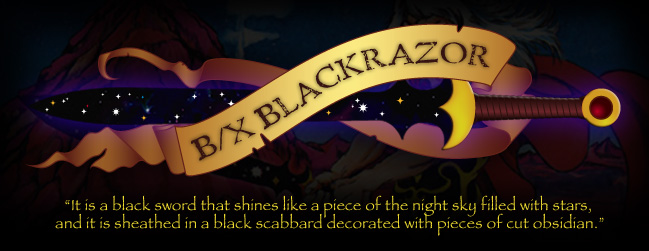
Considering that these are scurrilous rogues and tomb raiders, it makes perfect sense for PCs to have falling outs with each other. Most often, these conflicts occur over particularly valuable treasure items (specifically magic gear…recall Blackrazor?). My current batch of players are so darn nice and consensus driven that there haven’t been any such “incidents” at the table…though I’m sure it’s just a matter of time.
Well, whatever…the players made it safely back to Markesh (their current base of operations) dragging five huge chests (200 pounds each!) all brimming with treasure. Even with the HEFTY cut the galley captain took for providing them safe passage, they’re still filthy rich, most having enough to buy a good-sized house (if not an actual leopard farm…sorry, Greg!). We still have to see whether or not Laurel will stay on as Randy’s retainer/bodyguard, and the spell-casters need to learn their new spells, but other than that there’s nothing for the PCs to do but take in some much deserved R&R while scheming their next adventure.
The DM is looking forward to the break as well.
; )
Thursday, August 4, 2011
Traps (Part 2)
[continued from here; and yes, I fixed the formatting so it’s easier to read]
As I continue my discussion on traps, keep in mind Moldvay’s version of “trap theory” and remember that this is not only the edition I play, but the edition of the game that I FIRST played/learned to play.
The following excerpts on BOOBY TRAPS come from Ye Old Wikipedia:
“A booby trap is a device designed to harm or surprise a person, unknowingly triggered by the presence or actions of the victim. As the word trap implies, they often have some form of bait designed to lure the victim towards it. However, in other cases the device is placed on busy roads or is triggered when the victim performs some type of everyday action e.g. opening a door, picking something up or switching something on. Booby traps should not be confused with mantraps, which are designed to catch a person. Lethal booby traps are often used in warfare, particularly guerilla warfare, and traps designed to cause injury or pain are also sometimes used by criminals wanting to protect drugs or other illicit property, and by some owners of legal property who wish to protect it from theft. Booby traps that merely cause discomfort or embarrassment are a popular form of practical joke.”
This sounds like what we’re talking about when we discuss traps in a dungeon, right? Devices designed to harm someone who unknowingly triggers the device. In the section on historical usage of booby traps, they begin the entry with the Vietnam War and move forward from there…though, of course, explosive devices (the main form of booby trap used by the VC or US special forces or the Irish Republican Army), are NOT going to be the usual traps found in D&D.
In general, D&D uses more farfetched fiendish, mechanical devices.
Regardless, here’s the part that I find most interesting: the EFFECTS of booby traps:
"In addition to the obvious ability of booby traps to kill or injure, their presence has other effects. These include the ability to:
- demoralize soldiers as booby traps kill or maim comrades
- keep soldiers continually stressed, suspicious and unable to relax because it is difficult for them to know which areas, buildings or objects are safe
- slows down troop movement as soldiers are forced to sweep areas to see if there are more booby traps.
- make soldiers cautious instead of aggressive and confident
- create no-go areas (real or imagined) after a booby trap has killed or wounded someone
- cause a section or platoon to have to stop in order to deal with casualties, thus slowing and delaying those troops
- create confusion and disorientation as a prelude to an ambush"
Now, to me, this list is the real meat and potatoes of trap design, and we can see how these various effects were incorporated (or not) throughout the different editions of D&D.
Killing and Injuring: as discussed earlier, this particular aspect of traps has been emphasized with later editions of D&D, though the WAY in which it occurs (B/X’s auto-kill versus D20’s ramped up damage and ability drain) has differed.
Demoralizing PCs by killing/injuring comrades: as a side effect of the first, this has also become emphasized…though how many delves have been abandoned by a party for this particular reason? Isn’t the dungeon created so that players will explore it?
Keeping PCs stressed: This is exactly the "keeping PCs off-balance" thang espoused in the LBBs...and again, the ramping up of the DANGER involved (damage/death) has made PCs far more cautious with later editions of D&D. The design of DCC (“add more player characters so players need not be cautious”) defeats this aspect of trap theory, though at the benefit of (hopefully) speeding play. I haven’t yet played DCC so I’m not sure this is the case.
Slows down movement while searching: absolutely…which gives wandering monsters (or guard patrols) a chance to catch up to them (an emphasis of Holmes). For the Gygax defined (in the PHB) confining traps, the trap itself can slow PC movement if sprung.
Makes PCs cautious instead of aggressive and confident: Yep…and the more traps, the more one finds this occurring.
Creating “no-go” areas: An interesting idea. It asks the question, “Do DMs want players to go into areas?” The dungeon does not exist independent of the DM/players…it is designed and run by the DM for the players. If the DM does not want the PCs to experience something, they don’t need to include it in the dungeon. It’s an interestingly perverse idea to create places that are extremely difficult to get into in hopes that the players won’t find it/explore it (see The Forgotten Temple of Tharizdun for an example). I have been sticking similar locations in my recent adventures (the current one having the toughest)…but then, some might call me a naturally perverse individual.
Inconveniencing PCs with wounded comrades: this is an excellent idea/alternative to the instant death or damaging traps…blind or hobble victims of the trap so that the other party members are forced to abandon them or deal with their handicap. With magical traps, all sorts of curses can cause this effect. I need to include more such in my adventures!
Confusion as a prelude to ambush: This is similar to what Gygax describes (again, in the PHB) as channeling traps…things that throw off map-makers and force PCs into confrontations they might not want. The traditional “chute to next level” that lands a PC in the midst of monsters is one I’ve been toying with for a larger dungeon I’m working on.
There’s some food for thought here, and I want to continue this series with some specific examples from my own games and the effect traps have on players (as well as discuss some other possibilities that can cause different forms of consternation). Why? Because I think “traps” are an area ripe for an over-haul, and I'm interested in using them in unusual ways.
Have a good day folks!
: )