Tuesday, November 12, 2024

Answering the Dragon's Call

In my last post, I discussed my discovery of the old podcast "Chasing the Dragon" (a somewhat amusing title, considering I associate it with heroin smoking) in which a young-ish DM discusses his foray into learning 1st edition AD&D...a project I think is great. In his first episode, he asked a couple gamer buddies...both of whom had some 1E experience...a series of questions, getting their thoughts on the game.

I didn't like the answers they gave.

Of course, this was 2016. Back then, I wasn't worried in the slightest about AD&D (being rather preoccupied with living in Paraguay and raising a 5 year old boy and 2 year old girl). However, if Jason "the Mad Cleric" were to ask me this same set of questions, right now in 2024, here's what I would say:


(02:33)  "Have I absolutely lost my mind? Is learning AD&D and trying to go through all of Gygax's modules just absolutely crazy? What are your thoughts?"

I assume that by "crazy" you mean, 'Is this a waste of my time?' Specifically with the context that there have been some half-dozen D&D editions published since 1E and 1E not being supported by the company currently publishing the brand. The short answer is "no." There are plenty of people still playing 1E, plenty of of folks still interested in learning to play 1E. These people are all over the world, united by the internet, and many of them are kids and young people. It is a viable system, and one that is readily available...currently...via 'print-on demand.' In my own opinion, it is the only edition worth playing (I'm a busy guy). Most (if not all) of the editions published since 1E were done so MAINLY for business reasons.


(04:36)  "When did you first play? What do you remember from that first experience? What did you take away from it?"

I've detailed my personal history with D&D elsewhere; my friends and I started playing "full AD&D" (i.e. not some hybrid/Frankenstein game) circa November/December of 1984. I played till roughly 1990, when I put it aside in favor of other RPGs. I returned to 1E play in November of 2020, and have played it ever since. With regard to my first experience, I don't remember much specifically, save that it was exhilarating and exactly the creative outlet my friends and I needed. What I took away in 1990 (when I quit the game) was the false idea that one needs the right mix of friends/chemistry to make the game work, something I never thought I'd achieve again. However, I now understand that making the game work is largely a matter of commitment, something that (until I restarted four years ago) I had been unwilling and/or unable to do. As I wrote previously, I now consider it the only edition worth playing.


(10:03)  "So how long did you play AD&D?"

Roughly six years the first stint (1984-1990). After that I played many other RPGs NOT named Dungeons & Dragons. I got back into D&D play circa 2000 and back into old edition play around 2009. I've played 1E exclusively since November 2020...however, I've continuously owned and studied all my old books since the days of my youth, so even when I wasn't playing I had plenty of exposure to the system and Gygax's writings.


(12:34)  "Where do you think the AD&D mechanics excel?"

AD&D's mechanics excel at facilitating adventure gaming, a type of role-playing utterly unconcerned with "role-playing" (in the sense of portraying some sort of fictional character) or "creating stories" (in a literary sense). It does this by providing the tools...both in terms of mechanics and (what I'll call) "attitude" for long-term, engaging game play.


(15:16)  "Tell us how the skill checks would be dissimilar from Pathfinder or another game you might be familiar with?"

With the exception of a handful of highly specific classes (thieves, assassins, monks, and bards) there are no ubiquitous "skill checks" in AD&D. All classes in AD&D have their own suite of capabilities, but the ability scores are not used (unlike post-2000 editions of D&D) for determining "chance to succeed," instead providing modifiers to specific, targeted mechanics. Later books in the 1E series (Oriental Adventures, the Dungeoneers Survival Guide, the Wilderness Survival Guide) offered a rudimentary "skill system" (as the term would be thought of in modern "trad" gaming) based on "non-weapon proficiencies," but these were never integral to the 1E game (being given in HIGHLY OPTIONAL supplementary texts) contribute nothing of note and are (IMO) poorly done. With regard to the "skill checks" of the specific classes mentioned, "thief skills" are rolled using percentile dice; actual targets are based on the level of the character and slightly modified by race and DEX scores...success is accomplished by rolling UNDER the target number; in 1E, "higher" does not always equal "better."


(25:30)  "Why is this game, 1st edition, like that [an adversarial, tactical skirmish game instead of a 'role-playing game'], do you think?...and it's been kind of passed down to the other editions...do you think it's because it was written by one guy, and he was a war gamer in the past? And it just kind of bled over into his book? What's your take on that?"

It is like "that" because it was specifically designed in this way; D&D originally carried the subtitle "Rules for Fantastic Medieval Wargames." Modern understanding is poor when it comes to what D&D is and was, let alone its potential. Why was it written as a "war game?" Because it was created by war gamers Gary Gygax and Dave Arneson. The "role-playing" part grows out of game play organically, but AD&D is first and foremost a GAME, as Gygax makes abundantly clear in the text of his Dungeon Masters Guide. People who want to make it something other than "that" would be better served by finding an RPG aimed specifically at the type of gaming their looking for. Plenty of RPGs on the market to meet different needs.


(28:52)  "Have you guys actually played any of [Gygax's] modules? Because my understanding...and I haven't read any of them yet...is that a lot of them are just meatgrinders, absolute meatgrinders. And your character's going to die, and there's no time to pause, there's no real storyline to get to the end...is that descriptive of all of his stuff? What have y'all played of his modules? And what'd you take away from it?"

Your "understanding" is poor. Gygax wrote exactly 17 adventure modules for D&D, only 16 of which were written for (or adapted to AD&D (The Keep on the Borderlands was written to be included with the introductory Basic D&D box set). Of these 16, I own all but three and have run 11 of those 13 (I will note that I have run B2 KotB MANY TIMES, but only for B/X, never AD&D...it is not designed for AD&D). I wouldn't characterize any of Gygax's modules as "meatgrinders," with the possible exception of Tomb of Horrors...then again, much depends on how you define the term "meatgrinder." AD&D is intentionally designed to be adversarial, and poor play often results in character death; if your only experience with D&D play is a latter day edition in which death is rare (5E, for example) then, sure, you might consider ANY of the old TSR modules fairly bloody (with the notable exception of UK1). Gygax's modules specifically apply pressure and challenge in masterful fashion to provide a rich gaming experience; his adventures are widely considered some of the best published, and I don't disagree.


(33:57)  "Do you think players today would have patience for that [losing a high number of PCs...like one for every 1-2 hours of play...to in-game "death"]? Do you think people would be like 'this game sucks, let's play another game?'"

Having introduced the AD&D game to MANY players over the years, some as young as 9 or 10, my experience is that players love AD&D and are just fine with the level of danger it presents. And I kill a LOT of PCs in my games...I don't really 'pull punches' when it comes to running D&D. However, losing a character every 1-2 hours is pretty exorbitant...my players (all under the age of 14) can go many sessions without losing a PC to death. 1E is actually quite forgiving compared to OD&D or the various Basic D&D games and their clones: higher PC hit points, more clerical/healing magic, and a negative hit point "buffer" all provide AD&D characters with more staying power. And yet TPKs still happen (when players really screw up)...and that constant threat of death makes the game experience very fun, even as the plethora of "raise dead" options means a beloved character can usually be brought back to life...for a price. No, I don't ever hear cries of 'this game sucks' at my table. 


(39:39)  "You don't hear about a lot of people that are playing 4th edition saying, 'Hey, I'm going back to 1st edition because it was so awesome, and that was the game that was so much fun!' So what about AD&D is just not good? Like, what is it that was a misstep, that you're so glad they fixed...in 2nd edition or some later form?"

You don't hear a lot of 4E players saying they want to "go back" to 1E, because many of them...like YOU...have no experience playing 1E. They started with 4E...or 3E or 2E...and, frankly, don't know what they're missing. Others may have started with 1E but are slaves to playing whatever new hot edition is supported by "the company" and don't have the gumption to stick with something "outdated." Still others played 1E poorly...or had poor experiences with the system...and have never experienced the edition's full potential. Again, what you may not understand is that the company moved on from 1E mainly for business reasons: TSR ousted Gygax from the company but he continued to collect royalties for any book that carried his name, and 2E was a means of breaking that financial leash. But after Gygax's removal, TSR largely became a paperback novel publishing company (rather than a game company) and the quality of gaming material went down the tubes. 3E was published after TSR was purchased by WotC and a new system was designed to rehab the brand using "modern" game mechanics. 4E was published to give the company a cash infusion (i.e. forcing players to re-buy the new core books) and to capitalize on the MMORPG craze of the time (specifically World of Warcraft). 5E was rolled out as a "great compromise edition" specifically with the goal of recapturing marketshare and brand recognition after the disaster that was 4E. So, NO...1E wasn't "fixed" by any of the later editions. Later editions of D&D have only served to make the game worse in various ways. I have my own house rules...as any long-running 1E Dungeon Master is inclined to have...but NONE of those come from later editions of D&D. The vast majority of later edition changes have only served to make the game worse (although they also served to make the company money).


(44:30)  "So...do you think this game punishes players? It sounds like it's a 'DM's game' more than a 'players' game.'"

Again, the game is designed to be adversarial...it is designed to challenge the players. For the challenge to be real (i.e. for the challenge to matter) there must be consequences to failure. If there isn't, then there's little point to playing except mental masturbation. So does the game "punish" players? No, it "punishes" poor play (if you want to call those consequences "punishment;" I don't). But I've found most players ENJOY the type of adventure experience the AD&D game provides. 


(47:38)  "So, for myself or for anyone else who wants to learn AD&D what advice would you give? And with your advice I'd also ask for your two best house rules that you can remember."

I put these questions to my kids (ages 13 and 10) and they gave great advice: know the adventure you're running, know the rules you're running, prepare to adapt your game to the actions of the players. The house rules  they felt were most important included all dice rolls in the open, no PVP ('player vs. player conflict) at the table, no cell phones at the table, and no goofing off.  With regard to specific rule tweaks, the two most important ones I use are A) clerics need not memorize their spells ahead of time (they pray for their spell when a specific miracle is needed), and B) spells that are "ruined" in combat (because the spell-caster is damaged during the casting) are not "lost;" spells are only expended upon a successful casting. If I could ONLY change two rules in the game, those would be the ones...and if I could only change ONE rule, it would be the first (regarding clerical spells). Everything else in AD&D (especially racial class restrictions and level caps) I either enjoy or can easily live with.


(56:34)  "Do you have any final thoughts?"

So many. 1st edition AD&D may be difficult to parse and figure out, even for an experienced Dungeon Master, but it IS possible. My friends and I did it...at the age of 11 and 12...without any mentoring or parental help. I understand that the rapidly declining literacy of our culture may make this more difficult, but it's still possible. And its embarrassingly easy to teach people how to play (as players), even kids as young as 7 and 8 years old. I grok that some folks may be intimidated to play 1E, but it's really not rocket science, and there are many on-line groups, forums, discords, etc. where one can find advice, support, and help with learning. The game is easily (and cheaply) purchased through P.O.D. sources, and even cheaper if you just want a PDF/ebook. For less than $50, you can buy all three core books (PHB, DMG, and MM) plus a set of dice and you'll have a game that can provide DECADES of enjoyment. It's the greatest game ever published. And it's unfortunate that so many RPGamers...probably the majority...will never figure this out. However, there are some of us out here that are willing and able to help...willing and able to provide whatever knowledge we can, to aid in spreading the love for this game.

Best wishes.
: )

Friday, November 8, 2024

Chasing The Dragon

So, I like podcasts. As a stay-at-home dad, I'm busy (a lot) but usually not doing stuff that takes up too much of my 'mental attention.' Throwing on the headphones while cooking, cleaning, or driving is something I do.

[okay, no, I don't use headphones while driving...but you get the drift]

Most often, it's sports or news-related, but...as often as I can find it...I like to listen to podcasts about gaming. At least, about the type of gaming I do.

So it was Tuesday, that I was searching through my iHeart radio app, looking for podcasts...any kind of podcast!...about 1st edition AD&D. Because I needed something to occupy my mind, and throwing on CNN in the background was not my idea of "relaxing white noise."

And LO I found one: Chasing the Dragon, by a guy named Jason Wood, AKA The Mad Cleric. Started in 2016 (jeez...pre-Covid), he dropped all of six episodes, documenting his "quest" to learn and play AD&D (1E). No idea if he's still playing AD&D...his last 1E-related blog post appears to be from 2017 (though he did attend GaryCon in 2024). His is not a very active blog.

ANYhoo, I listened to the whole series. It's pretty good (very listenable) but also...so, so frustrating.

I'll explain: Jason (or "TMC," as I'll hereafter refer to him) first started playing D&D in 2011 with the 4th edition. Would have been in his mid-20s at the time (a little older than most folks stumble into D&D). at the time of the podcast he was 32 years of age. 

And yet he wanted to learn 1E!  Mainly, he wanted to play all those classic 1st edition adventure modules using the actual system for which they'd been written. It was a gaming experiment...and a pretty cool idea...for a guy who'd never had the chance to play in the heyday of the 70s and 80s.

[ha! Funny thing...the television series Stranger Things came out in 2016. TMC makes reference to it in his final podcast...the serendipitous coincidence of people becoming interested in 1E at the same time]

And me? I feel like a heel listening to this. Because I was so NOT into AD&D in 2016 (remember that it wasn't till 2020 when I finally broke down and returned to 1E). If TMC started his podcast today, I could actually help him and provide him with good information and context for much of the weirdness of the game...but in 2016 it wasn't even on my radar. Hell, I probably would have advised him to play B/X if he'd asked me my opinion back then.

And this is SAD. I feel sad about that. Because when it came to trying to LEARN the game, TMC ended up tapping a bunch of different people for advice, most of whom had no good advice (or very little) to give. And some of whom actually gave him counterproductive stuff...the kind of stuff that, in my opinion, would result in a frustrating, crappy game and (even worse) probably just lead him back into the stifling WotC embrace of 5E.

Does that sound harsh? Uber-hyperbolic? Okay, maybe it is. But yesterday, in anticipation of this post, I was re-listening to Episode 1 and jotting down notes (mainly timestamps) and my son asked me what I was listening to (he was doing geometry homework at the kitchen counter at the time). I told him: I'm listening to an old podcast about a guy trying to learn AD&D and the questions he's asking from these guys who don't have much expertise with the system. Kid asked if he could listen, too (i.e. take off the headphones, papa). So I did. After a few minutes he said: "These guys have no idea what they're talking about! They're just yapping; they're not actually SAYING anything!"

Yeah. I know.

The time stamps I was making note of were questions that TMC was asking his guests...because I figured I'd list them here, on Ye Old Blog, and write out the answers I would have given him. But after seeing how aghast my son was, I decided to do something different: I forwarded the podcast to one of the questions, played it for my son, and then asked him what answer he would have given the interviewer (stopping the podcast so he didn't hear the guests' answers). My daughter wandered into the kitchen at about this time, and I ran her through the same exercise.

Here's the question (from 47:36 of the podcast):
"So, for myself or for anyone else who wants to learn AD&D what advice would you give? And with your advice I'd also ask for your two best house rules that you can remember."
Diego's answer: Advice? Be prepared. Know the adventure you're running. Know the rules. Two best house rules? #1: all dice rolls 'in the box.' #2: no PVP.

[we have a puzzle box lid that we roll all our dice in. Only dice that land in the box "count;" any die that bounces out of the box gets rerolled]

Sofia's answer: Be prepared for anything. Best house rules? No "goofing." No phones at the table.

My kids. So smart. Their answers were ten times better than the ones I would have given. 

SO...maybe I won't harangue and berate and belittle the poor guy for his near-decade old podcast. Hopefully, TMC has continued his 'experiment' and is still playing 1st edition today...hopefully, he's discovered for himself how and why the game works...I mean, nine years? That's a pretty good chunk of gaming under the belt. Plenty enough time to "figure things out."

Isn't it?

For me, I suppose I have a burning question of my own: if a person sits down to learn AD&D with a concept of role-playing shaped by latter day editions, are they going to be able to realign their expectations? Shift their paradigm, so to speak? For myself, who played plenty of "trad" RPGs in the 1990s, I can tell you there were subtle tweaks of reprogramming that needed to be rewired in my brain. You can see it in my older, dumber blog posts. Fortunately (for me), I already had a foundation of D&D play from my youth...I'd been witness to successful D&D play, and it was just a matter of digging out WHY it had been successful.

Which is easier said than done (no one really knew anything about this damn hobby when I was a kid). But after two decades (!!) of speculation on gaming and game design, I've got a pretty good handle on it. Maybe a smarter, wiser person than me could figure this out in half that time, without the foundational play experience? Maybe?

Ah, well.

I know...I know..that I have readers who are going to see this line of thought as incredibly presumptious and arrogant. Because, in a nutshell, I seem once again bent on dragging "edition wars" into this glorious hobby of ours, being judgmental and thick-headed about what makes "good play" or "bad" and yadda-yadda-yadda. Yeah, I know. "D&D has evolved," right? It ain't the same game it was, it serves different needs, the people playing it are different, etc., etc.  Okay, sure...I don't want to fight you folks (much) over the subject. I'm just a salty curmudgeon made saltier by the trends I see in the country I live in.

[and that's all I'll say about the election other than: boy, am I glad I live in Washington State!]

Anyway, I'm NOT (really) trying to come down hard and "judge-y" on people who play D&D differently from me. My frustration...which I feel the need to express...is that there are people out there, who might want to play D&D the way that I do...and who could!...if they only could get the few, simple answers they need. There ARE simple answers! Not easy ones, perhaps, but simple. There is a roadmap to (what I call) "solid D&D play." But getting it into the hands of the right people at the right time (2016! 2016!) is a tough ask.

SO...if you're a buddy of TMC, or happen to have run into him or gamed with him at GaryCon, give him a shout out from me. Tell him there are people who have only just discovered his stuff and are curious to know how it's all worked out for him in the intervening years. We'd like to hear more about his travails with AD&D 1E, and see how much (if any) they mirror our own. Tell him, the system is still being played by folks...many folks...around the world. 

Just let him know. And happy Thursday folks.
; )

[posted Friday because my Thursdays always seem to bog down. Darn it!]

Monday, November 4, 2024

Why D&D Works

I had an epiphany Saturday night, something I'd been struggling with and considering for years: why does D&D work, i.e why does it have staying power as a role-playing game, when so many other RPGs do not?  What is it that sets D&D apart from all other systems, genres, and competitors?

Saturday, while walking to the store to pick up some beer, it came to me: raise dead. 

Now, to be clear, there are a lot of reasons why D&D works...and works really well...for long-term (campaign) play. The driving force of the advancement mechanics (the x.p./leveling "carrot"). The plethora of challenges that scale from low levels to high. The micro-/macro- scale of the setting (i.e. the premise of exploring closed "dungeon" sites, and the endless possibility of exploring a whole world or different dimensions/planes). 

But all these things can be (and are) replicated/implemented in other genres of games: lots of games have "levels" and/or points-driven systems. Lots of of genres feature "adventure sites" for drilled-down exploration. Most RPGs present a scale of challenges from the beginning stages until the later.  Many, many games have emulated these particular aspects found in D&D. 

However, while those things, when implemented, can add staying power (i.e. sustained interest/engagement with game play) in practice, I've never any of those games to last for longer than a few months...and generally not even that long. 

[cue all the folks who've been running 20+ year Traveller campaigns to pipe up]

Here's the thing: I think (I think) that unless you have some slavish devotion to a particular genre/setting IP (for example, the person who ONLY plays Star Wars, because they love-love-love Star Wars and would not play RPGs at all without system to allows them to live in the SW universe), for sustained engagement over time, the participants require two things:
  1. a real, true challenge that tests them (no matter how poor the player, they become competent with enough hours logged), and
  2. a "tangible" (I use this term VERY loosely) form of accomplishment/reward demonstrating their impact (i.e. there has to be something to show for the time spent).
And the area where D&D differs from pretty much EVERY GAME on the market (certainly every game I can think of...which is more than a few), is the presence of of game mechanics that allow dead/destroyed characters to return to the game without breaking the verisimilitude of an escapist (fantasy) game. This is not "plot armor" for characters; instead magic like raise dead, reincarnate, resurrection, and wish are all baked into the system...these spells are a hard-wired part of the game's setting.

So what does this mean? Why is it important?

Well, for one thing, it means a DM can push the players as hard as he/she feels is appropriate for their capabilities without fear that beloved characters might be killed derailing years of work and investment. See, I readily acknowledge that players develop attachments to characters over long periods of consistent play...and not just attachments to their own characters...and DMs are not immune to this effect either. You work a character from 1st level up to 5th or 8th or 10th+ level, and the character takes on the same status in the minds of the participants as a major character in a favorite television serial.

It happens. It's not about creating a nifty "backstory" for the character, or developing a PC's "personality." It's about actual play, over time. Such characters matter to players.

And D&D provides means of bringing them back to life. The D&D world is a magical world...by definition and by design...that presumes souls (and spirits, yes, I see you DDG) do not immediately depart to their eternal reward upon expiration of the physical body. Players know this going in to the game. No, it's not necessarily easy (nor cheap) to do so, but there is always room for an Orpheus like quest. I've seen it happen...more than once in more than one campaign.

And so, because of this possibility, DMs can push the players hard. The kid gloves can come off. The DM is free to create dangerous scenarios, and run those scenarios by the rules, letting the dice fall as they may, and allowing the players to suffer and strive and triumph and fail on the basis of their own abilities and their own luck. Without the need for plot armor immunity, "death saves," or comic book style "ret-cons." Real Play; Real Stakes. Death on the line. 

Which, by the by, makes the experience of playing D&D all the more visceral...all the more adrenaline-pumping...for the people sitting around the table. Cheers and groans and fear and real tension. And, upon success, real feelings of achievement. The kind of roulette spins that breed gambling addicts...which is why people who enjoy D&D play, will continue to love and enjoy it. 

It's not an interest in improv that keeps them riveted.

So, yeah, this is the difference between D&D and (pretty much) every other RPG on the market. Superheroes, space opera, horror, espionage...none of them offer both the hard challenge of D&D, and the setting ingrained "get out of jail free" cards that take the sting out of loss. Of course, the D&D game has more wonderful things than just the magic of raise dead (including asymmetrical game play, a reward system that encourages action and cooperation, etc.), but this is the thing that, I believe, is UNIQUE to Dungeons & Dragons, and it facilitates long-term buy-in and investment which opens the potential to see how a campaign can unfold...in all its glory.

Happy Monday, folks. 
: )

[and, if you're an American, please don't forget to exercise your right as a citizen and VOTE]

Friday, November 1, 2024

The European OSR: Tourney

Happy All Saints Day! Time for another Friday morning blog post to read as you recover from your candy and booze hangovers!  Had a frightfully good Halloween myself (okay, sorry, bad pun).

As I mentioned in my original post of this series, even though I couldn't get over to Cauldron this year, I provided them with "tournament adventure" to run. Since I've fielded several questions about this the last few days, I figured a blog post might be the best way to disseminate information.

SO...y'all have heard of OSRIC, right? For those who haven't, OSRIC was one of the first D&D retro-clones published...in fact, I believe it was The First retro-clone published (unless you want to count HackMaster).  OSRIC is a clone of 1st edition AD&D; originally compiled by an attorney with the free time and passion for the project, its goal was to provide a framework through which hobbyists could write 1st edition adventures ("written for OSRIC") without getting C&D letters.

[if any of that info is incorrect, please feel free to ream me in the comments]

Anyway, the folks behind OSRIC are working on releasing a NEW edition of OSRIC; cleaned up, clearer, better usability, etc. While I don't see any news about this on their web site, this isn't some big secret: it's been a topic of conversation on several discords I read, and there have been forum announcements about it. The kickstarter hasn't launched yet, but I know it's in the works.

What might be a secret (apologies for the spoiler) is that, some months back, several folks were asked to help with the KS by writing adventures...presumably for 'stretch goals' or the like. I was one of the people invited to participate, and I offered to do "something with pirates and saints' relics," this idea rising from the world/setting concept presented.

Enter my adventure: Children of the Sea. Here's the blurb from the intro:
A holy relic has been stolen, and the Church of Sacramental Bliss has offered a substantial reward to anyone that can recover it. Careful investigation has revealed the lair of the pirates holding the blessed item: an abandoned temple on a small, craggy island. Can brave adventurers recover the relic before someone else claims the prize?
That was written in early October; I can see from my laptop that I created the document that would become Children of the Sea on September 30th (for the interested, the maps were created October 4th). 

But I'd had several months to ponder the project: I was first contacted about penning an adventure in May...but summers are busy 'round these parts (I told them it would be tough for me to get it to them by August but November/December wouldn't be an issue). It would sit percolating on the mental 'back burner' for a while...

However, in July the fam and I travelled to Europe and I had a chance to meet up with Prince of Nothing in Amsterdam (that will be the subject of a later post...). Even by then I'd started thinking about offering "something" to the Cauldron people...some way to 'keep my hand in,' even if I couldn't make it to Germany. When I broached the idea of an adventure to Prince, he suggested I just take the idea direct to Settembrini (the main con organizer), whom we'd both met and knew to be an amiable guy.

So I did...in September. As I said, summers are busy times for us and the start of the school year ain't anything close to a "slowdown" in the action. On September 16th I mustered the courage to send an email, writing:
"While I won't be at Cauldron this year, I'd like to offer a new adventure that can be run at the convention. Similar to the old tournament modules of GenCon's yesteryear, this would be a short 1E module, fleshed and prepped, that willing DMs could run and (hopefully) help fill out your event schedule. I'll include pre-gens, etc. to make the thing as easy to "read and run" as possible, and it will be of suitable length for a 4 hour time slot. 

"My thought is that (if several DMs were willing to run the adventure) such a thing could be a shared "touchstone" for Con-goers."
However, I did not start writing (being busy and then suffering a bout of Covid) and, instead, waited for a very busy man to get back in touch with me. Which he did on the 28th. Buoyed by this affirmation,  I set to work and had the whole thing out the door by October 5th.

Cauldron is a fairly small convention..."cozy" is the word that comes to mind. Some 54 (55?) people live, eat, and game together in a German manor house over a long weekend; in 2024 folks arrived Thursday afternoon and departed Sunday morning. Games are played in four hour blocks from 9am till...well, till whenever people decide to sleep...with meal breaks in-between. Seven "official" gaming blocks were assigned Thursday through Saturday, with Sunday being reserved for brunch, awards, packing up, etc.

Children of the Sea was run by six different DMs for 43 total players, providing a shared gaming experience for 90% of Cauldron participants. Better than I'd hoped for when I first had the idea.

I don't know if GenCon still runs tournament adventures. But I know they used to, and several adventure modules rightly called "classics" started their lives as tournament scenarios. We laud those old adventures because they are so ubiquitous...so many people have played them over the years, the S-series, the G-series, the C-series. That shared experience is the thing that keeps them in our memories, more than whether or not they are exceptionally written and/or designed. So many of us can crow about how we dealt with the giants or bitch about getting murdered in a Tomb of Horrors trap or whatever. Common war stories...THAT is what we get from these things. Like the way I've seen war veterans from different social classes and different ethnic backgrounds still bond with each other. 

Yeah, it's fun to have a D&D "competition," but the tournament exercise also strengthens the community.

Or so it seems to me.

Anyway. Much fun was had by all. Certificates for winning play groups (and runners up) were given out. One group's score sheet was misplaced and was later found to have actually had the most measurable success of all (they will be acknowledged in the published version of the adventure). From all the reports I've received and read on-line, it was a good experience with all groups managing to "win" the scenario to one degree or another and with only a fifth of the players being killed or "transformed without their consent." 

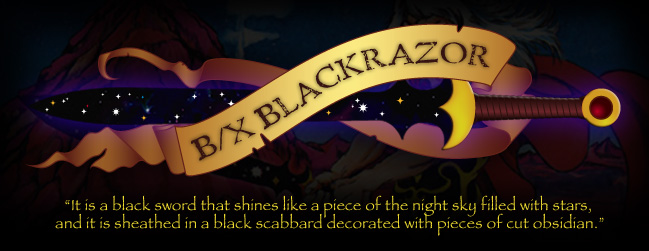
The Cauldron people have decided to make it an annual con event: the "Blackrazor Cup." Named for the iconic AD&D sword, not for me (the "Becker Cup?" Hell no...hard pass on that!). It will not, of course, always be an adventure penned by myself (though I am already thinking of what I might write for next year), but it will...I hope!...always be done in a similar spirit: providing a shared gaming experience where teamwork and cooperation and ingenuity are needed to overcome challenges and obtain great reward.

As for the adventure? I am currently in the process of polishing the thing for the OSRIC release, incorporating the feedback I received from both players and DMs alike...that's a lot of playtesting that got done in Germany!  My own gaming group didn't have a chance to play it till this week (Wednesday afternoon). We ran Children of the Sea exactly as written for the tournament, including drawing our six PCs from the tournament pre-gens, and setting a time limit of four hours.

The result was a TPK with 105 minutes still left on the timer. But I'm a pretty ruthless DM.
; )

[the kids still had a blast]

Happy Friday, folks!

Sunday, October 27, 2024

Adventure Site Contest II

My apologies for neglecting to mention this, but Ben Gibson is currently running the second installment of the Adventure Site Contest (ASCII).  Deadline for submissions is January 1st, so if you're sitting around watching NFL games this morning (as I am), that's something you can work on during the commercial breaks...at a maximum of 3 pages, these short-form adventures are ideal for seeding throughout your campaign world.

Little something-somethings for "off the beaten path."

I will NOT be competing this year, but as one of the judges, I will be reading...and reviewing...all the entries. If you've long cherished any interest in hearing me lambast your design chops for poor treasure counts, this is your chance! Hahaha!

All right, that's all for the day. The daughter and I are going to the Seahawks-Bills game this afternoon. She'll be wearing her Josh Allen jersey (*sigh*) not because she's a Buffalo fan, but because she finds "Joshy" to be tasty eye-candy (*double sigh*).  Ah, well...it is what it is, and professional sports are supposed to be entertainment; everyone's entitled to a favorite player.

[some of MY all-time favorites? Emmitt Smith and Mike Alstott. Never owned a 'Boys or 'Bucs jersey, though...]

Have a good week, folks!
: )

Friday, October 25, 2024

"Storygamers"

Oh, boy. A loooong one for a Friday.

"Storygamer" is a term that gets bandied about the internet a lot these days, generally in a pejorative fashion. I seem to see it a lot amongst those folks identifying themselves as "CAG (classic adventure gaming) gamers," generally setting themselves up in opposition to this particular type, or style, of player.

First allow me to reiterate (or explain) that this label of "adventure gaming" is simply meant to distinguish what I do from what is usually considered "role-playing" these days (i.e. in the 2020s). Up until the 2010s, I certainly would have called myself a "role-player," and these games I play "role-playing games" or RPGs. When it comes to running AD&D, I take the same approach I have (pretty much) always taken...generally speaking, the same approach I've taken towards ALL role-playing games I've run over the years.

That being said:
1) it is remarkably difficult to run most RPGs in the style of AD&D (and as evidence, I will point to the consistent LACK of my ability run other RPGs over the long-term; most non-D&D games...with some exceptions...have been extremely short-lived affairs).

2) the AD&D I run these days is a much more mature, calculated, and conscientious than the AD&D of my youth. Credit this with having grown as Dungeon Master, and the years of work I've done on self-analysis and self-development.
But just because I distinguish myself as an "adventure gamer" does not mean I consider myself part of a particular tribe. I'm less interested in being a part of any particular community, and more interested in the game itself...what it can do for me, what I can do for it.

[it is similar to my feelings of the "OSR" back in the day; as I've written before, I never saw myself as part of a "movement," so much as an old geezer that wanted to play old games]

So, while I'm happy to die on this hill of championing 1E play, I'm far less interested in digging a trench around said hill, and spiking it pickets to keep out the "storygamers." ESPECIALLY because I feel that, these days, we may be using too broad a definition of just what a "storygamer" IS.

Here's a good blog post defining story games from Ben Robbins (of Ars Ludi). It's from October 2012, but holds up today, echoing many of my own thoughts (from 2013 and now). Here's a solid quote:
"A story game is a role-playing game where the participants focus on making a story together instead of just playing “their guy.” The alternative–which I played 100% of the time for more than two decades–would be adventure games like D&D, where your character is your turf.

"Yep, I said adventure games. I’ve used the term “traditional games” a lot but in hindsight it’s a terrible term for the games we’ve loved for decades. Back in the 70s and 80s these same “traditional” games were frickin’ radical. I think “adventure game” is a better term. In an adventure game it’s the job of the players to beat the adventure the GM presents. Again, not my invention: “adventure game” was a common term for D&D etc. back in the day."
Yep. I'm not the first one to call my kind of gaming (i.e. Dungeons & Dragons gaming), "adventure gaming." And neither was Ben, as he readily admits. But I digress; we were talking about "story gaming;" and here ya' go:
"In adventure games your job is to play your character and make good decisions for them. If you mess up (or roll badly) your character can die and be removed from the game. In a story game any character you play is a facet of the shared story. You may even sabotage your own character or spin them into tragedy because it makes the story more interesting. It’s a shift from “what would my character try to do” to “what do I want to have happen to my character” and in the story at large."
Or, to put it another way:
"In an adventure role-playing game you can only accomplish something because your character can do it. In a story role-playing game you can make something happen because as a player you want it, not just because your character can make it happen. In an adventure game like D&D you decide what your character does, but your ability to succeed is a reflection of your character’s traits...

"In a story game...the character isn’t the limit of your power in the game. The rules give the players authority over things that are outside their characters’ control..."
Got that? A story gamer is playing a different kind of game (a "story game") with mechanical differences that support that type of play. Lots of examples abound, many of which came out of the Indie RPG (Forge) think tank. But what about all those folks who play D&D with funny voices? Check this out:
"Take D&D, old school D&D even. The players control their characters and the GM controls everything else. The characters’ chance of success is based on their character’s fictional abilities (good fighters win fights, poor fighters lose fights, etc.). But the GM could say to a player “Hey, tell me about the monastery your character came from.” Suddenly the player has some story game-style input into the fiction: their character didn’t create the monastery they were trained in, that’s the player making up things they want in the game. Or the GM could ask the group whether they want the next adventure to be more wilderness or dungeon crawling or political intrigue. Again, now the players are making contributions outside their characters. 

"Those examples are not that uncommon in adventure games. So hey, that makes them story games, right? 

"Not really. The important difference is that those contributions are arbitrary and non-binding. The GM is deciding when to ask the players for world input (if ever) and if the GM doesn’t like what they propose she can decide not to use it. The GM holds the veto. In an adventure games rules system, story game-style participation is an ad hoc privilege, not a right, and it can be rescinded at any time or never extended at all. It’s not a system.

"On the other hand, if you’re a player in an adventure game and you can always decide to make “bad but interesting” decisions for your character but the penalties can be pretty brutal. Yep, it was awesome and dramatically moving to have your paladin take off his armor before the big battle to show his unshakeable faith in his god’s prophecy, but in game terms it meant you had a terrible AC and got cut down in a few rounds. Oops. Now sit and wait while everyone else finishes the fight. The adventure game doesn’t have a method to reward your decision because that’s not what it’s built to do. It doesn’t expect you to play that way."
I am quoting heavily from Robbins's blog post because he echoes my understanding and feeling on the matter. What he is calling "story games" I (as a Forum alum) would probably call "story now" games...games designed to tell a story and unconcerned with aspects of exploration of challenge. They're nice parlor games, but not anything designed for long-term play (i.e. play of more than a handful of sessions). And they're not bad! At least they have an objective of play (tell a nice story) and mechanics to support that.

But Ben was writing in 2013. In 2014 we see the advent of 5th Edition Dungeons & Dragons...and shit starts to hit the fan. Because the publishers of 5E (i.e. Hasbro/WotC) had absolutely zero concern whether or not their game is coherent, instructional, functional, etc. nor even if consumers have any idea/consistent standard of how the game is meant to be played. Instead, their sole concern, was reestablishing market dominance, i.e. reclaiming the market share they'd lost to Paizo/Pathfinder after the debacle that was 4th edition. They did not Give A Shit how or why people played D&D, just so long as people were playing D&D...and they were going to do their damnedest to make sure THAT would be the game RPG folks were playing. Everything to Everybody.

SO...the  "brutal" consequence of trying to do "story" while playing an adventure game? All that had to go out the window. Characters have to be EXTREMELY hard to kill (if not impossible). Players have to "give consent" for negative consequences to affect their character. Creating character backgrounds and establishing stories for PCs became part of the actual chargen process. "Balanced" character archetypes ensure that no matter what a player's particular preference of "flavor," the characters will be on equal footing. Screw asymmetry. Thus the ascendance of My Guy/Gal syndrome and let's-tell-our-precious-little-stories-about-ourselves.

*sigh*

After my last post about the Euro OSR, I had a private conversation with an individual who discussed some of the issues they've had with their players, despite running a 1E game:
"...my players do not want to be motivated by gold, they find the notion of upkeep and training costs silly from an in-game perspective. 

"We ran indeed into a conflict...I wrote in a short reflection on the state of the campaign and their player skill that "saving the NPC is essentially a pretense for adventurous play - as adventurers, you want to loot treasure as much as possible while on the mission" and they were offended. ...They do not play to level up (and perhaps to a small extent even are used that the GM just awards level up after 'successfully' finishing an adventure without the tracking of XP)...
And:
"To a large extent my players are able to formulate their own objectives of play, especially during a long term campaign (i.e. unfinished business, taking revenge etc.), although in practice I seed the world with adventure locales...

"They pick perhaps also to some extent in line with their character motivations, or - at the same time - what they as players find interesting and then retroactively, if at all needed, formulate a motivation for their character. Especially this 'thinking meta as a player and bending my PCs' motivation to what I want' is very foreign to players invested in their characters..."
This, in my estimation, is NOT "storygaming." There is a disconnect between the players and the DM, but it isn't a bridge too far to span. In fact, it would seem to require only a step sideways by the DM to make things work: these players are still interested in "adventure" gaming, they just need some facilitation.

Among many (most?) D&D players who look down on old style play, there is a perception that killing and looting is too simplistic, too coarse, too dumb an activity to engage in. "Kill monster, loot treasure, repeat, how boring!" Most of these players...at least the ones that haven't jumped on the YouTube train of playing D&D like Improv Night at TheaterSports...still want adventure, but they want meaningful adventure, if not grandiose. Just like a fantasy story they've enjoyed reading (or watching on a screen). Collecting gold, doesn't seem "meaningful"...it seems mundane. And they want to be transported...the "fantasy" of fantasy adventure gaming is, essentially, an escape from the mundane hum-drum of the normal world.

But when we look at the classic adventures that everyone still adores...Hommlet, Against the Giants, etc...we'll see that none of them are bereft of story. Good adventures are scenarios: they have a premise, an idea or concept that gives them meaning. There's a reason players are there. 

And the characters' "story?" They build that through actual play, the longer they survive. It is inevitable in campaign play: the PCs will build friends and enemies, allies and rivals. They will have ambitions and victories and setbacks and comedy and tragedy...the longer they play. 

DMs want our players to live in the world we're building. We want them to want to spend time there. And most players who want to play D&D (and, yes, I'd even include modern 5E players) want a fantasy world worth living in. It's the DMs job to create that world.

When we sit down to play D&D, we all need to agree with the core concept of the game: players are adventurers in a fantasy world. "Adventurers" are individuals with a certain skill set that use those skills (and their wit) to risk danger as their occupation. That's their job. They are not town guards, or bakers, or kings-in-waiting, or court jesters. They are adventurers.

And because they are adventurers, we "keep score" (in this game we've agreed to play) by measuring how successful they are at their job (i.e. how much money they make), with some bonuses (x.p.) earned for defeating opponents with violence...because violence is inherent to the adventuring profession. They risk danger with their skill sets, i.e. sword and spell. Again: this is the game we've all agreed to sit down and play.

That doesn't mean the players can't choose to buck the premise. One of the great joys of D&D is that players have agency to operate outside the strict parameters set by (for example) a video game or a Fighting Fantasy novel. They are here to live in this world...not follow a script (and if the players assume they're supposed to follow a script, it's the DM's responsibility to disabuse them of this notice up front ASAP! That's not the game!).  

And living in a world requires some means of supporting yourself. 

It is the DM's responsibility to run the world...and that means providing consequences both for action and for inaction.  Players...because they have agency...have their choice of how to deal with the dangers of the world and the costs of living there. The DM has to make sure that there ARE "dangers" and "costs" so that the players are properly motivated to engage with them. The players can choose not to seek out treasure...and they will eventually be out of cash to feed themselves or their horses, reduced to living like penniless vagabonds (and treated the same by the locals). They can choose not to stamp out the monstrous ogre tribe that's moved nearby...and they'll see the village where they're staying dwindle as people move away (or are eaten), shops close, beer barrels run dry, etc. 

It all comes down to the DM's world building.  The (1st Edition) game already has rules for handling most pertinent situations that arise during the game. But it's up to the DM to build the world in which those rules get used...and it's up to the DM to present the world in a way that engages the players.

The players have no interest in investigating the caravan raids that have been halting trade with the southern jungles? That will affect the local economy. The players aren't interested in the giants expanding their territory into civilized lands? Civilization will start to shrink. The players aren't enticed to break up a slaver ring that's preying on the innocent? More people will continue to disappear in the night. 

It is UNIMPORTANT that the players wish to create mannerisms for their character, or write up a backstory. That's FINE if they want to do that. Most 1st edition PCs already have a "backstory" of sorts: they have a race. They have a class. They have a name. You can already tell a lot about the character's pre-game "history" just from these things (and more if you want to use secondary skills). It doesn't make them a "storygamer" to want to do these things...nor even if they want to "self-sabotage" (like the paladin removing his armor before a fight). 

That doesn't make the player a "storygamer," because we are not playing a story game. We are playing an adventure game. If it means anything at all, it just means they're not a very good adventurer (certainly in the case of the dipshit paladin)...and that doesn't mean they can't get better!

As the Dungeon Master, YOU have all the power. You create the world; you run the campaign; you arbitrate the rules. Any issue or disconnect here really falls squarely upon the shoulders of the DM. At least it does for those of us running old edition D&D. Choosing to DM this older version of D&D means choosing to take up this mantle of responsibility.

Old edition D&D is not "collaborative" in the same way a story game is. Players looking for a collaborative game...one where they provide input that impacts the game in spite of the rules and the results of the dice...would be best served to look elsewhere. Because old edition D&D doesn't support that kind of game play. It never has. Yes, you can glom on rule additions (hand out "narrative change" points to players or whatever), but the more adaptations you make, the more bits you're likely to muck up (requiring more changes), the farther you get away from what works WELL about the D&D game, and the more you'd (probably) be better served by finding a game that already has the objective of "creating a story."

Or, you know, such players could simply write their own fiction...either solo or in collaboration with others. Just saying.

Those players who stick around are signing up to play an adventure game, regardless of whether or not they are giving their characters fictional "motivations." That's FINE if they want to do that. A motivation rooted in fiction ("The six-fingered man killed my father; one day I'll have revenge!") is nearly as good as a motivation rooted in game play ("I want to find a fireball spell...and get to a level where I can cast it!"). Motivations are good, because they incentivize action. Doesn't mean they're ever going to be fulfilled or come up in play (that magic-user might die before 5th level...). Them's the breaks.

As DMs we are not true "storytellers," because all stories have an ending to them, and our responsibility as a neutral arbiter to the game prevents us from having an attachment to ANY possible ending. We create adventures (scenarios) with which the players interact. These scenarios make sense in terms of the fantasy world we've created. Our world is run to the best of our ability with the help of the rules. It is a world of adventure: a world with monsters and treasure, dungeons and dragons. The better we build it, the more players will want to adventure within it, and the more adventures they will have. Until their characters die or retire. And it's only then, when a PC has ended, will we be able to say "Okay, hear's the story of Stoutheart the Grim..." Or whatever.

DMs are world builders; D&D players are adventurers. The interaction of these roles (builder and explorer) is the game. Not a "story game." An adventure game. And, if YOU (DM) are running an old version of D&D...like 1st edition AD&D...you have nothing to worry about when it comes to "storygamers." Storygamers will find story games to play in, and that will be a 'win' for everyone involved.

Build your world, run your world, love your world. Do that and all the other "noise" will cease to matter.
: )

Tuesday, October 22, 2024

The European OSR: Czech Mate

During the days leading up to this year's Cauldron convention, I spent not a little time reading and rereading various blog and forum posts from last year's post-Cauldron swoon. Why? Partially because I'm a glutton for punishment and I wanted to remember all the fun I would be missing with my choice to stay home. 
; )

But more than that, I think that there has been something of a shift in gaming vectors since the advent of Cauldron...a subtle change in this wind that we call "old school" gaming. Other factors (especially Prince's NAP contests and the Classic Adventure Gaming podcast) have certainly contributed, but Cauldron is an EVENT, not theoretical discussion; an event where people meet, and experience, and gain practical knowledge through actual play. This practical, tangible experience is something the con-goers can then take back to their own gaming circles, disseminating knowledge all over Europe.

Yes, Cauldron is an international convention. Located (centrally) in Germany, last year's Cauldron had representatives from eight different European nations (plus one American, *ahem*). This year, that number jumped to 14 (or more, depending on how you want to count folks from the UK). And keep this in mind: the knowledge base of D&D in Europe is far shallower than that of the United States.  The total amount of D&D gaming that Europe has been exposed to over the years...especially in countries whose native language isn't English...is quite limited considering the game's 50 year history. European gamers have simply not had the access to the game and its product, the vast majority of which have been published locally (i.e. on this side of the ocean) and in the vernacular of its American publishers.

Please note: I am not trying to disparage our friends across the pond: there are many great minds on that side of the Atlantic who have made it their mission to explore and understand the history and workings of the D&D game...people whose understanding equals or (perhaps) exceeds my own. But for the majority of Europeans, their exposure to the history of "American D&D" starts far more recently than our own. The 1990s is usually the decade I hear cited by geezers my age and, as has been chronicled elsewhere, radical changes to assumptions and expectations of play took place with the advent of 2nd edition AD&D (published in 1989).

At this point, I will use Euro gamer Michal as an illustrative example. Michal (or "Mike" as he introduced himself to me) identifies as Slovakian, and it is his posts on a Czech gaming forum that actually started me ruminating on this subject. 

I got to know Mike at last year's Cauldron con. He looks more like a professional athlete (well over 6' tall and built like a linebacker) than a gaming enthusiast, but enthusiast he is...not just for D&D, but war games as well (he is deep into the Advanced Squad Leader...). Tactically oriented, he has a cooperative, team-oriented approach, and brings focus and intelligence to the gaming table. He won the "Most Valuable Player" trophy at Cauldron 2023, voted on by both peers and DMs, and it was well-deserved. He played in two of my game sessions, and he saved the party's bacon on multiple occasions with his actions.

Mike is also quite a bit younger than myself (15 to 20ish years younger, I'd guess...he just had his first child this last year). He does play "old edition" D&D, and had no problems sitting down to my 1E games, although he found my approach somewhat...mm, "disconcerting" at first.

You see, Michal cut his teeth on 2E AD&D in the 1990s. The '90s! That means he has a quarter century of role-playing under his belt!  But 2E is not 1E. Here, I will quote from Michal's own "after action report," using the (somewhat adequate) magic of Google to translate from Czech:
"Jonathan distributed pre-generated characters...I somewhat impulsively took a 6th level human cleric Daniel...

"...I ask Jonathan, is Daniel a cleric of any specific deity? I say no, it can't be solved. Okay. And he doesn't play make believe either. Okay...?! I feel a little insecure and I want to show a little insideness on the outside. I pull out the DMG and the D30 Sandbox Companion, and with feigned self-awareness, I begin to generate Daniel's personality from the tables - that he is restless, has a sense of duty motivated by visions from childhood, that he is afraid of blood (but does not mind dirt in the heat of his faith), that he is arrogant and selfish -entitled, a morose pessimist and a coward at that, but virtuous and with pure faith. And he has a suspiciously extensive knowledge of gambling, even if he avoids it. (Additionally, Dexterity 15 and Charisma 16... coincidence?) In a burst of inspiration, I also came up with an undefined neutral good deity of Foghorn, i.e. "Hmiel Corner" (probably some deity of sailors, lighthouses and marsh guards). That's a pretty cool figure, isn't it? And do you think it mattered? Not even a bit!"
I love the honesty here. I remember this exchange: Mike was very interested in playing his character right as a character. What are my motivations? What is my religion like? How am I supposed to portray this individual? I may have been a bit terse (because time is an issue in a convention game, and I knew none of that stuff mattered), but I did explain that the focus of the adventure was on the action at hand, not any kind of character development. 

Michal gives a very detailed play report in his post, but I'm less interested in what happened in the adventure (a scenario I've run many times in the past), and more interested in his thoughts and feelings, during the session. Check out his comments (some four/five encounters into the adventure):
"At this point I began to appreciate several aspects of Jonathan's tinkering: 
  • He framed our task very clearly and gave clear instructions. He also clearly listed his house rules, without justification or suggestions for compromise. At the same time, it appears confident and trustworthy - as if this system has been playing for years and knows what it is doing and what style of play it wants to achieve. It works, we accept his rules of the game and let ourselves be guided. 
  • It has very brief and precise descriptions. No delay, no flowery styles, no attempt at literary realization. At the same time, the descriptions are consistently from the perspective of the characters - what we can recognize, as long as we see what we can classify (e.g. he did not name the opponents). 
  • He has the game system in his little finger. Any action or intent is mechanically resolved within a few seconds, clearly limiting the characters' options - eg "you can move towards him, but you won't attack again this turn". At the same time, it isolates the players from the numerical mechanics, although it seems to me that if the player had better control of the mechanics (for example, how initiative or charge works), then this could affect tactical decision-making. Some nooks and crannies of the system are only revealed through the game. For example, I was surprised that if the character falls into the negative, after healing, he needs a week of recovery and thus is out of the expedition (and even an additional security risk). I'm beginning to feel at this point that there is very little judgment, ad hoc decision-making or "rulings" in the procedures. Instead, [the game] has its support in the rules for almost everything. It has its own game tools, a file with several pages of tables. It creates a sense of competence and impartiality. 
  • He is focused and has no side notes. He doesn't push his personality to the fore, he doesn't try to stand in the spotlight. He doesn't deviate, he doesn't salt the announcements. He seems to be keeping his fingers crossed, but he is also fair. Perhaps it is precisely referring to the module that allows him to assume a bit of a teacher's position, that he helps us with these difficult exams (and he is not to blame for them, they are already in the module)…"
Reading the subtext here of what Mike feels is different about the way I run an adventure at table, one can start to get an idea of what kind of game he is more used to seeing/playing. Games without clear objectives. Games that focus on description, narrative, and story. Games with ad hoc rulings by DMs with looser grasps of the system they're using. Games where DMs want to "ham" for the benefit of the players or for their own aggrandizement. 

That's not how I run D&D.
"In this room, Jonathan shows that if the fight needs to be fought, we will fight it even with the full mechanical load. I had the feeling that even in a situation where there are only a few weak opponents left, I would itch to feel that the players are bored and that I am delaying, since there is nothing at stake. I would feel pressured to say "and you killed the rest". But Jonathan, as well as later Prince, have such respect for the rules that the situation must be resolved through them. That irritated me a bit. One possible explanation is that even fights with weak opponents have a wear and tear function. And when one of the players gets on their nerves and lobs a high-level [Area of Effect spell] to get rid of them, that spell may be missing later."
Indeed. We are not telling a story. There are game consequences to game actions. Fights can be ended short of annihilation (via surrender or retreat) when warranted. And, as Michal notes later:
"Initiative mechanics are very important in such plans. AD&D has such fast-paced fights that they rarely last longer than three rounds, and sequencing actions really matters—and AD&D's initiative mechanics, despite their complexity and wide interpretability, shine."
Yep.
"Another note about the personality of the cleric Daniel. Later I talked to Jonathan about roleplaying and he says that it doesn't matter at all. You play as you would in that situation. There is no mechanism that captures roleplaying, Jonathan also cut off the belief. He does not insist on direct speech, even he reserves in-character NPC playing only for situations when the player requests it (i.e. my Speak with Animals, Speak with Dead, or interrogation), even though he roleplays very competently. But he says he doesn't play AD&D for this - he plays it for the challenge. And I got the impression that even his home gaming is oriented towards modules and jumping straight into the action."
A slight quibble with his assumptions here: my home game is not nearly as compacted and intense as a tournament game. There are periods of downtime; there are stretches of "inaction" (or, rather, activities of less intensity than dungeon exploration and combat). Campaign play is different from one-off convention play. But even then, there is little emphasis on portraying a fictional character at the table. In fact, there is NO emphasis on doing so. The character is an avatar for the player. If the player wants to act like an ass, they're welcome to do so, but they will probably face consequences (from both NPCs and their fellow players) for their actions. Usually, this isn't a problem in my home game: I strive to create a level of hazard/risk that forces players to cooperate and get along. Usually that's enough to keep the game focused.

The responses and comments on the forum thread offer further insight and interest...if you happen to read Czech or have the time to Google Translate it. Those interested can find the full thread here, from November of 2023, mere days after ending last year's Cauldron convention.

Since that time, I've had the opportunity to interact with Michal via the CAG discord on multiple occasions, usually offering suggestions or advice with regard to running 1st edition AD&D. Despite the newborn, Michal has continued to game (not always easy!) and is, I believe, currently DMing his home group through the old Slaver series, modified for campaign play.  In June of 2024, nearly eight months after meeting, he sent me a message (in English) which read (in part):
"Hello Jonathan, I wanted to reach out and thank you for the thoughts you placed in my head and the experiences you have shown me at the Cauldron Con. I have noticed that my game has shifted to a much more engaging playstyle than it was, say, one year ago, and it was strongly influenced by you. Before my goal was to show the players a somewhat whimsical and bizarre sandbox world with peculiar characters and monsters (such as a medusa repairing a bridge using petrified passersbys, or a rakshasa collecting religious scriptures) and yet internally coherent, however allowing interaction with the world in numerous registers akin to the literary style of the picaresque (i.e. if the players would decide to run an inn, we would I guess focus on the inn - although there was an explicit social contract that the PCs are ne'er-do-wells motivated to explore dungeons), and with much less focus on combat and other types of challenge. Characterisation of NPCs and PCs had a place too. I have the feeling there was some similarity to how Gabor Lux runs his games, except in reality my players never properly, intently, pursued XP or treasure.

"Meeting you has opened my eyes to challenge-oriented play where the GM plays more adversarially and provides hard situations for the players - and there is now much less focus on characterisation or whimsical (non-player) characters. I construct open environments and scenarios which are hard and tactically complex, and which are placed in a simulated sandbox world with its own (economic, ecological, political, military) dynamics. There is a bit of classical wargaming heritage in there, both in the sense of the role of terrain, manoeuvre and deployment of combined forces on the micro level, as well as simulation of the wider macro context...It is in a way liberating, since it feels much more authentic and enriched by my wargaming hobby and knowledges and skills I acquired throughout my life and academic career...."
Kind words indeed!  Would that it were so easy to change hearts and minds as just sitting down at a gaming table and throwing imaginary snake men at players!

But I didn't attend Cauldron to change hearts and minds, nor even to change people from one edition of D&D to another. The fact is, the first Cauldron was advertised as a venue for 1st edition AD&D...and I wanted to play 1st edition AD&D! That's why I went there (though, I do love Germany...). What I found when I got there was a lot of people who didn't have all that much experience with 1E (because, again, 1E doesn't have the history in Europe that it does in the United States), and the games I ran were as much demos for a particular playstyle as they were a chance to stretch my DMing chops.

Michal, unlike myself, was able to attend Cauldron this year. He did not win the MVP trophy this time, nor was he on the docket to run/DM any of the sessions. But he did have an excellent time at what he calls "the most focused and best organized RPG convention" he's ever attended. And regarding the actual gaming at this year's Cauldron, he had the following, telling comments:
"I seem to have noticed a much sharper, agile and action-oriented atmosphere and approach in the sessions I attended as compared to the previous year. It seems to me that in 2023 many of us have just come to witness 'proper' playstyles and GMing approaches and were fairly shy. But we have been marked, we have taken something precious with us when leaving the Schloss Hohenroda. In the year between, the Classical Adventure Gaming approach has spread like a virus to many of our homes and gaming rooms, and this year we returned more experienced and emboldened. Seeing the same faces again, retelling old battle stories and delving once again into the unknown, risking life and limb, felt like coming home. Thanks to the organisers we are witnessing the rise of a new European gaming culture, with ties and friendships across the continent and beyond, with passionate heralds as well as a new generation of designers..."
There is a shift that is taking place among certain groups of D&D hobbyists. Michal is not the only person touched by the change. Last year's Cauldron offered 16 sessions of AD&D, four of which were offered by Yours Truly. This year's Cauldron saw 20 registered 1E sessions plus 7 registered OSRIC sessions (the 1E retro-clone). For roughly the same number of convention-goers. I find that both amazing and encouraging. What will 2025's Cauldron convention look like?

I hope to see it in person.

***EDIT & ADDENDUM***

After sharing this post with Michal, he had a few comments/corrections he asked me to add:
  1. Any suggestion or inference that Mike was a "storygamer" (his word) prior to his first Cauldron attendance is false. While he has gone through several different gaming phases (2E trad, 3E tactical, Indie/weird), he has been strictly "OSR" since the mid-2010s, and even had his own OD&D retroclone in circulation. His games used gold for x.p. had numerous player deaths and ran a number of (presumably OSR) modules.
  2. Michal disagrees with my "subtextual assumptions" regarding the style of play he was used to, and upon further review, I agree that I allowed my own bias to jump to the conclusion of "games without clear objectives." However, my intent was not to insult but to distinguish 1E's measurable goals from objectives that are arbitrary, hidden, or (DM) fiat-based...all things endemic to 2E (and now 5E) play. That being said, Michal was talking about my clear-cut, goal-oriented obbjectives, which are part of (my) convention play, and not indicative of (my) normal campaign play.
  3. Michal states the Google translation is "terrible."
  4. Mike also corrected my assumptions about his age...we are actually quite close in age (he just looks a lot better/younger than I do...all that hair!). He has been playing role-playing games for 32 years.
Having hopefully set the record straight (feel free to skewer me in the comments section, man!), I believe I have been inspired to post a (somewhat) related follow-up that is NOT "Euro OSR" specific. Stay tuned!