Tuesday, January 24, 2023

Boring Old D&D

Dennis commented thusly on my last blog post:
"This week, my older boy and I started playing a campaign dungeon crawl board game. My friend, the game host Adam, the other adult player Emily, and I were discussing RPGs at our lunch break. Adam was telling us how he's usually uncomfortable with RPGs because he's not really into "doing voices" or trying to think like a fantasy person. He's much more into the puzzle-solving, tactical decisions, and finding ways to gain advantage from the rules side of game play. Hence his preference to play these sorts of games that sort of mimic D&D play, but with just the interaction with the rules and the current state of play to worry about. 

"I think he would 100% agree with this blog post, and honestly, I agree too. Knowing the rules, including the in-game lore that comes baked into the rules, is not destructive metagaming at all. It's good game play. 

"He was curious about how someone could play the same game for decades and not get tired of the rules, though!"
[emphasis added by Yours Truly]

Ah, yes. Boring old D&D, right? Let's get down to it. 

I'll start with this: my kids have been playing more video games lately than I like, which is probably about a quarter of what their friends play. They have Nintendo Switches with a couple-three games, the main one of which they play being Minecraft, a game that shares a lot of its play elements with old style (if Basic) D&D. Prior to this Christmas, they'd shared a single Switch, but my daughter received her own as a gift, and now they're able to do much more...cooperative play, for example, or networking with friends who own their own consoles. 

Yesterday, Diego asked if he could download Fortnite, a game that has been all the rage with his classmates the last year or two. Sofia asked if she could download Roblox, a game that is popular with kids in her class (and which I remember, was very big with Diego's classmates when they were Sofia's age). I told them both that I would "think about it," balancing the pros (21st century social networking and friendship building) with the cons (stunted development of mind/imagination as your entertainment is piped directly into your brain). I'm still thinking about it.

Video games are a vice. They can be addictive, they can lead to obsession. Are they as destructive as, say, alcohol or drugs or pornography or caffeine? Probably not...but they are damaging. And the damage they can do, minor though it is, can hit you in multiple ways from multiple angles. Relationships. Health. Mind. Maturation. I don't let my kids drink booze or coffee or surf porn or smoke...as a parent, why should I not police their gaming?  

D&D is not a board game (duh, says the choir I'm preaching to...just hold on). Yes, "duh," you say, no shit Sherlock, D&D isn't a board game.And yet there are plenty of folks, including longtime RPGers who've left D&D play, or who only play later edition D&D who look at the game I play and say, "sure, it's not a board game, but it's not much more than that, is it?" Guys (and Gals) who see the thing in the most simplistic of terms:
  • Kill monsters (roll-roll-roll)
  • Get treasure (count points)
  • "Level up"
  • Rinse
  • Repeat
How boring is THAT? Where are the bells? Where are the whistles? You play a fighter? So, you're a walking stack of hit points with a backpack to put treasure? And a sword and heavy armor? And all you do is charge and roll a D20 and play a game of dicing for attrition so that you can get an abstract "score" of points based on g.p. value in order to gain MORE hit points? How is that even FUN?  Didn't the whole novelty of the thing wear off after the first couple sessions? 

Hell, didn't the novelty wear off after the first couple of encounters?

And for some folks, the answer to that question must be a resounding YES, as evidenced by their own actions...their leaving of the hobby, or their moving on to other games, or their need to make D&D about something other than the game (It's about the "role-playing!" It's about the story making! It's about the strategy of character builds! It's about the camaraderie of friends playing together! It's about annoying the other players at the table and doing PVP! Etc.). The game...as written, as designed...is simply TOO SIMPLISTIC, even if you play the "advanced" version with its extra options and tacked-on complication and fiddly-ness.

For those people...well, I can only imagine what they must think of me. I mean, what do you think about a guy who's been playing the same game for 40+ years? Haven't you explored (or drawn) enough dungeon corridors? Haven't you found (or given out) enough treasure chests? Haven't you killed (or run encounters with) enough imaginary monsters? Isn't it BORING? 

Why not just play Sniper 3D (a stupid video game that I currently have loaded on my phone)? All the mindless bloodshed and violence, all the imaginary gold coins and points (and leveling), all the new gear upgrades and none of the WORK it takes to play (or DM) a game of Dungeons & Dragons. Right? If what you want is BORING OLD D&D why not just get an app that lets you murder-hobo in the free minutes that you can sneak during the course of your humdrum day? Take out some aggression on imagined foes! Feel good (*ding!*) about another "achievement" earned!

*sigh*

For all the imagination I see on display these days -- the huge numbers of tabletop games and RPG products on the market (both digitally and in print), the huge numbers of video games on the market, the huge numbers of TV shows and films on the various channels, networks, and streaming services -- for all the imagination I see on display these days, there is a surprising lack of imagination on display. 

Old D&D isn't boring. YOU are boring. Or, to borrow and repurpose a pithy phrase from a shopping bag picked up at a bookshop some years back: "If you think playing old D&D is boring, you're doing it wrong."  If you're tired of the game, you're not really playing the game to its potential.

Most games of the "board" variety, like most consumable entertainment "product" (movies, TV shows, video games, etc.) are FINITE. They have limits; they have boundaries. They END. You can take a game like, say, Star Wars: Knights of the Old Republic and play through it 3-4 times before it gets tiresome. Other games, like Red Dead Revolver might only be worth a single playthrough. Films and TV series are similar (some are worth a re-watch)...same with books and (probably) story arc campaigns of the type published by WotC.

But unlike these forms of entertainment, D&D is ENDLESS and INFINITE. For all practical purposes, anyway...there is (maybe) a limit to the human imagination, but in some 5,000 years of recorded history we haven't yet reached it. People who focus on the "killing" and "looting" aspects of the game are, in fact, missing the point of play: these are mechanical elements of game play (as is the Vancian magic system) that enable D&D to run. They are not the objective of game play anymore than the engine of a car is the "objective" (or point) of owning a vehicle.

Does it really not make sense? I'll try to clarify even more:
  • D&D is a fantasy adventure game...it provides (imaginary) peril and danger and as a game requires rules (systems, mechanics) for modeling its inherent violence. There are LOTS of good reasons why the system works as well as it does (that's for another post), but you NEED the system in order to run a game of fantasy adventure with perils, dangers, and inherent violence.
  • So why play a game of "fantasy adventure?" Well, I've addressed that before in a different long-winded post. Rereading it...well, I don't think I could restate things much better but (for purposes of this post) I'd just emphasize that experiencing fantasy adventure is kind of the opposite of experiencing boredom.
My daughter and I spoke at length yesterday about the kinds of games she enjoys playing (because she complained she doesn't like the same games Diego and I do, and neither he or I want to play her type of games). I found that the games SHE enjoys playing on the playground at school are (mostly) variations of video games her friends play, imaginary games based firmly in the gameplay of games like Doors, or Choo-Choo Charles, or Minecraft. Often, one or more participants will take the role of narrator, describing what occurs while the other kids react within the context of the game...it is imaginary play based on video games without the video game console.  

[not much different from how my friends and I played at her age...except that we were running D&D without books and dice]

The human imagination is an amazing thing, and (in conjunction with other likeminded individuals) can provide hours of entertainment without the need to resort to dice or rulebooks or gaming consoles. Boundless as it is, however, it requires grist to mill and fuel to go (I've written about this before, though it was with regard to artwork)...and here, HERE, is the main, major difference between "boring old D&D" and any number of other finite, consumable forms of entertainment: it encourages (some would say requires) you to go out and expand and explore and research and fill your mind and imagination. 

Instead of stunting growth and development, D&D (done right) increases growth and development.

Finite, closed system games (like all video games) do not do this. To build a world (as a Dungeon Master must) requires you to study geography, history, politics, philosophy, religion, economics, military warfare, agriculture...whatever!...all to varying degrees depending on what points you are emphasizing at the moment. Depending on what part of your imagination you need to expand for the requirements of your campaign.

And the exploration of the world (which is the part of the players) will expand their own imagination and understanding, even assuming they DON'T participate in outside research, because of the necessity of reacting to and meeting the challenges the Dungeon Master offers them.

I can't praise it enough. 

Closed system games don't offer this "mind expansion." Instead, they offer the opportunity for system mastery...board games, played enough, will evolve competent strategies, opening moves, specific tactical plays and functions that randomizers can only somewhat mitigate...in the end, one hopes for adequate opponents to offer challenge.  Understanding this, I see why a game like Magic: The Gathering maintains its popularity...it is endlessly evolving, endlessly offering NEW tweaks and forms of system to master. For the aficionado of competitive MTG play, any ennui is dispelled with each new series issue.

Old D&D, of the kind I play, does NOT evolve...au contraire, the more I tweak the rules, the more I end up going back to the tried and true default systems (more often than not). Instead, it is the PARTICIPANTS of the game (the DM, the players) who end up evolving. I am a different Dungeon Master today than I was a year ago, let alone three-four decades ago. Likewise, I'm a vastly different player (very much improved) than I once was. Very much improved...and loving it.

Tired of the rules? Tired of boring old D&D gaming? 

No, not at all. My interest and excitement only deepens the more I engage with it. Many long-lasting games have simple rules that are easy to master. It's important not to conflate "complexity" with "depth." The rules are simple so that they don't get in the way of the game. The game play is what makes D&D the King of Games. 
: )

Friday, January 20, 2023

Metagaming & Myopia

From the D&D Basic set, Sample Expedition (Moldvay, page B59):
Morgan: "...I'll search through the rags. Anything that looks like a cloak or boots?"

DM: "...Morgan, you do find a pair of old boots, but nothing like a cloak."

Morgan: "Fred will dump the silver and look for hidden compartments in the box. I'll try on the boots to see if I move silently -- we could use a pair of elven boots!"

DM: "...Morgan seems to be moving very quietly."

Morgan: "GREAT!"

The game of Dungeons & Dragons is a game. I know I've written that many times before; I know that other people have expounded on this idea many times before. It's not a new statement.

And yet, folks are constantly forgetting the fact.

"Your character wouldn't know that!" How many times has this phrase (or a variation of it) been uttered at the gaming table. How many times have DMs (or "helpful" PCs) policed would-be actions in the name of preventing a player from metagaming?

Per Ye Old Wikipedia, "metagaming" (i.e. approaching a game from outside the normal rule structure of the game in question) as applied to role-playing games
...often refers to having an in-game character act on knowledge that the player has access to but the character should not. For example, tricking Medusa to stare at a mirror when the character has never heard of Medusa and would not be aware of her petrifying stare.
In the above example from Moldvay's Basic, the Morgan's player is metagaming: she (the player) realizes there is a magic item called elven boots. She understands she is playing a game where players find magical treasures in dungeons. When she discovers an old pair of boots in a locked chest, she tries them to see if they function like the magical item...she uses player knowledge to inform and direct her character's action. Same as the player trying to trick Medusa into viewing her own reflected gaze.

Metagaming in roleplaying games is, generally, frowned upon. I was reminded of that recently when listening to the excellent first episode of the The Classic Adventure Gaming Podcast...a bunch of FAGs ("fantasy adventure gamers") discussing the fundamentals of fantasy adventure gaming, i.e. old edition D&D gaming.  These worthies bemoaned attempts to curtail metagaming as disrupting player agency...a bad thing in their estimation. A good example they cited was the DM disallowing a player from using flaming oil on a troll until AFTER seeing the thing regenerate from wounds sustained. 

As a longtime FAG myself, I found myself in total agreement with these youngsters (pretty sure I'm older than all of them...EOTB only started playing circa '87). But I wanted to consider WHY that is. I may be a cranky geezer, but I'm not so clueless as to believe I'm in the majority opinion here. What's the pushback against metagaming...and why do I find myself taking the opposite stance?

Back to wikipedia (*sigh*) where I find that the dislike of metagaming stems from two main issues:
  1. It upsets the suspension of disbelief.
  2. It affects game balance.
I'll address the second issue first. Metagaming for advantage has a loooong history, and applies to all sorts of competitive endeavors, not just roleplaying. If an umpire is calling pitches tight, you can draw more walks by making yourself smaller at the plate; if your boss cares more about friendship than performance when it comes promotion time, you go out of your way to be a "buddy." 

Gaming the system in this manner is certainly a form of cheating, but whether it is perceived as such is a matter of degree. Stealing signs in baseball wasn't illegal until 2017...and only then became illegal to use electronic devices to aid in sign stealing. Spreading rumors to your boss about a rival employee (in order to raise the boss's comparative estimation of yourself) would definitely be underhanded behavior.

But in a game like Dungeons & Dragons...a cooperative game of survival...what's the issue?  So what if the players know they need fire to defeat the troll? Oil, torches, fireballs...these are finite resources. The DM's ability to apply challenge (create monsters, etc.) is infinite. Why would a DM sweat players finding ways to circumvent challenge? Win or lose, the DM is going to responsible for creating NEW challenges anyway (in an on-going campaign). 

"Okay, JB, sure...but what about breaking the game? What about players that use the rules to their advantage such that there's no challenge AT ALL, EVER, EVER AGAIN?!"  Um...not sure what game you're playing there, pal. I guess I'd suggest you need to play something more robust...like 1st edition AD&D. In all my years of playing, I've never seen someone 'break' the system...and I've seen some pretty munchkin-y attempts.  The game scales amazingly well.

If the players aren't challenged by the game, it's the fault of the Dungeon Master, not "the meta."

So, let's look at the other complaint: upsetting the suspension of disbelief. Breaking the "immersion." Throwing sand in the well-oiled gears of the "role-playing" machine.

Mm.

D&D is a fantasy adventure game, i.e. a game that allows one to experience fantasy adventures. I know it is a "role-playing" game, but the role-playing is not the point of play...it is the medium through which the "play" gets done. You have a role to play. You are the fighter. Or the cleric. Or the All-Powerful Dungeon Maestro (trademark pending). What you are allowed to do in the game is based on the role you are playing. If you're a fighter, you don't get to turn undead or cast spells. If you are a player character, you don't get to design the dungeon. Got it?

"Immersion" (which I suppose could be loosely defined as "losing oneself in imagined escapist fantasy") DOES occur in the process of playing D&D, and for many participants...perhaps most participants...it is the main draw and attraction of the hobby. 

[I can tell you that my wife strongly dislikes playing RPGs because she is incredibly uncomfortable with the immersion experience: for her, it is NOT fun...rather it is disconcerting]

But in my experience, immersion does not come as the result of playing a role, or a character, or attending to one's background, backstory, character arc, etc.  Instead, immersion ONLY comes from being directly engaged with the gameplay at the table. That requires interest in the material and pressure applied by the circumstances of the game, as facilitated by both the DM and the system mechanics.

Now, I understand there are LOTS of human beings out there who don't give a rip about armor-clad, sword-swinging elves confronting slimy monsters in underground caves while looking for gold and jewels. I get that! Just like there are LOTS of people (like me) who care absolutely zero about whether or not they can put a round rubber ball through a netted hoop 10' off the ground. Different strokes for different folks. Hard to be engaged in a game whose premise you're just not into.

But it's the play of the game you are interested in that creates the immersive experience, the time loss where you look up and say "we've been playing for HOW long?"  You might get a kick out of pretending (internally or externally) that you are Michael Jordan, LeBron James, etc., but it's the action of playing basketball that draws you in, not the play-acting on the court. Likewise, I might enjoy putting on an accent and referring to myself as Wendell the Wondrous Wizard at the game table...but ACTING like an imaginary person is NOT the game. Confronting the challenge of the fantasy adventure at hand is the game.

Metagaming, then, does not discourage immersion...and, in many cases, can lead to deeper immersion as it allows players to more actively engage with the material at hand:

"Oh My God: a TROLL? We need fire to kill these guys!" "Who has the oil?" "I only have two flasks left and we're going to need the lantern to get out of the dungeon!" "I still have a light spell left." "Okay, we can risk it...see, this is why you save the fireball spell!"

D&D is a game. It is not a film, not a story. It does not require suspension of disbelief, because the immersion that occurs does not come (as with a film) from sitting down and passively absorbing the story that is fed through our senses. The immersion comes from participation and active engagement...as with any game.

No DM should worry about metagaming. Just worry about building the world...the game parts, run correctly, will take care of themselves. 
: )

Wednesday, January 18, 2023

Kid's Birthday

Tomorrow is Diego's birthday. I am a bit stumped what to get him. 

Back in November, I ordered a very nice Blood Bowl team that I'd hoped to have assembled and painted for him by Christmas...unfortunately, it was coming from over seas and has YET to arrive (just received a notice from the post office...looks like it won't get here till next week). Had thought that might make a decent b-day gift but...c'est la vie.

SO...what to get, what to get. Hasn't helped that both kids have been getting over colds the last 3-4 days...Diego just went back to school today...and my time to shop (even on-line) has been limited. No way to get something here mail order by manana.

Any suggestions?

Oh-oh...other kid's awake...gotta' get her ready for school. Later!

Tuesday, January 17, 2023

Legal Musings

Back when (the American version of) The Office was running, I made every effort to catch every episode (which was back before I had cable and access to DVR technology). I found a YouTube link to what is one of my absolute favorite scenes in the entire series:


For context, if I'm remembering correctly, Michael had left the Dunder-Mifflin company over being reigned in by on-site corporate stooge (Charles) and then formed his own paper company (with Pam and Ryan) in Jerry Macquire-esque manner. The D-M corporates confronting Michael in this scene have decided it is easier and more convenient to buy out Michael, ending his enterprise, rather than compete with his tiny company in an already-shrinking market.

The analogy of this scene doesn't map 100% to the RPG market, but there are lessons to be learned. 

Copyright law, in its current form, is pretty much an American invention...despite its origins in England/Europe...and was structured to serve an American objective: encourage industry. If anyone were allowed to copy, distribute, and profit from a creative individual's work (without paying the initial creative) than what incentive would there be for the creative in question to, well, create? Why would ANYONE be bothered to put in the effort and sweat of creation just to see someone else, with an eye for profit and a better marketing team, steal your work and reap the benefits?

The ability to copyright one’s work exists to incentivize creators to create.

But while holding a copyright provides some protections versus would-be thieves and liars (i.e. “plagiarist profiteers”), it is not an all-encompassing carte blanche. The term “fair use” in copyright law is (yet again) a concept originating in America designed to encourage and incentivize industry, rather than stifle such possibilities because of the fear of litigation. Fair use is the reason the Margaret Mitchell estate (Gone with the Wind) was unable to stop the publication of The Wind Done Gone; fair use is the reason Oracle was unable to stop Google from using Oracle's Java API code in Android phones.

Two things to always consider: 
  1. copyright law protects the expression of an idea, not an idea itself
  2. copyright law is designed to promote creative industry
Copyright law is different from trademark law. You can't write a game and call it Dungeons & Dragons; "Dungeons & Dragons" is a trademarked property. But trademarks mainly apply to brands and logos: "Dungeons & Dragons" (and "D&D") are trademarks of Wizards of the Coast/Hasbro. "Wizards of the Coast" and "Hasbro" are ALSO trademarks of Wizards of the Coast/Hasbro.

"Mind flayer," on the other hand, is not trademarked property.

If I write an adventure that includes an encounter with a mind flayer, am I infringing on WotC's copyright? So long as I don't include the creature's stat block (i.e. the expression of the idea of "mind flayer"), then probably not. Could WotC sue me over the use of their intellectual property ("mind flayer") without permission? They could, but they wouldn't have much of a case: the main argument they could make is that I am siphoning off their business, which is a bogus claim for a number of reasons, the main one of which is this:  WotC/Hasbro does not hold a monopoly on adventure writing.

Again, copyright law exists to encourage creative industry. Fair use exists to encourage creative industry. My use of a mind flayer in an adventure does not prevent WotC/Hasbro from selling books; on the contrary, if it is a popular/successful publication it probably encourages consumers to purchase more books in order to make use of it. And it does not prevent WotC/Hasbro from publishing their own adventures which might include mind flayers...it does not replace/supplant their ability to do business in this vein, for a number of reasons that should be rather obvious.

[okay, just in case it's NOT obvious: WotC/Hasbro would have to somehow prove that they have sole rights and privilege to publish D&D adventures, which would go against decades of examples to the contrary and would also be the same as proving they have the right to a monopoly...which courts in the USA tend to look down on]

But what if I wanted to write a supplement called "All About The Mind Flayer" describing the creatures' culture, society, and statistics; creating an entire variant background and description of how to use the monster in one's game? A definitive collection of gameable content; an "alternate history" of mind flayers, if you will...would THAT seek to subvert and replace a key intellectual property of WotC/Hasbro? Would it be perceived as undermining their business? Could the Hasbro corporation file a lawsuit against me?

Let's be clear: persons and corporate entities can ALWAYS sue you. 

Doesn't mean their lawsuit will be successful. And D&D has been explicit in every iteration that they fully expect owners of the property (Dungeon Masters) to feel free to create their own worlds, modify the game to suit their needs, change it as they see fit.

Yes, JB, sure...but monetize those changes? Isn't that infringing on the company's copyright?

Remember: fair use. A doctrine established to prevent the stifling of innovation and the discouragement of creation for purposes of industry (our delightful capitalist society). In this particular situation, it's instructive to check out the landmark case of Sega v. Accolade. Despite it being with regard to video games, many parallels could be drawn in a hypothetical legal battle with the publishers of Dungeons & Dragons. In brief:
  • Accolade (video game maker) reverse-engineered Sega technology to create video game cartridges that were compatible with Sega's new Genesis console, circumventing Sega licensing.
  • Sega sued receiving an injunction against Accolade, citing in part Accolade's unlicensed use of Sega's (copyrighted) computer code in their game design.
  • Accolade appealed and won based on fair use doctrine; the injunction was lifted, Sega was forced to pay the cost of the appeal, and precedent was set for decades to come including that functional principals of computer software cannot be protected by copyright law.
The case is worth reading (and studying), not the least of which for its later ramification on trademark law. Are "functional principals" of computer software much different from the "functional principals" of a roleplaying game? That's something that would need to be decided in court, but given the plethora of RPGs that have made it to market using similar language and terms as D&D (and which haven't been sued to death), my guess is: not bloody likely.

[and Hasbro could hardly argue an independently published book "Compatible with the World's Most Popular RPG!" tarnishes their trademark brand. Even a low quality product is just more evidence of the ubiquitousness of their product. Apologies for the digression]

However, in the end, the real question is always one about MONEY. How much money gets made by independent publishers? How much money does the corporation lose because of third-party publishers? How much money would it cost them to litigate every perceived infringement (not just issue a "cease & desist" notice) given the doctrine of fair use and the potential impact to the company's bottom line?

Now...

It's difficult to imagine that Little Ol' Me might ever fall into the crosshairs of Hasbro's corporate attorneys given how little money I represent, especially when I've gone out of my way to NOT use their registered trademarks (or "mind flayers") in my published books. I mean...really? To paraphrase Michael Scott, I can just start a new game company tomorrow...I have LOTS of names for game companies.

But that's ME...a hobbyist game publisher. I don't need to sell books to live...to eat or to pay rent. I do it because it's enjoyable and it's a creative outlet and because it's put a little extra money in my pocket, somewhat validating my participation in the hobby. Other people...people more financially invested or leveraged in the hobby...might be a LOT more "risk averse" than I am.

Thing is: I AM risk averse. I've been sued before (an old medical bill that wasn't covered by my insurance went too long overpaid when I was living in Paraguay for three years...eventually got straightened out); not a pleasant experience. I spent 15 years working in a field that involved interpreting, establishing, modifying, and enforcing superior court and administrative orders. My advice to folks has always been to stay on the right side of the law and work within a system, rather than trying to circumvent it...keep your nose clean, in other words.

And, in my estimation, that's exactly what I'm doing. 

I don't use the OGL in my books. I've entered no licensing agreement with WotC/Hasbro, free or otherwise. My books use my own text, copyright me. Many concepts and ideas are inspired by and/or borrowed from other games and RPGs (as well as works of fiction). I don't plagiarize. I try to give credit for inspiration and ideas when and if it is due, but it's impossible to cite ALL the creative influences on one's work. When my work is compatible with an existing work or game, my hope is that it will encourage people to play that particular game...raising all tides, so to speak. 

That's the biz, as I see it. And while 'good intentions' really don't matter (certainly not compared to money, sadly) I am still participating in creative industry...exactly the kind of creative industry that copyright law is designed to encourage and incentivize. 

Okay...that's enough for the moment.

Friday, January 13, 2023

Fair Use Friday

Anyone looking to stream a terrific interview should check out the Roll For Combat guys' YouTube video with Ryan Dancey. Yes, it's two hours and twenty minutes long...time you could spend watching a film or something. I listened to the thing while doing household chores and waiting in my car at (a very rainy) soccer practice. It's fascinating, not only discussing the legal ramifications of the original OGL, but also the history, purpose, and intention of it, why it came about, how it affected the gaming industry, possible consequences of WotC/Hasbro's attempt to "revoke it," and reasons why they would torpedo themselves (and upset their fan base) taking the actions they are.

If you're a person interested in the nuts-and-bolts of the industry behind the hobby, it's very good stuff.  Certainly more informative and interesting than anything I could write about the subject myself.

Wednesday, January 11, 2023

Live-Action D&D Television

[was going to write something about copyright law, fair use, and game "licenses," but everyone's sick of that stuff, right? Maybe next week...]

So...we watch a lot of TV at my house.

Too much, I'm sure...at least by the standards of a guy who spent several years (in his twenties) not even owning a television, and not missing it one bit. But the wife enjoys it, the kids enjoy it, and it's a (lazy) way to all spend time together as a family...huddled around the video altar for an hour or two every evening. 

The current slate of programming isn't all that great...Wednesday was the last decent series we finished which, for me, was kind of a "light" (or kid-friendly) version of Sabrina. Yellowstone is what the wife likes to watch after the kids go to bed and it's...fine. It's just the same old 'powerful family drama' thing again (see Sopranos, House of the Dragon, Empire, Billions, etc., etc.), just in a different setting.

[I will say that the Kayce character is the most 'Montana' of all the characters written for the series...his attitude, physicality, manner of speaking, way of thinking is very much like any one of my uncles. They don't wear cowboy hats in Missoula, though...I'm guessing that's more of a Bozeman/Wyoming thing]

Current shows watched with the kids are multiple. Ghosts is pretty funny, and while some of the humor is too risque for my children, most of that is pretty over their heads. The latest install of The Mysterious Benedict Society has, I think, ended(?) and it kind of went out with a whimper instead of a bang, though that show has some of the most likable kids in television. National Treasure (based on the Disney film franchise) is...ugh...I'm not a fan. The main character is pretty cool/interesting but all her friends are SO DUMB and the plot is so contrived and filled with coincidence it's like reading a BAD Nancy Drew story (though IS there such a thing as a 'bad Nancy Drew' story...?). I find myself cringing a lot. Some of the Mesoamerican stuff is good...and some of it shows the writers could stand to do a little more research. Yeah...but the kids really dig it (it's a Disney show).

Then there's Willow...or as we like to call it: "D&D the Series." We just started this one last week or so (after rewatching the 1988 film) and, as of last night, we're all caught up with the series (I think the season finale is tonight, but we probably won't watch it till tomorrow). 

Oh, boy...where to start?

George Lucas originally conceived of the idea for Willow circa 1972...long before D&D was a pop culture phenomenon. His idea was to create a kids' fantasy film that (as with Star Wars) incorporated a plethora of tropes from myth and folklore: fairies, brownies, witches, knights, trolls, etc. The idea was always to have a little person as the lead (original title: The Munchkins) as a literal interpretation of the small guy going off into the big world of adventure. Lucas met Warwick Davis when doing Return of the Jedi (the actor's first role...he played Wicket the ewok) who would become a staple figure in later SW films. In 1987 Davis was offered the role of Willow; he was 17 at the time.

Having had a chance to rewatch the film twice now in the last year (coincidentally we showed Willow to the kids over the summer, before we were even aware the series was going to be a thing), I'd call it cute, light-hearted fare, typical of the late-80s and a cut above most kids' fantasy films not involving Tim Burton or Jim Henson. In fact, it might have been the LAST (halfway-)decent live-action film featuring swords and sorcery until the 2000s. 

[when was Legend done? 1985? Yeah, same with Ladyhawke. Highlander, Labyrinth, and Big Trouble in Little China were all 1986; The Princess Bride was '87. After that, there's nothing worth mentioning till Jackson's LotR (2001). Maybe the 13th Warrior in '99? Not much magic in it, though. I LIKE Erik the Viking, but that's more parody and snark than earnest fantasy]

SO...fast foward to the new Willow which is, yet again, another example of Hollywood nostalgia-mining IP from decades past to appeal to the hearts (and wallets) of aging geezers like myself. 

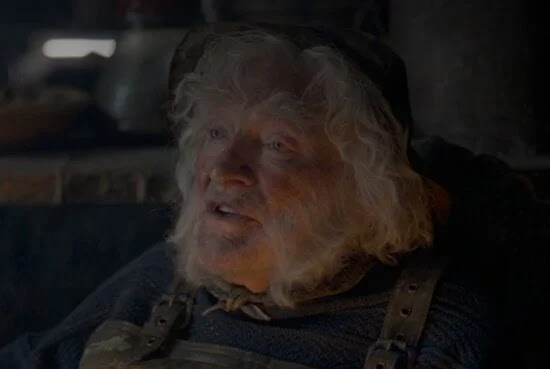
TV's Best Beard
It's...okay. The casting is pretty good. Warrick Davis, veteran actor, is a highlight; so is Amar Chadha-Patel (whose physical appearance will henceforth be the basis for ALL future D&D characters of Yours Truly, regardless of class). Tony Revolori is (surprisingly) growing on me. Elle Bamber and Ruby Cruz seem...fine, I guess (as actors), but their characters (especially "Kit") are written in a way that I find extremely obnoxious and grating. 

*sigh* I'm just not into teenage angst...and it is (for me) incredibly unbelievable given the circumstances in which the characters find themselves. They're just one step removed from "I miss my cell phone!"

Erin Kellyman seems to have already been typecast (after watching her in Solo and Falcon/Winter Soldier) and her emotional range seems...short. I can't tell if she's limited by the writing or her ability; probably a bit of both. But mainly her character ("Jade") is just...boring.

[I also hate Jade's sword; every time I see it on screen I just think of how unbalanced it looks and how many fingers she'd lose trying to wield it. Like, ALL her fingers]

The bit parts and cameos, however, are stellar: Joanne Whalley, Hannah Waddingham (!), Christian Slater (!!), Kevin Pollack, and Julian Glover all make the most of their brief appearances in the show. Adwoah Aboah, too, isn't half-bad, especially considering (I think) that this is her first on-screen acting role (?!). Every time some random human character appears on-screen with more than a few lines of dialogue/action, it's generally a much needed shot-in-the-arm for the series.

The show, Willow, is D&D. But not the good kind of D&D.

"I was once a paladin..."
(yeah, back before
your alignment change)
It was my (non-gamer) wife who first pointed this out to us: "This is just like Dungeons & Dragons!" You have the adventuring party composed of a pretty standard lineup (a couple fighters, a couple spell-casters, a thief, etc) going on an adventure, fighting monsters, looking for treasure, delving dungeons, finding secret doors, facing traps and obstacles, etc.  The classes and tropes are easily recognizable. First level adventurers off on their first real adventure.

But this isn't father's (or geezer blog writer's) D&D. This is D&D with DRAMA, where every character has a "secret past" (backstory!) or closeted skeleton or SOMEthing that is going to get worked out 'on-screen' over the course of the series. 

Because the STORY by itself (um, something-something about saving the world) isn't COMPELLING (or compelling enough) by itself. No. We need to resolve our unrequited love and deal with our murdered siblings and find out about our secret family members and blah, blah, blah.

Hey, remember the original film? Remember the backstory for Madmartigan? Or Sorsha? Or the titular Willow himself? Remember the film explaining why this farmer was interested in becoming a sorcerer? Or how he learned to be conjurer of cheap tricks? Or why his neighbors didn't like him despite him (apparently) being a normal hardworking family man with a decent farm, a doting wife, happy little children? Remember where he received his unbounded courage and tenacity and moral compass? 

No? Oh, yeah: because there wasn't any. Neither was there for ANY of the characters. You have a character, you have a situation (the plot of the film) and GO. Is Sorsha trying to work out mother-daughter issues with evil queen Bavmorda, some rivalry with General Kael, or moon over some lost lover or other? Perhaps. If she is (and that's all certainly possible for the actor to keep in the back of her mind) it isn't played out on the screen...it is simply background motivation that directs the character's actions.

Here (in the series) we have all this...um..."stuff," that is constantly being dragged out and examined and being discussed and worked on. And I suppose that if the series was about one featured character or protagonist that would be okay. But it's not about a single character...it's an ensemble cast, with six or seven (depending on whether or not you count the brother/prince) main figures, all of whom are (more-or-less) on the same team. 

So...this need to share spotlight time (and film minutes) on their various mental and emotional turmoils just feels like...I don't know...some sort of narcissism.

[which, you know, is kind of emblematic of late edition D&D ain't it?]

That and the anachronisms inherent in the show. Not just the dialogue which (again) sounds like typical teenage petulance and smack talk but the damn music. No need for a sweeping, epic score transporting us to a fantasy world like, say, Game of Thrones or Rings of Power or...heck...the original film Willow on which the series is based. Crimson & Clover? Enter Sandman? Good Vibrations?!

Um...okay. So this is a teen fantasy show that would have been at home on the CW ten years ago. Except with a bigger budget.

"Dude, JB is as big a curmudgeon about his fantasy television shows as he is about his D&D! Hey, Old Man, there's more than one 'right way' to create elf-magic-fiction content!" Sure, yep, absolutely. But, watching Willow would be a lot less jarring, less cringe-worthy experience if expectations weren't set based on the very IP the showrunners decided to mine.

[heck, I'm not even dinging the show for sometimes poor pacing and occasional crap editing. Well, I wasn't till now]

"JB, that Willow movie was 35 years ago! Expectations have changed about YA fantasy! Why do you think D&D had to evolve?!"

Mm-hmm. Indeed. Welcome to fantasy in 2023.

Now, I realize that I am hopelessly behind the times when it comes to modern (well, post-modern) sensibilities, but for me...geezer that I am...adventure fantasy is about something like escapism from the petty squabbles and dramas of daily life. Take the character "Kit" for example and her quest to find her father (which seems far more important to her than her initial quest to find her brother)...I'd say there's more than a few people out there who have had their fathers exit their lives in some fashion, and hardly ever is it for some 'heroic' reason. It might be inoperable cancer or a sudden heart attack that leaves a kid half-orphaned at the age of 12 (as happened to my buddy, Matt) . It might be the guy walking out on the family with no warning (as happened to my brother and I). Hell, I know two different guys (John and Ben) who BOTH had their fathers leave their mothers for some hippy-dippy commune before either was born. 

This kind of thing happens. Worse things happen with parents. I knew a guy who had a real problem with his mother because she sold his younger sister to a couple guys in order to finance her crack habit. There's some fucked up shit in this world...lots of reasons to want to escape reality for an hour or two on a regular basis. Do I need to have a fantasy setting, with magic and monsters, in order to deep dive the emotional wreck of human relationships? Isn't there therapy for that? Support groups to join? Books to read? 

How about a subplot related to the story at hand: for example, Kit has been trained to be a warrior/knight type but pretty obviously has been pretty sheltered up until the events of the story...how about dealing with the emotional baggage that comes with murdering sentient beings for the first time in her life.  She's having a semi-polite conversation with some hairy trolls one moment, and then whetting her blade in their lifeblood the next. And everything is still like "Oh no big deal. How can I get my romantic interest to not still be mad at me?" 

But, okay, maybe we want to de-emphasize the emotional consequences of murder and bloodletting in this "fun adventure fantasy." How about dealing with the issues of duty versus love with regard to her betrothal to a political ally who happens to be on the same adventure with her as with her lover. Instead, she pretty much ignores the man she's supposed to marry, as opposed to A) trying to get to know him, or B) arranging for some fatal "accident" that will remove an unwanted complication from her life. You know?

[can you tell I'm not a big fan of the writing?]

This is adolescent, narcissistic D&D. We are on an adventure, killing monsters, surviving dangers, and working on our (young adult) emotional baggage. We don't have to particularly get along or cooperate to survive because, you know, "plot immunity." Not a lot of fear or real stress, except for the stress of meeting expectations ("Will I ever learn magic? Jeez I was happier just baking muffins!"). This isn't swords & sorcery...it's High School Musical with Ren-Fair costumes and less singing. 

*sigh* I know...I'm an ass. My family's enjoying the show, and the thing has some stylish touches that are entertaining (really dig on the bits of psychedelia scattered about the series, as well as the occasional steampunk flourishes). But, for the most part, its style without substance. The substance of the show is...for my taste...rather bland. Not "vanilla" (pains have been taken to make the show very NON-vanilla in fantasy terms). But bland. 

Ah, well. One episode (I think) to go. We'll see if the finale changes my mind.

Monday, January 9, 2023

WAAAGH!

Yesterday, as my son and I left Lumen Field following the Seahawks' overtime victory over the Rams, I started chanting, 'Let's go Lions! Let's go Lions!' and it didn't take long before other voices joined me in the cheer. Not that I had any faith in Detroit's ability to beat the Packers at Lambeau.

And then the Lions, with nothing to play for but pride, curb-stomped Green Bay.

I'm not a man to have the optimism of Ted Lasso (or Pete Carroll)....I've been disappointed just a few too many times over the years.  But I don't consider myself to be a true cynic, either. And so I was surprised at how, well, stunned I was that the Lions actually won, sending the Seahawks back to the playoffs for the 10th time in the 13 year tenure of Seattle's head coach. Amazing. 


While I'm not one to shy away from admitting when I'm wrong (I'm actually well-practiced in it), my assessment of Smith's quarterbacking ability has not changed all that much. Still: as a pro bowler this year (triple amazing!) I feel I have to assign his Blood Bowl profile some extra skills. It's only fair to upgrade him to 'star player' status when he was one of the stars of the team this season.

Here he is:

Geno Smith
#7 Ork Thrower  MA 5 ST 3 AG 3 AV 9
Skills: Leader, Pass, Safe Throw, Sure Hands

It's been a good year for Geno, for the team, and for Seattle sports fans.  The Russel Wilson era has finished, the Pete Carroll era continues. Looking forward to Saturday's playoff game versus the Niners.

Have a good week everyone. D&D posts to resume shortly.

Go Seahawks!
; )