Saturday, July 4, 2009

O Paladin...


(sung to the tune of O Canada)

Hey, it may seem like I am knocking the whole Paladin class (and I guess I probably am when I write how "unnecessary" it is).  But I really bear the guy no ill will...at least, I bear no ill will to the players that like the class. I know they are out there in droves.

But I'll tell you that after reading JM's latest interview over at Grognardia, it's hard for me to knock most of the stuff published by TSR, at least in the early years.  This game was a brand-spanking new creation, and things that got thrown in were done because the player-creators thought they were fun, or made sense, or filled some niche in their game play.  And that's not something I can fault.

However, let me just explain how I see the paladin from my older, more mature "design eyes:"

OD&D: no idea (I don't own Supplement I).

AD&D and BECMI: simply a more bad-assy fighter; behavioral restrictions off-set by cool powers. Displaces the "normal" fighter with the proper attribute scores.

B/X: non-existent.

D20+: a lame-assy fighter; behavioral restrictions off-set by a handful of powers, far out-classed in fighting by actual fighters.

I've already explained why I think the game already has a "Holy/Unholy Warrior" type character in the Cleric class.  But let's look at the inspiration for the paladin, the Danish warrior Holger Carlsen from Poul Anderson's book Three Hearts and Three Lions.

Without going into the entire plot, Holger turns out to be a kind of eternal champion and one of Charlemagne's paladins.  He is very spiritual, as a chivalric knight should be, though not above "baser instincts."  He is very courageous, though not without fear (he sometimes prays to help him master his own fears).  People ask him to "lay hands on them" for blessings with the usual medieval respect (I won't say superstition) for the holy power of a chivalric knight (this doesn't actually heal anyone).  He is a tremendous fighter.  He has a very intelligent horse that mysteriously appeared for him, just as he himself mysteriously appeared when the people were in need of his help (in other words, it's no more supernatural than he is). He is a tremendous warrior.

If you wanted to 'port Holger Carlsen (Ogier the Dane) into a D&D game he would be a fighter. A lawful good fighter, perhaps, one with a high strength, wisdom, and charisma certainly, but a fighter.  There ain't nothing supernatural about him, unless it is the interest that cosmic powers have in him that cause him to be whisked between worlds and dimensions.  He's just a stand-up guy with a weird history plunged into a weird situation.  Oh, and he's a great fighter.

What about his prayers making him "fearless?" Isn't that kind of like he paladin's immunity to fear? No, my friends, that is called a saving throw.  Or good role-playing.

He seems robust and healthy! That is called a good constitution, not an immunity to disease.

No there's no point to adding a paladin to the game when one already has a Holy Warrior (i.e. the cleric)...UNLESS, you want your holy warrior to be more warrior and less cleric.  Which is what's been done.  I say, just let the clerics carry swords (and force them to follow the strict tenets of their faith to retain their powers) and there's no need to add paladins to the campaign...except, perhaps as a Level Title for the Cleric class.

There will be no paladin class in my B/X Companion. Sorry.

Friday, July 3, 2009

Summertime Gaming


It's July 3rd, I am off work (since the 4th is on a Saturday) and I am enjoying a caffeinated beverage at the Neptune in Greenwood while my wife gets a pedicure with her buddy downtown and outside people are enjoying the beautiful summer weather. Nevermind the drought, a quarter of the people in Seattle are transplants these days, and they are grateful for the break from the gray.

For me, it reminds me of my youth (what doesn't, really?) when I'd be out of school with no responsibilities besides taking the occasional family road trip and mowing the lawn weekly. The rest of my time was spent lazing around, riding my bike, reading books, and playing D&D with my friends and family.

So right now I'm thinking of my old S1: Tomb of Horrors module. I've been reading other folks posts around the internet and to me it feels like part of the Rite of Passage of an RPG blogger to share one's experiences with this fabled module. Guess it's my turn.

Originally, I was going to title this post "I Was A Killer DM," which would have been accurate if not literally truthful. I was, in point of fact, a real asshole at times, but I didn't collect deceased PC's character sheets for a "trophy folder," nor did I force players to rip them up (truth be told, I was always unhappy when someone crumpled a character sheet...to me, D&D is a game and characters could always "come back" from the dead. Maybe I read too many Marvel comics).

Tomb of Horrors is one of those problematic modules that have so many love-hate issues for so many people. I'm one of 'em, I guess. I've owned this module pretty much since its issue with the Green cover, and I actually own TWO of them (one came in a four-pack back in the day...imagine my disappointment with only getting 3 "new" modules). There were a couple things that really attracted me to it.

#1 It had a cool cover (which leads to disappointment #1...where the hell is the big lich-like monster? Argh!).

#2 It was the highest level module available at the time (levels 10-14).

The reputation for this module as a "meat grinder" was completely unknown to me. If it has that reputation with me now, it is only because it did grind so many characters. As one of my oldest modules, I must have run it at least four times, and perhaps as many as six. I can clearly remember running it for some players on the living room floor of my parent's house one sunny, summer afternoon like today, and another time running it on a dark evening in Port Angeles for some cousins (around Christmas time). I know that at least two different groups made it to the end, but I don't remember any single group slaying Acerak...though, I may have mis-placed a memory or two (we'll get to that).

The thing is, as a self-taught DM, I used these modules as models for games. I had never played D&D with high level characters before; now I found my players HAD high level characters, and how was I going to challenge them appropriately. I, of course, figured that published modules should be the yardstick to use for these things...can you believe Tomb of Horrors as an example of a 10-14 level dungeon? But for me it seemed appropriate.

And my players, back in the day, were fairly saavy. I take umbrage with the idea that it is an "impossible" or "unbeatable" (mostly, see below). A party that sticks to the task and follows the clues in the demi-lich's poem is going to be able to find his tomb...perhaps with a little luck. As I said, at least two groups I know made it that far.

Ha! I remember the first pair to do it...

Generally, players did NOT use their own "spoon fed from level one" characters for the game. Although I was a "killer DM" after the first couple practice runs, I decided that informed consent was appropriate: it's pretty hard, and the treasure take is a bit paltry for the challenge level. The module has pre-gen characters in the back, and many players (especially for one-off runs like with my Port Angeles cousins) would use these characters...often without even bothering to pick names. Hey, they were some level 14 characters in there! Right on!

Anyway, one of the first groups DID include a regular player...Bladehawk (I've mentioned her before) a high level fighter that had been able to thwart (or at least survive) all the modules and dungeons I had thrown at her. My brother was riding shotgun with one of the level 14 NPCs (a cleric, I think?), and together they were able to make it to the end.

Not without some set-backs. Early on they got the "naked teleportation treatment;" pretty low-down considering the amount of gear that high level characters possess. However, BH and company (I believe my friend Jason was also playing, but he ended up leaving either shortly before or after his character perished) decided to head back into the tomb. No way the 'Hawk was leaving her dancing defender sword behind! They found the false tomb, exited, figured out their mistake and went back a third time, this time making it all the way to the true tomb.

Pretty bedraggled by this point, my brother's character turned the key the wrong way and blew himself 10' into the air. Nearly dead, they finally found Acerak...and had no way to kill the bastard.

This leads to Disappointment #2 with the adventure (and it is the most prominent disappointment). The methods for killing a demi-lich are simply too obscure. Unless you've owned the module, or read the description in the Monster Manual II, there's no way for a player to know any of the creature's vulnerabilities. It's not like a vampire, based on folklore. It's not simple enough to be slain with a magic weapon or fire like some undead. It is immune to turning. And there's nothing in Acerak's riddle that provides a clue as to how the thing can be destroyed.

Maybe an especially kind DM would allow a legend lore, commune, or contact other plane spell to provide the info. But the high level players in my games made it through most of their adventuring careers without resorting to these mechanical "give me a hint" spells, and they didn't think to use them now. When running the module, I usually encourage the players to take a paladin in the party (at least as an NPC) if only to give them a fighting chance at the end, but it's never worked out that I remember.

With Bladehawk and her companion...well, her companion ended up getting his soul sucked out (whadya' know), BH decided discretion was the better part of valor, she grabbed her sword and left the dungeon and the demi-lich behind. She was the only party member to survive.

I've seen party members crushed by the juggernaut, burned to death in the sliding corridor, and lose members to poison and annihilation. I had at least one guy (or pair of guys) squashed to jelly against the roof of the dungeon. I don't remember anyone getting incinerated in a fiery explosion, but I know at least one guy snuffed it with the crown and scepter (I think that was Jason's thief character).

So has anyone actually succeeded? I think Alejandro may have with the help of the magic-user Arioch. But this doesn't really count...after all Arioch was an NPC magic-user, so having him cast contact other plane and stocking the correct spells for the demi-lich is basically handing the players a giant crutch. I don't remember if I did this or not, but it sounds like something I would have. I certainly WAS a killer DM, but towards the end of my DMing career, I know I was getting tired of the Tomb of Horrors being un-defeated, grinning like an old skull from my shelf of gaming products. I'll have to ask my brother if he remembers.
Thursday, July 2, 2009

Rise And Be Healed!


Here I was going to write about my Tomb of Horror experiences, but I guess I should throw in another two cents on D&D spirituality by continuing my discussion of the power of the Normal Man.  In this instance, the Divine power of the Normal Man.

Anyone ever play Bard's Tale?

Bard's Tale is pretty obviously based on Dungeons & Dragons.  You put together a party of adventurers, each one being a different race-class combo with a set of familiar stats, levels, experience points, hit points, etc.  All very recognizable to the average old school D&D player.

However, there are a couple major differences.  One is the lack of any kind of "alignment" characteristic. Another is the complete absence of any kind of cleric/priest class. Oh, there's a paladin, and at least a couple of the magic-user classes (there are four: conjurer, magician, sorcerer, and wizard) have spells that "heal" or duplicate traditional clerical spells.  But otherwise, there's no "representative of the gods;" at least not one that joins your adventuring party.

That doesn't mean the game is atheistic or even monotheistic...there are temples and shrines all over the game, each dedicated to a particular patron god.  Mechanically speaking, they are all the same: they serve the purpose of providing healing services (to any who can afford it). Turning stone to flesh, removing poison, exorcising possession, raising from the dead...all can be had at any temple for a price.

Who the heck are these guys?  They're not adventurers or you'd certainly hire one to tag along. They seem fairly amoral...as long as you have the gold, they aren't asking where you got your wounds, and if you don't have the money, they'll turn you away at the door, nevermind the "good" quest your on. Alignment be damned!  What kind of alignment do you think the "Thief Temple" has?

Earlier, I wrote how I believe the whole idea as clerics as church leaders is kind of a big steaming pile.  Clerics (the class, not the clerk) are the crusading templars, the holy (and unholy) zealot warriors, the champions of their patron deity.  This isn't St. Augustine...this is Joan of Arc, people. A little crazy, and powered by faith.

In my last post, I expounded a bit on the place of the Normal Man in relation to the PC adventurer.  Basically, the adventuring character (PC or NPC) is an exceptional person that learns from experience, growing in power, while the Normal Man does not.  He may be a peasant or a blacksmith, a soldier or a king, a (B/X) bard or a beggar...with the appropriate skills for his profession. But he does not have the extra combat abilities that are gained from surviving perilous adventures.

What's to say that the high priests and ministers of the temples aren't Normal Men as well? I mean, the bishop that ministers to his diocese is no different from the stay-at-home duke; that is, he is too concerned with the day-to-day administrations of running a church to run around slaying dragons.

I think the problem most people have with accepting this paradigm shift (and it requires one...ever since 2nd edition AD&D started calling clerics "priests," or ever since performingthe Marriage sacrament became a clerical spell in the Unearthed Arcana) is in fact the way spell acquisition is handled.

Clerics gain spells by going up in level, therefore priests (who, in a fantasy world, provide magical healing through spells) must also rise in level.  Otherwise, whose performing all those raise dead miracles at the local shrine?

Um...how about the deity of the shrine worshippers?

How about THIS for an idea.  Temples are staffed by Normal Men...from the lowliest acolyte on the totem pole to the Pontiff himself (or Reverend Mother...whatever).  All are Normal Men, who know only the duties and doctrines of their god(s).  However, by following the doctrines of their deity, they can ask for intercessions on behalf of the faithful (either the truly devout or those willing to pay for the service).  The deity grants the healing power (removes a curse, cures the lycanthropy, heals the disease), and the adventurers are free to go their merry way.

Doesn't that make more sense?

It does to me.  Clerics are the crusading knights; it's difficult for them to learn powerful healing spells (they have to be "high level" to raise the dead), because they spend so much of their time in weapons and combat training.  Yet once they do prove their faith to their god, they have the miraculous ability to perform healing magic "in the field."  The Normal Men (priests) of the temple need to perform long-winded rituals, light incense, sacrifice animals...all that stuff that takes time and money.  The cleric (paladin-templar) simply "lays on hands" and the miracle is granted!

Now onto the subject of alignment.  I already said that the idea of evil in a D&D world is kind of absurd: there are player character actions which can be compassionate or reprehensible, and there are opponents of player characters that may or may not be intending harm (see detect evil in the B/X game).  There is a third piece to be considered when it comes to deities, one I think Raggi gets pretty close to in his last couple posts even if he doesn't make it quite this succinct:

Deities don't care about alignment. Deities care about people following the tenets of their (the deities) doctrine.

The road to Hell is paved with good intentions after all. Look at all the discussions around the blogs about how following Good sometimes means killing a lot of people (normally considered Bad, right?). Good, bad, that's not what the deity cares about.  At least not in D&D which draws so much from old swords and sorcery literature.  And those use Old Time religion of the pre-Vatican II variety.  If you don't show up for Church, you're going to hell (unless you atone).  If you sleep with the wrong person, there's going to be a stoning (with rocks, friends).  And that sacrifice to Ares or Zeus better be the right type and at the right time or you can count on a plague or drought smiting your land.

Wow, hopefully I got my point across.  This post is getting long, so I better sign off and let it stew a bit.


Another Reason For A B/X Companion

Much as I like Frank Mentzer’s Companion set, especially the dominion rules, there are some problems with it…especially with the dominion rules!

I’ll get to this in a moment.

This has to do with something I’ve been gradually realizing the more I’ve delved into Old School gaming: D&D, as originally conceived and written, is a game of heroes. And I mean old school heroes (not Old School heroes…ugh! Semantics!). The game doesn’t need any help for the PCs to be heroic…they don’t need extra feats and kewl powers unless one wants to play a comic book super hero-type fantasy game (and doesn’t White Wolf already have Exalted?).

Here’s what I’m talking about: PCs (and any NPC with a “class” that gains “levels”) are EXCEPTIONAL individuals. Non-exceptional elves are HD 1 elves; dwarves and Halflings are the same, just like orcs, goblins, etc. Non-exceptional humans (i.e. humans that are not clerics, fighters, magic-users, or thieves) are classified as Normal Men.

And that’s it…that’s all you need to run a whole D&D society (at least in B/X). A Normal Man could be a priest, or a sage, or the ruler of a kingdom. But if he’s not an EXCEPTIONAL character (like ALL the player characters are!) then he’s still easily killed by a single sword thrust or arrow. HE AIN’T SO IMPORTANT TO THE STORY THAT HE NEEDS TO FIGHT AND ENDURE LIKE A HERO.

The PCs are heroic. Their capacity to learn from experience, gain levels, and increase their hit points give them the ability to take on more and last longer than other Normal Men. The increase of their abilities (i.e. increase of effectiveness) shows them as heroic forces to be reckoned with. Whereas a Normal Man priest could ward off a vampire with a holy symbol, a heroic crusading cleric can actually force the vampire to run away…or explode into dust! THAT’S power.

All the sentient humanoids have exceptional individuals…these are the “chiefs” and “sub-chiefs” present in monster descriptions. Only PC races (human, dwarf, elf, and Halfling in B/X) have the ability to actually “gain levels;” that is why they’re player allowed races.

(yes, I realize that may not have been the designer’s original intent, but that’s how it works out)

There’s no need to have bullshit like 3rd level nobles, 6th level blacksmiths, or 12th level peasants. There’s no need to stat up every monster with PC-like stats. This is needless complication and actually TAKES AWAY from the heroism of the player characters! Or forces them to need extra “super hero” abilities to make them “more special” (this ties into a related topic: Why I Hate Skills).

But let’s bring this back to Mentzer and his excellent Companion set. Excellent that is, except for the inflation of Normal Men to the ranks of PCs. And by this I mean, the rules whereby rulers of dominions gain experience points for sitting on their duffs.

At first glance, this seems like a reasonable set of rules. There’s a trade-off between characters that go out and adventure for experience and treasure (especially magic items), and those that stay home and “take care of business.” Shouldn’t these landowners gain something? And it’s not like they gain XP from ALL revenue. Mainly, just what they tax (and taxes affect Domain Confidence levels…tricky balance there). What’s wrong with this?

Well, a couple things , both part of the same whole: the de-protagonising of Player Characters. Here’s why:

#1 NPC Inflation: Check out the example tournament-feast adventure. Look at all those knights and lords, all high level fighters. That’s a lot of clout to be plying the lists…enough to make the PCs small by comparison. It’s one thing to have a high level EXCEPTIONAL person as an antagonist; it’s quite another thing to have all individuals born to nobility to be “exceptional” by dint of collecting taxes over the years. Not every ruler has carved out an empire with his or her own sword arm. Some are Normal Men born to their position.

#2 Retirement = Death: Only PCs that are actually out adventuring should be gaining XP, not guys sitting at home, handling the administration of a barony or county. Exceptional abilities are honed in the field (or the dungeon), and in life-and-death situations…not through practice with the castle guard captain. Once an adventurer has settled down, he (or she) has effectively been “put out to pasture.” A cleric’s deity isn’t going to see the need to reward the cleric with more powerful spells (why would the ruler cleric need them?) and a thief guildmaster is going to be too busy counting his money and training apprentices to improve himself. Complacency does NOT give a person better saving throws…hell, it should probably PENALIZE them.

#3 Encouraged Lethargy: From a design point of view, experience points (XP) are a reward mechanic. In RPGs, reward mechanics encourage and inspire behavior in play. If one can grow in power and wealth with little risk by NOT adventuring, then manning one’s throne will take precedence over heroic questing. Less risk means less loss means more gain…and a fairly boring campaign.

If a group wants to run a dominion based campaign where everything is intrigue and political maneuvering and little “adventuring” that’s fine…but characters have no need for “high levels” in that kind of game anyway (there’s little direct confrontation, save perhaps through proxies or assassins, and most armed conflict will be through war machines and military maneuvers). The rewards for characters in a game aristocratic intrigue are wealth, land, power, influence, and favors…NOT hit points, attack rolls, extra spells, or better saving throws! An individual (PC or NPC) can be feared or respected by the weight of his or her actions, not simply their “level.”

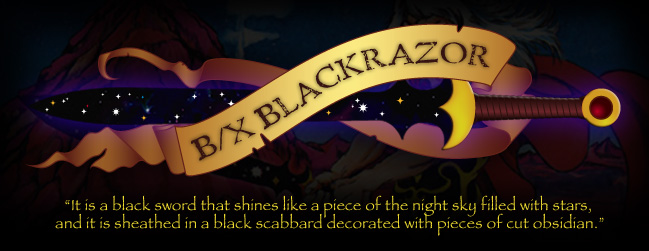
Thrall of Blackrazor

Ha! I've never played the D&D Miniatures game (nor even the old New Chainmail)...but if I did I would make sure my warband contained this guy.

'Course, I might need to greenstuff the miniature to give hime a new hairstyle...and a new Blackrazor. What's up with Jimmy Neutron wielding Grazz't's sword?

Yeah, Thrall of Blackrazor...it's just such a cool name I'd be tempted to buy the piece simply for posterity. But it would probable be better to do my own conversion of an Alejandro-type piece (I found an illustration of the fighter the other day...once I figure out how to hook my scanner to my Mac, I'll upload the picture...).

I never did use miniatures in D&D games...that was one "option" I never put into practice. I always preferred the abstract "battlefield of the imagination." Even with 3rd edition it was a challenge to convert my game play to the tactical map...but I was a lot better than the "old school" players I tried with whom I tried 3E gaming...they were fairly awful with 5' steps and attacks of opportunity and such, and I was constantly getting the better of them through sheer maneuver. This is probably due to my years of WH40K, Blood Bowl, and Mordheim game play (started long after I stopped playing RPGs regularly).

Hmm...I wonder if I could convert Blackrazor's Thrall to a Mordheim sell-sword. Sounds like my upcoming 4-day weekend (sorry, jokers!) will have a project or two for me to pursue.

Wednesday, July 1, 2009

Anyone Else Read This?


So it wasn't more than a couple days ago that I googled "Blackrazor" and found that my blog had made it to the first page.  Sadly, today I see that I have once again fallen to page two, behind comic book police forces and cellular phone adds.

Obviously, I have been neglecting my own subject matter.

And so it is I return to the subject of returning to the adventure of our youth, White Plume Mountain.  Or to be more specific, one author's novelization of WPM: Paul Kidd.

Let me say right from the start, I was not a huge fan of this book.  In fact, I sold it to a used book store (sorry, Kris...it was actually your book, I know) rather than keep it on the shelf (remember, I'm the guy that re-reads books multiple times?).  Just why I didn't like it, I'm trying hard to remember, so bear with me (I probably SHOULD re-read it, just for reference).

First off...well, strangely enough, I consider RPGs their own art form, different from such forms of artistic expression as literature, film, and comic books.  Similar to music or live theater, it is a collaborative art form. Like literature and film (and some types of music), RPGs tell stories. They're not always very good stories, but they are stories nevertheless.  The game rules which facilitate play, are much like musical instruments, or word processors, or the cameras used by a film crew.  Some RPGs better facilitate a "story-telling agenda" by directly addressing premise (see the Forge for some good examples). Some, like B/X D&D only tell stories by "putting together the pieces of what happened" AFTER game play. 

(some versions of D&D simply railroad players into the works of fiction of other authors...see Dragon Lance and Ravenloft modules for examples)

Anyway, RPGs tell a specific type of story.  There's back and forth banter between the players (including the DM) at the table, there's social contract issues, there's decision-making about how things go down...all of which make perfect sense IN PLAY, but not necessarily anything that makes sense from a "real world" perspective.  An epic battle that involves whittling down someone's hit points or a fortunate saving throw at just the right time doesn't translate well into screen or prose...the adrenaline rush for the players (again, including the DM as a "player") is not there for the audience.

Which is not to say I don't like ALL novels based on RPGs.  In fact, I thought both Dragons of a Winter Night and Dragons of a Spring Dawning were pretty good, though this was after Weis and Hickman stopped writing the novels like expanded adventure modules (see the first of the Chronicles series to see what I'm talking about).

The difference for me is this: the Dragon Lance novels are based on an RPG's themes and rules.  White Plume Mountain is based on an adventure module.  The module is designed to be played...not to be written (and read) as straight fiction.

Does this make sense to anyone besides me?  I'm having a hard time thinking of a proper analogy.  I suppose it would be one thing to watch a hockey movie (i.e. "a movie about hockey"), another thing to watch the film Miracle on Ice, and a totally different thing to watch Miracle on Ice if you had been an actual player in that historic game, and the cast of characters looked nothing like the team you played with, and the names had all been changed, and the score was different, and...etc., etc..

Except even then you might consider it to be good entertainment...but you know the game is more fun to play than to read about.

But I actually enjoy reading stories of other peoples' D&D adventures...hell, I read the various examples in both the Moldvay Basic set and the AD&D DMG with relish.  I wouldn't mind reading a write-up of one party's adventures in White Plume Mountain, even multiple party's stories actually (now THAT would be cool...an anthology of short stories that all showcase different adventure groups tackling the same module. HA!).

But that's not what's in Kidd's book.  It has a fairly dour, bald ranger who's as annoying as Keldern.  Rather than an adventurer looking for fame and fortune he's got some bullshit about righting wrongs and administering "justice;" he even has a stupid name like "Justicar."  He's so obnoxious that his only adventuring companion is a...skinned animal?  And not much of a conversationalist.

There is some kind of faerie that seems like a HackMaster "pixie-faerie"...is this some sort of 2nd edition race I'm not aware of?  There's some sort of weird sub-plot with an erinyes...I don't know, it's all kind of hazy.

I do remember that in the climactic battle beyond "the inverted ziggurat," Keldern...um, "Justicar" manages to take out the erinyes even though she has Blackrazor and the ranger dead to rights.  Or not (if this was based on an actual game,  the DM was a real pansy).

Basically, it's unlike the novel is paced and written like a novel with bites of WPM thrown in for flavor.  If I want to revisit old school Greyhawk adventures in a novel form, it needs to be more than Vin Diesel mopping up. I want to see a party of adventurers.  I want to see the opposition between the DM and players.  I want to see PCs sweating...or dying...and not because of some diabolic sub-plot.

There are some parts of the book that were enjoyable: the high level characters clad in all their accoutrements and entourages I found both believable and scathingly funny.  Same goes for the wagon driver and his dry commentary and Boy Scout "Be Prepared" attitude (gotta' have a rope...).  While I didn't like her characterization, I thought the simple inclusion of an erinyes was pretty cool...nothing says 1st edition to me like a lesser devil from the original Monster Manual. 'Course, I don't remember if she had the rope of entanglement or the venomous dagger that is the erinyes's signature weapons.

Um...I liked that it was set in White Plume Mountain...

...and that's about it.  If memory serves (and I admit, it is not as infallible as I wish it were), I was most disgusted by the poor treatment of Blackrazor itself.  Now, I am definitely considering finding a (used) copy of the book for research.  I'd like to run a mock combat between old Justy and the Lady E.  Even as a 6+6 Hit Dice monster she should have been able to take him...especially as she sucked the souls out of a couple critters before actual engagement.  This is Blackrazor, folks!

Sure, reading how a protagonist dies may not be good literature or cinema, but it's GREAT gaming drama (ask ol' Black Dougal about that...forever enshrined in the Sacred Halls of the Fallen Adventurer, a little demi-plane of Valhalla).  

Plus, Kidd's book can better serve as a cautionary tale for young D&D players: you don't split off from your party and head solo with naught but a dog-skin, a pixie, and a torchbearer as back-up! Sheesh!


Gaah! Evil!


Maliszewski wrote that he doesn't generally reference other blogs as "we already pretty much read the same ones anyway."  That could be, but I for one, am a little new to the blogging game (I have made it to July...yay!) and could certainly stand some references.  

For example, I came across this, written in 2006 that might have saved me a lot of ranting posts had I read it first (things don't ALWAYS have to be re-stated).

And yet, here I go again.  I was already considering the composition on "evil D&D I have known" when I saw this, and this, oh...and this, too.  Probably as I write this, someone is posting something similar. Seems like people have "evil" on the brain these days (or I just don't have an original thought in my brain).

I can remember when I first played D&D, I simply equated Chaotic with "Evil." Later on, when I got my hands on AD&D and I wondered how I possibly could have been so deluded?  Obviously, being Chaotic simply meant "loving freedom" and being Lawful meant "being a stickler for rules;" neither necessitated a good or evil bent.

Prior to AD&D most every PC was Neutral in alignment (the few that were not were Lawful). Not that we were enforcing alignment strongly (no "bolts from the blue" or XP penalties for poor alignment play).  Players simply picked alignments that they felt generally described their attitude (when you're a kid, you're not interested in "playing in character;" you ARE the character, for the most part.  Except now you have a sword or can cast spells).  I think that kids, without pre-conceived notions of play, still realize "hmmm...I'm killing things and robbing gold; they may be evil, but I'm not particularly good."  At least, I'd like to think that this knowledge of right and wrong is inherent in kids.

Once we started playing AD&D, just about every PC was Chaotic in alignment...generally Chaotic Good or Chaotic Neutral, though there were at least a couple Chaotic Evil.  A lot of alignments were chosen based on what was allowed by a particular deity, as per DDG (for example, one fighter was Chaotic Evil mainly so as to be in synch with her patron Ares; it was rare that she had the opportunity or inclination to commit "acts of evil" or depravity).

Though there WERE acts of depravity.  Ripping someone's arm off and beating them to death with it? Check. Slapping a servant girl with gauntlets of ogre power and breaking her neck? Check. Sacrifice and enslavement of humans including children? Check.  Random castration and maiming for vengeance or the sheer "humor" of it? Check on both.  Blood sacrifice of fellow PCs to power artifacts? You better believe it.

These are all examples from memory that don't include the wanton slaying and looting that is a large part of any D&D campaign.  Even aside from the philosophical question of whether or not "dungeon delving" is morally repugnant, the players needed no additional impetus to commit acts of mayhem...this was not one or two snarky players, this was pretty much ALL of us at one time or another. And the DMs were even worse with both PCs and NPCs (throw rape, torture, and assorted destruction and disenfranchisement into the mix).

Part of this comes with teenagers and pre-teens simply "pushing boundaries" of what is or is not acceptable (without parental supervision to our games, pretty much nothing was off the table).  In many ways, this was our gamist tendencies ramped up a notch: "Can you take the heat? Are you going to step on up?"  The ones that couldn't often ended up the ones that took the abuse.  I believe I mentioned earlier that players never used paladins in our games...I don't think one would have lasted long if introduced.

Even the player whose main character was a Lawful Good cleric of Athena, also had the following "side characters:" a human assassin named Shadowspawn (after the Aspirin Thieves World character), a female drow fighter-cleric (evil), and a Chaotic Evil insane healer (some class pulled from a Dragon magazine if I remember correctly)...this latter, Father Cornelius didn't last long before the other party members emasculated him (literally) and put him to the sword.  And this was the guy who was supposed to act as the party medic!

At some point all of us wanted to experiment with what was possible in a game "only limited by the imagination."  Certainly, these things were nothing one could do in real life without going to jail (or getting lynched), and as far as I know none of us ended up in jail and we're all (relatively) productive members of society today.  It's strange how, as I've grown older, I find myself much less enamored with the sadistic potentials in role-playing, though whether that's because I've "grown up," look for something different, or have been influenced by society...well, who can say?

As far as the monsters and antagonists present in D&D, I really don't see "evil" only "opponents."  Whether someone is taking on a red dragon or a gold dragon, who cares what the alignment is...they're both sitting on a pile of treasure.  Lolth may be "chaotic evil" but what has she ever done to me that I'd seek to invade her plane (which a past character of mine did in Q1: Queen of the Demonweb Pits).  Nothing.  She exists in a vacuum until introduced as a plot objective...and even then she has only as much importance as one gives her (my character failed to kill Lolth, permanently or otherwise, but she did not "ravage the planet" or anything).

Alignment in Old School D&D...good, evil, or otherwise...doesn't mean much compared to the objectives introduced by the DM and the actions of the players themselves.  If an NPC ruler is torturing one of the PCs, who cares what his alignment or motivation is...the other PCs are going to stage a rescue for their buddy (if they like him) or not (if they don't).  Who cares that a dragon or archon is "good" in alignment...if it's guarding some needed quest item "unto death" than the PCs are going to kill it and find a way to justify their actions (maybe!) later.

This is yet another reason why I'm moving back to B/X play...in addition to everything else, I want to leave the whole question of good and evil out of the game.  Some monsters are of Chaos and many are Neutral, but alignment is only a question of whether you stand for a civilized order or not.  The cosmic throw-down version of alignment seems to best answer the question of the difference between Chaotic and Lawful clerics, and the alignment of certain magic swords or other enchanted items.  If not for these things, there'd be little need for alignment in the D&D world.