Wednesday, June 24, 2009

Arcana Unearthed


I know that various pet game systems, settings, or supplements are much maligned in the OS blogs; I myself have a personal loathing for 2nd Edition AD&D and the Forgotten Realms setting. However, in the spirit of full disclosure, I feel I must admit my own not-so-proud Achilles Heel: I absolutely LOVED Unearthed Arcana.

I’ve speculated before that I might be a bit of a closet munchkin, though in all honesty that’s not why I and my players were so enamored of the book. Three-quarters of my gaming group owned a copy of UA, even though few even had their own Monster Manual, DMG, or PHB. Here’s the skinny:

Reason #1: After years of playing B/X and AD&D, there was finally a new game supplement…not just a new cover or a new monster manual. This had spells, and classes, and magic items, etc..

Reason #2: It was a TRUE AD&D supplement…and by that, I mean it had the Gygax name stamped right on the cover.

Once my group started playing AD&D, we played ONLY AD&D (with some additional pieces from the Mentzer Companion rules). We didn’t run Judge’s Guild adventures or use supplements that were non-TSR. Dragon magazine and official supplements were our only tools for the game…after that, we could create our own adventures or random tables. TSR in general and Gygax in particular, were our final authorities in gaming.

So Gary’s Unearthed Arcana was a godsend (so to speak) for us. New OFFICIAL rules? You bet!

We also found it incredibly useful…I never played a game without it. We used pretty much every rule in the book: Comeliness? Check…in fact the half-orc became an extinct species after the advent of UA. New races? Check…grey elves, drow, mountain dwarves (only one…see Comeliness), and I’m guessing even a svirfneblin was created (though never played). New classes? Check, check, check…no one in our gaming group ever used a cavalier (we never liked goody-two-shoes paladins anyway, and we weren’t that impressed with the cavalier’s armor), but everyone had a thief-acrobat at some point, there was a hierophant druid that was a major NPC of our game, and my brother rolled up several barbarians.

New weapons and equipment…we used it all: whips, lassos, blow guns. One girl who was an occasional player insisted on getting a man-catcher for her fighter…”I’m gonna’ catch me a man!” she’d say, when she wasn’t swinging a two-handed sword. Heck, we even started using pole arms now that the UA showed us what the hell they looked like (ranseurs and spetums were particularly popular).

Most of the magic items got used at some point…Heward’s Handy Haversack and extendable magic quarterstaffs (see Thief-Acrobat) were BIG hits, as were Iron Bands of Bilaro/Robilar and the Prison of Zagyg (an artifact from S4?!). A lot of the new clerical spells were used, and teleport without error and chain lightning became mainstays of our magic-user’s arsenal.

We used Table VI to create new characters…finally, no need to fudge rolls if you wanted to play a Ranger or Monk! Everyone knew their character’s social status, birth order, and legitimacy of birth…all of which led to good natured, in-character (and out-of!) ribbing.

Of course, the unarmed combat rules were a lot less messy than the ones presented in the DMG. We actually started using brawls and grappling in our games with the UA system. Previously, all enemies had been put to the sword.

Yeah…we used it all. The DMs of our group certainly did when designing adventures. I’d go so far as to say it was more useful than both the Find Folio and the Monster Manual II put together. I mean, how many times did YOU put a Grel into a dungeon? Or a Modron? Though the threat of a Tarrasque was ever present, I’m not sure the players ever encountered one.

No, the Unearthed Arcana was great. The increases to level maxiumums provided “topped out” demi-human characters with a new reason for adventuring, and the new rules and goodies provided all of us with a fresh set of tools to make our game play fun. God bless it!

Tuesday, June 23, 2009

Tales of the Greeks


Just finished watching Jason and the Argonauts.  Since I appear to be the only insomniac blogging about D&D on the West Coast, figured I'd post a quick one while the rest o y'all were sleeping. Don't worry...I still have to get up around 6am tomorrow.

Pretty cool movie, not sure if I've seen it before (if so, it was a looooong time ago).  I love the Greeks and their mythology, though I'm more up on my gods and goddesses than all the various heroes (oh, I know the basics, but I get some of the stories confused...for example, Jason and Odysseus).

Anyway, I'm pretty sure it was Heracles that killed the hydra, and not with a stab to the heart. Cinematic license, I guess.

I loved the portrayal of the Greek deities in the film...even moreso than in Clash of the Titans (which I also recently watched). Ray Harryhausen's films endow these mythic beings with such...I don't know...humanity while still retaining their regal divinity.  

I thought Hera's  character in Jason was especially well-done; so often she is portrayed as one cold-hearted bitch.  Here she was playful, loving, and motherly as well as a soul-mate-spouse of Zeus.  Usually she's shown as a nagging shrew, or a vengeful "wronged woman" (which she often is); but it was nice to be reminded why she's still Zeus's queen.

Awhile back I wrote a series of articles for Vault of Pandius detailing the use of Greek Olympians and Elder Titans in a BECMI campaign.  I was feeling a little miffed that the Greeks (my favorite pantheon of gods) had been so snubbed by the Wrath of the Immortals set.  Perhaps I'll make them available here...at least they have some stats for Grecian Immortals (as well as how to use them in a Mystarran campaign).

BTW: for those who are unaware of Pandius, it is the top resource for non-product BECMI stuff on the Net.  Lots of good stuff there for folks who like Mystarra and the Known World, including a bunch of (bleah!) conversions to 3E. I strongly recommend all B/X players check it out if they haven't already!

Alejandro (Part 2)

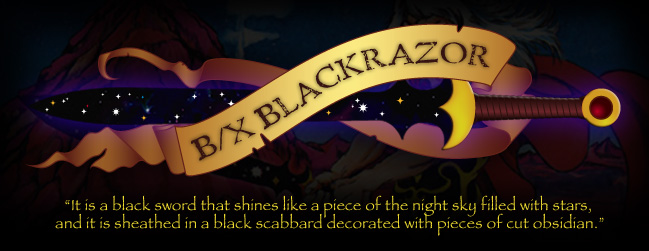
Decided it was time to write more tales of the black sword…enough with these Elf and Northman posts!

By the black sword, I am speaking of Blackrazor of course, not Kas’s wretched short sword, nor Elric’s infamous rune blade.

“Big Al,” my brother’s fighter character Alejandro, was the only player that ever wielded Blackrazor on a long term basis. Why no one else chose to retain the blade after winning it from White Plume Mountain, I can only guess. Certainly, not all characters could meet the alignment restriction. Some perhaps wanted the reward money for turning it in. Others already possessed weapons they considered “better;” I’m just not sure any realized the potential power of the weapon.

Let us recall what Blackrazor does…it sucks souls and transfers life force from its victims to its wielder (I won’t say “its master,” as with an infinitely increasing ego, no mortal could ever truly master Blackrazor). This transferred life force comes in two forms: increased hit points, and temporary bonus levels “to fighting ability.”

Back in the day, fighters shared many of the same responsibilities that a tank/warrior in the World of Warcraft has…namely: absorb damage and draw “aggro.” Of course, drawing aggro in the Old School is accomplished a little differently…instead of having special skills or talents that “taunt an opponent” you simply do the old fashion thing: hit him as hard and as often as possible so that he refuses to ignore you.

Blackrazor’s special powers turn the AD&D fighter into the ultimate tank. Increasing hit points make the fighter a huge “meat shield” even without clerical support. Increasing combat ability means more attacks per round + more chance to hit which = more damage output. Coupled with the threat of soul-sucking, a wielder of Blackrazor is going to draw a LOT of “aggro.” And that’s even before adding the haste ability.

If memory serves, Blackrazor was the last weapon found by Alejandro and Co. in their conquest of White Plume Mountain. Whelm was discovered first, though for the life of me I can’t remember how they dealt with Ctenmiir…I am guessing Isaiah got a lucky “turn” roll and they looted the hammer before he returned. Wave was next, and while they got “blown out the top” (as is wont to happen in that encounter), they returned shortly thereafter for the Blackrazor.

No one ever believes the “doughty hobbit warrior” is anything other than a disguised monster and a trap. Never. Whether this is due to the Venger-Halfling switcheroo in an early episode of the Dungeons and Dragons cartoon, or just the sheer un-likelihood of encountering a friendly henchman-type in the middle of a volcano/dungeon…who knows? The point is, everyone draws down and attacks this lil’ guy at first opportunity. He’s neither a great surprise, nor a great challenge.

Anyway, pulling Blackrazor last, many adventuring parties may never actually get the chance to use it in battle and see what its capable of…perhaps this is why they have no qualms parting with it after the adventure. In the case of Al’s party, they decided to accompany Nix and Nox to the Indoctrination Center before leaving (I'm guessing my brother and his friend had no idea the meaning of the word “indoctrination” or its shady implications). Once they realized things were no good (I had to make up a mage Keraptis on the fly), they fought their way out…and here Blackrazor first demonstrated its power.

Alejandro must have already been around 8th to 10th level when the party began their siege on WPM. I’m pretty sure he was in the 9-10 range as the party had recently completed the Desert of Desolation series (I3-I5) withOUT the aid of Blackrazor. Can you imagine my brother’s surprise as he downed one of the Efreeti? Suddenly Alejandro rocketed to 19th or 20th level fighting ability (an efreet having 10 hit dice) plus an extra 40-50 hit points. Even if Alejandro had gained an ACTUAL ten levels, he would have only gained 30 hit points (3 per level after 9th). A fighter’s fighting ability maxes out at level 17 with two attacks per round and the best “to hit” rank in AD&D. Activating Blackrazor’s haste function at this point simply turned him into a one-man killing machine (4 attacks per round!).

Once Blackrazor had “fed” on a single opponent, the contest was over. Keraptis may have killed one or two henchmen before Al downed his first efreet, but the fighter was unstoppable thereafter. Big Al exited the Mountain with an effective level around 35 or so and probably double his normal max hit points.

There was no way Alejandro would relinquish Blackrazor after this first taste of power. A new legend had been born.

Light Summer Reading

Just finished my Boyer book at lunch, and decided to pick up a few more "soft" novels for break time reading (I've been trying to take the bus more to cram more reading time, but lately I've been having to carpool (and drive) leaving me little time for heavy texts). I saw these in the picture window of Eliott Bay Books, and picked 'em up for about $2.95 apiece:

  • The Last Unicorn (Peter S. Beagle)...it's been a long while since I've read this one, but it's a classic fantasy tale, and quite depressing (as was the film). Great reading for summers in Montana on Flathead Lake, where my wife and I will be going in late August.
  • The Elves and the Otterskin (Elizabeth Boyer)...what a find! More tales of the Alfar, and this is one I haven't read. I hope it's as good as The Wizard and the Warlord.
  • The Time of the Dark (Barbara Hambly)...I have no idea what this one is about, but it shares the same cover art as the old Role Aids AD&D Module Fez III: Angry Wizard. I wonder if they're related? I always did like that illustration....
  • The Sword and the Sorcerer (Norman Winski)..."now a major motion picture!" Yes, THAT Sword & Sorcerer. I don't know if the book came first or if it's an adaptation of the film, but I felt it was my duty to find out, seeing as how I've watched the movie at least a dozen times. Now that I have the book, I'll never need to watch it again!

Ha! Wait till I do the B/X version of Talon's triple-bladed monstrosity. I actually already had plans for that post (Magic Swords I Have Known #10), but as my original timeline of posts have already been de-railed, I may need to move it up in the order.

: )

B/X Norse


While I may not have got much blogging done over the weekend, I was able to get a fair bit of reading done…so much so that I’m nearly done with The Wizard and the Warlord; I’m either on the last or the second to last chapter. Which means I’ll be able to get back to Asimov’s Foundation series soon (which I am reading for the FIRST time). Loads o inspiration there for a Traveler campaign.

Anyway, reading the tales of the Alfar with an eye to incorporating the setting into B/X has been mui useful. Here’s the Norse treatment of magic and elves (Alfar) according to Boyer (a scholar of Scandinavian folklore):

  • Alfar (elves) exist in a faerie realm parallel to the mundane.
  • Elves are inherently magical (can do cantrip-type magic), but need training to pull off spectacular effects.
  • Wizards are simply well trained in the use of magic, though magical training does not preclude them from fighting with arms and armor.
  • Aside from their inherent magical nature, elves have the same foibles and weaknesses of human folk.
  • Elves have neither “infravision” nor particularly keen senses, and they don’t speak a plethora of languages (presumably they speak Old Germanic).

The alfar are divided into two types: the ljosalfar (light elves) and the dokkalfar (dark elves). The dokkalfar cannot stand the light of day, although dokkalfar still require torches and fire for light and warmth, and there are dokkalfar farmers who (presumably) must toil a bit in daylight to grow crops(?). This latter may simply be an inconsistency in the author's writing, as elsewhere the dokkalfar are depicted as living in underground caves/ruins/forts. In at least one section, it states the dokkalfar are slain instantly by sunlight, being turned to stone as with trolls, though this never occurs in the book and may simply be a rumor.

The ljosalfar have no such weakness to darkness, they simply prefer the sun. Because of their war with the dark elves, they often patrol at night hunting trolls and dokkalfar.

Anyway, one thing that this book has gotten me thinking about, even more than “another way to perceive elves,” is the Magic-User class in general. Wizards in Boyer's book are one of three types:

- The young apprentice learning the trade.
- The mature wizard, powerful and arrogant.
- The wizened old man, knowledgeable but weakened with age.

These first two are portrayed as hale and hearty individuals…often relying on spells, but certainly capable of wielding swords in their defense (and presumably able to wear armor…little description of armor other than an occasional helm is ever given in the book anyway). To me, these “hale and hearty” wizards are much more like the Elf class of B/X D&D. It takes them longer to train in combat than a fighting man (because of their studies) but they are perfectly capable of learning spells like a magic-user AND fighting like a fighter.

The Magic-User class on the other hand represents the wizened old wizard or witch…the reason he can’t use armor or weapons has nothing to do with his class and everything to do with his AGE. His staff he leans on for support, his dagger is for cutting his meat or occasionally of use in ritual magic. He is too old to march long distances wearing armor…or even carrying a heavy backpack! And yet the aged wizard often has more magical might due to his time spent studying and poring over old tomes and scrolls.

There was a line in one of Robert Aspirin’s early Myth books that I always found noteworthy…Aahz is telling Skeeve (his apprentice) that the reason humans don’t study both magic AND fighting is that their life spans are so short, they rarely have time to master one, let alone both.

Certainly, this would be true of anyone “working the Elf class;” a race with a long life span (say, an actual elf) could accumulate more XP over hundreds of years than the average human adventuring as an “Elf.”

In a game world that mimicked the Norse mythology of Boyer’s books, one could make the following adjustments:

  • Limit classes to Cleric, Dwarf, Fighter, Thief, Wizard (Elf), Aged Wizard (Magic-User). Non-dwarves may be mundane (scipling), ljosalfar, or dokkalfar.
  • No class may progress past level 14.
  • Only dwarves and dokkalfar have infravision; dokkalfar are precluded from using fire/light magic and suffer -1 to all rolls when in sunlight.
  • Languages are determined by Intelligence only, not race (though dwarves will always speak both Common and Dwarvish); there is no “elvish” language; reading runes is a separate language.
  • Norse Trolls = Bugbears (use bugbear stats rather than troll stats) and are rather plentiful. They die in sunlight (turned to stone).
  • Magic items are rare and often have "strings attached" (curses or conditions).
  • Limited armor (no such thing as plate mail).

After going through this exercise, I actually feel less incentive to change the Elf class in normal B/X play. I still like the “heroic elf” character; something between Tolkien's vision and the Alfar for a straight D&D campaign, but the above adjustments are good for a true Northern Reaches campaign of the Norse variety. While Boyer doesn't get into religious differences, the Norse gods are definitely present (dwarves, for example, consider themselves the "chosen priests of Thor") and I feel no qualms in including clerics of Odin (Law) or Loki (Chaos) or any of the other Aesir and Vanir.

This is pretty cool, actually...perhaps I'll do a similar treatment of Tolkien for B/X.


Monday, June 22, 2009

Elven Role-Models (One More Rant)


Out of both the Modvay and Cook rule sets, out of all the BECMI rule books, and out of all the pages of Rules Cyclopedia, there is exactly one decent picture that represents (for me) the Elf class...it's the elf in the center of the Willingham illustration on page B1 of the Moldvay Basic Set.

Yep...that's her. That's it. Nada mas worth mentioning out of 11 rule books and one rules compilation. Pretty crappy, if you ask me.

See, the thing is with these RPG things is that the game world is all imaginary.  There's no board to the game, there are no illustrated cards, there's certainly no animated computer images.  Everything is in your mind.

And because everything comes from one's imagination, the artwork and illustrations in the game books are immensely important.  They are what inspire and fire the imagination.

I am sure that one of the reasons D20 and later editions of D&D have sold as well as they have, despite being such shoddy products play-wise, is the beautiful illustrations in the game books.  3rd edition was great...hell, the half-elf bard was cool enough to make me want to revisit the bard class, 2nd fiddle character though it was. The 4th edition has art that's even better.  The slick production values allow the artists' visions to jump off the page and into the minds of players and DMs alike.

So why O why isn't there more than one decent picture of an Elf in the whole of the "Basic D&D" line?

C'mon...sell me on playing one of these chumps!  What's the matter?  Is it that the illustrators couldn't think of how to make the Elf lord...well, "lordly?"  Certainly they couldn't in the MCI rule sets...and they couldn't do it in the Rules Cyclopedia either.  Where's the Elf in full plate with a two-handed sword?  Nope...they're all scantily clad and wielding bows.

The image I've posted is the only one that does justice to the elf class.  Here we see an obviously low level elf, only fitting as the illustration is the title page for the Basic set.  She's probably wearing the best armor she can afford...chain mail, perhaps magical.  She's armed with both a shield and a sword; no bow in sight. 

Even if she hasn't already used her handful of spells for the day, she knows better than to try them against a red dragon...sleep and magic missile will do little, and shield won't protect her any better than her armor and saving throw versus dragon breath. Quite possibly she is the leader of the party, seeing as how she is in the forefront of the engagement.  She is not hanging in the back casting spells or shooting arrows, but rather taking the brunt of the dragon's fire while the rest of the party supports her. 

Yes, her goose is probably cooked...but at least she'll go down swinging.

Similar to the halfling illustrations in the Cook Expert set, this Elf looks both courageous and determined. She's not backing down, she's not running for cover, she's not holding back.  The dragon is unfortunately awake, not surprised, and has rolled a nasty Reaction roll.  The whole party's quite possibly dead (their magic-user's got nothing better in the tank then throwing fireball at a red dragon?).  But the Elf is going to uphold her honor.  Of the bunch, she's probably the first one that'll deserve to be raised by the local healers.  

I'd like to see more of her type in the game world.

In Praise of Mentzer's Expert Set


This is a particular post I've been wanting to add for awhile.  Of course, I needed to upload the image so folks would know what I'm talking about, which means waiting till I had access to my own computer.

I think Mentzer's Expert set is great.  Quite frankly, I believe I actually enjoy it more than the Companion rules, which were fairly indispensable to my original gaming group (though we were using them with AD&D...hey, it's not our fault AD&D blew off dominion and mass combat rules!).

As already stated in earlier posts, my first exposure to D&D was through the Moldvay/Cook Basic and Expert sets, subsequently followed by AD&D, subsequently followed by a decade+ hiatus from D&D in any form.  However, I did go out of my way to collect all the BECMI books somewhere down the road...around my mid-20's actually. I did this for a specific reason: I wanted to complete the promise that was begun in Moldvay/Cook's B/X rules. 

So I purchased the Companion set, I got my hands on the Master set, and eventually I found the Immortal rules.  I figured I didn't need the Red and Blue boxes, 'cause I already had B/X, right?

Wrong.

Mentzer's Expert rules is pretty much the exact same as Cook's Expert set with only a few exceptions.  One of those exceptions are more clerical spells (up through 6th level, I believe where the Cook set only goes through 5th).  The additional spells presented in the Mentzer Expert set are present nowhere else (well, except the Rules Cyclopedia, of course).  Once I discovered this, I made the decision to acquire both Mentzer's blue set and red set.  Heck, I even got a second copy of the Expert book (total of two) as back-up.

I've never been disappointed.

Mentzer's Expert set is only 64 pages long, the same length as the original, and nicely layed out.  Threshold and its sample adventures are greatly appreciated, and I can say (from a player's point of view) that it makes an excellent base of operations for a starting adventuring party...my old AD&D DM made plenty of use of Threshold, and I never realized she was getting it from her Expert set.  

In 64 pages, Mentzer manages to include everything from the Cook edition (with the exception of the crowbar...dammit, why not, Frank?) plus adds extras like Threshhold and the additional spells.

It also has killer artwork.  I like Elmore's artwork anyway (I was a big fan of SnarfQuest), but it can be grating and cheesy at times, especially the some of the stuff in the Red box set (a little too Dragon Lance if you ask me).  The stuff in the Expert set, though, is pure gold in my opinion.  The cover is my favorite of the BECMI series (possibly tied with the Companion cover).  The character classes (especially the cleric pictures) look like "experts," not novices, and not high level master-types.  For me, they really capture the mid-level adventurer...and make me want to play any of the classes.

Well, with one caveat...the pictures of the demi-humans. There really aren't any, at least none that are prominent.  The one visible elf in the entire book is the girl on page 58...and she's not wearing armor?  Excuse me, this is D&D, not AD&D...elves (especially mid-level ones) are going to be wearing at least leather or chain mail, don't you think?  Why else are they splitting half their XP?  What's with the Peter Pan outfit, missy?  The dwarves are a little better, while the only halfling I could find (in the crowd on page 37) is...well, he doesn't inspire ME to play a halfling!

I don't know if the decision to concentrate the illustrations on "cool pictures of humans" was deliberate or not, but if the intention was to draw focus to the humans (for the high level play described in the Companion and Master sets), then mission accomplished.  By the time I get to the fat midgets and leafy tights of the Companion set, I'm probably NOT going to be playing a demi-human.  Thanks, guys.

But back to the praise...with regard to everything EXCEPT the demi-human artwork and the missing crowbar (and some blatant typos...yes, I'm looking at you page 23), I find Mentzer to be at least equal to the Cook set.  Erol Otis and those other OS artists rock, but Mentzer's Expert book is the one I use as my "working" rule book when I'm playing B/X these days.  It's great.