Showing posts with label ua. Show all posts

Saturday, December 21, 2024

The Rundown

I am writing this Thursday morning, though I don't intend it to post up till Sunday. The holidays have caught up to me and my time over the next week or so will be fairly occupied.  Yes, I'll be checking emails, responding to comments, etc. but I doubt I'm going to get much posted before the New Year, unless it's a "happy Christmas" missive or something.

In deep diving the Unearthed Arcana these last several weeks (has it only been since Thanksgiving? My how time flies...) I've found that it isn't all bad. True, it is mostly bad, but that's still better than I expected to find. It's interesting to wonder if my pained memories of UA's indulgences (so awful in implementation 'back in the day') may have been part of what prevented me from taking up the torch of 1E far sooner than I have...that those indiscretions of my youth may have left a bad taste in my mouth putting me off the AD&D game and leading me down the road of B/X play, obstinately turning up my nose at the better game for years. If so...how sad. It's certainly true that my enthusiasm and fire for 1st edition was stoked immensely with the realization that I could simply play the game with the original (three) core books, that I need not adapt the entirety of the line.

Well, whatever...water under the bridge. I am immensely enjoying my game as is, and...

[pause, as I take my first sips of coffee in some nine days. Apologies: I got back from Mexico on the 8th, fully addicted to caffeine and had to (once again) go through the rigamarole of breaking my dependency. This involved quite a bit of excruciating withdrawal symptoms as well as a seven day juice fast...I just started eating again yesterday, but this my first morning with a freshly brewed pot of decaf. Mmmm...]

*ahem* As I was saying, my game is immensely satisfying the way it is now, but with my new broad-minded attitude, I think it no great crime to add the good from the UA to my campaign.  Keeping in mind that I have yet to examine...let alone curate...the spell lists and magic items; here is the current list of items from the Unearthed Arcana that I will henceforth be including (presented in the order in which they appear):
  • (page 8) Non-human characters who choose to single-class in a class that they could normally be multi-classed have their maximum level limits raised by +2.
  • (page 13) Armor permitted updated as per the table. New weapons, where added, as per the table. Old weapons (thieves using short bows?): NO. New weapons that are not a part of the campaign (staff slings and hand crossbows, for example) are ignored. Yes, assassins can use a shield and still perform an assassination attempt. Likewise, if a character wishes to pick up and keep a weapon they can't use, I'm generally okay with it.
  • (page 14) No cavaliers. However, see my new Bogatyr class which WILL be part of the campaign. They are generally only found east of the Cascades.
  • (page 17) I don't mind there being a 15th level Grand Druid (good luck getting to three million experience points!). My own campaign setting has a 14th level Great Druid, but I'm sure he/she is beholden to a higher power...there's always someone bigger. No hierophants as of yet (and maybe never).
  • (page 18) Barbarians are being added, as much a "sub-race" of humans as a "sub class" of fighters. The class is largely unchanged from how it appears, save that there are no attribute requirements for entry. In my campaign, there aren't many "barbarian tribes;" you'll find them in the frozen lands to the north (British Columbia), in some of the deeper jungles to the south (Oregon), and in the mountains of the Idaho Deathlands (to the east)...basically, the farther away you get from "civilization" (Washington State) the more barbaric the humans you'll find. 0-level human types the barbarian replaces in the MM (cavemen, dervishes, nomads, and tribesman, etc.) remain 0-level, d6 hit point type creatures. NOTE: a barbarian may only receive x.p. from a "sold" magic item if it is an item they could normally use (as per the table on page 20). Otherwise, the barbarian receives NO SHARE in the x.p. gained by the party (though they may give the barbarian a cut of the money received).
  • (page 22) Ranger's "giant class" opponents updated as listed. No other changes to the ranger from its appearance in the PHB.
  • (page 22) Thief ability armor adjustments for wearing armor other than leather now added.
  • (page 23) Thief-Acrobats now added, as written.
  • (page 26) Field plate (as per the DMG) remains a part of the game, but is not available for purchase in every one-horse town. All new weapons added, with the EXCEPT for the hand crossbow and staff sling (both are Drow weapons, first appearing in the D-series of modules; perhaps they are available for purchase/learning in the Underdark). I see no reason to include the buckler...isn't that just a "small wood shield?"...but the spiked buckler is okay.
  • (page 27) New weapons get their bonuses. As there is no "full plate" armor, only AC adjustments to 1 are considered. Full plate may be added in the future as "jousting plate" or "tournament plate" but it will be bulky armor and have a movement rate of 6". "Field plate" is the fitted plate armor that is worn on the battlefield for real combat.
  • (pages 28-31) All spells will need to be reviewed before being implemented. When choosing spells to cast, players are restricted to spells found in the PHB. All UA spells will require spell research to acquire, though they may be found on spell scrolls or in certain grimoires (see S4: The Lost Caverns of Tsojcanth). No cantrips.
  • (page 72) "Appendix VI" of the WotC re-print. As stated, armor penalties are implemented as listed. Thieves and their subclasses may NOT perform "thief skills" when wearing armor heavier than studded or elfin chain. Bards wearing magical chainmail are penalized as if wearing elfin chain. All multi-class options are ignored in favor of the (standard) PHB lists.
  • (page 75) Armor and encumbrance for new armors as per table. Field plate provides no bonus other than a high armor class (if "jousting plate" is permitted, the same will hold true)...no "damage absorption."
  • (page 77-78) New weapons as described with the exceptions already listed.
  • (page 79) I am still deciding how to use/implement spell books in my campaign.
  • (page 80) Illusionists acquire spells as per the DMG; there is no read illusionist magic in my game and no such spell is required to read illusionist spells/scrolls. There are no cantrips.
  • (page 80) Cost of magic-user/illusionist spell casting: these rates are a little low (in my opinion), but they form a good starting basis for negotiation.
  • (page 82) Combat penalties in darkness are adopted. Ignore all references to faerie fire (spell is used as per the PHB). 
  • (page 84-106) New magic items will be reviewed as needed, although magical field plate, full plate, and elfin chain should all be cut from the lists...sorry!
I have not yet reviewed the appendices. My base impulse is to ignore Appendix Q: Weaponless Combat (I'm happy with the DMG, thank you very much), but Appendix R: Non-Lethal Combat looks interesting. I do not allow demi-human clerics as PCs, nor do I care much about their gods, so Roger Moore's Appendix S: Non-Human Deities is absolutely worthless to me...it's just crap filler. Appendix T: Pole Arm Nomenclature (from Dragon Magazine #22!) is helpful but provides no actual game mechanics.

Aaaaand...that's all she wrote. Happy holidays, folks!

Tuesday, December 17, 2024

*sigh* Cavaliers

This post is going to address several "bad ideas" found in the UA;  I mean, might as well get them all out of the way at once, right?

Weapon specialization is a VERY bad idea...it falls under the category of "how much have you been drinking, Gary?" Len Lakofka first introduced the idea of an archery specialist (character class) along with a lot of really crunch missile fire rules in Dragon #45; it's not terrible (we had an archer PC back in the campaign of my youth), but most of the crunch only serves to slow down the game (worrying about whether actions occur at the beginning, middle, or end of a segment? Come on, dude...we don't need to micromanage more than we already do). And it introduced the idea of "point blank range" (*sigh*), to Gygax and got him thinking about OTHER possible types of specialists. Hence, weapon specialization.

One can see the appeal in an existing (long run) campaign: high level fighters are watching all the other character classes get fancy spells and abilities for achieving those 'teen' levels and, yet, they're doing the same-old-same-old since they picked up that frost brand sword back at 6th level; 'where's the love?' they cry. Unfortunately, implementing weapon specialization wrecks the combat economy from the very beginning. A normal party generally has a potential damage output of 4.5 damage per PC (roughly) with the high strength fighter types making up for low damage wizard types. But this goes off the rails with weapon specialization and (especially) double specialization (both available at 1st level). A fighter with an 18+ STR (up to 18/50...achievable for most fighter types) and double specialization in longsword strikes with a +4 to hit and +6 to damage, as well as getting two attacks every other round...a potential average damage output of 21 points in round one (25 against a large sized creature). Average hit points for an ogre are 19...for a bugbear 15. First level fighters should not be able to chop down gnolls and hobgoblins with impunity, and if the DM ups the challenge of monsters thrown at 1st level groups, the other party members (who have the same combat abilities as ever) are far more likely to suffer. Plus PBR rules means that same fighter, even without double specialization had a potential average damage output 34 damage per round, due to double damage and adding STR bonuses (all part of the PBR rules) for shots fired within 30'. Back when we used the UA rules in my youth, we saw a LOT of bow specialists. 

Bad Len. Bad, bad, bad. 

Next terrible idea to discuss is the Method V version of generating ability scores. Ostensibly restricted for human characters, this method of ability generation all but assures you of achieving the scores you need to take whatever particular class you desire to play. Having also used this a bit when the UA first came out, I can tell you the PCs end up having a LOT of high scores, not just in the ones they need...far more so than any of the other methods found in the DMG. Rolling 9, 8, 7, 6, and 5 dice (and taking the best three) for the five most important abilities of a particular class are going to give you much better scores than the DMG's Method I which has you roll 4d6 across the board...and who cares if MV makes you roll 3d6 for one (ONE!) ability score when that ability is, more often-than-not, Comeliness?

Method V appears to have originated in Dragon #63 with the introduction of the barbarian class. Originally, the barbarian had NO minimum ability qualifiers (probably a good thing, considering it's supposed to replace normal man types like the nomad, caveman, tribesman, etc. in the MM), but instead determined its abilities through a new method: 9d6 for STR, 8d6 for CON, 7d6 for DEX, 3d6 for INT and CHA, and 4d4 for WIS. The sea change here, however, is the choosing of the class before rolling the dice (i.e. before seeing if the player has achieved the dice rolls needing to qualify for the class). Gygax discusses this decision in Dragon #67:
A few wondered why a decision to be a barbarian character had to be made prior to rolling dice for attribute scores. The answer is simple: The game is based on role-playing principles, and it is easier to do so with a course determined in the first place. Method I of Generation of Ability Scores encourages the player to choose a character profession from a predisposition rather than dice determined statistics. It is but a step removed from there to deciding on play as a barbarian subclass fighter and rolling dice accordingly. Frank Mentzer suggests that the 4d6 system could be employed with minimum score requirements of 16 strength and constitution, 15 dexterity, and a maximum wisdom of 15. That will work, but it seems to beg the question. Playing as a barbarian is a determined choice, not as one of several possibilities -- or a mere afterthought. This is a part of the whole concept...

...In all truth, the sub-class is not too powerful. It is, in fact, under-powered unless some very good rolls are gained in the areas of strength, dexterity, and constitution. To have real prospects for long-range play, the character must have 18, 16, and 17 respectively. That, Gentle Readers, is why they are given 9d6, 7d7, and 8d6 for those categories. A low-level barbarian has a better than average chance of survival without such high rolls, but at higher level, he or she is not going to do well unless strength, dexterity, and constitution combine to give high hit points, low armor class, and superior punishment potential.
Indeed. So the lesson, Gary, is "don't play a barbarian if you can't roll the high stats," NOT 'give the players the ability to play whatever they want.' Sorry. After 40+ years of game play (more than Gygax had at the time he was writing), I've seen what coddling does to one's game. That ain't the way to go.

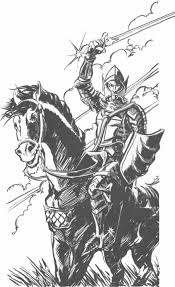
So, now we turn our attention to the cavalier...a class that may have had an interesting kernel of an idea, but then worked hard to make it work with these other concepts (like weapon specialization) to its overall detriment.

I mean, that's sugar-coating things. The class is a travesty.

Here's what you get with the cavalier in its FINAL presentation (i.e. as it appears in the UA):
  • It is not a subclass of fighter, but its own class...and it puts the paladin subclass beneath its banner (more on this later).
  • STR, DEX, CON of 15+, INT and WIS of 10+ to enter; however, Method V in the UA makes these quite easy requirements (with 8d6, 7d6, and 9d6 dice rolls).
  • Open to humans, high elves, gray elves, dark elves, and half-elves with NO LEVEL LIMITS. That's right...you don't like being limited to 6th or 8th level fighter? Be a cavalier (who still fights and saves as a fighter), and achieve whatever level you like.
  • Hit points start at 1d10+3 at 1st level with D10s up through 10th (note: fighters only go through 9th) with +3 hit points thereafter (same as a fighter).
  • Progressive "to hit bonuses" in lance plus two other weapons of choice (one a sword, the other a horseman weapon like a flail or military pick). This bonus starts at +1 and increases by +1 every six levels with no end. This bonus can be used defensively as part of a parry (and can also "parry" with a shield at the same time). Cavaliers may make multiple attacks as a fighter 5 levels higher than their actual level with these weapons of choice. High elves would be advised to select longsword.
  • A bunch of horse/riding related skills that no one cares about in a dungeon.
  • Each of STR, DEX, and CON are assigned a % number (similar to exceptional strength) and every level the cavalier rolls 2d10 and adds the number to the current percentage; when the number exceeds 00, they move up to the next number, eventually topping out at 18/00 in all three abilities (the percentage doesn't mean anything for DEX and CON, but an 18 is still an 18). How this interacts with the CON reduction from a raise dead/resurrection spell isn't stated, nor if these numbers can exceed racial maximums.
  • Immunity to fear, +2 bonus to save versus illusions, a bunch of 90% chances to resist mind-effecting magic, etc.
  • Ability to continue functioning at negative hit points (though cannot continue to fight).
All pretty swell, right? Like a fighter except more powerful (and potentially a LOT more powerful). You'd probably be thinking, man, that cavalier cat must need a ton of experience points to level up (as the barbarian does). HA! That's the kicker, son...the cavalier needs LESS x.p. to level up than the 'lowly' fighter...at least into the teens:

9th level --    fighter: 250,001       cavalier: 220,001
10th level --  fighter: 500,001       cavalier: 300,001
11th level --  fighter: 750,001       cavalier: 600,001
12th level --  fighter: 1,000,001    cavalier: 900,001
13th level --  fighter: 1,250,001    cavalier: 1,200,001
14th level --  fighter: 1,500,001    cavalier: 1,500,001

So, sure...after reaching 14th level, the cavalier will need more x.p. per level than the fighter to level up (an extra 50K per). But his 300K per level is still a damn sight faster than the ranger (325K), paladin (350K), or barbarian (500K). And to out-pace the fighter? With all those additional benefits? I mean, just what the hell was Gygax thinking? 

Elf? Probably.
This cavalier class makes the fighter all but meaningless in an AD&D campaign. It wrenches humans from their proper place at the center of the universe and allows elves to be ascendant (what is the incentive to play a human cavalier over a high elf?). Of course, it also radically changes the paladin class (now open to half-elves) giving the pally ALL the abilities of the cavalier PLUS all the abilities of the paladin (listed in the PHB), plus the ability to raise the character's CHA every level in the exact same manner as their STR, DEX, and CON.

This is not a complaint about "power creep;" this is simply stabbing the character economy in the heart with a red-hot (lance) point.

SO, NO. There will be no cavalier in my games, sir...not in the way they are detailed in the UA. Neither will there be any weapon specialization or "point blank range" for missile fire. Nor, will I be using Method V for the generation of ability scores (I remember axing that waaay back in high school...and having fierce arguments with my brother over the subject). No sir!  Method I will (continue to) do us just fine.

However, I might very well include the barbarian class...I'll just remove all minimum ability requirements for entry. You want to be a sickly member of your tribe/village, that's okay by me.
; )


Friday, December 6, 2024

Demi-Human Expansion

 AKA Cocaine Is A Hell Of A Drug

From Dragon Magazine, issue #96:
With expansion of the deities in the WORLD OF GREYHAWK Fantasy Setting, and by Roger Moore's articles herein so as to provide for the races of demi-humankind, there is no logical reason to exclude their clerics from play...

Elves, half-elves, and halflings -- being more nature-oriented than the other demi-human races -- deserve admission to the druid sub-class. Elves are now unlimited in their ability to rise in levels within the druidical ranks, just as half-elves have always been...

Elves are no longer prohibited from entering the ranger sub-class with the same reasoning that now opens the druid sub-class to that race....
E. Gary Gygax, April 1985

In the previous Dragon (issue #95), Gygax had outlined new level maximums for the various demi- and semi-human races for characters that have exceptional ability scores, i.e. prime requisites that exceed the normal maximum for their species. As such an event only occurs through the use of powerful magic (for example dozens or scores of wish spells), I see no problem with extending levels for those rare circumstances. 

Likewise, I have even less problem with the new rule that allows single-classed non-humans to boost their maximum level by +2 in a class that they could normally multi-class with (for example, an elven magic-user or dwarven fighter). This is sensible and a nice bennie for non-humans that seek to "focus" in a particular profession. An excellent addition to the game, while still allowing humans to maintain their place in the PC hierarchy by dint of their "unlimited potential."

SO...see those last two paragraphs? One thing: non-obtrusive. Second thing: good and welcome.

Now, let's talk about everything else. Because Gary seems to have been all coked up when he tweaked out the rest of this mess.
Players and DMs alike should take note of an impotant new rule change which is alluded to herein: player characters can be members of certain demi-human sub-races that are not permitted to PCs by the rules in the Players Handbook -- namely, the valley elf, grugach, drow, duergar, and svirfneblin. More will be said about this new development in subsequent articles. For now, however, players who choose to have drow, duergar, or svirfneblin characters should heed this general stricture: The alignment of such a player character may be of any sort, but daylight adventuring must be severely curtailed due to the nature of these creatures. Without special eye protection and clothing, these three demi-human types will suffer slight problems and sickness due to exposure to sunlight. 
No, Gary. No. No. No.

No, you cannot give players to play powerful demi-humans...creatures originally designed to provide additional challenge to high level PCs with their extra special abilities. Creatures with built-in magic resistance or natural spell powers or the capability of summoning elemental monsters regardless of class. No, Gary. You are high, man. You are NOT thinking straight.

Unfortunately, however, the drugs would continue to flow all the way through the publication of the Unearthed Arcana, when the final blow would be struck to the balance of non-human class relations:
The cavalier class is not listed on the tables for elves and half-elves, and the bard class is not listed on the table for half-elves, because level advancement in either of those classes is unlimited to any character with the requisite ability scores to qualify for the class.
Fucking cocaine, man. 

Anyone unfamiliar with the cavalier class as it appears in the UA will have to wait for the next post in this series to understand just how crap-tastic it is to give elves unlimited class advancement in a class that's...basically...a better fighter. That such a character could also be, say, a drow with a bunch of bonus bennies is a friggin' travesty. Oh Noes! So sad I have a -2 penalty to hit in daylight...we're exploring dungeons, jackass! If I'm getting into fights in town, there's already something wrong!

*sigh*

But let's talk about some of the more subtle problems here. Letting non-humans into the ranger and druid class is a thumbing of the nose at the (unstated) wold-building inherent in the original work. Rangers are not "woodsy heroes of good" (and even if they were, why the hell would a DROW get to be one?)...rather they are AVENGING KILLER HUMANS that hunt and murder the humanoids that threaten humankind. That rangers operate in the wilderness is because THAT'S WHERE THEY FIND THEIR PREY.  It's not the "civilized" ork or goblin that they're protecting (human) people from...it's the roaming bands of cannibalistic hostiles that would otherwise overwhelm fragile humanity. Regardless of your take on alignment, forcing rangers to be "good" places them in direct opposition to the listed (evil) alignment of their quarry.

And druids? Do we not remember what these are and where they came from?
DRUIDS:  These men are priests of a neutral-type religion, and as such they differ in armor class and hit dice, as well as in movement capability, and are a combination of clerics/magic-users...they will generally (70%) be accompanied by a number of barbaric followers....
From Supplement I, Greyhawk
...They are more closely attuned to Nature, serving as its priests rather than serving some other deity... Druids have an obligation to protect woodland animals and plants, especially trees. Unlike the obligation of lawful and good types towards others of this sort, the tendencu of druids will be to punish those who destroy their charges, rather than risk their own lives to actually save the threatened animal or plant. Druids will not slay an animal if it can be avoided, and they can never willingly or deliberately destroy a copse, woods or forest -- no matter how enchanted or evil it may be -- although they may attempt to modify such a place with their own magicks.
From Supplement III, Eldritch Wizardry

As explained in the PHB: "Druids can be visualized as medieval cousins of what the ancient Celtic sect of Druids would have become had it survived the Roman conquest."  These are very HUMAN  characters, aligned with neutrality/nature, not the frolicking Chaotic Good elves feasting on freshly hunted deer. If anything, druids and elves would probably live in a state of polite distance (if not Cold War style hostility), each in their own section of the forest...if not different forests altogether. That half-elves can beliong to the druid class (and the druidic-based bard class) speaks more to their human nature than any elvish part of their blood.  The same reason, really, that they can become rangers (although lacking the unlimited leveling potential of a fully human ranger). 

It's part of the neat thing about half-elves: they get more OPTIONS than an elf. Now you're giving me no reason to play a half-elf at all...except as a bard (and interestingly enough, all the half-elves in the campaign of my youth were bards, including my own PC). 

And thus a new trope was born...of elven archer-y rangers and leafy-pantsed druids. Man, it always bugged me the way 3.0 portrayed rangers and druids as elves, and now I know why (though I guess that's not as bad as dragonborn paladins...). Still, if you're going to allow elves to become rangers "by the same reasoning" that gives them unlimited druid access, why not go all the way and let halflings play giant-killer, too? What? They can't shoot a bow?

Idiocy.

Of course NOW ("officially") halflings can become CLERICS...something that wasn't allowed in the PHB (even for NPCs). And, why? Because Roger Moore came up with some demi-human deities for a specific campaign setting, that Gary wanted to throw his editor a bone (and some royalties) by using them as filler in the new UA book. AND he (Gary) extended the maximum clerical level obtainable by non-humans (PC and NPC alike) to the point that a dwarf or elf with 18 wisdom (not even a number requiring wish magic!) can obtain double-digit (!!) levels of experience...while the poor half-elf can't get higher than 8!

That's right: a dwarf cleric can reach a higher level of cleric than they can fighter. Cocaine.

Okay, again, understand the original world-building of the game. Originally, ONLY HUMANS COULD BE CLERICS...of the adventuring sort. Yes, you could find dwarf and elf clerics (see their monster description in Supplement I: Greyhawk), because it makes sense that a demihuman population worships their own gods and have their own priests. But those clerics were of limited ability: 

On the other hand half-elves, since their inception, have always been allowed to earn levels as an adventuring cleric: presumably because of their human nature. That they could not advance very high showed how their elven half limited their ability to advance within the (human/adventuring) church...even though they could make up for it through multi-classing (half-elves with OPTIONS had the largest number of multi-class possibilities of any race in the PHB). It is this same elven nature (presumably) that prevented the character from being a paladin (originally) even though they wee human enough to take up the mantle of ranger. 

[yet another reason why the UA's allowance of half-elf paladins is such a slap in the face]

Similarly, half-orcs were also given the ability to become clerics and cleric multi-classes...the only other non-human (besides the half-elf) with the capability. Again, the assumption is this is possible because of the character's semi-human nature...they have the blood of humanity in their veins and so can learn the ways of the human (adventuring) church. That these teachings could be perverted to evil and combined with the skills of an assassin speaks to their orcish side, I imagine.

But with the UA rules, no half-orc with max wisdom (14) nor half-elf (18) will ever equal a dwarf with even a 16 wisdom (not an elf with 17) because...reasons? Their racial deities are cooler, I guess?

*sigh* (again)

Hey! How 'bout this? Have you ever noticed that...with the advent of the new super-official Unearthed Arcana...even while demi-human class and level potentials were "expanded," a LOT of the original (i.e. PHB race-class combos) were actually reduced? Huh? What? That's right...here's the comparison:

   Dwarf fighter, STR 16 (or less) in PHB: maximum 7th level
   "Hill Dwarf" fighter, STR 16 (or less) in UA: maximum 6th level

   (High) elf fighter, STR 17 in PHB: maximum 6th level (7th with STR 18)
   High/Grey elf fighter, STR 17 in UA: maximum 5th level (6th with STR 18)

   Gnome fighter, STR 18 in PHB: maximum 6th level
   Gnome fighter, STR 18 in UA: maximum 5th level

   Half-elf fighter, STR 18 in PHB: maximum 8th level
   Half-elf fighter, STR 18 in UA: maximum 7th level

   (High) elf magic-user, INT 18 in PHB: maximum 11th level
   High elf magic-user, INT 18 in UA: maximum 10th level

So, yeah: adopt the new UA rules and all your "standard" races are going to suck a bit more. Hey, but at least they raised the maximum thief level a half-orc can achieve (still not "U" however, so why would a half-orc be anything bother being anything but an assassin?).

It's crap...it's all just a big pile of crap. I'm sure there are folks that LOVE the Unearthed Arcana rules and the newly expanded demi-human roles. Sorry...I'm not one of them. Here, I'll share another fun, personal anecdote with everyone: when I decided I wanted to start playing AD&D again (four-ish years ago), I decided to look at each D&D race, and their allowable classes, and figure exactly how high of level I wanted their potential to be based on A) how I viewed the species, and B) how it fit with my world/setting. This included looking at what I wanted their best fighting ability to be, the highest level of skill I wanted them to get to, the best spells they would have access to, and all the various "class abilities" (like the gaining of henchmen or "baron status" or whatever) they might achieve. I decided that I was not going to be a "slave to the rules," but would "make my own choices" as to what level/class restrictions would be allowed in my game. 

And what I found was that I liked ALL the classes and level restrictions AS WRITTEN. The PHB limits are perfectly appropriate, based on how I see my campaign world. Well, except I'd like a dedicated, "focused" non-human to be able to achieve a slightly higher level (and the UA '+2 to max' rule gets that job done). 

But I definitely don't want elven cavaliers and (adventuring) dwarven clerics and half-elf paladins in my game. Nor do I have any interest in making duergar and drow and svirfneblin available as PC race types...my players have yet to discover and explore the Underdark! Why should that content be available to players from the get-go? 

(Spoiler: it shouldn't)

There have, of course, been worse travesties in D&D since the UA was published. Allowing PC githzerai (hello, 2E Players Options!). And WotC's devolving the druid class into its current shape-shifting/no semblance of origin/bullshit is a clear sign that the designers live in Seattle and smoke way too much weed ("Dude, like, why don't we, like, lean heavy into the shape-changing thing? Like isn't that better than making them use a scimitar all the time?" "Yeah, dude. Like what if it were a dragon-born druid, and it could become, like, a REAL dragon." "Dude, cool.").  Yeah, far worse travesties. But adopting the UA rules wholesale into your 1E game is...pretty bad. You're going to end up with a lot of elven cavaliers.

(I mean, why wouldn't you? No level cap, right?)

No. The PHB works JUST FINE. Add the +2 bonus to max level for single-class demi- and semi-humans. Leave out the non-standard "sub-races" (terrible term, BTW, Gary). Leave out the cavaliers. If PCs end up taking their prime requisites into the 20s some point down the road then, sure...take a gander at the UA tables to get an idea at how many bonus levels to grant (here's an idea: +1 to max level for each point over 18). But, otherwise, just stick with the classics; stick with what works.

And remember folks: drugs are bad for your brain.

Must. Stop. Doing. Cocaine.


Thursday, December 5, 2024

The Ugliness Of Comeliness

From Dragon Magazine, issue #67:
Frank Mentzer and Francois Marcela-Froideval are already hard at work, and I am being flooded with suggestions and ideas from these Good Gentlemen. Francois uses a "Beauty" attribute for his characters, and I have come to the conclusion that you might also like to use such a rating. Here are my thoughts...
E. Gary Gygax, November 1982

Oh, man...my urge to say something snarky regarding "the French" is nearly overwhelming.  However, Monsieur Marcela-Froideval was an important figure in introducing Dungeons & Dragons...and the general role-playing hobby...to French speakers through the Casus Belli magazine (reviews and translations of which can be found over on Prince of Nothing's blog), and that alone is worthy of my respect.  But, yeah, trust a Frenchman to come to the conclusion that a "beauty" attribute was needed in his fantasy game.

Gygax, though, should've known better.

Instead, his "thoughts" on the a beauty attribute led to the creation of a new, seventh ability score called comeliness, made official with the advent of the Unearthed Arcana. Comeliness appeared in the UA pretty much exactly as presented in Dragon, save that the effect of high level magical scores provided an effect similar to the new 2nd level illusionist spell fascinate (in the original Dragon article, Gygax lists the effect as similar to charm person). For those who've never heard of this new ability score, I'll note that it never appears in any other edition of D&D...the shelf life of this 'wonderful addition' lasted all of  four years in "officialdom."

To understand why I am so sour on comeliness, I need to first explain why I rather LOVE the charisma ability score. Charisma, while an abstract attribute, is still an excellent way to measure an very real trait possessed by real life humans.  We see examples of people with (and without) "charisma" all the time: it is that "likeability" factor, that je ne sais quoi, that "star power" that some people possess...and that others don't. It is one of those "intangibles" that coaches of pro-sports teams talk about particular players having...or lacking. It is not dependent on good looks...it is not dependent on talent. It is something else that some people have in greater measure than others...though it is impossible to measure.

The D&D game provides the mechanics needed to measure it with the charisma attribute. Mechanically, it impacts reaction rolls, loyalty, and morale of one's followers...all things that you want and need to measure in a fantasy adventure game. Remember that D&D did not come out of the tradition of the lone, cinematic hero-guy/gal, taking on the army of baddies single-handedly.  It was a game created by and for war gamers who had grown up reading adventure fiction that dealt with leaders of men and methods of outfitting and leading others into unknown dangers. Bob Howard's stories are filled with these forceful personalities (Conan is always at the head of some group of pirates or barbarians or mercenaries...and neither Belit nor Sonya of Rogatino are shown as slouches in the leadership department), and the Lord of the Rings books...an obvious inspiration for fantasy war-gaming...have plenty of "charisma" examples from Aragorn who is portrayed as "fair though appearing foul."

The charisma ability is plenty efficient in providing for the mechanical needs of the game, i.e. how one interacts with (potentially) friendly NPCs, and how one attracts (and retains) followers and henchmen. A character can have whatever appearance the player wants them to have...the handsome assassin with the charisma of 7 is still going to be off-putting and nasty, while the grizzled paladin has that "air about him" that puts folks at ease and makes them want to fight by his side.

*sigh* I could (and someday should) wax on about charisma, and how it impacts the game by the character classes that have high charismas...whether due to minimum requirements (druids, paladins, and bards) or for those choosing NOT to use the ability as a "dump stat" (say, fighters, magic-users, and thieves).  But enough digression...this post is about lambasting comeliness, not lauding comeliness.

In the campaigns of my youth, we of course used comeliness. My long-run PC had a comeliness stat even before I'd laid eyes on the Unearthed Arcana. I'll relate the anecdote from my personal history for the sake of posterity:  my best friend and co-DM, Jocelyn, called me up one afternoon in the summer of 1985; I was in my kitchen, my parents (probably) both at work.  She told me (excitedly): hey, I need you to roll a D20. What for? I said. I'll tell you afterwards, said she. So I ran to my room (because my telephone was on a cord, naturally...this was '85), and returned to the kitchen, diligently rolling the D20 on the kitchen counter, with zero idea the reason.

The die roll came up a "1." Since this was possibly some sort of saving throw, I re-rolled rather than tell my DM the result (sue me...I was 12 years old at the time), and the die came up a 20. "20," I said (figuring this was a great number). No, that won't work, she said...you have to re-roll. Now I was wondering if I should have gone with the "1."  But I rolled again, as instructed, and the die roll came up an 18. "18," I said. Okay, you have a comeliness score of 18, she told me. "What the heck is that?"

You see, Jocelyn was often the first one of our group to pick up the new book or adventure module...she had a lot of ready spending cash (care of her family), and easy access to a nearby (large) bookstore. So she had picked up the new Unearthed Arcana (before any of the other members of our group had even heard it existed) and was making sure all our regular characters had the new comeliness score duly recorded. Rather than clue us in to what we were rolling (by having us roll 3d6) she was having us roll D20s and only taking numbers that fell between 3 and 18 (us kids having little concept of "bell curves" at the time, having skipped over that boring section of the DMG).

So, for most of my 1E career in my youth, I was playing a half-elf bard with an 18 charisma and a 21 comeliness, a character who could easily fascinate any female character he met unless they possessed a wisdom score of 15+. One can imagine how that went. 

[we had far more "urban" adventures than dungeon]

But without going into the sordid details (which, one could argue, detracted from the overall gameplay), I will point out that plenty of other PCs in the game had outrageously high scores, and not just from "mystery D20 rolls." It wasn't long before ALL of us regular players (Jocelyn, Scott, Matt, and I) had our own copies of the UA, and we all incorporated comeliness as part of our standard chargen process. And being adolescents, comeliness scores became very important. 

To the point that we stopped seeing certain types of characters. Gone were dwarves, gnomes, and half-orcs. Halflings only appeared as NPC henchfolk (or the occasional thief-acrobat) and were generally considered "comic relief." Most characters were in the high teens for their COM score...a lot of elves and half-elves. My character didn't even have the highest score...one PC had a 22 comeliness. And these weren't even results from fudging dice rolls (though I would not be surprised if some were...); rather, characters with low comeliness scores would be deemed as unplayable.  No teenage kid wanted to play a character that was "plain to average" in looks...let alone "homely" or "simply ugly." Regardless of the player's own self-esteem, the teasing was merciless.

And consider that we were playing D&D as it was originally meant to be played. That is, we were not doing the "new school" thing of portraying some "character" with their tragic backstory of needing to overcome being the Ugly Duckling or whatever. For us, we were exploring the D&D game world and the character was only our vehicle...so if the character was ugly then WE were ugly.  Why would anyone want to embody that?  We were playing escapist fantasy not because we wanted to pretend to be something we were not...we were playing escapist fantasy because we wanted to do things we couldn't do in real life: Cast spells. Fight monsters with swords. Climb sheer cliffs. Etc.  No one wanted to be judged (negatively) on their looks. Shit...we could get that in our normal, daily life!

Using comeliness in-play...and especially high comeliness with its mechanical effects...led to the game becoming different. No longer was Charisma a wonderful stat for modeling "leaders of men" and "commanding presence." Instead, when interacting with NPCs (and with other PCs!) we were more concerned with that O So Important first impression...and just how much mileage one could get out of manipulating someone before the comeliness effect wore off.  It became, in fact, a method of PVP for the players at the table, a weapon to be wielded both directly and indirectly (through the ability to influence NPCs)...a method of 'one-upping' other players, promoting rivalries, creating resentments, grudges, and hurt feelings.

Comeliness contributed to the decline and eventual death of our campaign.

Yeah, that probably sounds overly dramatic...and probably is (I am writing of events that occurred some 30+ years ago). Definitely it was more than just "comeliness" that led to the breakdown of that first, long-running game of AD&D between me and the friends of my youth. However, let me add one more anecdote from my history:  after my gaming group broke up (shortly after we'd all entered high schools), I got the urge to play D&D again...probably around my sophomore or junior year of high school. And I started a new 1E campaign, running a game for my brother and a couple of his friends.  It lasted a few months...long enough for the PCs to get up to level 12 or thereabouts (we were doing the Giants-series when we all lost interest or got too busy to continue). But we didn't use comeliness in that game at all. In fact, I'm not sure I allowed ANY of the UA rules for that campaign...though I might be misremembering.

Anyway.

Regardless of what I may or may not incorporate from the rest of the Unearthed Arcana, I have long since determined that comeliness is NOT an ability score I want in my game. If I want a handsome prince or beautiful princess in my game, I'll put them in without any such score. If I want a more "fairytale feel" to the campaign, I'll link their outward beauty to their inherent Charisma; if I want something more "true to life," I won't. But I really don't see any benefit to including an objective measurable stat for how pleasant or unpleasant a person appears.

This is a funny illo, though.
Besides...isn't beauty in the eye of the beholder? Just because Gimli has a thing for ancient elf queens, doesn't mean most dwarves wouldn't prefer dwarvish women, right? Wouldn't a halfling be a bit off-put by the sheer size of a human? Why one stat, one scale, for all species? That's not how the biology of species works...a cat doesn't eye-up a good-looking dog. Jeez.

Comeliness...out.

Tuesday, December 3, 2024

Unearthed Arcana Revisited

From Dragon Magazine, issue #59:
What follows is strictly for the AD&D game....

With plenty of labor and even more luck, there will be an ADVANCED DUNGEONS & DRAGONS expansion volume next year. It will be for both players and DMs, with several new character classes, new weapons, scores of new spells, new magic items, etc. What will follow here in the next few issues is a sampling of the material slated for inclusion in the expansion.
E. Gary Gygax, March 1982

There would be no expansion volume in 1983. Nor in 1984. The "next book of monsters" (also mentioned in the article) which was to be released afterwards, instead appeared in 1983 under the title Monster Manual II. Presumably, being mainly a compilation of new monsters appearing in prior publications...especially TSR adventure modules...it was a much easier matter of transcribing existing creature entries in alphabetical order. 

Unearthed Arcana, the 'Book That Was Promised,' was finally published in the summer of 1985.

Pause for a minute. Why am I writing this? Just what is this all about?

Let's talk some straight talk for a moment:  as long time readers know, I got back to playing AD&D again in November of 2020. Since that time, I've introduced a lot of young 'uns to the game, written a lot of adventures, and spent a bunch of time spreading "the Good News" of the game (as I see it). However, in all that time...now entering my 5th year of 1E campaigning...I've limited my game to the only books I consider good and essential, namely the PHB, the DMG, and the various monstrous manuals (MM, FF, and MM2). The adventures I've written (approximately 6 or 7) have all carried the notation that I strongly recommend against using the rules in the Unearthed Arcana.  I haven't even cracked the UA in front of my kids; I've mentioned the book to Diego, but given only a cursory (and negative) overview of the tome to him. Neither of my kids know much...if anything!...about it, which should come as a surprise considering just how much lore they know of the history of the D&D game, its publications, and the various changes its seen over the decades.

[f.w.i.w.  my kids get curious about stuff and I tend to be a wind-bag of a talker]

Just why have I excised the Unearthed Arcana from my 1E table? It's not like I never used it...as I mentioned the first month I started this blog (!), we absolutely adored the UA, back in the day, and implemented every rule it had: Comeliness, traveling spell books, social standing and birth order, bronze armor, etc., etc. If it was in the UA, it was in our game. Chain lightning was a staple spell. Heward's Handy Haversack was a staple magic item...as were magic quarterstaffs (had to have something for all those thief-acrobats in our game). My brother ran multiple barbarian characters. We used weapon specialization; maybe even double specialization. There were Hierophant Druids. We replaced the unarmed combat system in the DMG with the simplified version found in the UA. I mean, we used it all.

So why have I not used it at all since returning to the King of Games, four years ago?

There is a stigma to the UA these days. The Grogtalk folks refer it as "The Book That Shall Not Be Named." Published in 1985 it is deep into the decadent years of TSR (post-Mentzer Basic, post-cartoon, post-DragonLance)...the years that led to the spiraling issues that would (eventually) cost Gygax his company. There is a commonly held belief that the Unearthed Arcana was solely cobbled together from past Dragon magazine articles in an effort to bring one more Gygaxian cash-cow to the table to save the company from debt. This idea is echoed in the Wikipedia article on the book:
The original Unearthed Arcana was written by Gary Gygax with design and editing contributions by Jeff Grubb and Kim Mohan, respectively, and published by TSR in 1985. Gygax reportedly produced the book to raise money as TSR was deeply in debt at the time. He announced in the March 1985 issue of Dragon magazine that Unearthed Arcana would be released in the summer of that year. He proposed the book as "an interim volume to expand the Dungeon Masters Guide and Players Handbook", as the information was spread out in several places and difficult to keep track of. Unearthed Arcana was to include material previously published in Dragon, written by Gygax and updated and revised for the book.
While the latter part of that quote is indeed from Gygax's own pen (in March of '85), the inference is clearly inaccurate...as stated at the beginning of this post Gygax had already planned on an expansion volume in 1982, and the articles he penned over the next many issues (which would compose the bulk of the UA) were written expressly for the book that was coming. This was not some sort of cash grab...THAT statement in the wikipedia article is accredited to a 2006 article in The Believer magazine, in which the author (Paul La Farge) asserts:
By 1984, the company was $1.5 million in debt, and the bank was ready to perfect its liens on TSR’s trademarks: in effect, to repossess Dungeons & Dragons. Gygax got word that the Blumes were trying to sell TSR, and he returned to Lake Geneva, where he persuaded the board of directors to fire Kevin Blume and published a new D&D rulebook to raise cash.
But La Farge's research is suspect. He notes in his footnotes that the book was Unearthed Arcana, a tome that "introduced the gnome race;" a gross misstatement (the gnome had been around since the 1978 PHB), done mainly, I believe, for effect (the gnome race was rather reviled by 2006, due to changes of characterization over the years). But I draw this conclusion because much of the article seems snarky and sensational.

While TSR was definitely facing financial difficulty due largely to mismanagement, it is a fact that Gygax had every intention of publishing Unearthed Arcana long before 1984. His time spent in California (which would result in three seasons of the Dungeons & Dragons cartoon...from '83-'85) was the main reason for any delay in publishing the projects that envisioned...and I believe that, and the personal issues he had during this time (his 1983 divorce and his new "Hollywood social life") contributed as much as anything to the declining quality of the products with his name on it post-1983.

But much, if not MOST, of the UA was created before 1983. Not only that, much of it was play-tested...if one is willing to believe the statements/updates given in Dragon magazine in 1982.

And so...perhaps this material is worthy of the game?

That's the conclusion that I am...slowly (and somewhat reluctantly)...beginning to come to. Why were the acrobat, barbarian, and cavalier featured in the D&D cartoon (first airing in September of 1983)? Because, they provided a good advertising vehicle for a planned book that had already published and tested said classes (the last one, the cavalier, being found in the April '83 issue of Dragon). I have no compunction with the feelings that the UA, as published, was somewhat rushed, slap-dash, and error-riven. But much of the stuff in the book...both its ideas and its mechanics/rules...were far less so. 

Rather, they were thoughtful or interesting...and worth a gander.

What took me down this particular rabbit hole? Well, a couple weeks ago I had this "great" idea of statting up the "D&D kids" for the 1E system. But while most every one of them is easy enough, Diana the acrobat was throwing me for a loop. And since I certainly didn't want to use the UA (because of the reputation the thing is currently carrying), I figured I'd 'go back to the source' and check out the original Dragon article that had been "ransacked" for Gygax's "company needed cash infusion." And what I found (in issue #69) was an article, pretty much word-for-word the same as in the UA, and written by Gygax himself (whereas, I had assumed most if not all the UA material had been culled from the work of other authors). There was also this introduction:
"This time, rather than reveal a new sub-class such as the Barbarian, I though the Enlightened Readership of this splendid vehicle might enjoy another concept. What you are about to read is the information so far developed pertaining to a split class. This a first. To my knowledge, such a possibility has not been expressed before in any similar game system. There is nothing similar to it in the AD&D game system although choosing to change from one profession to another is not too unlike the idea. Let us then get to the business at hand. I bring you, without further ado, the official new split-class for thieves."
"This time?" "The information so far developed?" "Official new split-class?"  This was not some highlight piece deemed to have enough traction for inclusion in a cash grab book...this is a sneak peak at mechanics already in development! By Gygax himself! In January of 1983!

I quickly found a copy of Gygax's "barbarian" from July of 1982 (issue #63); more information helped crystalie the picture:
"As usual, I am working on too many projects at once, and each gets a bit of attention but seems to never get done. At some point quite a few should suddenly be completed, and my productivity will seem great indeed. Meanwhile, I have dusted off the barbarian character class which the testers have enjoyed the most of the new classes I have proposed for the expansion of the AD&D rules. While the other classes seem to need more work, barbarians were instantly used and enjoyed by those eager for a change. Now you, Gentle Readers, have a chance to test the class for yourselves and see if you agree."
Okay, so...wow. This was a project in active development since at least 1982. It was being worked on in conjunction with other projects (in issue #59...March 1982...he details these as including the Monster Manual II, the never-would-be-released T2, The Forgotten Temple of Tharizdun (WG4), and yet another adventure called "Wasp Nest -- The City State of Stoink" which I don't think I've ever heard of). It is being tested in play. It is to be part of an actual, planned expansion to the AD&D rules.

And what, exactly, was my problem with this rule set again? Re-reading the barbarian entry, I don't see anything terrible with it. Nothing over-powered, considering the x.p. cost...and while the magic item restrictions can be 'bought off' at higher levels (the levels where those restrictions can really matter), doing so negates many of the barbarian's special abilities. And above 8th level, a normal fighter will be going up TWO levels for every ONE of the barbarian. 

No looking back, my main issue with the barbarian appears to have been all the "world building" required to use the class effectively...and that's exactly what I like about it now, in my (more mature) elder years. This bit (from the UA):
Cavemen, dervishes, nomads, and tribesmen (see Monster Manual, "Men") are now considered barbarians.
...is, frankly, amazing. And says a LOT about how Gygax expected DMs to approach the AD&D campaign in their individual settings.  The standard classes are all a part of a civilization; and everything outside of that civilization are considered superstitious, magic-fearing savages. Political correctness be damned; in a post-apocalyptic fantasy setting, I kind of like this...a lot!  And it makes the humanoid tribes even MORE savage. Something to think about.

But...okay. The barbarian is cool. The thief-acrobat is cool. What about the other stuff: things like comeliness, weapon specialization, and the (*shudder*) cavalier class? 

Here's the thing: going through these Dragon magazines, issue-by-issue, it's clear that not al of the items that ended up included in the Unearthed Arcana were created equal. The new attribute Comeliness, which I detest immensely, was simply a rambling thought exercise by Gygax as part of an update/letter to the "Loyal Readers" regarding the state of the project (see issue #67). Weapon specialization, another poorly thought out concept, is simply mentioned in passing (after a larger section featuring new illusionist spells) as a conversation Gygax had with Len Lakofka with some hastily sketched out (and un-tested) rules, based on Len's unofficial "archer" class. There is no "double specialization" mentioned. 

[sorry, folks, I'm not a big Lakofka fan]

And the cavalier? It was not an off-the-cuff musing like some of these other articles. But it IS different from how it finally appears in the Unearthed Arcana. For one thing, the cavalier is a sub-class of fighter...as it should be!...a horseman specialist based on the chivalric knights of myth and legend.  It is, however, generally a mess, trying to shoehorn the half-baked weapon specialization rules with the theme-specific weapon restrictions, and focus on mounted (i.e. lance combat). Except that elven cavaliers (another concept I abhor) get archery specialization because...elves?  It's pretty dumb/bad, though perhaps not as terrible as the UA version which changed the nature of the paladin class, all for the bad.

However, Gygax admits the cavalier is only half baked; again this is April 1983 and life was pretty complicated (he'd just finalized an acrimonious divorce with his wife of 25 years in March); in his intro to the class he writes:
"As usual, your comments are invited. Input is most desirable, for what appears here is the basis -- not the final form -- of the sub-class. As is also usual, it is unlikely that comments sent to us will receive a direct reply -- there just isn't anyone on staff at this time to handle such work. While I am working to put together AD&D material, and Frank Mentzer is engaged in the revision and expansion of the D&D game system, the Industrious Staff of TSR are seekingpersonnel to fulfill the needs of you, the Understanding Readers. Thus, we should soon have the wherewithal to respond properly to all correspondence. Meanwhile, suffer along and accept my general thanks to all of you."
Sure, Gary. On to California.

So, the Unearthed Arcana is a mixed bag. New weapons, spells (perhaps), barbarian and acrobat classes? Good. Cavalier, comeliness, and weapon specialization? Frigging awful. Yes, the thing was rushed to production without adequate play-testing (or, even, proof-reading) probably because the company was strapped for cash to pay the bills. But this was a planned project, and much of it has Gygax's imagination and good design work imprinted in it. 

And, for me, that's enough to give the UA a second try. Not the whole book, mind you, but much of it. I will, of course, want to go through the old Dragon magazine articles and see which ones need pruning, which ones are unworkable, which ones were 'good enough' before other fingers stepped in to "help" get the book together. It isn't a big deal...something to amuse myself (culling these idea). And, hopefully, something to amuse my players.

[it is, perhaps unfortunate that I have altered the 1E magic system for my home game, as the plethora of new spells and the spell book rules (not to mention cantrips and apprentice MU mechanics) would be far more useful with "standard" 1E. But my system works too good to change it just to add a handful of beloved spells (like dismissal, chain lightning, and teleport without error). Well...we'll see. We'll see]

All right, that's enough for now. My expanded mind has been emptied, and I'll try to get some sleep. Signing off from Mexico!
; )
Just look at this geezer...


Wednesday, September 1, 2021

High Level Work

September 1st, and the kids are off to school (at least till noon) for their first day of the school year. It does feel like summer's over...and I'm not terribly sad about it. Autumn has always been my favorite time of year.

I wonder if I'll still feel like that when they're grown and gone. 

*sigh* Melancholy thoughts.

Got through the soccer weekend...our matches went 6-0, 1-0, 2-0, 3-0 and we came home with the trophy. My kid was a beast. I'd rather watch my own children play soccer then watch the Seahawks; funny how that it is. The drive back wasn't nearly as bad (three-and-a-half hours as opposed to five). 

Spent several morning hours Monday and Tuesday writing my adventure for Prince's contest. Got the thing done by the afternoon (no small feat considering everything else on my plate, including preparations for the start of school). Ended up being about ten pages (plus maps). I am, of course, less than happy with how it turned out, but that was going to be a given...no proofreading, no chance to edit, no chance to play test. Plus, me being me, I'm usually less than thrilled with my published work. Usually.

However, I'm not the judge of the matter. Prince's plan is to take the best eight to so submissions and compile them in a single book which will be sold (I believe) for charity. He received double that number...including my own humble work...which gives me a 50-50 chance of making the cut. 50% of being my first, published AD&D adventure. 

First days indeed. Never did complete that module for my B/X Companion.

[yes, I realize I did that thing for Patrick's adventure writing contest. That was more a challenge of inserting content into a predetermined format than creating an adventure from whole cloth]

For the interested folks: the adventure is a "short" excursion for high level (10th to 14th) characters. Originally conceived as an invasion/sacking adventure, the scale of the contest had me pare down the thing to (more or less) a single dungeon...a return to a location that had already been invaded/sacked, but that had more secrets to reveal. Spurning the usual demon cultist thing, I turned to the OTHER big baddies of the MM...the devils...to give me my adventure theme. I ended up using just about every "lawful evil" monster in the book.

Except beholders. I haven't written (or used) an adventure that included a beholder since I was 12 years old. One of these days, I'll go back to that particular well...

10th to 14th level is an interesting range of player characters. Generally, AD&D characters have hit their "name" level by then, and the experience point needs have leveled out (no pun intended). That is to say, a 10th level fighter needs just as many x.p. as the 14th level fighter to advance. Likewise hit points differences are far more compact between such characters (a +6 difference between a 12th and 14th? That's hardly a single dice roll difference, especially considering CON bonuses). 

Spell use, special abilities (especially turning), and access to powerful magic items DO, on the other hand, represent a significant difference between high level and the low-mid range, and these are the major hurdle for the DM seeking to create significant challenges for high level characters. However, AD&D is as much a resource-driven game at the high levels as it is at the low levels...all of these miraculous powers have their limits, even (and especially) in Advanced D&D.

This is why I found Prince's contest so particularly exciting. Use by the book monsters and magic items. Limit yourself to a single edition. Considering these constraints, and whether or not simple monsters could be made dangerous for high level characters in the space allotted (20-30 "rooms")...especially with my own personal constraint of a Lawful Evil-themed adventure (no vampires! no demons! no red dragons!)...well, now, THAT was a challenge!

[I know Alexis will be gritting his teeth at all this alignment talk. The adventure was written to use AD&D RAW...those were the design parameters. The adventure can still be run without alignment, and very little "fun" lost]

Much of the adventure's design was inspired by (or stolen from) my activities over the summer: Yellowstone, the Lewis & Clark Caverns, Fort Casey, and Orcas Island, as well as various blog posts and news stories I've been reading. The two levels of the temple are clearly modeled on the U.S. National Cathedral. Reflections on lies and hell and musings on how to make devils "interesting." Anthony Huso's essays on high level play. Etc.

[nothing related to Covid, Afghanistan, or politics (thank goodness). I've enough of that]

And despite my being "less-than-happy" with the quality of my writing, I'm fairly happy with the results of the design over all. I'd like to run/test it...and my kids are certainly excited to play it (they wanted to play test it before I emailed the thing to Prince; unfortunately, I was working with a tight deadline). Of course, they don't have high level characters, so I'd have to make some pre-gens for that to happen, and that is a tall order: you're not just talking a few stats and an equipment list, but followers and henchmen and strongholds, etc. Because those things are a part of "high level play," too.

[one might consider such NPCs as "bonus" hit points, attacks, and spells]

But we'll get something done. Probably not this week (still finishing up our Blood Bowl tournament...plus I'm coaching school soccer again). But soon...before the month is out.

Anyway, if the adventure does make Prince's cut, folks will be able to access it once he's done with his compilation. Otherwise, I'll give the thing a couple polishing passes and make it available myself. Just for fun. Just dipping my toe in the adventure-writing arena. See what people think, get some feedback, etc. I mean, why not?

By the way, the module's name is Hell's Own Temple, altered from a longer (and more pretentious) title. It is "modular"...that is, designed to be dropped into any campaign (well, maybe not a landlocked one, as it takes place on an island), so long as the campaign's run with first edition AD&D. The adventure is written using ONLY the PHB, DMG, and MM; no other books are required...and, in fact, I strongly suggest NOT using additional rulebooks when running it (especially not Unearthed Arcana). 

I will, of course, let people know when it's available.
; )

Saturday, May 7, 2016

Gonzo

I got some bad news earlier this week. Oh, it's no big deal for folks not from Seattle...and even for folks who are, it won't matter much unless you care about basketball (which I don't) or private investors dumping hundreds of millions of dollars into the local economy in the form of jobs, improvements, and infrastructure (that's me). So...well, a bit of a downer.

So to cheer myself up, I started surfing the blogs (as I'm wont to do), looking for something to lighten my mood. Specifically, I was interested in finding info about Paul Reiche's (and Erol Otus's) old FAE supplements The Necromican and Booty and the Beasts. What I found was Mr. Lizard's fantastic gaming blog, and I've spent much o this week reading his archives.

Ian "Lizard" Harac is a very smart, very funny guy who's been playing RPGs since the 70s...a looong time, in other words. A part-time game designer (his latest book has good reviews), he makes no bones about his affection for "gonzo" gaming...his pet project (years in the works) is a GW-style game with a bat-winged, laser-eyed bear for a logo (Earth Delta). He was heavily inspired in his formative years by the Arduin books of David Hargrave, and that's mostly what I've been reading: his series of posts reviewing, detailing and commenting on the three tomes that make up "the Arduin Cycle."

For me, a guy who was never exposed to Arduin (never owned, read, perused, or played in Hargrave's world), Lizard's articles have been nothing less than fascinating. And funny..I often find myself laughing out loud at his caustic observations. I'm a big fan of snark and sarcasm (there are worse failings to have...*drink*), and Lizard is an equal-opportunity offender, sniping at Old School, New School, and Indie gaming wherever his fancy takes him. At the same time, it's obvious the love and admiration he has for these crazy-works, books that have inspired his own gaming for decades...as I said, he makes no bones about it.

Not that he plays OD&D or S&W or any other retro-clone...Lizard is a Pathfinder guy these days, and the content he posts on his blog (other than reviews and reflections) is for that game, which he finds preferable with its well-defined limits and boundaries...even if he approaches it in a gonzo fashion. His stance is that "D&D" is more a genre than a system, a genre defined by its kitchen sink, gonzo attitude (not to mention dungeon delving and whatnot), and the system Pathfinder (or D20) provides (with its defined conditions and visual battle mats) gives him the freedom to allow his imagination free reign unencumbered by a system that can degenerate into argument over ill-defined rules.

In fact, Lizard is pretty explicit in his criticism of what he sees as some "revisionist history" among OSR folks. What he is quick to point out (and something I don't disagree with) is that, far from being enamored with a "rules light" or "streamlined" approach to role-playing, real "old school" play was typified by players (and DMs) wanting MORE rules...more systems, more mechanics, more definitions. More clarification of a game that was far from clear. The additional supplements to OD&D, the additional rules published in The Dragon, the larger page count of AD&D, the extra denigrated volumes of the Unearthed Arcana, etc. were all things clamored for by players...players dissatisfied with the Rules As Written.  In addition to Arduin, he points to the other fantasy RPGs that were published back in the day that (with the exception of Tunnels & Trolls) added more complex rules, skill systems, combat options, etc. to what was the basic D&D-ish premise...not necessarily trying to model realism but wanting to model more.

As I said, I don't disagree with him. If I like and champion B/X or other "basic" games these days, it's because they provide something closer to the happy medium I prefer in gaming. Certainly that wasn't how I operated in my youth, when I was a stickler for segments and speed factor and weapon vs. armor and minutia. A Dragon mag that provided new, specific "thieves' tools" (each with their own cost, skill affected, and individual bonus) and random tables for determining what was in the purse or pocket that the thief was picking...that kind of stuff was appreciated by myself and my players. New "content" for the game (whether from the UA or the Dungeoneer's Survival Guide, etc.) was welcomed as new "canon" and quickly adapted into our game. It did head off arguments and provide guidelines when a young Dungeon Master (myself) needed some back-up "authority" for my rulings. It's no good saying the objective of a game is "having fun" when different people at the table have different concepts of fun.

Lizard's writing...both about Arduin and his remembrances of the hobby "back in the day"...has really got me thinking and considering my own game, reflecting on how much "gonzo" I want and what I feel are appropriate limits for, well, everything. Level advancement and allowable classes. Magic consumption and endgames. Adherences to genre consistency and allowing the imagination free reign. In my youth, my co-DM and I created all sorts of random tables and systems on par with what one finds in the Arduin books...but we only did so when there wasn't already an appropriate table or system available as "canon" for our games (which was often enough that we had many pages of such charts and tables). In my youth, I stole ideas willy-and-nilly from any fiction, film, or TV show that caught my imagination and while (I admit) I still do this somewhat, it's nowhere near the wild abandon with which I use to approach my "larceny." These days I'm more restrained (I'd like to say "refined" but that might be giving myself too much credit), and I wonder if my concepts suffer a bit from being too conservative and/or staid in my approach.

Well, regardless, it's gotten me thinking (though I have a lot of other things on my mind this week and most of it is NOT gamer related). And it is entertaining reading. If, like me, you had the misfortune to miss Arduin the first-time around, you might just want to take a gander at what Mr. Lizard has to say on the subject. His passion for the material is positively contagious.

"Gonzo" - when practical < awesome.

Friday, July 3, 2015

D&D - The Cartoon (Part 2: Setting Considerations)

As was commented in my prior post, folks who treated themselves to the DVD box set of the Dungeons & Dragons cartoon received an adventure for use with the D20 edition of D&D (I couldn't find a copyright date so I'm not sure if it's for 3rd or 3.5) that includes statted up pregens of the show's main protagonists plus Venger. Curious folks can download a copy of this here (link available through the Dungeons & Dragons Cartoon Encyclopedia).

All of these character write-ups are terrible. They are simply 7th level characters, equipped and outfitted as such, and bear almost zero resemblance to the characters portrayed in the show. For example, Sheila the Thief (rogue in DND3 terms) wears a +2 mithril shirt and dual-wields two masterwork rapiers thanks to her two-weapon fighting feat. Presto the Magician has an Intelligence of 20(!) and carries a whopping 15 spells, most of which are of the damage causing/combat variety (ice storm, wall of fire, fireball, haste, lightning bolt, glitter dust, mage armor, scorching ray, burning hands, ray of enfeeblement, and shield (x2) make up the non-utility spells he carries in his memory). Diana the Acrobat doesn't have the acrobatics feat (hmmm...) but does have all the special abilities of a 7th level monk (her class in the write-up) like immunity to disease and resistance to enchantments (still mind). Funny, the write-up only gives her a Charisma of 11...less than Sheila (15) and Presto (13!) and barely more than Eric and Bobby (9 and 10 respectively). This despite being the natural leader of the group whenever Hank is absent and generally the most charismatic/confident one of the bunch.
"Yeah, Charisma is my 'dump-stat,' too..."
Ridiculous or not, the handbook is simply a product of the time it was produced, and probably designed to tempt most fans of the cartoon (who, like me, grew up watching it in the 80s) to check out the newest edition of D&D (since you'd still need the core rules to run the adventure/use the characters...no quick-start rules here!). As a teaser to a product, it's certainly an enticement.

However, consider the actual game at the time the show was written/aired. In 1983 your choices of D&D were pre-Unearthed Arcana AD&D (1st edition), the B/X version of D&D, or Mentzer's Basic (in the main, a repackaging of B/X retaining nearly the entirety of the Moldvay/Cook rules). Mentzer's Companion (which started to deviate substantially from previous "basic" sets) wouldn't be out till 1984 and the Unearthed Arcana (which took 1E into the "1.5" range) wouldn't be out till 1985.  Both Holmes's version of Basic and the original ("0E") edition had been discontinued by 1983. Other than the reissue of "basic/expert" in its Elmore illustrated glory, the most recent rule books to be published for the D&D line would have been the Fiend Folio (1981) and the Monster Manual II (sometime in 1983).

In light of the status of the show's namesake/inspiration, we can analyze the cartoon through one of two lenses: AD&D (pre-UA, 1st edition), or B/X D&D (or BE pre-CMI, pre-RC).

[note: I'm not saying one SHOULD do this, only that we CAN. The show exhibits a number of unique concepts not present in any edition of D&D, including and especially objectives unrelated to the acquisition of treasure/loot and the idea of reluctant adventurers of a non-heroic stripe ("reluctant" and "non-heroic" not generally being found in combination)]

Regardless of the rule system used as one's "lens" there are several interesting setting choices to note:
  1. The show eschews the typical "Tolkien high fantasy" tropes in its presentation. There are no elves. All the protagonists (and the adventurers that they meet) are human. Orcs are clearly of the "pig-faced" variety not the twisted elves, green-skinned berserkers, or burly adventurers found in other fantasy adventure games. Dwarves are encountered as a species of sentient (like lizard men or orcs) that act as a goal/objective (slaves that need to be freed) not fellow adventurers. The single instance of a "halfling" in the series is nothing but an antagonist in disguise, and a creature that displays none of the halfling traits found in most editions of D&D. This is a human-centric universe.
  2. Mythology is, for the most part, absent. Other than the titular dragons, unicorns, and the aforementioned slave-miner dwarves there are no creatures from classic mythology found in the series...no pegasi, elves, manticores, chimera, etc. Even the "classic" monsters that appear are different from their actual mythology. Dragons have multiple heads, are part demon, or breath lightning. Unicorns have the ability to teleport. Hydras breath fire rather than being slain by it. Goblins shoot lasers. Movie monsters are likewise removed for the most part: no vampires, werewolves, or mummies, for example (though there is an encounter with something resembling a zombie or ghoul). On the whole, this is a world of alien creatures, not the kitchen sink of folklore Gygax created.
  3. On the other hand, creatures now identified as intellectual property and brand identity (mind flayers, displacer beasts, carrion crawlers, etc.) do NOT appear. Lolth even appears as a human, not a Drow (there are no dark elves, nor elves of any type in the D&D cartoon).
  4. Magical items, while present, are not nearly as ubiquitous as they are in normal D&D campaigns. All magical items exhibit specific, strange powers. Most contain some backstory or interesting history, even if it isn't fully revealed. The protagonists' possession of magical implements is quite unique, marking them as "heavy hitters" of the realm (alongside such notables as Warduke, Strongheart, and the being known as Dungeon Master). All are items that are coveted by those seeking power (generally, bad folk).
  5. Despite the titles provided to the protagonists, none of these characters exhibit any of the normal abilities associated with their class. To be clear, in 1983 there was no "cavalier," "barbarian," or "acrobat" class in the existing rule books, yet even taking into account the Unearthed Arcana (which presented classes first demonstrated in earlier Dragon magazines) we see none of the skills possessed by player characters of these classes.
The last point is worth elaborating a bit. Gygax first published the barbarian class in Dragon #63 (July '82), the first of a number of classes he was testing for a new as-yet-to-be-released publication (this was explained in issue #65 when he provided a list of possible classes and asked for feedback). The thief-acrobat was published in issue #69 (January '83) and the cavalier in issue #72 (April '83)...all essentially as they would later appear in 1985's Unearthed Arcana.

Folks whose only exposure to the WotC barbarian of D&D3+ might be surprised at how different the character class is...more an "outdoor skill monkey" with big hit points and an abhorrence to magic in any form. There is no "rage" ability or "uncanny dodge bonus" no trap sensing or (from 3.5) damage reduction. Just a more woodsy brute with an ability to hit creatures only damaged by enchanted items (necessary due to the class's refusal to use magic weapons!) and the ability to call up a barbarian horde at high levels.

[note that Bobby the Barbarian displays none of these traits]

Meanwhile, while Diana does possess some of the acrobatic abilities associated with the "thief-acrobat" class...a kind of 1E prestige class that gains pole vaulting and tumbling skills starting at sixth level...she displays zero of the thief abilities that are just as much a part of the class. There is no "1st level acrobat" in AD&D...the thief-acrobat is a high level thief that specializes in cat burglar type escapades a la Hanse Shadowspawn from the Thieves World series of books. The in-show explanation given for Diana's abilities is that she is an Olympic gymnast...otherwise, she'd (presumably) have no such abilities aside from those granted by her magic totem.

[hmmm...this is getting long again. More to follow...]