
Showing posts with label return to wpm. Show all posts

Friday, October 1, 2021

"Story Awards"

[file this under the "bashing someone's edition" category]

Comments on my Wednesday post had me going back and forth a bit with Dan regarding 2nd Edition AD&D and its reward mechanics...so much so that I had to go back to my battered copy of the 2E DMG (I keep one on hand for reference) and try parsing out the system yet again. 

First, a note on my experience with 2E: it ain't much. I quit playing AD&D around 1988 after my original gaming group "broke up." Met some kids in my high school who still played, but A) they continued to play 1E even into the '90s, and B) D&D just wasn't my "scene" any more (at that time). We gamed together, but it was generally Palladium, Vampire, Stormbringer, or something weird (Toon or random shit). Later on, in my 20s and looking to get back into D&D I delved deep into the RC/BECMI realm...and could find no takers. So I decided to buck up and get the 2E books. Ran one aborted game (the group dissolved in argument before we even started) and played in another with an experienced 2E DM...however, while I had fun with the latter the whole thing degenerated into a shit-storm because:

A) we wouldn't play on the DM's rails, and
B) all the PCs had different agendas

[the party consisted of a ranger, a rogue, and a "war-priest" (this latter being a mechanical fighter who fashioned himself the holy man of a god who did not grant spells or turning ability, but instead allowed edged weapons and better combat prowess). The ranger was happy to do whatever (as long as he could shoot guys with arrows), the "priest" wanted to build his religion (asserting dominion over bandit groups and whatnot by besting their leaders and converting them), and the rogue was being played like an old-school thief, picking pockets, sneaking around and stealing shit, etc. The DM eventually threw his hands up at trying to manage us into his adventure]

I own exactly three 2E-era modules, and only one of them have I tried running (as a 1E adventure); two of them I picked up for...um..."research" purposes. We'll get to those in a minute. Point is: not much experience with 2E. Had a buddy in college that wanted to start a 2E campaign (can't remember, but he might have wanted ME to run it. Didn't happen), but that never got off the ground. Still, while I have read the books, once or twice, I'm far from an expert on 2E, nor have I any experience of running or playing in a 2E campaign. Its nuances are bound to escape me.

[oh, wait...I did some SpellJammer stuff with/for Steve-O. That's 2E, right? But that was a loooong time ago; we played far more Rifts than SJ]

Back to yesterday...Dan wrote:
You keep calling Individual XP "standard" when it's specifically called out in the book as an optional rule. Never used it, and never played with any else who used it either.
Dan is correct. On page 46 of the 2E DMG; here is what it says in the Experience Point Awards section:
There are two categories of experience point awards: group and individual. Group awards are divided equally among all members of the adventuring party, regardless of each individual's contribution. The idea here is that simply being part of a group that accomplishes something teaches the player character something useful.

From a strictly game mechanics point of view, this ensures that all player characters will have the opportunity to advance in experience points at roughly the same rate. Individual awards are optional, given to each player based on the actions of his character and his character's class.
Emphasis added by moi. This is the only place where it is noted that class XP awards are optional...it is NOT noted on page 48 (where the class awards are listed), although there is a side bar regarding individual awards for clever ideas, role-playing, encouragement of others, etc. that is EXPLICITLY noted as being an "optional rule." When you list one "optional rule" in a sidebar to another section, I think you can be forgiven for making my mistake (especially when the section text begins with "there are two categories of XP awards: group and individual..."). Ah, well. 

[I will note my one stint playing in someone's 2E game, these individual awards were NOT deemed optional, which was part of what led to our breakdown in play: fighter was trying to fight, thief was trying steal, etc. Does not make for a cooperative atmosphere]

SO there are only two ACTUAL, non-optional XP awards in 2E: combat awards (hello 3E, 4E, and 5E!) and story awards. Combat awards are strictly mechanical: there's a table based on a defeated opponent's level/HD which is modified by special abilities...very similar to all prior editions of D&D. The "story award" is different; here's what the text says:
This other group award is that earned for the completion of an adventure. This award is determined by the DM, based on the adventure's difficulty. There is no formula to determine the size of this award, since too many variable come into play. However, the following guidelines may help:

The story award should not be greater than the experience points that can be earned defeating the monsters encountered during the adventure...

The story award should give a character no more than 1/10th the experience points he needs to advance a level...

Within these guidelines you have a great deal of leeway. 
There is more to the section but it offers nothing concrete, only discussing how XP is used to monitor (and regulate) character progress, some notes about handing out arbitrary "survival" awards (properly noting "survival is its own reward"), and penalizing XP earned by PCs that died during an adventure.

What isn't discussed is...well, a lot. Like the fact that different character classes require different XP amounts to level so that "one-tenth" limitation isn't going to apply equally among classes. Nor is there a discussion of what constitutes a "story" or its "completion" or what to do when the party deviates from what the DM feels is the story proper.

[is Bilbo's story about killing a dragon or is it about stealing some gold from its hoard or is it about finding self-reliance, courage, and leadership? And is his story the same as the Thorin's?]

So, I spent the morning digging through the closet in my office (a monumental feat if you've never seen it) to find the three 2E adventures I own for a little guidance on this whole "story award" thing; they are: Return to the Keep on the Borderlands (John Rateliff), Return to White Plume Mountain (Bruce Cordell), and Night Below: an Underdark Campaign (Carl Sargent). Hoo-boy!

As I noted back in 2017, Rateliff in RtKotB strongly urges DMs to use the "optional" (old edition) mechanic of giving XP for treasure found. This in addition to "any appropriate story awards." Regarding the latter Rateliff writes:
Appropriate story awards are listed at various points in the text; generally speaking, rescuing hostages, defeating the plans of evil characters, and eliminating a threat to the Keep are all achievements worthy of experience point awards. For each cave in the Caves of Chaos that is completely cleaned out, give the group a story award. 
He then lists some actual numbers: 100 XP for Caves A through E, 200 XP for Caves F, G, H, and J, and 300 XP for Caves I and K. 
These story awards are in addition to any experience points gained in actually exploring said cave [note: Rateliff's emphasis, not mine]. When the adventure deviates from the established script [??], extrapolate the story awards listed in the text to come up with appropriate awards for your player characters.
Okay, then. What story awards are actually listed in the text? Nothing. There are none. Good work, Rateliff.

[please feel free to point out any I missed. I read/skimmed the book twice today and found nothing]

Okay, so: "completing the adventure" equals "genocide." Or something. I see why he "strongly urges" DMs to use the old x.p. for gold system. Moving right along...

Cordell's Return to White Plume Mountain is the adventure I have (years ago) tried running with 1st edition rules; it didn't go very far, but I am familiar with it. Cordell's a pro's pro and explicitly lists the (2E) XP Awards in a prominent section at the end of the adventure:
The characters may be eligible for additional experience points based on their actions. Each character actively involved in ending the threat of the False Kerapti should receive an XP story-award of 1,000 times his or her level. If the heroes save the child-Keraptis from the shade of the vengeance, each receives an additional 2,000 XP. If they refuse to give the child-Keraptis up to the Resistance (the easy way out), but instead find a good and proper foster home for him, award each PC an additional 3,000 XP. 
Well, that's all pretty cut-n-dry right? Defeat the bad guys, save the kid, and get him to a good home and you can earn 12,000 to 15,000 XP (the adventure is for characters 7th - 10th level). Which is a bit outside the one-tenth guideline limit for story awards, but it's close (unless you're playing a rogue).

What's NOT cool, though is this: you've got a fairly brutal, 80+ encounter dungeon with a "hook" that has NOTHING to do with defeating "false Kerapti" or "saving a [special special] child." The (multiple) hooks boil down to:
  • Retrieving a stolen magic weapon (yours or someone else's)
  • Rescuing an old friend
  • Investigating "rumors of evil"
  • Curiosity (anything in that-there mountain?)
Screw. You. Cordell.

SO, assuming you're running the adventure straight AND you're not using any optional rules AND your DM isn't telegraphing the plot like a madman (i.e. railroading, etc.) THEN the only x.p. you could potentially end up with is from the monsters you fight? What does that encourage PCs to do?

I *thought* (briefly) that perhaps "story XP" would be awarded for recovering the various magical weapons. I mean, that's one of the main hooks for the adventure (go find Wave). And look here! Each of the magic weapons lists an "XP Value" with its description. That must be what it's for, right?

No. ALL magic items in 2E have an XP Value. But I thought 2E didn't award XP for finding treasure. It doesn't:
Note: XP Value is the number of experience points a character gets for making an item.
[DMG2E, page 135]

Remember those "optional" individual XP awards? Right. Wizards (optionally) earn XP for enchanting items. If your 2E wizard makes Blackrazor (and the DM is using the optional individual awards), you character will get 8,000 XP. Yay...fun D&D, that.

SO...we go on this cool adventure...that has a hidden goal/objective. We spend multiple sessions exploring its multiple levels of danger. We maybe NEVER accomplish the "hidden" story award of the thing. But as long as we're fighting and killing everything we encounter, we'll earn experience towards leveling. 

Great. Plowing ahead...
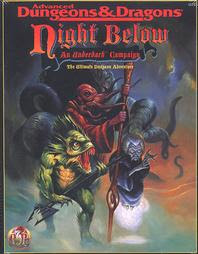
Big Fat Adventure
Night Below!
This book is massive. I ordered it POD off DriveThru sometime back, and it's a couple hundreds of pages (not counting dozens of maps). Originally a three-book boxed set, it is considered one of the finest offerings of the 2E era (here's a review); it is an ENTIRE CAMPAIGN designed to take PCs "from 1st level to 10th level and beyond." Check this part out (from page 9 of the introductory chapter):
Earned XP
This campaign assumes that characters gain XP for monetary treasure, at the rate of 1 XP for each gp value of the treasure. DMs not wishing to employ this optional rule should increase XP story awards to compensate, ensuring that the PCs advance at a sufficient rate to meet the challenges of the adventure. Playtesting shows that to maintain campaign balance, PCs should earn some 60% of XP from sources other than slaying monsters.
Oh, 2E.  When it comes to XP for treasure, 2E says "I just can't quit you."

Night Below offers an interesting sub-system called Social Collapse Points (SCPs) that PCs earn as they destabilize the evil subterranean societies, and succeeding at bringing about this collapse does earn the characters bonus XP in the thousands, but almost all of the things that earn SCPs are either slaying monsters or destroying/vandalizing property. But that's part of the "story awards" for Book 2 of the campaign (that section effectively ends once collapse had been achieved). The story awards I could thus find include:
  • 1,000 XP for concluding Book 1 IF the PCs can wipe out the bad guys in a single foray.
  • 5,000 XP for earning 50 SCPs in Book 2
  • 5,000 XP for earning 100 SCP's in Book 2
  • 100,000 XP for destroying the ultimate Big Bad in Book3
But there IS a lot of treasure in Night Below....though probably not enough, considering the lack of XP awarded for magic items in 2E.

Hey, folks. I know the following thought is probably going to be met with some ire, but I'm going to post it anyway. In my last post, with regard to "story awards," Dan wrote:
I have no idea where you get the idea that this discourage self-starters. An adventure is an adventure, regardless of whether the DM lays it out on a platter or the PCs choose it themselves. Finding a goblin lair in the wilderness and looting it is a completed adventure just as much as slogging through a boring Dragonlance module is. I have never run a game with XP for treasure in my life, and player engagement has never been a problem.
How does one define adventure? In B/X, it is a single game session; does this hold true for 2E? If not, where is the adventure's beginning? Where is its end? Who says when it's over? The DM? In a B/X or 1E game, PCs can beg off at any time...because they don't like the scenario, the risk versus reward, whatever. But this idea that a "story" must be "completed" is a shitty, shitty concept.

What it SOUNDS like...and please disabuse me if this is wrong...is that 2E advancement is, at its simplest, just "combat experience multiplied by two." That is, you get experience points for defeating opponents, and then you get the same experience ("x.p. equal to defeated opponents") whenever the adventure is considered to be "done." Which...well, that's just 3E again, but with a different formula for calculating it, no?

Am I mistaken?

I want to continue this discussion (somewhat) in my next post, but it won't be about 2E specifically. In an effort to be constructive, I'm going to talk about the positive aspects of 1E's reward system.

Have a good weekend, folks.
: )

Friday, April 5, 2013

Respecting Ogres - 5AK Combat (Part 2)


Don’t you want YOUR ogre to be tougher?

For me, in designing 5AK (or D&D Mine or whatever you want to call it), the ogre was one of the “baseline” monsters in designing the game. Ogres are a part of the D&D tradition, sure, but they show up so often in fantasy folklore…representing the large, bestial, BULLY of the human psyche. The abuser. The monster that is O-so-human, and yet a hulking fiend of destruction, too. How do you represent that, and do it justice?

In the end I gave ogres HD 4+2 and the equivalent of light (chain) armor.

Now, granted, that may not seem like much difference compared to the usual AC 5, HD 4+1 ogre found in D&D, but rest assured those numbers mean far more to MY game than your run-o-the-mill, B/X equivalent. In fact, it’s closer to the 700 pound bruiser detailed in Alexis’s recent post (no, his point is something very different from mine…I just like it as an illustration of what an ogre should be like).

Assuming a party similar to the one Alexis describes (of course, there are no halflings or burning hands spells in 5AK, and I don’t have a “ranger” in my game for obvious reasons, though we can assume something equivalent to an archer or temple knight), the outcome in 5AK might have been pretty close to the same. My thief’s “bushwhacking” ability only extends to “living, humanoid targets of roughly human size” specifically so that you don’t find ‘em backstabbing giants and jinn, but it’s really up to the individual DM to determine whether or not an ogre is close enough or not. I’d probably rule “not,” but the character would still have a good 75% chance of doing damage (if not higher based on the creature’s position sleeping).

Then, assuming the monster was awakened and combat ensued we could expect the killing to begin. Average HPs for such a group would be, mmm, 22 for the fighter, 17 for the thief, 9 for the mage, 7 for the cleric, 4 for the “ranger.” A HD 4+2 creature in 5AK is bigger, faster, and stronger than just about everyone in the party, and would likely crush the cleric or ranger with a single shot (average 7 damage, hits the cleric 86% of the time or the ranger 92% presuming heavy armor)...though if this was their first fight of the day that might be mitigated by other factors.

Meanwhile, the chance of the PCs actually harming the ogre would be pretty slim with the exception of the fighter. The high level thief would have a 42% chance of damaging it (actually pretty close to the 45% chance a B/X thief of the same level would have against a “normal” ogre) with a 3% chance of killing the creature outright with a lucky attack (the dagger in the eyeball attack). The 5th level hero would actually have a 67% chance to injure the creature (better than a standard B/X fighter unless you're including high ability scores) with a 17% chance of killing it outright (the same chance a hero in Chainmail has of killing such a monster). The other party members would have a lot smaller chance to even scratch the beast (17% for the cleric or ranger, 28% for the wizard assuming he wants to mix it up in melee)…but then fighting monsters IS an activity best left up to heroes. Non-fighters would do better to use the tried and true method found in folklore when dealing with ogres: trickery.

In point of fact, a group of non-fighting PCs venturing into an ogre’s den with the intention of slaying such a creature in hand-to-hand combat deserve to have their heads handed to them. I mean, what are you thinking of? Sure, David was able to slay Goliath with a rock…but he had the power of God on his side (and/or it was a one-in-a-million shot...you decide). When your PC doesn’t happen to be the divinely chosen king of the divinely chosen people, then you better be the rough-and-tumble equivalent of Beowulf…otherwise, what are you doing except getting in Beowulf’s way?

To write D&D Mine, I’ve been deconstructing the game of D&D and looking at it piece-by-piece and you can see where there’s stuff that’s been broken. I mean, the reason that so much of D&D game play is treated like “our many different ways to kill a monster” is precisely because the rules are written in that fashion. An ogre should just be a walking sack of hit points waiting for a few low level characters to down him with half a dozen arrows…what kind of adventure is that? It cheapens the whole thing, in my opinion.  At the same time, it’s not enough to simply assign bunches of extra HPs to monsters. Didn’t I just read that WotC’s research shows players enjoy SHORTER combats? No shit, Sherlock…shorter combats mean more time spent adventuring (which might include a lot of things besides rolling dice and tracking damage).

That’s why “hit dice” in my game have been returned to their proper place as the number of “hits” a creature can suffer before going down. For example, a four hit dice ogre can take four human-incapacitating wounds before being brought down (which is what a successful attack roll measures…the ability to apply a man-incapacitating wound to a target). Yes, I realize that’s less than the six wounds needed in Chainmail (so my ogre is still less than the Ogre of Gormely Keep), but quite a handful for your average adventurer to deal with…like an intelligent bear.

And it’s quite a bit stronger than even an AD&D ogre. Oh sure…an average superhero equivalent in 5AK will put one down pretty fast (exactly as fast as a superhero in Chainmail at 9th level, actually), but it’s never for-sure-for-sure. And it’s nothing like AD&D. I remember converting my old AD&D bard to 2nd edition (and for those who don’t know, there’re major differences between the 1E and 2E bards) in order to solo-test the 2E adventure Return to White Plume Mountain, which is practically filled to the brim with ogres dressed in +5 armor (to give them an AC of 0). It was a pretty silly exercise, but in some ways it’s a pretty silly adventure, and the point is the character could still handle the creatures pretty handily. It just necessitating rolling a LOT of dice to get through the war of HP attrition.

ANYway… point is, as I was saying, that THAT type of game is pretty soft. As far as our adventure gaming goes, we have been coddled a bit…the RPG equivalent of everyone getting a juice box and a trophy at the end of the season. As with sports, part of the whole purpose of playing the games is THE PLAY ITSELF, not the accolades that may (or may not) be deserved for the playing. And if you make the fighting the centerpiece…and the fighting too easy…then the game starts to lose its luster, becoming less of an adventure and more of a…well, I don’t really know what you’d call it.

Actually, I guess that wasn’t really my point. My real point is that I like ogres. I need to mix some in to my next 5AK play-test. I wonder if I put them on-board a ship? Ooo-oo…maybe the PCs travel by ship to the Isle of Ogres. Oh, that sounds good!
; )

Friday, June 15, 2012

Breaking with Tradition (Part 2)

All right, a little more time on my hands…let’s continue.

In order to figure out what a magic system looks like, one has to consider how magic works in one’s particular game world…the WHYS of magic, if you will. For most players (including DMs/GMs), I realize, the whys don’t matter a whole hell of a lot: the important thing is the mechanics of an RPG. How many spells does my magic-user get to cast during the game session? What are the ramifications of using spells? This has a direct impact on how the game is played.

For example, in D&D my 1st level magic-user is able to cast ONE spell. After that spell is gone I am left with an unarmored, dagger-wielding adventure possessed of D4 hit points. What does that say to me as a player? Make that one spell count. And so the spell players tend to choose is the one that can have the most lasting impact (i.e. Charm Person or Sleep)…even though a different spell might end up being the exact perfect the party requires to overcome a particular challenge or encounter.

If I’m playing a street shaman in Shadowrun, I know my spells cause me fatigue (and serious injury if I reduce my magic attribute with cybernetic enhancement) depending on the power and type of spell used. The number and variety of spells available to me differs depending on which edition one plays, which can make your character more prone to relying on guns then your Power Ball spell.

As said, PLAYERS don’t usually care WHY magic works in a game, just HOW it does. And many games don’t really give a good reason as to why magic works anyway (see recent discussions on disassociated mechanics, especially regarding 4th Edition)…at least from an “in-game” perspective.

But for traditional RPG designers, the “whys” ARE important. The designer needs to know the “logic” of the game world, so they can create game mechanics that are connected to that game logic. Knowing and working with one’s “fantasy physics” helps create a rich imaginary environment into which participants can better lose themselves, the desired end of non-narrative agenda role-playing.

[if you don’t buy that last statement I’m not sure why you’re still playing table top role-playing games]

“Applied game logic” isn’t anything new to designers with a specific setting attached to their RPG, it’s something considered (at least, haphazardly) with regard to monster cosmologies (what monsters/opponents make sense and are available) and chargen (what classes/skills should be available for player characters). Lesser designers (i.e. “poor” or “inadequate” for my tastes) will think less about these things and simply take a “kitchen sink” approach to what goes into a game (leading to all sorts on inanity like bestiaries with conflicting cultural mythologies and skill lists containing unused skills like “cooking” and “small power boat” just for the sake of “completeness”). Greater designers will hone every aspect of a game to razor sharp pertinence, right down to setting specific ability scores (instead of generic “Strength, Intelligence, Personality,” etc.).

But applied game logic doesn’t always make the cut with more generic RPGs. Now, of course, there’s generic and then there’s GENERIC…some games are simply engines to which one attaches a setting splat book that provides those extra game tweaks and adjustments based on “applied logic.” But then you also have pseudo-generic RPGs, whose ranks include both Dungeons & Dragons and a myriad of other fantasy imitators (knock-offs, heartbreakers, whatever you want to call them). Although D&D purports to be a “generic” fantasy RPG, much can be inferred about its setting simply based on what’s included (and not included) in its hallowed pages.

I’ve discussed this before over many posts (some illustrative examples: plate armor with no firearms, existence of paladins, multi-planar cosmology, Drow and other “civilizations,” named artifacts, etc.) but for this post the only thing I want to spend time on is the cosmology of spell-casting, i.e. magic use.

D&D offers the following cosmology of magic:

- Spells are learned, with more spells being learned by those with more experience (true even of clerics, whose broad spell lists are opened by increasing in level).
- To be a spell-caster one must have “what it takes” to comprehend the power (INT for magi, WIS for clerics).
- Each spell is a bit of finite power (ammunition) to be expended.
- Spells must be memorized by an individual or else stored in a magical device to use.
- More experienced casters can mentally store more spells (ammo) and (conversely) LESS experienced casters are limited in what can be stored.
- Spell-casting requires concentration, often words and gestures, sometimes materials.
- Spells are formulae that need to be performed exactly, and as such they can be interrupted.
- Spells are not always effective depending on the personal strength of a target to resist (saving throws).
- Non-casters have the ability to resist magical spells.
- And finally: Casters must be well-rested to implant spells in their brain, but implanted spells are held indefinitely until used regardless of the caster’s physical or mental state (!!!).

That last bit is the really weird one. To my mind there’s a real implication of spells being living entities, enslaved in a spell book and bound for service through the reading/memorization process (or slaved to deities and bound to service via prayers of supplication). Each spell is thus a mini-demon, being conjured with a specific purpose in mind. In Vance’s Dying Earth stories (the inspiration for D&D magic) this seems more than just an “implication” but it’s not a subject broached in the D&D books (unless, perhaps, the 2nd Edition adventure Return to White Plume Mountain).

Gygax himself simply stated he used Vance’s magic cosmology as it “well articulated” the power of mnemonic incantation (I recall reading somewhere else that he found it a bit different from other systems being floated at the time, and liked that). I would also guess that the main motivation in creating the D&D magic system was an attempt at game balance and playability. While the system IS playable with much more minimal fuss compared to other systems (I find Palladium’s PPE tracking to be a pain in the ass, for example), many folks have decried the game balance issues of D&D magic-users: too weak at low levels, too powerful at high levels. And while I’m not a huge advocate for “game balance,” this particular balance issue has a direct impact on playability.

Look, I know there are folks who are just thinking, dude, shut up, it works okay? Fine, yeah, it WORKS well enough you can play the game. But I for one get tired of it…and tired as well of players either A) complaining about it (especially at low levels), or B) simply ignoring it (i.e. not playing magic-users) because of it. The stupidest thing I’ve ever seen as a DM is players abandoning dungeons as soon as the wizard’s sleep spell is expended. “We’ll be back tomorrow!” Yeah, um, did Gandalf tell the Fellowship to retreat after he ran out of spells in Moria?

And that’s not to say the players are stupid/dumb…they’re playing smart based on the circumstance of the game, right? Tactically dealing with the hand that’s been dealt by the game designer. But I doubt that’s how the designer(s) originally envisioned the game being played (exiting the dungeon mid-session to “refresh?”)…unless they were reading a much different version of the literature in the appendix than what I’ve seen.

I just have to look at Gygax’s own house rules (thanks to Cyclopeatron and others): new player characters start at 3rd level, and magic-users with a high INT (not unusual based on Gary’s method of rolling abilities) gain a bonus spell. For a MU this gives a starting PC magical firepower equivalent to a 4th level magician (if one was using Rules As Written): right square at that “mid-level sweet spot” where wizards are neither too weak nor (yet) too powerful.

I’d be curious to see Arneson’s own house rules on the subject.

But for me, the plan is not how best to house rule playability. As I wrote at the beginning of this post, I’m more interested FIRST in the why of magic and spell-casting: the in-game justification for how it works and why it works for my particular game. This is no big thing to do (even though conspicuously absent from D&D): Siembieda defined it through his psychokinetic energy (PPE) in Rifts, and the Shadowrun guys have their “channeling mana from the astral plane” deal-i-o. Once I’ve got the definition down, THEN it’s a matter of modeling it in game terms AND (lastly) iron out the playability/balance issues.

However, in working on those whys, in defining what magic is and how it works, I can see already that this system is probably NOT going to resemble Vance…which means it ain’t going to look all that much like D&D. Oh, it’ll have some of the trappings: there will be spell lists and levels of power and probably spell books, for example. But that might be the extent of the resemblance.

Let’s talk a little bit about magic in literature (and no, I don’t mean Harry Potter): in books and stories, based on folklore or not, what does magic-use LOOK like? And here I’m only talking about stories and collections that include MULTIPLE magi, not individual plot points like Prospero in The Tempest. I’ll also only be including human magic-users, not angelic “Istari” like Gandalf and his ilk.

Here are my bullet points:
  • Magic requires study and training; it is generally taught, master to student.
  • Not all magicians are equal; some are more powerful (and feared/respected) than others.
  • “Power” is generally defined by one’s repertoire of spells (more is better) and the potency of those spells.
  • Becoming a magician requires a certain ambitious temperament; it’s generally described as hard work.
  • Becoming a magician requires a certain level of intelligence (“native talent”).
  • Magical knowledge is generally stored in writings: books and grimoires, scrolls and tablets. This holds true for priestly magic as well (priests and magicians are often interchangeable where magic is concerned).
So far none of that really disagrees with the “D&D version” of spell-casting. But let’s continue, shall we?
  • Being a spell-caster does not preclude one from wearing armor or wielding weapons.
Whoa! Right out of the gate, right? But there it is: what besides game mechanics (or a post-D&D book of fantasy fiction) ever said a wizard was prohibited from wearing armor or wielding a decent weapon? I prefer my wizards to have the option (like the sorcerers in the original Conan film). Okay, now to the nitty-gritty:
  • Spells effect supernatural change through the use of magical formula, generally spoken.
  • Spells require mental discipline in addition to their formula; only a person with the proper mental state can use a formula even by reading it.
  • Conversely, any magician (presuming the proper training) can use a formula by reading it.
  • Spell formula are spoken and recorded in ancient, obscure, and/or mystical languages, uncommon to those without training.
  • More potent spells are longer and more complex (harder to record, memorize, and/or recite).
  • A spell known (i.e. memorized) can be cast.
  • Knowledge of a spell formula is only lost through the usual method of losing knowledge: time and age, replacement (learning something new, forgetting something old, etc.) head injury.
  • Spell formula, especially those newly discovered/created, are jealously guarded secrets.
  • Magic is best performed sparingly and privately as a spell witnessed can be learned and duplicated.
  • Because of this, and the aforementioned temperament, magicians tend to be secretive, mysterious, and stand-offish; it is the rare wizard that is jovial or gregarious (antisocial tendencies), let alone reckless and flamboyant/demonstrative.
  • This behavior, coupled with general ignorance on magic, adds to their allure as well as their intimidation of non-magi.
  • As academics, magicians tend to be less robust (also more cultured and refined) than other adventurers.
There, see? Now I have some idea of what I want magicians in my game to look like. And having that, I can stat out how exactly magic works in my game…and I can see already that there’s little about it that’s “resource based.” Certainly, magic-users are limited by the spells they know or possess (and per the literature, creating a new spell appears to be the work of years or decades, not weeks as per normal D&D research time), but there aren’t any spell slots, or magic points, or fatigue boxes, or mana burn to worry about. No, it’s not going to look much like D&D at all, I guess.

Of course, I could never make D&D look like I wanted to when it came to favorite S&S characters like Lythande and Elric, etc. so I guess that’s a bit of payback.

; )

Wednesday, February 8, 2012

The Second Pillar – Reward

The second pillar that is fundamental to the integrity of the D&D game is reward. Participants who participate in game play (whether as a player character or Dungeon Master) can expect to be rewarded for their actions.

Some might say the act of play itself is its own reward, and to a certain degree that is true (we’ll address that in the 3rd Pillar). However, actual compensation for the merits of one’s in-game (imaginary) action has been true through almost every edition of the game and is an identifiable part of the D&D game’s foundation. If characters are not being rewarded for their action, I’m not sure what you’re playing can be called “D&D.”

Similar to what was discussed in the prior post, the rewards to be had are different depending on the role one takes when participating in the game; I’ll discuss each in turn.

For player characters, we can see that one’s reward is one of improved effectiveness, decisively tied (in most editions) to the player’s response and success to challenges issued. A player character that meets and overcomes all challenges will progress quickly in game effectiveness, gaining experience and thus level, increasing attack ability, saving throws, hit points, number of spells, etc. A player character that chooses to face fewer challenges will find his (or her) effectiveness increased at a slower rate, as will player characters that seek many challenges but fails at overcoming those challenges.

This has been the case since the earliest editions of the game, when PCs were considered scurrilous rogues seeking fortunes within dark dungeons. The measure of a character’s “score” was, in the main, directly attributable to the value of treasure brought out of the ground. Recover a great deal of treasure and your character received more points, increasing in level (game effectiveness) and allowing the character to recover MORE treasure…though with a gradually diminishing rate of return.

By the 3rd (D20) Edition of the game, the experience points awarded were solely due to overcoming challenges commensurate with ability; whether or not treasure was recovered was of secondary concern (at best), except with regard to magic items (we’ll get back to those in a moment).

In addition to in-game effectiveness, the reward of game play also includes MORE game play and DIFFERENT game play, as the rewards reaped open up greater avenues of exploration for the player characters. A character that increases in level (and thus effectiveness) is able to delve deeper, darker dungeons and face greater challenges, presumably reaping greater reward. A character that acquires a spell or magic item allowing planar travel can journey to other dimensions, even across game and genre boundaries (see the notes on Gamma World and Boot Hill crossover in the original Dungeon Masters Guide). A character that acquires Name (9th) level and enough gold to build a stronghold fortress can begin exploring the adventures only open to a ruler of men: opening territories for expansion, drafting armies for conquest, making treatise and alliances, and seeing about putting an heir on the throne.

“Reward” is a fundamental pillar of the D&D game. Reward informs play; it explains why it is that player characters take action, why they behave as they do. Reward provides the motivation for character activity; some players may be uninterested in facing a challenge simply for the sake of a challenge (not all of us are “adrenaline junkies,” even in our imaginary worlds!), but for the sake of REWARD they will participate.

The promise of power can be a strong lure for even the most recalcitrant adventurer. Spell-users, especially the unarmored, lightly armed magic-user, will find that the best way to increase his (or her) survivability is take on challenges, to act heroic rather than stay home studying their tomes for it is only through adventuring that the wizard’s spell-casting ability improves.

To some, this doesn’t make a whole lot of sense; the RPG Ars Magica, for example, makes the acquisition of magical power a product of staying shut-in for seasons at a time, poring over dusty scrolls and pursuing alchemical study and experimentation. Perfectly sensible and realistic, and Ars Magica is a very cool game (I’ve owned a couple editions). On the other hand, except as a mental exercise, this type of game play (tracking seasons and study points) is DEAD BORING to play. The Dungeons & Dragons game rewards active participation; it rewards PLAYING the game. As an activity of group participation, I prefer my RPG game play to have more player activity and less mental masturbation.

Since we’re on the subject of magic, I will mention that magic items in the D&D game are a stylistic trope that provides an additional “piece” of the reward system. After all, magic items are not simply gifted or sold to PCs (well, not in most editions of the game). Instead they must be found or earned/awarded through game play. They provide a similar bonus as experience points (i.e. they increase character effectiveness and open up other avenues of game play, depending on the effect of the item) and provide “crowing rights” to players: “Hey, I got a portable hole!” “Yeah, well I have a sword of sharpness, so there.”

Crowing (i.e. bragging) is part of the out-of-game reward that players receive; again referring back to the Forge article on the gamist creative agenda, players play the game in part to test their mettle and feel a sense of accomplishment at overcoming challenge. Whether that turns your crank or not, the game of D&D (at least in its pre-2007 editions) rewards players commensurate with the challenges tackled and the results achieved; whether or not you feel like bragging about it is entirely up to you.

For the Dungeon Master, there are rewards to game play as well:
  • The reward of creatively expressing oneself through a rich fantasy environment, not to mention interesting settings and scenarios.
  • The reward of cackling uproariously at your players’ expense when your fiendish challenge completely burns them.
The first item is something many GMs of other role-playing games can attest to as a “reward of play” (not all GMs…in some indie-style “story-games” the setting is too collaborative or too “set in stone” to allow much “world building”). But we’ll discuss some specific differences (with regard to D&D) when we get to the last pillar.

The second item, though, is something a lot fewer RPGs offer.

Because of the natural antagonist role placed on the DM by the Dungeons & Dragons game (i.e. the role of challenging the players), the DM has a chance to exercise his (or her) own personal brand of destruction in acting as an obstacle to the players. This can be in the form of a fiendish monster encounter or diabolical trap; it can be a cleverly mapped labyrinth or a moral quandary of epic consequence.

For an example of that last one, I advise checking out the fairly excellent Return to White Plume Mountain, the only 2nd edition book of any kind that still sits on my shelf. It forces players to make all sorts of ethical choices due to the nature of the adventure (wherein power is promised with a price, and mental possession is on the board for player characters)…and the climax (should the PCs reach it) is the real kicker: kill the baby or don’t kill the baby!

I mean, who would hurt a little baby?
; )

Anyway, as I said in the last post, the challenge of being a DM is in setting up challenges for the players that are neither overwhelming nor “softball.” The PAY-OFF (i.e. the “reward”) for the DM is in seeing those plans come to fruition and (if done correctly) feeling totally at ease with the self-indulgent hosing of the player characters.

Hey, I’m just being honest. A DM needs SOME kicks, after all…it’s not like we exist purely for the players’ entertainment, puffing them up with set pieces that are easy to knock down. We are required to “play fair” with the players (that’s explicit in every edition I've read), but providing we’re not throwing the might of the universe at ‘em, we’re obliged to try to knock the PCs down a peg. That’s OUR fun, and D&D is one of the few games that allow the referee to indulge in that kind of mayhem.

[in other RPGs, game moderators are working to build a world or story…sometimes in collaboration with players, other times “for the benefit of players” (and when the latter is done with respect to “story,” then you’ve got a railroad going on)]

Admittedly, not every DM “cackles” with glee (I was being superfluous there, though in my case it HAS been a literal truth at times), but DMs can take pride is their challenges and “stumping” the players, enjoying the push-and-pull of competition.

In building a new Dungeons & Dragons, care must be taken to build upon the pillar of reward, just as it is with the pillar of challenge…existing editions point to the way in which challenge is integrated with reward to provide a game that is both stimulating and motivating. If building the game in a modular fashion (as is the stated intention of current designers), modules can be developed that address this integral part of the D&D foundation. Some possible examples:
  • Rewards for increased effectiveness at different levels of play (low, mid, high)
  • Rewards coupled with new avenues of exploration (an example of such from the past might be the SpellJammer setting…by finding/building a space-worthy magic item or spell, it opens up “fantasy space” for exploration/exploitation by the party).
  • Additional rewards in terms of level-based minor abilities (similar to D20’s feats)
  • New methods of “keeping score,” new incentives to motivate players, “tournament style” add-ons for real crowing rights, etc.
  • Instruction and information for DMs to better gauge challenges so that they can “crow” on their own; modules that offer different ideas of how to “stick it” to players, giving DMs alternatives to the standard method of counting “wins” (I can think of a few, but listing them will sound more self-indulgent and sadistic than I already do!)
All right, that's enough to chew over for today.

Next pillar up: ESCAPE.

Wednesday, August 26, 2009

Something Wicked This Way Comes…


I’ve been thinking a bit about witches this morning, due in no small part to Helena Bonham Carter’s excellent turn as Bellatrix Lestrange in the Hairy Bottom films…I’ve been a fan of her neurotic character portrayals ever since Room With A View, but Bellatrix certainly has that Goth-rocker chick look that is so fetching even as it is ruthlessly malevolent. In other words, Carter makes an excellent witch.

[side note: is every British actor with some name recognition going to make an appearance in the Potter films? I mean really…about the only ones they’re missing are Ian McKellen (Gandalf) and Julian Sands (Warlock), which I suppose is understandable. I fully expect Jeremy Irons and Hellen Mirren to show up in the last installment…though of course Irons already played a wizard in that stinky Dungeons & Dragons movie, so I suppose he’s out, too. Boy THAT’s worth a post of its own!]

So, anyway, witches…where the hell are they? In D&D, I mean.

Now of course I refer to pre-D20 editions; I’m sure there are at least a half-dozen “witches” with various adjectives attached to their names (“blood witch,” “bog witch,” “sand witch,” etc.) floating around the various D20 tomes. But in earlier editions we find REFERENCES to witches without any actual witches!

To me this appears to be an over-sight…the question is was it deliberate or not? Oh sure, you might simply assume a witch is a “female magic-user” or even an “EVIL female magic-user,” but nowhere in the description of magic-users do I find any reference to witches. Moldvay’s basic set names Merlin the Magician as an example magic-user, but that guy was a wizard not a witch.

Um…at least I distinguish wizards and witches as two different things. With all due respect to Hairy Bottom fans, I grew up thinking the male witch was a “warlock” not a wizard; I owe this more to watching many, many syndicated episodes of Bewitched as a child, not D&D.

Though I DO note that the 6th level magic-user title in the Cook/Marsh expert set is Warlock/Witch (Cook and Marsh must have watched Bewitched, too). Of course, this is the only place I find where witch is mentioned as a level title for magic-user (2nd edition has none, OD&D and AD&D don’t use it, and BECMI leaves off all female level titles…apparently women had stopped playing D&D by the time Mentzer released his rule set; such a shame).

Not that it makes a lot of sense for a 6th level magic-user to be a “witch” anyway. In fairy tales and folklore (AND J.K. Rowling books!) witches are especially known for their ability to transform others and themselves (you know, princes into frogs or changing themselves into dragons). Certainly you’d think a magic-user would need to master the polymorph spell (at least one of them) prior to taking up the title of “witch.” But polymorph (self or other) is a 4th level spell…and magic-users don’t gain access to 4th level spells until the 7th level.

Hmm…this reminds me that I never did overhaul the magic-user level titles, as I did with both the cleric and the fighter. I’ll have to get back to this one day.

So, sure…one could say a “witch” in D&D (at least according to Cook/Marsh) is a 6th level magic-user. But I don’t think this is the best way to consider the class. After all, the witch is generally treated as a “monster” in the text of these early editions. Let’s look at the mentions of witches throughout D&D:

In OD&D we have no mention of the witch as a magic-user (in descriptive text or level titles); we DO see an illustration of a “beautiful witch” along with an “Amazon” (in LBB 3, I believe). Throughout most of the LBBs, these illustrations represent creatures on the monster list, though no witch is listed in LBB2, even as a suggested possible monster (at the end where they write about the possibility of robots and gelatinous cubes).

In Holmes D&D they mention that male characters with a high Charisma can escape transformation and be retained as a love slave; this is in the same paragraph where it is cited that female characters with a high charisma will be kept captive instead of be eaten by dragons (see? Dragon = Witch, i.e. monster).

In Moldvay’s Basic book we find references to Morgan Le Fay and Circe the Sorceress (classic antagonists) but no witches. I can’t help but think that if the polymorph spell had been present in the Basic set, Moldvay would have created a monster type called a “Witch” that used it. After all, Moldvay gave us the HD 2 Noble, the HD 1+1 Berserker, the HD 1 Bandit, and the ever esteemed Normal Man monsters. He seemed to have a good handle on not needing a particular type of human to equate with a particular class/level.

The Cook/Marsh Expert set DOES have polymorph, and even references a save versus polymorph (of which there is none in B/X, unlike AD&D).

AD&D…well, the Monster Manual DOES have Night Hags and Sea Hags, and I have always found “hag,” “crone,” and “witch” all to be interchangeable when it comes to fairy tales and folklore…take a look at Baba Yaga, for example. And speaking of Baba Yaga, her hut is also present in the DMG, though I don’t remember if it mentions her as being a hag (it might even refer to her as an arch-mage! I’ll have to check my DMG later…).

2nd edition AD&D of course has NO BALLS when it comes to anything that smacks of Satan, witchcraft, or El Diablo. However, the VERY interesting Return to White Plume Mountain, DOES include “the Witch Thingizzard” as a MONSTER, not a character class and is the closest thing to what I’m looking for.

In fact, I had both Night Hag and Sea Hag scheduled to go into my B/X Companion, and instead of making them knock-offs of the AD&D/BECMI versions, I may just make them knock-offs of Thingizzard and throw ‘em all under the “Crone/Hag/Witch” category (without designation of “Sea” or “Night” variety)! I think the rich, literary history of the wicked witch deserves a decent D&D monster, rather than a Vancian spell-slinger.

By the way: all apologies to the Wiccan community. I’ve known many Wiccans and self-professed Witches (who considered themselves different from the former), and all were fine upstanding folks with no Satanic human sacrifice or devil worship anywhere to be found (though the “witches” were raging alcoholics…). In the 21st century I’d guess that most folks would back away from the idea of witches as monsters so as not to offend followers of the Wiccan religion (well, except Kevin Siembieda), but for a pulpy game like D&D I think it is appropriate to have some corrupted individuals of the Brothers Grimm variety present. As I said…all apologies. I will probably NOT use the term "Crone" in my B/X Companion as I realize this is a sacred part of the life cycle in Wiccan tradition ("the wise grandma") and should not be correlated to the derogatory term “hag.”


Sunday, June 7, 2009

2nd Edition AD&D...How I Loathe Thee


Let me count the ways...no, I'd be here all day.

Actually, I'm feeling pretty generous right now as I sit eating a french toast doughnut from Mighty-O and enjoying my morning coffee.  But charitable or not, I wanted to veer off the Blackrazor love-fest and get this subject out of the way.

I had a regular gaming group right up until 1987 or so.  We played mainly AD&D, though we would venture into other games from time-to-time (Marvel, ElfQuest, Twilight2000, James Bond...a pretty mixed bag when I think about it).  However, this core group split up just prior to high school, and my gaming has been varied, eclectic, and sporadic ever since.  And the vast majority of that gaming has NOT been D&D.

Fact is, I haven't had or run a long-term "campaign" anywhere near my old D&D games.  Sure I had a Vampire saga that lasted a couple years, but it limped along for most of its life, providing nowhere near the drama and engagement of my old D&D buddies.  Ahh, such is life.

The upside to this is that I got out of D&D just prior to the 2nd edition of AD&D being put out by TSR.  

Wow, 2nd edition.  Because I stopped playing D&D for the most part, I never invested in these game books at the time they were released. Later on (post college, circa 1997) I had the urge and opportunity to run some D&D games, but the players available were playing 2E, and so I purchased the books from a used book store. Yow.

I collect RPGs; its just something I do, much to my wife's chagrin. I own dozens (nay, scores!) of games, some of which I have never played.  I enjoy the creativity that goes into writing them, I enjoy the care and attention of the authors, I enjoy the art...heck, most are fun to read and can show you different perspectives of the gaming hobby.  Very few of the games have I gotten rid of over the years (though some have been loaned out and permanently lost).

2nd edition D&D is one that I sold back to the used game store.  

Look, I'm not a total grognard.  I enjoyed the Dragon Lance novels when they came out, and they certainly informed some aspects of our gaming to the better; certainly we used the extensive maps from the DL modules as designs for our own strongholds (High Clerist's Tower, I'm looking at you!).  In a long term game, the player characters do have the opportunity to rise out of the "grittiness" and become truly heroic.  I wish more of my players had enjoyed affectations like winged helmets (that's a subject for another post).  But 2E, while pushing story, really shot itself in the foot in my opinion.

I guess the main thing I disliked was the simple removal of the grittier elements from AD&D.  Folks know what I'm talking about here: assassins, half-orcs, demons, and devils.  In my opinion, removing these things was the equivalent of turning the game into a Saturday morning cartoon, of the kind acceptable to the Christian Right...you know: He-Man (where folks carry swords they never stab people with).  Grittiness provides conflict and drama...or at least a particular type of conflict and drama that I enjoy, to balance against the "high adventure" stuff.  What? A man can't love him an orc wench?

The second thing and larger reason for chucking it though was the incoherence of game design...and here I'm talking about the reward mechanism (i.e. the experience point rewards).  In a nutshell, reward systems encourage player behavior.  The different methods of awarding experience encouraged different behaviors dependent on class.  This is fine with those rewards can still be met in the principal game setting (for a good example, see Top Secret, pre-SI).  

But if the name of the game is (literally) Dungeons and Dragons, the experience awards for certain classes (namely clerics and magic-users) are vastly inferior to the reward system of the other classes (fighters and rogues)...at least if you come from a traditional background of D&D gaming that involves dungeon delving.  If you want to run a game of proselytizing priests...well, then you should probably be playing a different game (like GURPS Inquisition or something).

There were certainly other issues...the original 2E "monster manual" was a binder of loose pages that I thought was miserable (fortunately, I had waited long enough that I could purchase the one book MM later printed).  Old systems that I had used in the past had been removed or re-worked.  Like others, I felt the blue ink was an eyesore.  I believe they removed psionics, which I had often employed with good results.

But the deal breaker, on top of everything else, was the total nerfing of the Bard class.  I loved the bard, I still love the bard, when I wasn't the DM, my main character was a bard.  And the new bard was crap, crap, crap.  This deserves its own post.

OKAY...so I realize I said that I was feeling charitable.  And even though my doughnut is now gone, I AM still feeling charitable.  There were a couple bright spots that came out of 2E...things that I miss even now from old school games and new school games.

The first is a module: Return to White Plume Mountain.  I felt it was brilliant and a worthy successor to the original.  I still own it, even after selling back my other 2E books. It will get its own post on this blog (in case you hadn't guessed).

The second is a monster: the Mummy Lord.  I love, love, love this monster. I feel the 2E MM handled it exactly right, artwork and all.  I almost saved my 2E MM, but I realized (rightly) that keeping a hardcover book for a single monster was a waste of shelf space. Yes, I know there is a Mummy Lord monster available on the SRD.   I haven't yet posted why I loathe 3E+ but a large part of that has to do with STAT BLOCKS.  Suffice is to say, the SRD version doesn't quite measure up (in my mind) to the original version from 2E.

An honorable mention goes out to the Players Options book which provided some rather interesting options (I had a player that had a Githzerai fighter-wizard!), and some excellent artwork (the ork with the axe and blade, the hobgoblin with the falchion were both quite inspiring).  However, this one I had no difficulty letting go.

By the way, lest anyone is wondering, I did in fact play 2nd edition AD&D on at least three occasions.  Once as a player (I ran a fighter), once as a DM (with a self-created adventure), and once just running a solo game for myself through Return to White Plume Mountain to see "how it played."  I know I started at least one or two more campaigns that never quite got off the ground (characters were created, but I don't remember any game play).